Quiet Conformity: The New RSHE Mandates and the State’s Imposition of Gender Ideology

How England’s updated sex education guidance undermines parental rights, marginalises religious truth, and reshapes children’s identity through legal compulsion.

In July 2025, the Department for Education quietly issued a revised version of its Relationships, Sex and Health Education (RSHE) Statutory Guidance, replacing the 2019 framework that had shaped England’s approach to teaching children about relationships, sex, and wellbeing. While couched in cautious bureaucratic language, this updated guidance deepens the ideological commitments of its predecessor—particularly in relation to the affirmation of gender ideology in both primary and secondary education.Subscribed

The new statutory document reasserts the primacy of the Equality Act 2010, stating that schools “must ensure that they comply with the relevant provisions” of that Act, under which “sexual orientation and gender reassignment are amongst the protected characteristics”¹. As in the 2019 edition, gender reassignment is treated not merely as a category for legal non-discrimination, but as a legitimate and affirmed identity to be integrated into school life and curriculum. In practice, this compels schools to treat a child’s declaration of transgender identification as a protected personal reality, and any failure to do so could be classed as discriminatory.

The curriculum expectations are unequivocal. The guidance mandates that “all pupils [are] to have been taught LGBT content at a timely point as part of this area of the curriculum”². This is to be “fully integrated into their programmes of study… rather than delivered as a stand-alone unit or lesson”³. In other words, affirming LGBT content—including trans-identification—is no longer optional, even for schools with religious character.

This development is more than pedagogical; it is ideological. The 2025 guidance instructs schools to “avoid language which might normalise harmful behaviour among young people—for example gendered language which might normalise male violence or stigmatise boys”⁴. Though framed as safeguarding advice, such language mirrors the ideological presuppositions of radical gender theory: that traditional sex distinctions are not only outdated but potentially harmful, and that gender itself is a social construct detached from biological reality.

While the document nominally allows schools with a religious character to “teach the distinctive faith perspective on relationships,” it immediately qualifies this by insisting that “teaching should reflect the law (including the Equality Act 2010) as it applies to relationships”⁵. Thus, a Catholic school may still teach the Church’s anthropology—that man is created male and female, that sex and gender are not severable—but it may not do so in a way that would undermine or fail to affirm transgender identification, lest it fall afoul of equality legislation. The Church’s witness is thereby marginalised, tolerated only within limits set by the State.

This has profound implications for parental rights and religious liberty. While the guidance upholds the right of parents to request withdrawal from sex education, it reaffirms that there is “no right to withdraw their pupils from relationships and health education”⁶—subjects that now regularly include ideological content on gender identity, relationships, and sexuality. Nor may parents prevent children from being taught about transgenderism in integrated contexts under the banner of inclusion or safeguarding. From three terms before their sixteenth birthday, the child may override even a parent’s request to withdraw from sex education⁷.

The erosion of natural and moral categories does not stop at curriculum content. The RSHE guidance, though not primarily focused on facilities, indirectly affirms policies that challenge the integrity of single-sex spaces. By insisting that schools create environments that are “inclusive of all pupils” and that they avoid any action that “discriminates against protected characteristics”—including gender reassignment—it places institutional pressure on schools to accommodate self-declared gender identity in areas such as toilets and changing rooms. However, what the guidance omits is just as telling: it does not affirm, clarify, or remind schools of their existing legal right to maintain single-sex facilities under Schedule 3 of the Equality Act 2010, which permits such provision where it is “a proportionate means of achieving a legitimate aim.”

In fact, schools are still legally entitled to provide toilets, showers, and changing spaces separated by biological sex, especially in consideration of safeguarding, dignity, and privacy. Yet by failing to state this explicitly, the Department leaves headteachers and governors exposed to activist pressure and confusion—inviting the assumption that to limit access to facilities based on sex, rather than gender identity, would be discriminatory. In reality, it remains lawful for schools to provide single-sex spaces and to make case-by-case decisions about access, particularly where safeguarding or the rights of other pupils are concerned⁹.

In this way, the State places itself not only as the provider of education, but as the final arbiter of human identity. It is not simply transmitting knowledge, but shaping the self-understanding of the child—defining what it means to be a person, a man, a woman, a moral actor. As Catholics, we must reject such an overreach. It is not the role of the State to dictate the content of the human soul, nor to impose a pseudo-anthropology that severs body from identity, nature from vocation, and freedom from truth.

The Church teaches with clarity and compassion that our identity is not self-constructed, but divinely given. “Male and female He created them” (Gen. 1:27). This foundational truth about human nature is not a matter of bigotry or fear, but of love—of fidelity to the God who made us, and to the flourishing He desires for each person.

It is not enough for Catholic educators to quietly comply, nor for parents to outsource their children’s moral formation to an ideologically compromised system. We must act. Catholic schools must form the whole person in truth—not only in religious instruction, but across the curriculum. Parents must reclaim their rightful role as the first educators of their children. And the Church must equip its faithful to resist the slow imposition of untruth through policy dressed in pastoral concern.

Where the State demands silent assent, we must respond with faithful witness. Where the culture says affirm, we must have the courage to say no—not out of malice, but out of love for the child, for truth, and for the God who is Truth incarnate.

Thanks for reading Selsey Substack! This post is public so feel free to share it. Share

  1. RSHE Statutory Guidance – July 2025, p. 36.
  2. Ibid., p. 36.
  3. Ibid.
  4. Ibid., p. 5.
  5. Ibid., p. 37.
  6. Ibid., p. 6.
  7. Ibid., p. 6.
  8. Equality Act 2010, Schedule 3, Part 7, Paragraph 27.
  9. Department for Education, Gender Questioning Children: Non-Statutory Guidance for Schools in England, December 2023.


When Change Becomes a Creed: The Crisis of Continuity in Church and Culture

Why Cardinal Goh’s “Adapting to Change” reveals not renewal, but rupture—and how the same error is collapsing the West from within

The July 2025 reflection by Cardinal William Goh of Singapore, titled Adapting to Change, arrives at a time when the Church is facing profound upheaval. His meditation—presented as a scriptural and pastoral exhortation—functions in reality as a theological statement: namely, that change is intrinsic to fidelity, and that without adaptation, tradition becomes sterile and irrelevant.

This premise, though expressed with spiritual sincerity, raises significant concerns for the faithful. It proposes a model of theological development that blurs the boundaries between immutable truth and mutable practice—one that has contributed to the ongoing crisis of identity, doctrine, and liturgy in the post conciliar Church.Subscribed

Change as a Theological Imperative?
Cardinal Goh’s core thesis is that “not changing is being unfaithful to our past,” and that even theological expression must evolve in order to preserve relevance.¹ He maintains that while doctrine cannot change, theology “is always evolving,” and that a failure to re-express truth in new forms risks rendering the Christian message “redundant, if not irrelevant.”²

He applies this logic to traditional practices such as fasting and penance, but most significantly to the Mass itself. The Eucharist, he argues, has undergone constant change since apostolic times, and must continue to change so as to remain “faithful to its original meaning yet relevant to our times.”³

Yet this view omits the vital distinction between authentic development and doctrinal mutation. It conflates adaptation in delivery with alteration in content. The Church does not maintain her relevance by reshaping her message to fit each era’s preferences. Rather, she remains the enduring sign of contradiction in every generation—her witness sharpened, not softened, by fidelity to what is eternal.

St. Vincent of Lérins and the Rule of Tradition
The true measure of change in the Church is not pastoral expediency or sociological effectiveness, but fidelity to the rule of faith. As St. Vincent of Lérins taught, genuine development must occur eodem sensu eademque sententia—“according to the same sense and the same judgment.”⁴ Any theological development that reinterprets the meaning of doctrine, rather than clarifying or deepening it, must be rejected.

Cardinal Goh’s suggestion that tradition demands constant re-expression fails to account for this distinction. If change is made the criterion of fidelity, then the deposit of faith becomes plastic—shaped by the moods of the age rather than grounded in divine revelation.

Liturgy and the Myth of Continuous Evolution
The notion that the Roman Rite has always changed and therefore must continue to do so requires qualification. Organic development—yes. Radical rupture—no. The received liturgy of the Church, from the earliest Eucharistic prayers to the codified Roman Canon, developed slowly and reverently across centuries. The upheavals of the late 20th century, by contrast, introduced discontinuities in structure, language, orientation, and theology. These were not “new wineskins,” but a new vessel altogether.

If we are to preserve the Mass as a true participation in the heavenly liturgy, as taught by the Fathers and reaffirmed by the Council of Trent, then it must be protected from innovation that compromises its sacrificial nature, its vertical orientation, and its mystical continuity with the worship of the saints.

Penance and the Collapse of Catholic Memory
Cardinal Goh rightly laments the decline in penitential discipline following the modern substitution of individual choice for communal practice. Friday abstinence, once a unifying sign of Catholic identity and solidarity with Christ’s Passion, has become optional and largely forgotten.⁵

This erosion of visible markers of faith is not the result of failing to adapt, but of adapting unwisely—abandoning discipline in the name of flexibility. The ancient practices of fasting, abstinence, and liturgical observance do not need to be rebranded for relevance; they need to be restored with reverence.

The Danger of Ambiguity
The greatest danger in Cardinal Goh’s reflection is not its call for spiritual attentiveness, but its lack of theological precision. Phrases such as “theology is always evolving” and “we must be in sync with the times” risk reducing revealed truth to a negotiable category. The Church does not exist to keep pace with the world, but to call the world to repentance and conversion.

Christ is not “new wine” in the sense of novelty, but in the sense of divine fulfilment. The parable of the wineskins is not an endorsement of constant reinvention, but a warning: when new forms are poured into unsuitable structures, both the wine and the vessel are lost (Mt 9:17).

The Secular Parallel: Cultural Collapse by Innovation
This theological tendency toward perpetual adaptation finds an uncanny mirror in secular culture. The post-Christian West is governed by a similar fallacy: that all progress is necessarily good, that inherited wisdom must be deconstructed, and that anything old is by definition oppressive.

From architecture to education, morality to medicine, Western societies have adopted the same creed: change equals virtue. Thus, classical learning has been supplanted by identity politics, marriage by contractual fluidity, and the natural law by arbitrary feelings. This is not progress—it is cultural amnesia, a forgetting not only of who we are but of what it means to be human.

The logic of Cardinal Goh’s “dynamic fidelity,” applied outside the Church, leads to grotesque results: sex reassignment in children, the redefinition of family, euthanasia for the lonely, and sacrilegious celebrations masquerading as mercy. When truth becomes negotiable, power fills the void. When identity is fluid, tyranny is inevitable.

Conclusion: Fidelity Means Preservation, Not Innovation
True progress in the Church is measured not by novelty, but by deeper immersion in the mystery already revealed. The Catholic tradition is not an empty shell awaiting reinterpretation, but a living heritage handed down with authority and guarded by the Holy Spirit.

As the Church faces increasing pressure to adapt her doctrines, redefine her sacraments, and restructure her identity, it is essential to recall the timeless counsel of the Fathers: What has been believed everywhere, always, and by all must remain the criterion of truth.⁶

To preserve the faith is not to resist growth, but to ensure that every development is faithful in content and form to the one deposit entrusted to the saints. Let the Church adapt only insofar as she never ceases to be the Church—and let society repent of its own blind embrace of change before it forgets what truth is altogether.

Thanks for reading Selsey Substack! This post is public so feel free to share it. Share

¹ Cardinal William Goh, “Adapting to Change,” 5 July 2025, Facebook Reflection.
² Ibid.
³ Ibid.
⁴ St. Vincent of Lérins, Commonitorium, ch. 23.
⁵ Goh, “Adapting to Change.”
⁶ St. Vincent of Lérins, Commonitorium, ch. 2.


Public Sin and Ecclesial Responsibility: The Forgotten Meaning of the Confiteor

“I confess to Almighty God,
and to you, my brothers and sisters,
that I have sinned…”

These familiar words from the Confiteor, recited at the beginning of the Holy Sacrifice of the Mass, are not a mere liturgical formality. They are a declaration—before God and before the Church—that our sins, even when privately conceived, affect the whole Body of Christ. The phrase “and to you, my brothers and sisters” is not poetic embellishment. It is a solemn admission that we are accountable to one another because we are mystically united in the Communion of Saints.

The Church’s Ancient Witness: Public Penance as Restoration
In the early Church, this accountability was visibly enacted. Grave sins, particularly those causing public scandal, were confessed publicly before the congregation. In the medieval Church, this developed into the rite of public penance, where notorious sinners were ritually expelled on Ash Wednesday by the bishop and only readmitted to the sacraments after a period of visible penance, culminating in solemn reconciliation on Maundy Thursday. These rites were not acts of humiliation but of restoration—remedies applied by the Church to heal her members and preserve her witness.

The Crisis Today: Silence in the Face of Manifest Grave Sin
This principle—public sin demands public repentance—has been tragically obscured in modern times, especially in the realm of politics. In the name of tolerance, diplomacy, or false mercy, the Church now too often treats grave public scandal as a private spiritual matter. But silence in the face of manifest sin is not mercy; it is pastoral abandonment. It leaves the sinner in peril, misleads the faithful, and weakens the Church’s public witness.

A Grave Parliamentary Offense
On 17 June 2025, the House of Commons passed Clause 191 of the Crime and Policing Bill, effectively decriminalising abortion up to and including birth. It is the most radical change to British abortion law in over fifty years. Among the 379 MPs who voted for this barbaric provision were thirteen self-professed Catholics. Some also supported the legalisation of assisted suicide—undermining the Church’s constant teaching on the inviolability of human life. These votes were not cast in ignorance or ambiguity, but with full knowledge of the Church’s moral law.

The Named Offenders

Those MPs include:

  • Rebecca Long-Bailey (Labour – Salford)
  • Dame Siobhain McDonagh (Labour – Mitcham & Morden)
  • Andy McDonald (Labour – Middlesbrough & Thornaby)
  • Dr Ben Spencer (Conservative – Runnymede & Weybridge)
  • Chris Coghlan (Liberal Democrat – Dorking & Horley)
  • Dan Aldridge (Labour – Weston-super-Mare)
  • Kevin Bonavia (Labour – Stevenage)
  • David Chadwick (Liberal Democrat – Brecon, Radnor & Cwm Tawe)
  • Colum Eastwood (SDLP – Foyle)
  • Florence Eshalomi (Labour & Co-op – Vauxhall)
  • Claire Hanna (SDLP – Belfast South & Mid Down)
  • Pat McFadden (Labour – Wolverhampton South East)
  • Oliver Ryan (Independent – Burnley)

To date, there has been no public act of repentance, no retraction, no clarification, and no statement of conscience from any of them. If, by the grace of God, any one of them has since repented, confessed, and been absolved, then that too should be made known publicly, as the sin was public and caused grave scandal to the faithful.

The Distinction Between Public and Private Sin
This reflects a crucial and often misunderstood distinction in Catholic moral teaching between private sin and public sin:

  • Private sin is known only to the individual (or a few), and its harm is primarily internal—against one’s own soul and relationship with God. These sins are rightly confessed in the secrecy of the confessional, where grace heals in silence.
  • Public sin, however, is committed openly or is widely known—especially by those in positions of visibility or influence. Its effects are external and communal: it wounds the unity of the Church, confuses the faithful, and leads others into error by scandal—that is, the sin of causing others to stumble (cf. Matt. 18:6).

Scandal and the Duty of Correction
Scandal, in Catholic teaching, is not merely about causing offense. It is about causing spiritual harm by leading others to believe that sin is acceptable. When a public figure who claims to be Catholic knowingly promotes abortion or euthanasia, and suffers no ecclesial consequence, the result is a false witness—one that suggests Catholic doctrine can be disregarded without penalty.

Answering Objections: Is Public Reproof Uncharitable?
Some argue that it is uncharitable or unjust to publicly call out these MPs. But this objection misunderstands the nature of mercy, correction, and authority.

Catholic tradition, Scripture, and canon law are united on this point: public sin requires public correction. As St. Paul exhorts, “Them that sin, reprove before all: that the rest also may have fear” (1 Tim 5:20). St. Thomas Aquinas affirms that where scandal arises from public sin, it must be corrected publicly, lest others be led into the same error (Summa Theologiae, II-II, q. 33, a. 7).

Charity is not the avoidance of discomfort. It is the willing of the true good of the other. To allow Catholic legislators to persist in sacrilege while maintaining public communion with the Church is not merciful—it is cruel.

The Role of Bishops and the Laity
That is why Canon 915 obliges ministers of Holy Communion to withhold the Sacrament from those who “obstinately persevere in manifest grave sin.” This is not a punishment but a safeguard—for the dignity of the Eucharist, the integrity of the Church, and the salvation of the person in error.

The bishops of the Church bear a particular responsibility here. As successors of the Apostles, they are not only private pastors but public guardians of the faith. When they fail to admonish Catholic public officials who defy the Church in grave matters, they share in the scandal by omission.

The laity, too, are not exempt. The Confiteor reminds each of us that sin—even when secret—has consequences for others. When the faithful fail to insist on coherence between public action and professed belief, they allow falsehood to masquerade as fidelity.

The Goal: Restoration Through Visible Repentance
Yet the goal is not exclusion but reconciliation. The Church longs to welcome back the sinner—but repentance must come first. The Confiteor ends not in condemnation but in hope: “Pray for me to the Lord our God.”

If any of the MPs who voted against life and truth were to repent, confess, and publicly amend their error, the Church should receive them with joy. But that repentance must be visible. For where the sin was public, the healing must be public too.

Conclusion: A Call to Fidelity and Courage
In our time, the Church must recover the clarity of her Tradition and the courage of her saints. Only then can she speak with authority to a world that has forgotten what sin is, and no longer believes in grace.

First published on Selsey Substack

  1. Code of Canon Law, Canon 915: “Those who have been excommunicated or interdicted after the imposition or declaration of the penalty and others obstinately persevering in manifest grave sin are not to be admitted to Holy Communion.”
  2. Catechism of the Catholic Church, §1385: “Anyone conscious of a grave sin must receive the sacrament of Reconciliation before coming to communion.”
  3. For the list of MPs and their votes, see The Catholic Herald, 6 July 2025.
  4. On the nature and necessity of public penance, cf. Dom Jean Leclercq, The Love of Learning and the Desire for God, and Fr. Pius Parsch, The Church’s Year of Grace, vol. II.
  5. On the distinction between public and private sin, cf. St. Thomas Aquinas, Summa Theologiae, II-II, q. 33, a. 7.
  6. On scandal and its gravity, cf. Catechism of the Catholic Church, §§2284–2287.
  7. On ecclesial correction as an act of charity, cf. Pope St. Gregory the Great, Pastoral Rule, and St. Catherine of Siena, Letters, esp. to Pope Gregory XI.


Open Letter to Zöe Franklin MP on the Assisted Dying Bill

On 24 June 2025, Liberal Democrat MP for Guildford, Zöe Franklin, gave an interview to Premier Christian News explaining her decision to support the Assisted Dying Bill, which recently passed its Third Reading in the House of Commons. In that interview, Ms Franklin described the Bill as “safe, compassionate and carefully regulated,” and stated that her Christian faith informed her vote. She expressed the view that God “is not content” with the suffering of those unable to access assisted death and argued that such inequality is unjust.

In response, Archbishop Jerome Lloyd of the Old Roman Apostolate has issued an open letter, published below, addressing the moral, theological, and legislative concerns raised by Ms Franklin’s position.

The Archbishop’s letter engages not only with the doctrinal incompatibility of assisted suicide with the Christian faith, but also with the serious legal, medical, and ethical implications of the Bill. Drawing on official statements from multiple Royal Colleges—including the Physicians, Psychiatrists, General Practitioners, Pathologists, and Surgeons—the letter underscores widespread professional alarm about the Bill’s deficiencies in safeguarding the vulnerable, ensuring clinical oversight, and preserving the integrity of end-of-life care.

The letter also reflects the consistent moral teaching of the Church on the sanctity of human life, the nature of true compassion, and the dangers of allowing emotionalism to guide public policy.

This intervention is part of the Old Roman Apostolate’s broader mission to defend the dignity of the human person and bear witness to perennial Catholic teaching in the public square. It is offered in a spirit of respectful engagement, pastoral concern, and moral clarity.


A Pastoral Epistle on the Sanctity of Life in the Face of the End of Life Bill (UK)

A Pastoral Epistle on the Sanctity of Life in the Face of the End of Life Bill

To the Faithful of Christ, dear brothers and sisters in the Lord,

Grace, mercy, and peace be with you from God our Father and from the Lord Jesus Christ.

In these critical times, we address you with pastoral concern and apostolic conviction. On April 25, 2025, the Terminally Ill Adults (End of Life) Bill is scheduled for further debate and voting in the House of Commons. Labour MP Kim Leadbeater, who introduced the bill, has confirmed this date and emphasized the importance of proceeding without delay.

As shepherds of souls and witnesses to the Gospel of life, we cannot remain silent in the face of legislation that seeks to legalize the deliberate ending of innocent human life. The implications of this bill—however framed in terms of compassion and autonomy—are profound and call for clear teaching, faithful resistance, and fervent prayer.

Life Is Not Ours to End
The proposed bill seeks to permit adults with mental capacity, diagnosed with a terminal illness and a prognosis of six months or less, to request medical assistance to die. Such an act, regardless of intention, constitutes the moral equivalent of suicide, and the cooperation of others in that act is euthanasia. The Church has consistently condemned both.

From the earliest centuries, the Christian tradition has held that life is a gift entrusted to us by God, not a possession to be disposed of at will. “You are not your own; you were bought at a price” (1 Cor 6:19–20). St. Augustine taught with clarity: “He who knows it is unlawful to kill himself may nevertheless do so if he is ordered by Him whose commands we may not neglect.”¹ His words underscore that life and death are under divine sovereignty.

The Cross Is Not a Curse
The suffering of terminal illness is real. It can be frightening, painful, and isolating. But Christ has gone before us. The Cross was not a failure; it was the place of redemption. Those who endure suffering in union with Christ participate in His saving Passion.

The Roman Catechism, issued by the Council of Trent, teaches us that suffering borne patiently is pleasing to God and a source of grace: “The other part of this Commandment is mandatory, commanding us to cherish sentiments of charity, concord, and friendship towards our enemies, to have peace with all men, and finally, to endure with patience every inconvenience which the unjust aggression of others may inflict.”² To propose death as a solution to suffering is not only a false mercy; it is a rejection of the redemptive value of suffering, which has always been part of Christian witness.

The Role of the Physician and the Meaning of Care
This bill also distorts the very vocation of the physician. Traditionally, doctors have sworn the Hippocratic Oath, promising never to administer poison, even when requested. The Church has consistently upheld this moral boundary. Pope Pius XII taught that while one may accept palliative means to alleviate pain, “It is not right to deprive the dying person of consciousness in order to eliminate suffering if this renders impossible a final act of love for God.”³

In his 1954 address to the World Medical Association, Pius XII emphasized the natural moral law, affirming that euthanasia has been officially condemned.⁴

The Slippery Slope and the Silence of Society
Advocates of assisted suicide often claim strict limitations. But once society concedes that it is lawful to end life to alleviate suffering, the logic inevitably widens. We have seen this in nations where euthanasia was introduced with similar promises—only to expand later to include psychological distress, non-terminal illness, and even minors. St. Thomas Aquinas warned that the toleration of lesser evils often paves the way for greater ones: “Human law is framed for a number of human beings, the majority of whom are not perfect in virtue. Wherefore human laws do not forbid all vices.”

Moreover, such laws erode the fabric of society. They suggest to the aged and the vulnerable that their lives are a burden. But as Pope Pius XI taught in Casti Connubii, life is sacred “not only in its beginning and development but also in its natural termination.”⁶ We must build a civilization of charity where no one is abandoned, and where each soul is cherished until God Himself calls them home.

Our Christian Witness and Duty
Dear faithful, this is not merely a civil matter. It is a spiritual trial. In times like these, we are called to be salt and light, to give public testimony to the Gospel of life.

We urge you:

  • Pray earnestly for our legislators, doctors, and those approaching death.
  • Write respectfully to your Members of Parliament, urging them to reject this bill and protect the most vulnerable.
  • Visit the sick and elderly, accompany the dying, and support Catholic hospice initiatives.
  • Instruct the young in the sacredness of life, and the nobility of offering suffering to God.

St. John Chrysostom wrote: “The one who honors the sick honors Christ Himself.” Let this be our response to a culture that tempts the suffering to despair: to meet them not with poison, but with prayer; not with death, but with love.

Conclusion: Choose Life
We must remind our fellow citizens and lawmakers of the ancient words of Moses: “I have set before you life and death, blessing and cursing: therefore choose life, that both you and your descendants may live” (Deut 30:19). Let no Christian be found among those who choose otherwise.

May Our Lady, Health of the Sick, and St. Joseph, Patron of the Dying, intercede for us all. And may Christ our King, who conquered death by His own death, fill you with courage, fidelity, and peace.

May Our Lady, Comfort of the Afflicted, intercede for us.

Yours in Christ,

S. Isidori Episcopi Confessoris et Ecclesiæ Doctoris
Brichtelmestunensis MMXXV

Footnotes
¹ St. Augustine, City of God, Book I, Chapter 26.
² Catechism of the Council of Trent, Part III, The Fifth Commandment.
³ Pius XII, Address to Catholic Physicians and Anesthesiologists, November 24, 1957.
⁴ Pius XII, Address to the World Medical Association, September 30, 1954.
⁵ St. Thomas Aquinas, Summa Theologiae, I–II, q.96, a.2.
⁶ Pius XI, Casti Connubii, §64.

How to Contact Your MP Before the Assisted Dying Vote

Practical Guidance for Faithful Citizens

The Terminally Ill Adults (End of Life) Bill is due for parliamentary debate and vote on April 25, 2025. Now is the time for faithful Catholics to speak out—clearly, charitably, and urgently. Here’s how to contact your MP effectively:

1. Find Your MP
Visit www.theyworkforyou.com or members.parliament.uk
Enter your postcode to find the name and contact details of your local MP.

2. Choose Your Method

  • Email is fastest. Most MPs can be reached at:
    firstname.lastname.mp@parliament.uk
    (e.g., jane.doe.mp@parliament.uk)
  • Write a Letter if you prefer a physical approach. Address it to:
    [MP’s Name]
    House of Commons
    London
    SW1A 0AA
  • Call the Constituency Office or attend a local surgery (drop-in meeting). Times are usually listed on the MP’s official site.

3. Keep It Short and Personal

  • Start by stating you’re a constituent (i.e., you live in their area). MPs prioritize messages from their own voters.
  • Use your own words—this carries more weight than a form letter.
  • Share why you personally oppose assisted suicide. You might mention:
    • The sanctity of life and Christian teaching.
    • Concerns about the pressure this may place on the elderly, disabled, or those with mental health struggles.
    • The role of true palliative care as a compassionate alternative.
    • Fears of “mission creep” from other countries where similar laws have expanded.

4. Be Respectful and Clear

You don’t need to be a policy expert. Speak sincerely, and end by asking them to vote against the Terminally Ill Adults (End of Life) Bill on April 25.

5. Follow Up

A short thank-you or reply if they respond can build trust—even if they disagree. If they express support for the bill, clarify your concerns respectfully and encourage them to reconsider.


Your voice matters. MPs often cite messages from constituents when making their decisions. As faithful citizens, let us not be silent when the vulnerable are at risk. As St. Paul reminds us, “Do not be overcome by evil, but overcome evil with good” (Romans 12:21).

For further moral guidance and resources, see the Anscombe Bioethics Centre at bioethics.org.uk.

Would you like a printable or shareable version for parish bulletins or chapel noticeboards?


SPUC Conference 2023

His Grace, ✠Jerome had the privilege of attending the conference hosted by the Society for the Protection of Unborn Children in Milton Keynes last weekend. It proved to be an incredibly encouraging and inspiring experience. The passionate speakers effectively communicated the remarkable efforts undertaken by the charity in their dedicated pursuit of the goal to “make abortion unthinkable”.

We were delighted on the first evening to hear in person one of the UK’s most courageous spokesmen for the gospel and orthodox Christianity, culture warrior Deacon Calvin Robinson. He gave an inspiring talk about the importance and relevance of the pro-life campaign for the sake of women and unborn children and some great words of encouragement to all present. We took the opportunity to thank him for his efforts online and in the media “to speak the truth to power” and assured him of our support and prayers for his work.

Deacon Robinson was the sole “keynote” speaker this year, as the Executive Committee judiciously deemed it preferable to update the members on the charitable campaigns and advancements since the previous in-person conference in 2019, prior to the Covid outbreak. Diverse members of the SPUC staff shared their expertise through informative presentations, interactive workshops, and engaging showcases, illuminating the remarkable achievements and ongoing endeavors of the organization.

The conference commenced with a formal address delivered by the esteemed CEO. John Deighan, a distinguished Papal knight, brings an extensive history of political campaigning and media involvement on ethical matters, spanning nearly three decades in both the Scottish and Westminster Parliaments. He initially pursued a career in engineering and teaching before dedicating sixteen years as the Parliamentary Officer of the Catholic Bishops’ Conference of Scotland. In 2021, he assumed the role of CEO of SPUC UK, succeeding veteran pro-life campaigner, John Smeaton. John delivered an eloquent and compelling speech at the conference, leaving the audience deeply inspired.

We were thoroughly impressed by the extensive range of projects currently in progress. These include ongoing initiatives to engage with schools, as well as the development of RSE curriculum support materials, theatrical productions, and even a feature film with globally recognised actors. Additionally, efforts are being made to provide support for pregnant students and offer after-abortion recovery care and support services for women. The talks and showcases proved to be highly informative in a professional setting.

SPUC National Conference 22-24 September 2023. Kents Hill Park Training and Conference Centre, Milton Keynes. Photo by and copyright of Paul McSherry 07770 393960 @Paulmcsherry2

The opening presentation was given by Alithea Williams, the Public Policy Manager at SPUC, titled “An Historical Aberration? A Comprehensive Look at 55 Years of Abortion in the United Kingdom.” During her talk, she meticulously examined the legal history of abortion, both in ancient times and specifically in our own country and the beginnings of the pro-life movement. It wasn’t until the 20th century that the concept of the fetus as a non-human entity gained traction, influenced by ideologies such as Communism, National Socialism, and eugenics, before eventually being adopted by feminists.

Advocates for abortion rights consistently endeavor to contest this notion by utilizing language and terminology that diminishes the significance of the fetus and the act of abortion. Nevertheless, the fundamental principle of acknowledging the humanity of the Unborn remains the cornerstone of British law, as exemplified by recent case law.

Carla Foster was convicted for performing a late-term abortion during the Covid pandemic. Initially sentenced to 28 months in prison, her sentence was later reduced to a 14-month suspended one. She was convicted under the Offences Against the Person Act 1861, Foster in Stoke-on-Trent Crown Court by Justice Edward Pepperall “for administering drugs or using instruments to procure an abortion”.

Presented by Margaret Akers, SPUC Services Co-ordinator, the informative discussion on “Changing Narratives: How SPUC’s Impact on Women Can Drive Positive Change” shed light on the impact of abortion on women. A new initiative called Her Voice was introduced, which allows women to share their personal experiences of abortion and its effects. The website provides a platform for women to record their testimonies, which can be shared with others seeking to understand the impact of abortion.

SPUC National Conference 22-24 September 2023. Kents Hill Park Training and Conference Centre, Milton Keynes. Photo by and copyright of Paul McSherry 07770 393960 @Paulmcsherry2

Margaret also shed light on two ongoing initiatives. The Alma Mater Fund, which extends financial assistance to university students facing unplanned pregnancies, and The Abortion Recovery Care & Helpline (ARCH), SPUC’s affiliated organization, dedicated to supporting women, men, and families in rebuilding their lives and relationships post-abortion. Both these initiatives are making a huge difference to the lives of the women and families they help.

We also learned about the SPUC petition on Abortion Coercion, calling on the Health Secretary to commission research into the area of abortion coercion, and in doing so, to make this “insidious problem” a priority for health and social policy moving forward. Ideas about “choice” and “autonomy” are central to the abortion industry, however, many abortions take place because a woman feels she has no choice – either because of her circumstances, or because she has been forced by her partner, family, or even medical professionals. Highlighting the insidious problem of abortion coercion is one of SPUC’s current major campaign concerns.

The problem of abortion coercion is backed up by recent research. A BBC poll found that 15% of all British women had experienced pressure or coercion to have an abortion that they did not want. In addition, 3% (33) of respondents said they had been given a substance or tablet to induce an abortion without their knowledge or consent. 5% (54 women) said they had experienced physical violence with the intent to end their pregnancy.

YouTube player

Michael Robinson, Executive Director of SPUC (Public Affairs and Legal Services), delivered a presentation titled “Making abortion unthinkable.” During the session, he delved into the successful advocacy efforts that have led to changes in abortion laws in various countries. It was especially enlightening to gain insights into the strategic approaches employed by abortion advocates and similar activists, and to explore how we can leverage those same tactics to bring about positive change ourselves.

President of Texas Right to Life, Dr. John Seago’s interview provided a comprehensive explanation of how strategically shifting the conversation around the Unborn to emphasize their inherent humanity proved to be a highly effective approach in influencing public opinion and driving legislative change. Through his groundbreaking Texas Heartbeat Act, Senate Bill 8 (SB 8), Dr. Seago played a pivotal role in the momentous overturning of Roe V Wade in the United States on June 24, 2022. This remarkable accomplishment solidifies his status as a trailblazer in the pro-life cause worldwide.

We also saw presentations from other SPUC staff highlighting other areas of the charity’s work from Fundraising, Communications, Policy & Legal through Advocacy & Development, Creative Cultural & Youth Development and SPUC’s Video Producer and Content Creator. From these we learned that grass roots membership of the charity had grown since the previous conference from 37’000 to 40’000 members and nine new branches have been formed in the past eighteen months.

We also gained knowledge about the remarkable initiatives undertaken in collaboration with schools, “LifeVoice” including partnering with a theatre company to create and stage compelling plays. Furthermore, the SPUC team has successfully executed a prestigious film project that has already garnered recognition and received an award at the esteemed Cannes Film Festival. In addition, SPUC is diligently working on producing comprehensive materials and resources for the Relationships & Sex Education curriculum, which will be implemented nationwide across Scotland in the upcoming academic year.

Conference workshops and sessions gave delegates opportunity to ask and share knowledge

The workshops proved to be highly educational, providing valuable insights for the delegates. The interactive nature of these sessions allowed participants to not only learn more about each other but also gain a deeper understanding of their collective endeavors in the pro-life movement. The SPUC staff skillfully facilitated branch development, engagement with local clergy, ARCH initiatives, and youth work, exhibiting utmost professionalism throughout. There were also stalls providing information and resources for various SPUC pro-life partners, campaigns and projects.

As the first in-person conference since 2019, there was a remarkable sense of camaraderie and fellowship among the delegates. Interestingly, two-thirds of the attendees were attending for the first time, reflecting the significant growth in membership and activism in recent months. The conference capacity had to be expanded three times to accommodate the overwhelming interest from those who wished to attend with the final total numbering 180 delegates from across the British Isles. Moreover, financial assistance was able to be provided to all those who needed help to attend. In addition to ✠Jerome other clergy were also present, including diocesan priests, the FSSP and Marian Franciscans.

Despite being a non-religious organization, SPUC brings together Christians from various denominations who share the pro-life cause in common. Throughout the event, attendees had the chance to participate in Masses and prayer services, including the Traditional Latin Mass with many delegates expressing their gratitude for the opportunity to experience the traditional Catholic liturgy for the first time. Meal times and evenings provided moments for fellowship and enjoyable entertainment. On the first evening, the audience was delighted by CEO John Deighan’s daughter’s singing and guitar performance, while the second night featured a lively Ceilidh with a live band and dance caller. Both the staff and delegates thoroughly enjoyed these occasions, allowing them to relax and engage in meaningful conversations.

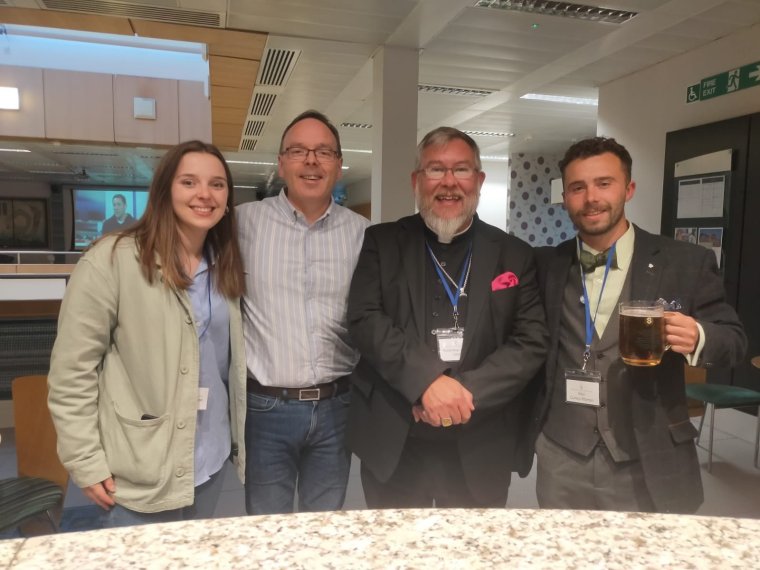
John Deighan CEO and daughter with ✠Jerome and conference delegate, Alex Curley-Warren

The upcoming Youth Conference is scheduled for February, and there are plans to organize two or three one-day conferences in different regions. Additionally, many hope there will be another three-day conference in the near future. Delegates thoroughly enjoyed the chance to connect, engage in prayer, share meals, and catch up with one another, as well as interact with the SPUC staff. The conference venue proved to be exceptionally suitable for this kind of event. Overall, everyone expressed their satisfaction with the high quality and diverse food options provided during mealtimes, as well as the comfortable accommodations and helpful, friendly venue staff.

As the oldest and largest pro-life organization in the world, SPUC unequivocally demonstrated its professionalism and unwavering commitment to its charitable objectives. The caliber of their campaigns and projects, along with their flawless execution, left a lasting impression on all who attended. The Executive Committee, CEO John Deighan, and the entire SPUC staff deserve heartfelt congratulations for orchestrating an extraordinary event that will be etched in the memories of those fortunate enough to attend.

For more information about SPUC and its efforts for the pro-life cause, or to become a member visit www.spuc.org.uk