Tertiodécimo Kaléndas Januárii. Luna

romanmartyrology

Tertiodécimo Kaléndas Januárii. Luna. The Twentieth Day of December. The Night of the Moon. 

Vigília sancti Thomæ Apóstoli.
The Vigil of St. Thomas, Apostle.

Romæ natális sancti Zephyríni, Papæ et Mártyris.  Ipsíus tamen festum recólitur séptimo Kaléndas Septémbris.
At Rome, the birthday of St. Zephyrinus, pope and martyr.  His feast is celebrated on the 26th of August.

Ibídem pássio sancti Ignátii, Epíscopi et Mártyris; qui, tértius post beátum Petrum Apóstolum, Antiochénam rexit Ecclésiam.  Hic, in persecutióne Trajáni, damnátus ad béstias, Romam vinctus míttitur; ibíque, circumsedénte Senátu, immaníssimis pœnárum supplíciis primo est afféctus, dehinc objícitur leónibus, quorum déntibus præfocátus, hóstia Christi effícitur.  Ejus vero festívitas Kaléndis Februárii celebrátur.
In the same city, the martyrdom of St. Ignatius, bishop and martyr.  He was the third after St. Peter the Apostle to rule the church of Antioch, and in the persecution of Trajan was condemned to the beasts.  By order of Trajan he was sent to Rome in fetters, and there tortured and afflicted with the most cruel torments in the midst of the assembled Senate.  Finally he was cast to the lions, and being ground by their teeth became a sacrifice for Christ.  His feast is observed on the 1st of February.

Item Romæ sanctórum Mártyrum Liberáti et Bájuli.
At Rome, the holy martyrs Liberatus and Bajulus.

In Arábia sanctórum Mártyrum Eugénii et Macárii Presbyterórum, qui a Juliáno Apóstata, cum ipsíus impietátem arguíssent, sævíssimis plagis affécti sunt, atque in vastíssimam erémum relegáti, et gládio cæsi.
In Arabia, the holy martyrs Eugene and Macarius, priests.  For reproving Julian the Apostate for his impiety, they received severe stripes, were banished to a vast desert, and finally were put to the sword.

Alexandríæ sanctórum mílitum et Mártyrum Ammónis, Zenónis, Ptolemæi, Ingenis et Theóphili; qui, tribunálibus astántes, cum quidam Christiánus, in supplíciis pósitis, trepidáret et jam prope ad negándum declináret, vultu, óculis ac nútibus illum conabántur erígere.  Cumque hac de causa clamor totíus pópuli in eos prosilíret, prorumpéntes in médium se Christiános esse testáti sunt; per quorum victóriam Christus, qui suis eam ánimi constántiam déderat, gloriosíssime triumphávit.
At Alexandria, the holy martyrs Ammon, Zeno, Ptolemy, Ingen, and Theophilus, soldiers.  Standing near the tribunals, and seeing a Christian under torture and almost ready to apostatize, they endeavoured to encourage him by their looks and by signs.  When on account of this the crowd raised an outcry against them, they stepped forward and declared themselves Christians.  In their victory, Christ also who had given them fortitude triumphed.

Géldubæ, in Germánia, sancti Júlii Mártyris.
At Gelduba in Germany, St. Julius, martyr.

Antiochíæ natális sancti Philogónii Epíscopi, qui, Dei nutu ex causídico ad eam Ecclésiam regéndam accersítus, advérsus Aríum, una cum sancto Alexándro Epíscopo et Sóciis, primum pro fide cathólica certámen íniit, clarúsque méritis quiévit in Dómino; cujus ánnuam festivitátem sanctus Joánnes Chrysóstomus præcláro encómio celebrávit.
At Antioch, the birthday of St. Philogonius, bishop, who was called by the will of God from the office of lawyer to the government of that church.  With the saintly bishop Alexander and his companions, he engaged in the first contest for the Catholic faith against Arius.  Renowned for merits he rested in the Lord, and his feast was commemorated by St. John Chrysostom with an excellent eulogy.

Bríxiæ sancti Domínici, Epíscopi et Confessóris.
At Brescia, St. Dominic, bishop and confessor.

In Hispánia deposítio sancti Domínici de Silos Abbátis, e sancti Benedícti Ordine, miráculis in captivórum liberatióne celebérrimi.
In Spain, the death of St. Dominic of Silos, abbot of the Order of St. Benedict, renowned for the miracles which he had wrought for the liberation of captives.

Et álibi aliórum plurimórum sanctórum Mártyrum et Confessórum, atque sanctárum Vírginum.
R.  Deo grátias.
And elsewhere in divers places, many other holy martyrs, confessors, and holy virgins.
R.  Thanks be to God.

December XX.
St. Philogonius, Bishop of Antioch, Confessor
St. Paul of Latrus, or Latra, Hermit

FOR NEWS OF CONTEMPORARY MARTYRS…

Open Doors – The world’s largest outreach to persecuted Christians in the most high-risk places.

Foundation for Relief and Reconciliation in the Middle East – providing humanitarian relief in Iraq through St George’s Church and Clinic.

Voice of the Persecuted – Informing the world of Christian persecution, one of the worst humanitarian crises on the planet, today.

O Clavis David

dec-20-o-key-of-david

The fourth great “O” is: O Clavis David, et sceptrum domus Israel; qui aperis, et nemo claudit; claudis, et nemo aperit: veni, et educ vinctum de domo carceris, sedentem in tenebris, et umbra mortis.

English: O Key of David and sceptre of the House of Israel; you open and no one can shut; you shut and no one can open: Come and lead the prisoners from the prison house, those who dwell in darkness and the shadow of death.

It reflects the following prophecies and Scripture:

O Key of David and sceptre of the House of Israel;

  • sceptre“For unto us a child is born, unto us a son is given: and the government shall be upon his shoulder: and his name shall be called Wonderful, Counsellor, The mighty God, The everlasting Father, The Prince of Peace.” Isaiah 9:6 (comp. Isaiah 7:14-16, where the promise of “a child,” “a son,” is first made – a child who was, like this Child, to be “God with us”). The word translated “government” (misrah) occurs only here and in verse 7, it is probably to be connected with sat, “prince,” and Israel. Government was regarded as a burden, to be born on the back or shoulders, and was sometimes symbolized by a key laid upon the shoulder. Vizier means “burdened.” The Latin writers often speak of the civil power as borne on the shoulders of magistrates (Cic., ‘Orat. pro Flacc,’ § 95; Plin., ‘Paneg.,’ § 10).
    “His name shall be called.” It is not important whether we view what follows as one name or several. Isaiah does not mean that the “Child” should bear as a name, or names, any of the expressions, but only that they should be truly applicable to him.
    “Wonderful” The Messiah would be “wonderful” in His nature as God-Man; in His teaching, which “astonished” those who heard it (Matthew 7:28); in His doings (Isaiah 25:1); in the circumstances of His birth and death; in His resurrection, and in His ascension. “Wonder” would be the first sentiment which His manifestation would provoke, and hence this descriptive epithet is placed first.
    “Counsellor” As the Word, as Wisdom itself, as He who says, “Counsel is mine, and sound wisdom: I am Understanding” (Proverbs 8:14), He is well named “Counsellor.” None will ever seek His counsel in vain, much less repent of following it.
    “The mighty God” The term “El”, God, had been previously applied to the Messiah only in Psalm 45:6. It denotes in Isaiah absolute divinity; it is never used hyperbolically or metaphorically.
    “The Everlasting Father”  If the term “Father,” applied to our Lord, sits uncomfortably with us, we must remember that the distinction of three Persons in the Godhead had not yet been revealed (in Scripture). But the reference here is indeed to the Everlasting Father, the one Creator, Preserver, Protector of mankind who is absolutely eternal.
    “The Prince of Peace” A “Prince of Peace” had been long shadowed forth, as in Melchizedek, “King of Salem,” i.e. “of Peace;” and again in Solomon, “the peaceful one;” and Isaiah himself had already prophesied the peacefulness of the Messiah’s kingdom (Isaiah 2:4). Compare the song of the angels at our Lord’s birth (Luke 2:14). If the peacefulness has not vet very clearly shown itself, our Lord’s kingdom has yet to come into the hearts of most men. Christ is a Prince, often so called, Ezekiel 34:24 He is so by birth, being the King’s Son, the Son of God, and by office, power, and authority; He is so a Prince as that He is a King; He is exalted to be a Prince and a Saviour; and He is a Prince superior to kings, being the Prince of the kings of the earth, Acts 5:31 and He is called the “Prince of peace”, because he is the author of peace; just as He is said to be the “Prince of life”, Acts 3:15 for the same reason: He is the author of peace between Jew and Gentile, by abrogating the ceremonial law, the enmity between them, and by sending the Gospel to both, and making it the power of God to salvation to some of each of them, and by bringing them into the same Gospel church state, and making them partakers of the same privileges and blessings, internal and external, Ephesians 2:14 and He is the author of peace between God and sinners; He has made it by the blood of the cross, having the chastisement of their peace laid upon Him, in consequence of a covenant of peace He made with his Father, who was in Him reconciling the world to Himself.
  • “His authority shall grow continually, and there shall be endless peace for the throne of David and his kingdom. He will establish and uphold it with justice and with righteousness from this time onwards and for evermore.” Isaiah 9:7 The Messiah’s kingdom shall ever increase more and more; there shall be no limits to it; ultimately it shall fill the world (comp. Matthew 28:18, 19). The continual spread of Christianity tends to the accomplishment of this prophecy. That the Messiah is to sit on the throne of David, suggests, but does not absolutely imply, His Davidic descent. That descent is, however, announced with sufficient clearness in Isaiah 11:1, 10 (see O Radix Jesse). A gradual establishment of the kingdom would seem to be implied, such as is taught also in the parables of the mustard seed and the leaven. The kingdom is to be both universal in respect of extent and in respect of duration eternal. God’s jealousy of his own honour, which is bound up with the prosperity and final triumph of his people over all their enemies, will assure the performance of all that is here prophesied.
  • Key_David_Bookcover“I will place on his shoulder the key of the house of David; he shall open, and no one shall shut; he shall shut, and no one shall open.” Isaiah 22:22 The first mention of the key of the house of David is found in the book of Isaiah, in a description of the duties of Eliakim, the royal chamberlain of King Hezekiah of Judah: And it shall come to pass in that day, that I will call my servant Eliakim the son of Hilkiah: And I will clothe him with thy robe, and strengthen him with thy girdle, and I will commit thy government into his hand: and he shall be a father to the inhabitants of Jerusalem, and to the house of Judah. And the key of the house of David will I lay upon his shoulder; so he shall open, and none shall shut; and he shall shut, and none shall open. (Isaiah 22:20-22) The key of the house of David is symbolic for the government of Eliakim in Isaiah 22 (v.21), which is a type or symbol of the government of Jesus Christ as described in Isaiah 9. Note also that according to Isaiah, the government or kingdom of Jesus Christ is established, or founded, on a work of judgement (Isa 9:7). This is an important aspect of the key of the house of David.The key of the house of David, possessed by Christ, opens two important doors. In the travelling Tabernacle of Moses, there were two “doors”. Through the first door was the Holy Place, the first apartment. This is the door opened first chronologically in Revelation 4:1, in the heavenly Tabernacle, with the key of David. “After this I looked, and, behold, a door was opened in heaven: and the first voice which I heard was as it were of a trumpet talking with me; which said, Come up hither, and I will show thee things which must be hereafter. And immediately I was in the spirit; and, behold, a throne was set in heaven, and one sat on the throne.” Rev 4:1-2 The scene that John sees in heaven after the first door is opened, is a throne room (Rev 5:6-11).  In this scene, the one on the throne is God the Father, and the Lamb as it had been slain is Jesus, returning to His Father from His crucifixion. There is a book or scroll with seven seals which only Jesus as the slain Lamb can open, and the seals are opened in sequence from Rev. 6:1 to 8:1. Christ as the sacrificed Lamb is the only one qualified to receive the title deed to the Kingdom, containing the names of all the saved, the Lamb’s book of life. The type of this in the Old Testament is the kinsman redeemer Boaz, who by purchasing the land of Naomi, also took Ruth as his wife. Jesus is our kinsman redeemer, who by His sacrifice bought back ownership of the earth, which Adam had forfeited to Satan at the fall. By this, Jesus also takes those faithful believer’s He has redeemed as His bride, restoring to them their inheritance. “For such as be blessed of him shall inherit the earth; and they that be cursed of him shall be cut off.” Psalm 37:22
    The second door opened the veil or door from the Holy Place into the Most Holy. On the Day of Atonement the high priest entered the Most Holy apartment of the Sanctuary or Temple, which was symbolic of the judgement of God’s people. In the Most Holy was the Ark of the Covenant, containing the standard of judgement the Ten Commandments of God (Exodus 20:2-17). The last of the seven churches is called Laodicea “a people judged” because they are living in the time of the judgement. This event is also described in Daniel: “I beheld till the thrones were cast down [set in place], and the Ancient of days [God the Father] did sit, whose garment was white as snow, and the hair of his head like the pure wool: his throne was like the fiery flame, and his wheels as burning fire. A fiery stream issued and came forth from before him: thousand thousands ministered unto him, and ten thousand times ten thousand stood before him: the judgement was set, and the books were opened.” Dan 7:9-10 The books being opened in the judgement are the evidence, to include the Lamb’s book of life (Rev. 3:5), which is Christ’s last will and testament: “And for this cause he [Christ] is the mediator of the new testament, that by means of death, for the redemption of the transgressions that were under the first testament, they which are called might receive the promise of eternal inheritance. For where a testament is, there must also of necessity be the death of the testator. For a testament is of force after men are dead: otherwise it is of no strength at all while the testator liveth.” Hebrews 9:15-17 Those being judged are the professed people of God, those who claim to be the heirs of Christ, the rightful inheritors of eternal life: “For the time is come that judgement must begin at the house of God: and if it first begin at us, what shall the end be of them that obey not the gospel of God?” 1 Peter 4:17 And every one that hath forsaken houses, or brethren, or sisters, or father, or mother, or wife, or children, or lands, for my name’s sake, shall receive an hundredfold, and shall inherit everlasting life.” Matthew 19:29 

you open and no one can shut; you shut and no one can open:

  • heaven...“Then Jesus came to them and said, “All authority in heaven and on earth has been given to me.” 

    Matthew 28:18 Jesus here asserts that He, as Son of man, has received from the Father supreme authority in heaven and earth, over the whole kingdom of God in its fullest extent. This is not given to Him as Son of God; for, as God, naught can be added to Him or taken from Him; it is a power which He has merited by His incarnation, death, and Passion (Philippians 2:8-10), which was foretold in the Old Testament (Psalm 2:8; Psalm 8:5-8 & Daniel 7:13, 14), and with which he was imbued on the day that He rose victorious from the grave. The power is exercised in His mediatorial kingdom, and will continue to be exercised till He has put all enemies under His feet, and destroyed death itself (1 Corinthians 15:24-27); but His absolute kingdom is everlasting; as God and Man He reigns forever and ever. This mediatorial authority extends not only over men, so that He governs and protects the Church, disposes bureau events, controls hearts and opinions; but the forces of heaven also are at his command, the Holy Spirit is bestowed by Him, the angels are in His employ as ministering to the members of His body. It is with this authority that He imbues His apostles and their successors in the Church

    “And I will give to thee the keys of the kingdom of heaven. And whatsoever thou shalt bind upon earth, it shall be bound also in heaven: and whatsoever thou shalt loose on earth, it shall be loosed also in heaven.”  Matthew 6:19,

  • And to the angel of the church of Philadelphia write: These things saith the Holy One and the true one, he that hath the key of David, he that openeth and no man shutteth, shutteth and no man openeth: I know thy works. Behold, I have given before thee a door opened, which no man can shut: because thou hast a little strength and hast kept my word and hast not denied my name. Revelation 3:7-8 Like the Philadelphians in Revelation 3 (see above ref the key of David), we must never deny the Lord, nor be overly proud of our attempts at holiness, remembering always from Whom our strength is supplied. “The keys of the kingdom of heaven” (Matthew 16:19) are not to be confounded with “the key of knowledge” in Christ’s rebuke to the hypocritical Pharisees “Woe unto you, lawyers! for ye have taken away the key of knowledge: ye entered not in yourselves, and them that were entering in ye hindered.” Luke 11:52. The keys belong to Christ, but have been committed to His Church, but not unreservedly. If the Church errs in binding or loosing, He cancels the judgement. Binding and loosing, in the common language of the Jews, signified to forbid and to allow, or to teach what is lawful or unlawful. The Church may open where Christ will shut, and shut where Christ will open. He alone openeth so that none shall shut, and shutteth so that none can open.

Come and lead the prisoners from the prison house, those who dwell in darkness and the shadow of death.

  • “…To open the blind eyes, to bring out the prisoners from the prison, and them that sit in darkness out of the prison house.” Isaiah 42:7. Though in Christ, the Messiah has the power to heal both physical as well as spiritual blindness, it is the latter we should interpret here.
    “Come and lead the prisoners” we might understand as those Jews shut up under the law, i.e. entrapped by ignorance and hypocrisy, tied to the “letter and not the spirit” of the law (cf 2 Corinthians 3:6); “from the prison house” we may understand as those entrapped and enslaved by sin and Satan; “those who dwell in darkness” i.e. the Gentiles, destitute of all divine knowledge, having not known the prophets and the law as had the Jews.

Quartodécimo Kaléndas Januárii. Luna

romanmartyrology

Quartodécimo Kaléndas Januárii. Luna. The Ninteenth Day of December. The Night of the Moon. 

In Mauritánia sancti Timóthei Diáconi, qui, ob Christi fidem, post diros cárceres, in ignem conjéctus, martyrium consummávit.
In Morocco, St. Timothy, deacon, who after severe imprisonment for the sake of Christ was cast into the fire and achieved martyrdom.

Alexandríæ beáti Nemésii Mártyris, qui, primo per calúmniam quasi latro Júdici delátus, eóque crímine absolútus, mox, in persecutióne Décii, Christiánæ religiónis nómine accusátus, cum latrónibus jussus est incéndi, Salvatóris déferens similitúdinem, qui una cum latrónibus pértulit crucem.
At Alexandria in Egypt, blessed Nemesius, martyr, who first was denounced before the judge as a robber, and being freed from that charge, soon after, in the persecution of Decius, was accused before the judge Emilian of being a Christian.  He was twice subjected to torture and condemned to be burned alive with robbers, thus bearing a resemblance to our Saviour, who was crucified with thieves.

Nicææ, in Bithynia, sanctórum Mártyrum Daríi, Zósimi, Pauli et Secúndi.
At Nicaea, the Saints Darius, Zosimus, Paul, and Secundus, martyrs.

Nicomedíæ sanctórum Mártyrum Cyríaci, Paulílli, Secúndi, Anastásii, Syndímii et Sociórum.
At Nicomedia, the holy martyrs Cyriac, Paulillus, Secundus, Anastasius, Sindimius, and their companions.

Gazæ, in Palæstína, pássio sanctárum Meuris et Theæ.
At Gaza in Palestine, the martyrdom of Saints Meuris and Thea.

Romæ deposítio sancti Anastásii Papæ Primi, viri ditíssimæ paupertátis et apostólicæ sollicitúdinis, quem (ut ait sanctus Hierónymus) diu Roma habére non méruit, ne orbis caput sub tali Epíscopo truncarétur; nam, haud multo post ejus óbitum, Roma a Gothis capta et dirépta fuit.
At Rome, the death of Pope St. Anastasius I, a man who was rich in his poverty and filled with apostolic zeal.  St. Jerome says that Rome did not deserve to possess him long, lest the capital of the world should be devastated under so fine a bishop, for shortly after his death Rome was taken and sacked by the Goths.

Antisiodóri sancti Gregórii, Epíscopi et Confessóris.
At Auxerre, St. Gregory, bishop and confessor.

Aureliánis, in Gállia, sancti Adjúti Abbátis, prophético spíritu illústris.
At Orleans in France, St. Adjutus, abbot, famous for the spirit of prophecy.

Romæ sanctæ Faustæ, quæ fuit mater sanctæ Anastásiæ, ac nobilitáte et pietáte éxstitit insígnis.
At Rome, St. Fausta, mother of St. Anastasia, renowned for her noble birth and her holiness.

Avenióne beáti Urbáni Papæ Quinti, qui, Sede Apostólica Romæ restitúta, Græcórum cum Latínis conjunctióne perfécta, infidélibus coércitis, de Ecclésia óptime méritus est.  Ejus cultum pervetústum Pius Nonus, Póntifex Máximus, ratum hábuit et confirmávit.
At Avignon, blessed Urban V, who deserved well of the Church by restoring the Apostolic See to Rome, by bringing about a reunion of the Latins and the Greeks, and by suppressing heretics.  Pius IX approved and confirmed the veneration which had long been paid to him.

Et álibi aliórum plurimórum sanctórum Mártyrum et Confessórum, atque sanctárum Vírginum.
R.  Deo grátias.
And elsewhere in divers places, many other holy martyrs, confessors, and holy virgins.
R.  Thanks be to God.

December XIX.
St. Nemesion, Martyr, &c.
St. Samthana, Virgin, Abbess in Ireland

FOR NEWS OF CONTEMPORARY MARTYRS…

Open Doors – The world’s largest outreach to persecuted Christians in the most high-risk places.

Foundation for Relief and Reconciliation in the Middle East – providing humanitarian relief in Iraq through St George’s Church and Clinic.

Voice of the Persecuted – Informing the world of Christian persecution, one of the worst humanitarian crises on the planet, today.

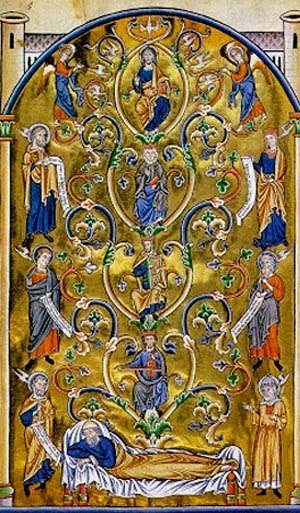
O Radix Jesse

dec-19-o-radix

The third great “O” is: O Radix Jesse, qui stas in signum populorum, super quem continebunt reges os suum, quem Gentes deprecabuntur: veni ad liberandum nos, jam noli tardare.

English: O Root of Jesse, standing as a sign among the peoples; before you kings will shut their mouths, to you the nations will make their prayer: Come and deliver us, and delay no longer.

It reflects the following prophecies and Scripture:

O Root of Jesse…

  • root2bof2bjesse“A shoot shall come out from the stock of Jesse, and a branch shall grow out of his roots.” Isaiah 11:1 Jesse was the father of King David (1 Sam. 16:10–13). David inaugurated a great kingdom, but the greater “David” (Ezek. 34:23–25; Zech. 12:7–10), now only a tender plant (53:2), will rule an incomparably greater kingdom. All that is left of the Davidic dynasty is a stump. The privileged sons of David no less than Assyria are like trees that have been chopped down (Is 10:33, 34). But in spite of this judgement on Judah, the Lord will raise up new leadership from the dynasty of David (Matt. 1:1). Micah had prophesied that the Messiah would be of the house and lineage of David and be born in David’s city, Bethlehem (Micah 5:2). see O Adonai
  • “A record of the origin of Jesus Christ, the son of David, the son of Abraham: Abraham begot Isaac…” Matthew 1:1–17 and continues on until …and Jacob begot Joseph, the husband of Mary, of whom was born Jesus, who is called Christ. Thus there were fourteen generations in all from Abraham to David, fourteen from David to the exile to Babylon, and fourteen from the exile to the Christ. Matthew emphasizes, right from the beginning, Jesus’ title Christ—the Greek rendering of the Hebrew title Messiah—meaning anointed, in the sense of an anointed king. Jesus is presented first and foremost as the long-awaited Messiah, who was expected to be a descendant and heir of King David, so the genealogy serves the essential purpose of demonstrating this line of descent. Thus, Matthew begins by calling Jesus son of David, indicating his royal origin, and also son of Abraham, indicating that he was a Jew; both are stock phrases, in which son means descendant, calling to mind the promises God made to David and to Abraham.
  • “And Jesus himself began to be about thirty years of age, being (as was supposed) the son of Joseph, which was the son of Heli…” Luke 3:23-38 Luke places his genealogy at the beginning of the public life of Jesus (Luke 3:23-38) and his account ascends from Joseph to Adam or and to God. This genealogy descends from the Davidic line through Nathan, who is an otherwise little-known son of David, mentioned briefly in the Old Testament (1 Chronicles 3:5; but also see Zechariah 12:12). The prophecy of Nathan (2 Samuel 7:12–16) understood as foretelling a son of God who would inherit the throne of his ancestor David and reign forever is quoted in Hebrews (Hebrews 1:5) and strongly alluded to in Luke’s account of the Annunciation (Luke 1:32–35). Likewise, the Psalms (Psalms 89:3-4; Psalms 132:11) record God’s promise to establish the seed of David on his throne forever, while Isaiah (Isaiah 16:5) and Jeremiah (Jeremiah 23:5-6) speak of the coming reign of a righteous king of the house of David. David’s ancestors are also understood as progenitors of the Messiah in several prophecies. Isaiah’s description of the branch or root of Jesse (Isaiah 11:1–10) is cited twice by Paul as a promise of the Christ (Acts 13:23; Romans 15:12). 
  • O-Radix-Jesse-1Concerning the genealogies… God promised to establish the throne of King Solomon over Israel forever, (1 Chronicles 22:9–10) but the promise was contingent upon obeying God’s commandments (1 Chronicles 28:6–7; 2 Chronicles 7:17–18; 1 Kings 9:4–5). Solomon’s failure to do so is explicitly cited as a reason for the subsequent division of his kingdom (1 Kings 11:4–11). Against King Jehoiakim, Jeremiah prophesied, “He shall have no one to sit on the throne of David,” (Jeremiah 36:30–31) and against his son King Jeconiah, “Write this man childless, a man who will not prosper in his days; for no man of his seed will prosper, sitting on the throne of David or ruling again in Judah.”  (Jeremiah 22:24–30) Some see this prophecy as permanently disqualifying Jeconiah from the ancestry of the Messiah (though not necessarily of Joseph) [e.g, Irenaeus, Adversus haereses (“Against Heresies”), p. 3.21.9j].

    To Zerubbabel, God declares through Haggai, “I will make you like my signet ring,” in clear reversal of the prophecy against his grandfather Jeconiah, “though you were a signet ring on my right hand, yet I would pull you off.” (Haggai 2:23 (cf. Jeremiah 22:24) Zerubbabel ruled as governor though not as king, and has been regarded by many as a suitable and likely progenitor of the Messiah. Clearly Matthew said that the blood father (begot) of Joseph was Jacob. Matthew had satisfied the Mosaic Law by showing the male ancestry of Jesus by going through Joseph instead of Mary. Keep in mind that this genealogy shows the legal, or royal, or public record, of descent and not the human descent, hence the inclusion of Jeconiah of Solomon. Luke shows the human descent of Christ through David to be Nathan, and not Solomon; thus avoiding the curse of Jeconiah. This alludes to the possibility that Luke’s genealogy is for a different person other than Joseph i.e. but of Mary. For Mary as the birth-giver of Jesus and a Jewess – it would be through her that the genetic Davidic bloodline would be inherited by Christ. Luke as a physician and writing for Gentiles might wish to emphasise this point, as Matthew would want to emphasise the legal point for the Jews following the Mosaic Law; both concur that Christ was born of Mary, a virgin, betrothed to Joseph.

standing as a sign among the peoples;

  • “On that day the root of Jesse shall stand as a signal to the peoples; the nations shall inquire of him, and his dwelling shall be glorious.” Isaiah 11:10 The prophet makes a further reference to the days of the Messiah and the accession of the Gentiles to His kingdom, which the apostle Paul follows, Rom. 15:12; There shall be a root of Jesse; and he that shall rise to reign over the Gentiles, in him shall the Gentiles trust. Here is the crux of this prophecy, speaking of Christ as the root of Jesse, or a branch out of his roots (Isa. 11:1), and also, a root out of a dry ground, Isa. 53:2. He is the root of David (Rev. 5:5), the root and offspring of David Rev. 22:16.
    crucifixion-silhouette-kent-sorensenHe shall stand, or be set up, for an ensign of the people. When Christ was crucified he was lifted up from the earth, that, as an ensign or a beacon, He might draw the eyes and the hearts of all men upon him, John 12:32. His preaching of the everlasting gospel and the salvation He brings, in which the apostles and their successors as standard-bearers likewise by their ministry display the banner of His love, to allure us to Him (Song 1:4), the banner of His truth, under which we engage in the war against sin and Satan. Christ is the ensign to which the faithful children of God scattered abroad are gathered together (John 11:51), and in Him they meet as the centre of their unity. To him shall the Gentiles seek. We read of Greeks that did so (John 12:21; “We would see Jesus”), when Christ spoke of his being lifted up, to draw all men to Himself.
    His rest shall be glorious. The triumph of the Cross make even His death glorious and His resurrection and His ascension too after which He sits at the right hand of God and in the Church, that Mount Zion of which Christ has said, “This is my rest”, and in which he resides. This, though despised by the world, having upon it the beauty of holiness, is truly glorious, a glorious high throne, Jeremiah 17:12. Both Jews and Gentiles shall be gathered to Him, Isaiah 11:11. As God delivered His people, and gathered them out of all the countries where they were scattered (Ps. 106:47; Jer. 16:15, 16), so He will a second time by the powerful working of the Spirit of grace with the Word. The outcasts of Israel and the dispersed of Judah (Isa. 11:12), the diaspora to whom the apostles’ preached, the twelve tribes that were scattered abroad (Jas. 1:1; 1 Pet. 1:1), shall flock to Christ; and probably more of those scattered Jews were brought into the church, in proportion, than had remained in Israel. Many of the nations, the Gentiles, shall be brought in by the lifting up of the ensign, the Jews were jealous of Christ’s going to the dispersed among the Gentiles and of His teaching the Gentiles, John 7:35.
  • “And again, Esaias saith, There shall be a root of Jesse, and he that shall rise to reign over the Gentiles; in him shall the Gentiles trust.” Romans 15:12. That they should believe in Christ (Rom. 15:12), quoted from Isa. 11:10; where observe, First, The revelation of Christ as the Gentiles’ king. He is here called the root of Jesse, that is, such a branch from the family of David as is the very life and strength of the family: compare Isa. 11:1. Christ was David’s Lord (as God), and yet withal He was the Son of David (Matthew 1:1–17; Luke 3:23-38; Matt. 22:45), for he was the root and offspring of David, Rev. 22:16. Christ, as God, was David’s root; Christ, as man, was David’s offspring.—And he that shall rise to reign over the Gentiles. When Christ rose from the dead, when He ascended on high, it was to reign over the Gentiles. Secondly, The recourse of the Gentiles to Him: In Him shall the Gentiles trust. Faith is the soul’s confidence in Christ and dependence on Him. The method of faith is first to seek Christ for a Saviour; and, finding Him able and willing to save, then to trust in Him.

before you kings will shut their mouths, to you the nations will make their prayer:

  • “Thus saith the Lord, The labour of Egypt, and merchandise of Ethiopia and of the Sabeans, men of stature, shall come over unto thee, and they shall be thine: they shall come after thee; in chains they shall come over, and they shall fall down unto thee, they shall make supplication unto thee, saying, Surely God is in thee; and there is none else, there is no God.” Isaiah 45:14 Sabeans i.e. descendants of Seba (Gen. 10:7); Africans (Isa. 43:3). They were “men of stature,” and engaged in merchandise (Isa. 45:14). Their conversion to the Lord was predicted (Ps. 72:10). The nations will come to worship the one God (Zech. 8:23; Eph. 3:6). Encouragement given to the believing Jews, who trusted in God and continued instant in prayer, assuring them that God would in due time accomplish this work by the hand of Cyrus, Isa. 45:11-15. A challenge given to the worshippers of idols and their doom read, and satisfaction given to the worshippers of the true God and their comfort secured, with an eye to the Mediator, who is made of God to us both righteousness and sanctification, Isa. 45:16-25. And here, as in many other parts of this prophecy, there is much of Christ and of gospel grace.
  • 9732976“So shall he sprinkle many nations; the kings shall shut their mouths at him: for that which had not been told them shall they see; and that which they had not heard shall they consider.” Isaiah 52:15 Many nations shall be the better for Him, for he shall sprinkle them, and not the Jews only; the blood of sprinkling shall be applied to their consciences, to purify them. He suffered, and died, and so sprinkled many nations; for in His death there was a fountain opened, Zech. 13:1. He shall sprinkle many nations by his heavenly doctrine, which shall drop as the rain and distil as the dew Isaiah 45:8 Drop down dew, you heavens, from above, and let the clouds rain the just: let the earth be opened and bud forth a Saviour.” Moses’s did so only on one nation (Deut. 32:2), but Christ’s on many nations. He shall do it by baptism, which is the washing of the body with pure water, Heb. 10:22. So that this promise had its accomplishment when Christ sent His apostles to disciple all nations, by baptizing or sprinkling them. As conceived by Christ, the Great Commission linked the missionary activity of the Church with that of Christ Himself (John 14:12). As the first and greatest missionary (Heb 3:1), He came to seek and to save the lost (Luke 19:10). The church’s mission was to be patterned after His (John 20:21). As His ministry included teaching, preaching and healing (Matt 4:23), so would theirs (Acts 4:2; 5:12-16).
    The great ones of the nation shall show Him respect: they shall with great humility and reverence receive His oracles and laws, as those who, when they heard Job’s wisdom, after his speech spoke not again, Job 29:9, 22. Kings shall see and arise, Isa. 49:7.
    The mystery which was kept secret from the beginning of the world shall by Him be made known to all nations as the apostle writes, “Now to Him who is able to establish you according to my gospel and the preaching of Jesus Christ, according to the revelation of the mystery which has been kept secret for long ages past, but now is manifested, and by the Scriptures of the prophets, according to the commandment of the eternal God, has been made known to all the nations, leading to obedience of faith” Romans 16:25, 26. The Gospel brings to light things new and unheard of, which will awaken the attention and engage the reverence of kings and kingdoms. This is applied to the preaching of the Gospel in the Gentile world, Romans 15:21. Much had been said in the Old Testament concerning the Messiah; much had been told them, and they had heard it and rejected it (Nehemiah 9:20, 30; Micah 3:8; Zechariah 7:12; Matthew 23:34); Christ disappointed the expectations of those who looked for a Messiah according to their fancies, but outdid theirs who looked for such a Messiah as was promised (Isaiah 44:24-28; Isaiah 46:8-11).

Come and deliver us, and delay no longer.

  • The prayer of the Church, of those who through obedience have received faith from God, echoing the cry of God’s faithful people throughout the centuries, imploring the Messiah “to come” as the prophets foretold and as He revealed Himself to be. That, beholding the Cross, His ensign, as many as may be saved in this world, may be through baptism and share eternity with Him when He comes again at the end of all ages.

Quintodécimo Kaléndas Januárii. Luna

romanmartyrology

Quintodécimo Kaléndas Januárii. Luna. The Eighteenth Day of December. The Night of the Moon. 

Philíppis, in Macedónia, natális sanctórum Mártyrum Rufi et Zósimi, qui ex illórum número discipulórum fuérunt, per quos primitíva Ecclésia in Judæis et Græcis fundáta est; de quorum étiam felíci agóne scribit sanctus Polycárpus in epístola ad Philippénses. At Philippi in Macedonia, the birthday of the holy martyrs Rufus and Zosimus, who were of the number of disciples by whom the primitive church was founded among the Jews and the Greeks. Their happy martyrdom is mentioned by St. Polycarp in his Epistle to the Philippians.

Laodicéæ, in Syria, pássio sanctórum Theotími et Basiliáni. At Laodicea in Syria, the martyrdom of the Saints Theotimus and Basilian.
In Africa sanctórum Mártyrum Quincti, Simplícii et aliórum; qui sub Décii et Valeriáni persecutióne passi sunt. In Africa, the holy martyrs Quinctus, Simplicius, and others who suffered in the persecution of Decius and Valerian.

Ibídem sancti Moysétis Mártyris. In the same country, St. Moses, martyr.
Item in Africa sanctórum Mártyrum Victúri, Victóris, Victoríni, Adjutóris, Quarti et aliórum trigínta. Also in Africa, the holy martyrs Victurus, Victor, Victorinus, Adjutor, Quartus, and thirty others.

Mopsuéstiæ, in Cilícia, sancti Auxéntii Epíscopi, qui, olim sub Licínio miles, pótius elégit cíngulum exúere quam uvas Baccho offérre; factúsque Epíscopus, præclárus méritis quiévit in pace. At Mopsuestia in Cilicia, St. Auxentius, bishop, who, being at first a soldier under Licinius, preferred to surrender his military insignia rather than offer grapes to Bacchus. Having been made a bishop, he was renowned for his merit, and died in peace.

Turónis, in Gállia, sancti Gratiáni Epíscopi, qui, a sancto Fabiáno Papa primus ejúsdem civitátis Epíscopus ordinátus est, et multis clarus miráculis obdormívit in Dómino. At Tours in France, St. Gratian, appointed first bishop of that city by Pope St. Fabian. Celebrated for many miracles, he calmly went to his repose in the Lord.

Et álibi aliórum plurimórum sanctórum Mártyrum et Confessórum, atque sanctárum Vírginum.
R.  Deo grátias.
And elsewhere in divers places, many other holy martyrs, confessors, and holy virgins.
R.  Thanks be to God.

December XVIII.
SS. Rufus and Zozimus, Martyrs
St. Gatian, First Bishop of Tours, Confessor
St. Winebald, Abbot and Confessor

FOR NEWS OF CONTEMPORARY MARTYRS…

Open Doors – The world’s largest outreach to persecuted Christians in the most high-risk places.

Foundation for Relief and Reconciliation in the Middle East – providing humanitarian relief in Iraq through St George’s Church and Clinic.

Voice of the Persecuted – Informing the world of Christian persecution, one of the worst humanitarian crises on the planet, today.

O Adonai

Dec-18-O-Adonai

The second great “O” is: O Adonai, et Dux domus Israel, qui Moysi in igne flammae rubi apparuisti, et ei in Sina legem dedisti: veni ad redimendum nos in brachio extento.

English: O Adonai, and leader of the House of Israel, who appeared to Moses in the fire of the burning bush and gave him the law on Sinai: Come and redeem us with an outstretched arm.

It reflects the following prophecies and Scripture:

O Adonai…

  • christ-in-glory07“For the Lord is our judge, the Lord is our ruler, the Lord is our king; he will save us.” Isaiah 33:22 “Adonai” means “Lord” and was the Hebrew word used to replace God’s name YHWH held to be too sacred to pronounce aloud; the repetition of “Adonai” three times is common in the Scriptures, here preceding judge, ruler and king. These attributes summarise the ideal theocracy, to be realised by the Messiah alone; the judicial, legislative, and administrative functions as king to be exercised by Him in person (Isa 11:4; 32:1; Jas 4:12). Jesus came to inaugurate the reign of God on earth “The kingdom of God has come near; repent and believe in the good news” (Mark 1:15), primarily by His rule in the hearts of men (Luke 17:20-21) through His saving redemptive sacrifice on the Cross (Hebrews 9:28). Ultimately we will live with Him in the fullness of the kingdom of God (John 6:40; 1 Corinthians 15) when it comes to earth “Your kingdom come. Your will be done, on earth as it is in heaven” (Matt 6:10). For as was revealed to St John the Beloved concerning the kingdom of God at the end of the ages, when Christ shall reign “Look what I have done,” Christ says from His throne “I have made all things new.” (Revelation 21:5)
  • “[…] but with righteousness he shall judge the poor, and decide with equity for the meek of the earth; he shall strike the earth with the rod of his mouth, and with the breath of his lips he shall kill the wicked. Righteousness shall be the belt around his waist, and faithfulness the belt around his loins.” Isaiah 11:4-5 This refers to the kingship of Christ as “Adonai”. Only Our Lord Jesus Christ could possess all these properties, for only He as the Son of God could possess the divine judgement: for He it is who touches the hearts of the faithful and mortifies their concupiscence: and to those who will not repent, He alone can pass sentence, so that all the world will be smitten with His rod, which is His Word, He who is life itself [cf O Sapientia].

and leader of the House of Israel…

  • But thou, Bethlehem Ephratah, though thou be little among the thousands of Judah, yet out of thee shall he come forth unto me that is to be ruler in Israel; whose goings forth have been from of old, from everlasting. Micah 5:2 echoed in St Matthew’s Gospel “And thou Bethlehem, in the land of Juda, art not the least among the princes of Juda: for out of thee shall come a Governor, that shall rule my people Israel.” Matthew 2:6 Both Christian and Jewish scholars have long held this prophecy referred to the birth-place of the Messiah. Bethlehem is called by Micah, Bethlehem Ephratah, and by Matthew, Bethlehem in the land of Judah, both are one and the same place. Bethlehem Ephratah was in the land of Juda, as appears from the prophecy of Micah itself, from Ruth 1:2 and the Septuagint version of Joshua 15:60 and is described in this manner by Matthew, partly to distinguish it from another Bethlehem in the land of Zebulun, Joshua 19:15 and partly because its other name Ephratah was now disused. This prophecy is relevant regarding “leader of the House of Israel” in the antiphon (above) for the Messiah would be “born of David’s line” and Bethlehem Ephrathah is the town and clan from which king David was born (1 Samuel 16:18-23). Luke 2:11 For unto you is born this day in the city of David a Saviour, which is Christ the Lord.

who appeared to Moses in the fire of the burning bush…

  • Bourdon,_Sébastien_-_Burning_bushAnd the angel of the Lord appeared unto him in a flame of fire out of the midst of a bush: and he looked, and, behold, the bush burned with fire, and the bush was not consumed. Exodus 3:2 This was no ordinary angel, no created being but in fact “the Angel of the Covenant”, the Second Person of the Trinity Himself, the eternal Word and Son of God i.e. Christ! If we read on we find the “angel” describes Himself as YHWH, and calls himself the God of Abraham, Isaac, and Jacob, a created angel would never do that! Some scholars believe this was a prefigurement of the Incarnation, for certain the Divine Presence is indicated by Moses taking off his sandals. This would seem to tie-in with the proto-martyr Stephen’s own preaching to the Sanhedrin concerning Christ (cf Acts 7:30-53) and the Old Covenant. Consider too these words of the prophet, Isaiah 63:9 “In all their distress he too was distressed, and the angel of his presence saved them. In his love and mercy he redeemed them; he lifted them up and carried them all the days of old.” Consider also the “angel of the Covenant” referred to in the Canon of the Mass, “…We most humbly beseech Thee, Almighty God to command these things be carried by the hands of Thy holy angel to Thy altar on high, in the sight of Thy divine majesty; that as many as partake of the most sacred Body and Blood of Thy Son at this altar, may be filled with every heavenly grace and blessing. Through…”

and gave him the law on Sinai:

  • 10246And the Lord said unto Moses, Come up to me into the mount, and be there: and I will give thee tables of stone, and a law, and commandments which I have written; that thou mayest teach them. Exodus 24:12 Jesus said, “Everything must be fulfilled that is written about me in the Law of Moses, the Prophets and the Psalms” (Luke 25:44). In the Exodus God gives Israel new life; they are redeemed not only from the physical oppression of Egyptian slavery but the spiritual bondage and deceit involved in worship of the Egyptian gods. God commands them to worship Himself alone as their true life (Exod. 20:2-3). Accordingly, the law in its total scope sets forth the way of life. True life comes from God and involves fellowship with Him. If the Israelites obey the commandments, they will live (Lev. 18:5; Deut. 28:1-14), and if they disobey they will die (Exod. 19:21-22; 32:9-10; Deut. 6:15; 28:15-68). The ten commandments embody the core of this life. They express what true life is like in our relations directly to God (primarily commandments 1-4) and in our relations to fellow human beings (primarily commands 5-10). Christ then who “is Wisdom” i.e. “life” (see O Sapientia) is “the way of life” encapsulated in the ten commandments.

Come and redeem us with an outstretched arm.

  • “He himself bore our sins in his body on the tree, so that we might die to sins and live for righteousness; by his wounds you have been healed. For you were like sheep going astray, but now you have returned to the Shepherd and Overseer of your souls” (1 Pet. 2:24-25) “ ‘Now is the judgement of this world. Now shall the prince of this world be cast out. And if I be lifted up from the earth, I will draw all to Myself.’ But He said this to signify by what death He was about to die” (John 12:31-33). “Dogs have surrounded Me; a band of evildoers have encircled me; they have pierced My hands and My feet…” (Psalm. 22:16)“And they crucified Him” (Mark 15:25). 

O Sapientia

dec-17-o-antiphon

Today marks the beginning of the great “O Antiphons” marking the passing of the “Golden Nights” as the Church prepares herself for the final octave (eight days) towards the Feast of the Nativity. They are recited at Vespers as the Magnificat antiphons and each emphasises a title of the Messiah. They express the hope of the prophets of Israel and the expectation of the Church.

The first great “O” is of Wisdom. O Sapientia, quae ex ore Altissimi prodiisti, attingens a fine usque ad finem, fortiter suaviter disponens que omnia: veni ad docendum nos viam prudentiae.

English: O Wisdom, coming forth from the mouth of the Most High, reaching from one end to the other, mightily and sweetly ordering all things: Come and teach us the way of prudence.

It reflects the following prophecies and Scripture:

O Wisdom, coming forth from the mouth of the Most High,

  • “I came out of the mouth of the most High, and covered the earth as a cloud.” Sirach 24:3 explicates the meaning of St John’s opening verses of his Gospel John 1:1, In the beginning was the Word, and the Word was with God, and the Word was God.” It also reflects the nature of “Wisdom” that IS Christ, who as the “logos” (Greek: Word) is the “ruach Elohim” (Hebrew: spirit of God) referring to the creative activity of God (Genesis 1:2), and active power (Isaiah 40:13), in providence (Job 33:4, Psalm 104:30), in redemption (Ezekiel 11:19 & 36:26-27 ), in upholding and guiding the chosen ones (Nehemiah 9:20, Psalm 143:10, Haggai 2:5), and the empowerment of the Messiah (Isaiah 11:2; 42:1 & 61:1);

reaching from one end to the other, mightily and sweetly ordering all things:

  • “Wisdom reacheth from one end to another mightily: and sweetly doth she order all things.” Wisdom of Solomon 8:1 The most basic knowledge of Biblical symbolism reveals that any reference to the female gender in scripture points us to the head of that gender. The head of the woman is the man (Gen 2:23 And Adam said, This is now bone of my bones, and flesh of my flesh: she shall be called Woman, because she was taken out of Man), the head of the man is Christ (1 Corinthians 11:3 But I would have you know, that the head of every man is Christ; and the head of the woman is the man; and the head of Christ is God.) , and “the head of Christ is God”. Now which of these is ‘wisdom’? ‘Wisdom’ certainly is not the woman, because her head is the man. Wisdom is certainly not the man because his head is Christ. But since God “by wisdom founded the earth” (Prov. 3:19), and since wisdom “is a tree of life unto them that lay hold upon her” (Prov. 3:18), and since “the head of Christ is God” (1 Cor 11:3), then it only follows that it was by Christ that the earth was founded, and it is Christ who is a tree of life (cf  Isaiah 11:2) to those who lay hold on Him, and it is Christ, who was with God “from the beginning” (John 1:1-2; Prov. 3:19). It is only Christ that can be this ‘wisdom’, because it is Christ who we are told, was used of God to create all things, “For by him [Christ, wisdom] were all things created, that are in heaven, and that are in earth, visible and invisible, whether they be thrones, or dominions, or principalities, or powers: all things were created by him, and for him: And he is before all things, and by him all things consist.” Colossians 1:16-17

Come and teach us the way of prudence.

  • “The spirit of the Lord shall rest on him, the spirit of wisdom and understanding, the spirit of counsel and might, the spirit of knowledge and the fear of the Lord. His delight shall be in the fear of the Lord.” Isaiah 11:2-3 At His baptism by St John the Baptist, the heavens opened and the Spirit of God descended like a dove upon Jesus (Matthew 3:13–17; Mark 1:9–11; Luke 3:21–23); here the human nature of our Lord required, and received abundantly, the sanctifying and enlightening influences of the Holy Ghost; “Wisdom and understanding,” or intellectual and moral apprehension (εὐσυνεσία) the ability to perceive moral and abstract truth; “counsel and might,” or the power at once to scheme and originate, and also to carry out thought into act; “The knowledge and the fear of the Lord,” or acquaintance with the true will of God, combined with the determination to carry out that will to the full (John 4:34; Luke 22:42; Hebrews 10:7).
  • “[…] he is wonderful in counsel, and excellent in wisdom.” Isaiah 28:29 Christ is the “husbandman” described in this chapter of Isaiah, the wonderful Counsellor, qualified to give suitable and proper advice to the sons of men; and of “might” or “power”, to preach the Gospel with authority; in giving counsel to man, both with respect to things temporal and spiritual; and whose counsel is always wise and good, and for the best; he is “wonderful” in forming wise plans and schemes of operation; the wise plan of his works of creation and providence was formed in his vast and infinite mind from eternity; the wise scheme of our redemption and salvation by Christ was concerted by him, wherein he has abounded towards us in all wisdom and prudence; and the manner, means, time, and place, of his gathering and the effectual calling of his people, are all wisely fixed by him; and he does all things after “the counsel of his will”, Ephesians 1:11; Proverbs 3:19 “The Lord by wisdom hath founded the earth; by understanding hath he established the heavens.”

Nota Bene. Sometimes the character of “Wisdom” is mis-attributed to the Blessed Virgin Mary, largely because of an assumption concerning the use of the feminine gender and perhaps because the Church often uses readings from the books of Proverbs and Sirach (Ecclesiasticus) on Marian festivals in the liturgy. It’s important to appreciate that it is about the Messiah, her son, that the allusion to “Wisdom” is ever made in connection with Our Lady; Our Lady certainly employed “wisdom” and chose “wisely” in accepting and applying herself to the Will of God for her, but it is her son, Christ, who is “Wisdom”.

Sextodécimo Kaléndas Januárii. Luna

romanmartyrology

Sextodécimo Kaléndas Januárii. Luna. The Seventeenth Day of December. The Night of the Moon. 

Romæ natális sancti Joánnis de Matha, Presbyteri et Confessóris, qui Ordinis sanctíssimæ Trinitátis redemptiónis captivórum Fundátor éxstitit.  Ipsíus tamen festívitas, ex dispositióne Innocéntii Papæ Undécimi, ágitur sexto Idus Februárii.
At Rome, the birthday of St. John of Matha, priest and confessor, founder of the Order of the Most Holy Trinity for the Redemption of Captives, whose feast, by decree of Pope Innocent XI, is observed on the 8th of  February.

Massíliæ, in Gállia, beáti Lázari Epíscopi, sanctárum Maríæ Magdalénæ ac Marthæ fratris, quem Dóminus in Evangélio appellásse amícum et a mórtuis excitásse légitur.
At Marseilles in France, blessed Lazarus, brother of the Saints Mary Magdalene and Martha, of whom we read in the Gospel that our Lord called him his friend and raised him from the dead.

Eleutherópoli, in Palæstína, sanctórum Mártyrum Floriáni, Calaníci, et Sociórum quinquagínta et octo; qui, témpore Heraclíi Imperatóris, a Saracénis ob Christi fidem occísi sunt.
At Eleutheropolis, the holy martyrs Florian, Calanicus, and their fifty-eight companions, who were slain by the Saracens because of the faith of Christ, during the reign of Emperor Haraclius.

In monastério Fuldénsi sancti Stúrmii, Abbátis et Saxóniæ Apóstoli; quem Innocéntius Papa Secúndus, in Concílio secúndo Lateranénsi, in Sanctórum númerum rétulit.
In the monastery of Fulda, the holy abbot Sturmius, apostle of Saxony, who was ranked among the saints by Innocent II, in the second Lateran Council.

Bigárdis, prope Bruxéllas, in Brabántia, sanctæ Wivínæ Vírginis, cujus egrégiam sanctitátem mirácula crebra testántur.
At Bigarden, near Brussels, St. Wivina, virgin, whose eminent sanctity is attested to by frequent miracles.

Constantinópoli sanctæ Olympíadis Víduæ.
At Constantinople, St. Olympias, widow.

Andániæ, apud Septem Ecclésias, in Bélgio, beátæ Beggæ Víduæ, quæ fuit soror sanctæ Gertrúdis.
At Andenne, at the Seven Churches, blessed Begga, widow, the sister of St. Gertrude.

Eódem die Translátio sancti Ignátii, Epíscopi et Mártyris; qui, tértius post beátum Petrum Apóstolum, Antiochénam rexit Ecclésiam.  Ejus corpus ab urbe Roma, ubi ipse, sub Trajáno, glorióse martyrium tertiodécimo Kaléndas Januárii consummáverat, Antiochíam delátum, ibídem, in cœmetério Ecclésiæ, extra portam Daphníticam, pósitum fuit; in qua celebritáte sanctus Joánnes Chrysóstomus conciónem ad pópulum hábuit.  Póstmodum vero ejus relíquiæ rursus Romam translátæ sunt, et in Ecclésia sancti Cleméntis, una cum córpore ejúsdem beatíssimi Papæ et Mártyris, summa veneratióne recónditæ.
Also, the translation of St. Ignatius, bishop and martyr, who, the third after the blessed Apostle Peter, governed the Church of Antioch.  His body was taken from Rome, where he had suffered martyrdom under Trajan on the 20th of December, and deposited in the church cemetery near the Gate of Daphne at Antioch.  St. John Chrysostom, on that solemn occasion, preached the sermon to the people.  Afterwards his relics were carried back to Rome and placed with the highest reverence in the church of St. Clement, together with the body of that blessed pope and martyr.

Et álibi aliórum plurimórum sanctórum Mártyrum et Confessórum, atque sanctárum Vírginum.
R.  Deo grátias.
And elsewhere in divers places, many other holy martyrs, confessors, and holy virgins.
R.  Thanks be to God.

December XVII.
St. Olympias, Widow
St. Begga, Widow and Abbess

FOR NEWS OF CONTEMPORARY MARTYRS…

Open Doors – The world’s largest outreach to persecuted Christians in the most high-risk places.

Foundation for Relief and Reconciliation in the Middle East – providing humanitarian relief in Iraq through St George’s Church and Clinic.

Voice of the Persecuted – Informing the world of Christian persecution, one of the worst humanitarian crises on the planet, today.

Décimo séptimo Kaléndas Januárii. Luna

romanmartyrology

Décimo séptimo Kaléndas Januárii. Luna. The Sixteenth Day of December. The Night of the Moon. 

Sancti Eusébii, Epíscopi Vercellénsis et Mártyris; cujus dies natális Kaléndis Augústi, et Ordinátio décimo octávo Kaléndas Januárii refértur.
St. Eusebius, bishop of Vercelli and martyr.  His birthday is commemorated on the 1st of August and his ordination on the 15th of December.

Sanctórum Trium Puerórum, id est Ananíæ, Azaríæ et Misaélis; quorum córpora apud Babylóniam, sub quodam specu, sunt pósita.
The three young men, Ananias, Azarias, and Misael, whose bodies are buried in a cave near Babylon.

Ravénnæ sanctórum Mártyrum Valentíni, magístri mílitum, ejúsque fílii Concórdii, atque Navális et Agrícolæ; qui, in persecutióne Maximiáni, pro Christo passi sunt.
At Ravenna, the holy martyrs Valentine, an officer of the army, Concordius, his son, Navalis, and Agricola, who suffered for Christ in the persecution of Maximian.

Fórmiis, in Campánia, sanctæ Albínæ, Vírginis et Mártyris, sub Décio Imperatóre.
At Mola di Gaeta in Campania, St. Albina, virgin and martyr, under Emperor Decius.
In Africa pássio plurimárum sanctárum Vírginum, quæ, in persecutióne Wandálica, sub Ariáno Rege Hunneríco, suspéndia, póndera laminásque ignítas perpéssæ, martyrii agónem felíciter consummárunt.
In Africa, many holy virgins who reached a happy end of their martyrdom in the persecution of the Vandals under the Arian king Hunneric by having heavy weights tied to them and burning plates of metal applied to their bodies.

Viénnæ, in Gállia, beáti Adónis, Epíscopi et Confessóris.
At Vienne in France, blessed Ado, bishop and confessor.

In Hibérnia sancti Beáni Epíscopi.
In Ireland, St. Bean, bishop.

Gazæ, in Palæstína, sancti Ireniónis Epíscopi.
At Gaza in Palestine, St. Irenion, bishop.

Et álibi aliórum plurimórum sanctórum Mártyrum et Confessórum, atque sanctárum Vírginum.
R.  Deo grátias.
And elsewhere in divers places, many other holy martyrs, confessors, and holy virgins.
R.  Thanks be to God.

December XVI.
St. Ado, Archbishop of Vienne, Confessor
St. Alice, or Adelaide, Empress
St. Beanus, Bishop in Ireland

FOR NEWS OF CONTEMPORARY MARTYRS…

Open Doors – The world’s largest outreach to persecuted Christians in the most high-risk places.

Foundation for Relief and Reconciliation in the Middle East – providing humanitarian relief in Iraq through St George’s Church and Clinic.

Voice of the Persecuted – Informing the world of Christian persecution, one of the worst humanitarian crises on the planet, today.
Décimo octávo Kaléndas Januárii. Luna

romanmartyrology

Décimo octávo Kaléndas Januárii. Luna . The Fifteenth Day of December. The Night of the Moon. 

Octáva Conceptiónis Immaculátæ beátæ Maríæ Vírginis.
The Octave of the Immaculate Conception of the Blessed Virgin Mary.

Romæ sanctórum Mártyrum Irenæi, Antónii, Theodóri, Saturníni, Victóris, et aliórum decem et septem, qui, in persecutióne Valeriáni, pro Christo passi sunt.
At Rome, the holy martyrs Irenaeus, Anthony, Theodore, Saturninus, Victor, and seventeen others who suffered for Christ in the persecution of Valerian.
In Africa, pássio sanctórum Faustíni, Lúcii, Cándidi, Cæliáni, Marci, Januárii et Fortunáti.
In Africa, the martyrdom of Saints Faustinus, Lucius, Candidus, Cælian, Mark, Januarius, and Fortunatus.
Ibídem sancti Valeriáni Epíscopi, qui, cum esset annórum plus octogínta, in persecutióne Wandálica, sub Rege Ariáno Genseríco, convéntus ab eo ut tráderet Ecclésiæ utensília, idque constánter renuísset, extra civitátem singuláris jussus est pelli; cumque præcéptum esset ut nullus eum neque in domo neque in agro dimítteret habitáre, multo témpore in strata pública nudo sub áere jácuit, et, in confessióne et defensióne cathólicæ veritátis, cursum beátæ vitæ complévit.
In the same country, the holy bishop Valerian, who, being upwards of eighty years of age, in the persecution of the Vandals, under the Arian king Genseric, was asked to deliver the vessels of the Church, and as he constantly refused, an order was issued to drive him all alone out of the city, and all persons were forbidden to allow him to stay in their houses or on their land.  For a long time he remained lying on the public road, in the open air, and thus in the confession and defence of Catholic truth he ended his blessed life.

In territorio Aurelianénsi sancti Maximíni Confessóris.
In the territory of Orleans, St. Maximin, confessor.
Apud Ibéros, trans Pontum Euxínum, sanctæ Christiánæ ancíllæ, quæ miraculórum virtúte gentem illam, témpore Constantíni, ad Christi fidem perdúxit.
Among the Iberians across the Euxine Sea, St. Christiana, a maidservant, who by virtue of her miracles led that people to the faith of Christ, in the time of Constantine.

Vercéllis Ordinátio sancti Eusébii, Epíscopi et Mártyris.
At Vercelli, the ordination of St. Eusebius, bishop and martyr.

Et álibi aliórum plurimórum sanctórum Mártyrum et Confessórum, atque sanctárum Vírginum.
R.  Deo grátias.
And elsewhere in divers places, many other holy martyrs, confessors, and holy virgins.
R.  Thanks be to God.

December XV.
St. Eusebius, Bishop of Vercelli
St. Florence, or Flann, Abbot in Ireland

FOR NEWS OF CONTEMPORARY MARTYRS…

Open Doors – The world’s largest outreach to persecuted Christians in the most high-risk places.

Foundation for Relief and Reconciliation in the Middle East – providing humanitarian relief in Iraq through St George’s Church and Clinic.

Voice of the Persecuted – Informing the world of Christian persecution, one of the worst humanitarian crises on the planet, today.