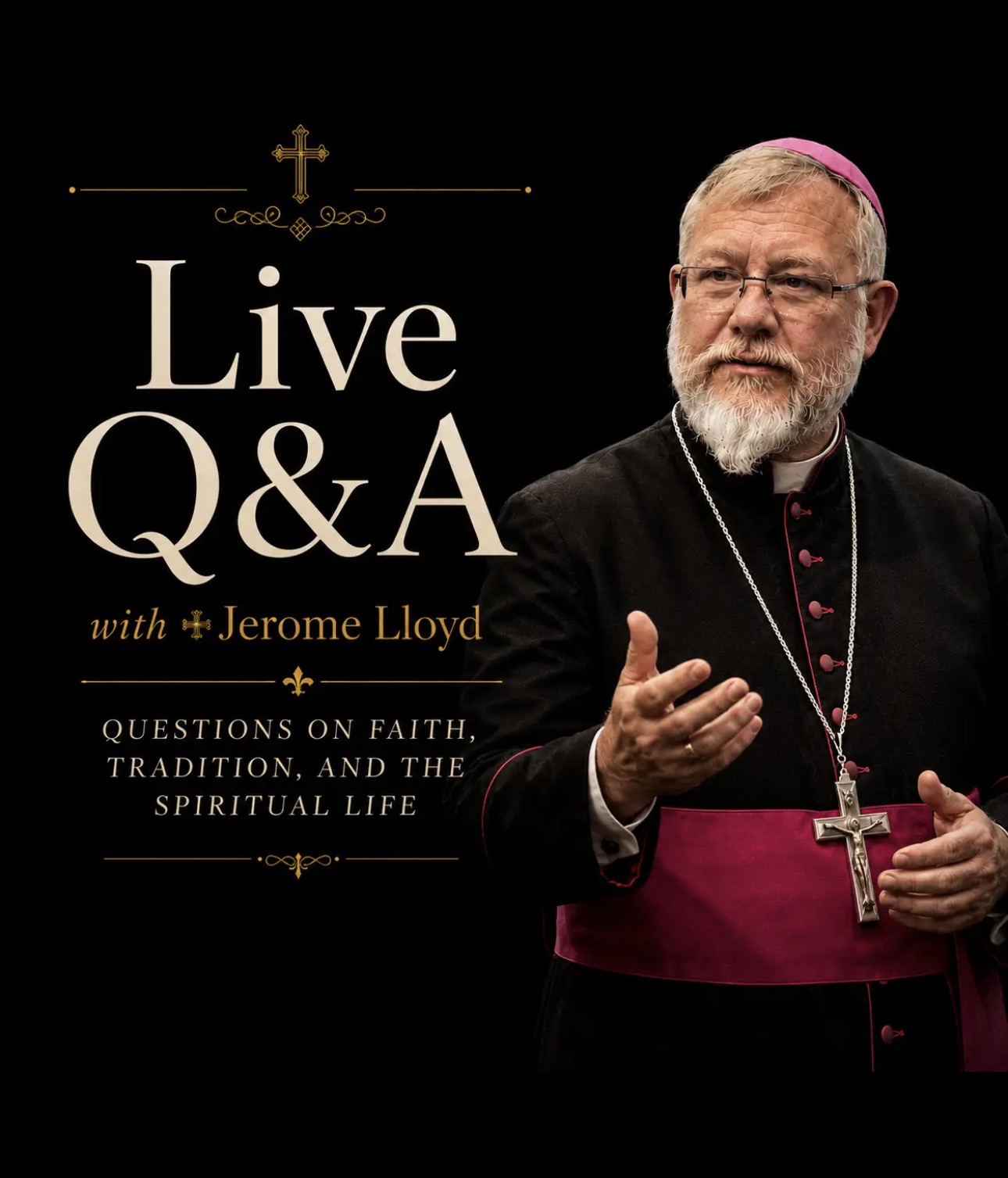
Daily reflections through Holy Week By ✠Jerome OSJV, Primus of the Old Roman Apostolate
Maundy Thursday – The Gift, the Commandment, the Betrayal
It is the first day of the Triduum. The solemn door opens. And we step into a sacred threshold—Maundy Thursday, Feria Quinta in Coena Domini, the day of the Supper, of the Mandatum, of the Priesthood, and of the Holy Eucharist.
This is the only day in the Roman year when the Church dares to speak of glory in the midst of Passiontide. In the Tridentine rite, the sacred ministers clothe themselves in white. The Gloria is sung for the last time. The bells ring out, and then fall silent. And why? Because something is being instituted—not ended. The Passion has not yet begun in blood. It begins in gift.
Tonight, the Church kneels with Christ in the upper room. She listens with awe to the words that create the New Covenant:
“This is My Body… This is My Blood… Do this in commemoration of Me.”
With these few words, Christ empties Himself anew—not merely by taking the form of a servant, but by becoming our Food, hidden under the appearance of bread and wine. The Passover of Israel becomes the Sacrifice of the Lamb. And in this moment, Christ gives the Church what no prophet could give: the Eucharist, the Priesthood, and the Commandment of Charity—all born in one liturgical act.
And yet, beneath the white vestments, a shadow already falls. For the one who will betray Him has already stretched his hand toward the dish. Judas is present. And the Lord knows.
He does not cast him out. He does not expose him. He simply continues to love him, to feed him, to kneel before him.
The Mandatum, the foot-washing preserved in the pre-1955 rite as a separate and optional devotion after the Mass, unveils the humiliation of divine love. Christ does not only command charity—He enacts it. He, who flung stars into space, now bends down and washes the feet of sinful men. He who is the Head becomes the servant.
But even this act is misunderstood. Peter, impetuous and proud, resists. He cannot bear the thought of being served by the one he ought to serve. He forgets that to receive Christ’s love requires humility—the humility to be washed.
And so must we. We must allow ourselves to be washed. To be fed. To be loved—on God’s terms, not ours.
The pre-1955 Missal preserves the sacredness of this night not by diluting it with dramatics, but by enshrining it in awe. The Canon of the Mass remains unchanged, because tonight’s sacrifice is already Calvary—but hidden in mystery, veiled in bread and wine. The Offertory and Communion chants sing of the Chalice of salvation and the Body of the Lord received with reverence and trembling.
And after the Last Gospel, there is no dismissal. The Mass does not end. It is interrupted. Because the Passion has begun.
The Blessed Sacrament is not reposed in the tabernacle. It is carried to the Altar of Repose—ornately veiled, adorned with flowers and candles—but this beauty is fragile. For this is not a feast. It is a vigil.
And the altar is stripped in silence.
Vestments are removed. Linens taken away. The tabernacle is left open and bare.
This is not merely a symbol. It is a liturgical expression of desolation. The Bridegroom is taken from us. The sanctuary is exposed. The household of God is left empty, for He has gone out into the night.
The Church invites us to follow Him in prayer—to remain with Him, if only for an hour, in the garden of His sorrow.
But already we know how the story will unfold. The betrayal is sealed. The sleep has begun. The swords are drawn. And the Passion will now move swiftly.
But tonight, we are still in the Upper Room.
Let us not rush past it. Let us not forget the greatness of the gift.
Tonight, the Lord gives us everything. His Body. His Blood. His Priesthood. His commandment. His kneeling. His silence. His patience. His love.
And He gives it knowing He will be betrayed. He does not give because we are worthy. He gives because He is good.
And so tonight, the Church—poor and trembling as she is—stands in the radiance of this mystery, and prays not to be worthy, but to be faithful.
She prays to remember what the apostles forgot: That love is not a feeling, but a death.
That glory is not triumph, but gift.
That the altar is not a table—it is a Cross.
And that the Bread we receive is not a symbol. It is Christ Himself.
May we never forget what He gave us.
May we never take lightly the words spoken this night.
And may we never again approach the sacred mysteries without awe, without reverence, without humility.
For this is the night in which Christ our God passed from this world to the Father, and gave Himself to those He loved—to the end.
Let us kneel with Him. Let us watch with Him. Let us love Him.
Daily reflections through Holy Week By ✠Jerome OSJV, Primus of the Old Roman Apostolate
Spy Wednesday – The Price of Betrayal, the Silence of the Redeemer
The Church, ever the wise and sorrowing mother, arrives this day at the threshold of unspeakable treachery. It is Wednesday in the Great and Holy Week, a day whose ancient name in the Christian West—Spy Wednesday—still echoes with the hiss of betrayal. It is today, the sacred liturgy reminds us, that Judas Iscariot became a traitor, not by compulsion, not by sudden impulse, but by a will that had already turned away from the Light and had made a pact with the shadows.
He, who once walked among the Twelve, who ate of the multiplied loaves, who saw the dead raised and demons cast out, who received the morsel from Christ’s own hand at table—he is the one who sells the Lord for silver. And yet, the mystery that chills the heart is not only the betrayal, but the setting of it: at table, in intimacy, beneath the same roof where Christ dwelt in love. The treason is not from a stranger, but from a friend. “My friend, wherefore art thou come?”—the gentle rebuke in Gethsemane cuts more deeply than any sword.
The Mass of this day, in the venerable rite of the Roman Church, offers no dramatized retelling, no explanatory commentary. It simply places before us the weight of Scripture, the tension of prophecy, and the voice of the suffering Christ rising in the psalms. The Epistle, taken from the prophet Isaias, does not describe a man broken by violence, but a divine figure clothed in garments red from the winepress—garments stained not by the blood of others, but by His own, for He has chosen to tread the winepress alone. The Fathers saw in this figure none other than Our Lord Jesus Christ, striding alone into the fury of His Passion, His victory hidden beneath bruises, His strength expressed in silence.
Then comes the Passion according to St. Luke: tender, terrible, majestic. It opens with Judas—the same Judas—communing with the priests of the temple, not in prayer, but in commerce. He sells the Light of the world for a sum worthy of a field of blood. From this moment forward, the Gospel unfolds with a quiet gravity that defies commentary. The sleeping disciples, the agony in the garden, the unjust arrest, the mocking and spitting, the denial of Peter—all is told without embellishment, as though the Evangelist, stunned by the reality of the mystery, simply sets it down as it happened.
And what does the Church place on our lips as the priest offers the unbloody Sacrifice? Not a psalm of vengeance, but a psalm of afflicted supplication. From Psalm 101—“Domine, exaudi orationem meam, et clamor meus ad te veniat.” “O Lord, hear my prayer, and let my cry come unto Thee.” This is the prayer of Christ and His Church, not in triumph, but in abandonment. The One who will soon hang upon the Cross does not raise His voice in protest, but in prayer. He does not curse His enemies; He cries to the Father.
And what of Judas? What shall we say of him? He is not a curiosity, a villain from the margins of the Gospel. He is a warning. He is the parable of the Christian who persists in sin, who walks with Christ externally but harbors rebellion within. He is the scandal of sacrilegious Communion. He is the one who receives the Body of the Lord while his mind calculates betrayal. He is every soul that clings to silver rather than surrender. And his final act is not his worst—his worst act is not his betrayal, but his despair.
For Judas might have been saved. He might have run to Calvary, as Peter ran to the tomb. He might have wept, as Peter wept. But he did not believe in mercy. That was his final fall.
Today, we are placed in the company of both men. Peter denies; Judas betrays. But only one returns. Only one is healed. The liturgy does not ask us to scorn Judas. It asks us to examine our own hearts: to ask where we have compromised, where we have clung to resentment, where we have sold Christ in little ways.
And it asks us to return. Now. Before the kiss is given. Before the mob comes. Before the rooster crows.
For we are still in the sanctuary of time. We still walk in the acceptable hour, the day of grace. “Inclina aurem tuam ad me, Domine”—“Incline Thy ear to me, O Lord”—the psalmist cries. And so must we.
Spy Wednesday is not yet Good Friday. It is the final warning, the last call of mercy before the Passion overtakes us. Let us meet it not with silver in our hands, but with tears in our eyes. Let us watch with Christ, before we are found sleeping. Let us pray with Him, before we deny Him. Let us love Him now—while we still can.
Daily reflections through Holy Week By ✠Jerome OSJV, Primus of the Old Roman Apostolate
Holy Tuesday – The Shadow of Betrayal and the Silence of Christ
The Church, in her venerable and ancient liturgy, does not hasten toward Calvary. She tarries. She lingers. Each day of Holy Week, in the classical Roman Rite, is not merely a chronological step closer to the Cross; it is a mystical unveiling of the soul’s interior drama as it draws near to the abyss of divine love and human frailty. And Holy Tuesday, so often overshadowed by the greater liturgical moments that follow it, possesses a weight and gravity that cannot be ignored.
This day is a mirror. It is not yet the moment of betrayal or crucifixion, but it is the moment in which the soul begins to realize how easily it could fail the test. Today, the Church hands us the Passion according to Saint Mark, not to recite like a school lesson, but to consume as a sacrament of truth. It is the shortest and most stripped-down of the Passion narratives—precise, unembellished, like a blade honed on the edge of divine justice. And because of this, it pierces.
The liturgy gives us no grand entrances, no miracles, no discourses. Instead, it presents us with Judas preparing his betrayal, Peter swearing loyalty he will not keep, the disciples failing to watch, and Christ suffering in silence. The Word made flesh speaks almost nothing in His own defense. He does not argue. He does not explain. He stands before His accusers with the silence of truth.
The Church, in her wisdom, has preserved this Gospel in the very heart of Passiontide, that it might confront us with ourselves. Not with who we imagine ourselves to be, but with who we truly are. We are all in the narrative—somewhere. We are at the Last Supper. We are in the garden. We are standing by the fire with Peter. We are asleep when we should be praying. We are asking, with trembling hope or lurking guilt: “Is it I, Lord?”
That haunting question from the mouth of the Apostles is the spiritual signature of this day. And the answer, if we are honest, is yes. Yes, it is I. I have denied You by my silence. I have betrayed You by my sins. I have fled when I should have stood firm.
But the liturgy does not condemn. It reveals. The Passion of Christ is not placed before us to crush us beneath the weight of our failures, but to lead us, as it led Peter, into that salutary sorrow which produces repentance. The same Peter who swore he would never deny the Lord—he who drew his sword, who followed at a distance—this same Peter falls. And it is not the judgment of Christ that breaks him, but the gaze of Christ: silent, sorrowful, piercing, merciful.
It is in that gaze that the Church invites us to dwell today. The Communion antiphon, taken from Psalm 68, expresses not triumph, but humiliation:
Adversum me exercebantur qui sedebant in porta: et in me psallebant qui bibebant vinum: ego vero orationem meam ad te, Domine: tempus beneplaciti, Deus, in multitudine misericordiae tuae.
“They who sat at the gate spoke against Me; and they who drank wine sang against Me. But I—My prayer was to Thee, O Lord: it is the time of Thy good pleasure, O God, in the multitude of Thy mercy.”
Even here, in the midst of mockery and betrayal, the Messiah prays. He does not curse His enemies. He does not curse His weak friends. He turns instead to the Father. In the day of derision, He chooses intercession.
This is how the Church teaches us to suffer.
Not with outrage. Not with cynicism. Not with bitterness. But with prayer. This is the secret strength of Holy Tuesday: its quiet insistence that the true disciple does not scream when he is misunderstood, nor retaliate when he is wounded. He simply turns his face toward Gethsemane and follows the Lord who goes there alone.
But the day is not only about weakness. It is also about hope. The fall of Peter is not final, because his tears are real. He leaves the courtyard weeping—not to hide in despair, but to begin again. The liturgy does not ask us to be perfect. It asks us to be penitent. Judas despaired, Peter repented. Both sinned, but only one allowed himself to be redeemed.
We stand today between them.
The Passion according to Saint Mark ends with Christ delivered into the hands of men. He does not resist. He does not explain Himself. He is, as Isaiah foretold, the Lamb led to the slaughter, silent before His shearers.
And yet, it is this silence that saves. The Word who was made flesh now saves the world without speaking. His silence is not absence—it is power restrained by love.
We are invited to enter that silence. To make it our own. Not merely by observing the events of Holy Week, but by participating in them—through recollection, through contrition, through sacramental confession and holy reception of the altar’s divine victim.
Holy Tuesday is the hinge of Holy Week. It is the moment when the soul must stop pretending that it can follow Christ from a safe distance. It must draw near or fall away. It must weep or turn away in pride. It must confess, “I am Peter,” and let the tears come.
Let them come.
The Church will be waiting for us at the tomb, when the stone is rolled away.
But today, she stands with us at the fire, where the rooster is about to crow.
And she asks, for the last time before the Passion begins in earnest:
Will you follow?
Or will you sleep?
Practical Devotions for the Day
Read and meditate on Mark 14 slowly, asking: “Where am I in this story?”
Make an unhurried examination of conscience. Identify not just sins, but patterns of betrayal: spiritual apathy, moral compromise, avoidance of truth.
Pray the Litany of the Passion or Psalm 50 (Miserere), offering acts of reparation.
If possible, go to Confession—to rise like Peter, not fall like Judas.
Daily reflections through Holy Week By ✠Jerome OSJV, Primus of the Old Roman Apostolate
Holy Monday: The Fragrance of Love, the Shadow of Death
Feria Secunda in Hebdomada Sancta – Tridentine Liturgy (Pre-1955)
If Palm Sunday casts the triumphant but somber shadow of the Cross over the week to come, Holy Monday draws us more intimately into the household of Bethany—into the closeness of friendship, the costly nature of love, and the first outward steps of Christ toward His appointed death.
The traditional Roman liturgy for Holy Monday, unchanged until the mid-twentieth century, is stark, tender, and heavy with impending grief. The chants, readings, and prayers form a mosaic of divine foreknowledge and human response—welcoming Christ with love or plotting against Him in hatred. Each gesture, each word from today’s Mass calls the soul to stand either with Mary of Bethany in adoration, or with Judas in murmuring criticism.
The Liturgical Structure: A Gathering Storm
Holy Monday retains all the Lenten austerity that intensifies in Passiontide. The Mass is offered in violet vestments, without Gloria or Alleluia. The chants are drawn from the Psalms, anticipating suffering yet grounded in hope. The silence grows deeper. The Crucifix remains veiled. The Church is beginning to walk with Christ—not in theory, but in real time.
The Gospel from John 12:1–9 is the central moment of this day. Six days before the Passover, Jesus comes to Bethany—to the house of Lazarus, Martha, and Mary. This visit, in its quiet domestic setting, marks a profound turning point in the Passion narrative. Christ, already marked for death by the high priests, chooses to spend His final days not in hiding, but with friends, entering fully into the human tenderness that will make His Passion all the more painful.
“Mary, therefore, took a pound of ointment of right spikenard… and anointed the feet of Jesus, and wiped His feet with her hair.”
Mary’s Gesture: Extravagance or Prophecy?
The Church Fathers, particularly St. Gregory the Great and Origen, saw in this moment a deeply mystical significance. Mary’s action is not merely emotional—it is liturgical, prophetic, and deeply sacrificial. She pours out precious oil, not on Christ’s head as a king, but on His feet as one already anointed for death.
The value of the ointment—“three hundred denarii,” nearly a year’s wages—scandalizes Judas. To him, such love is wasteful. To Christ, it is beautiful.
“Let her alone: that she may keep it against the day of My burial.”
In this statement, Christ accepts her offering not as sentiment, but as preparation. Mary sees what the others do not: that the road to Jerusalem is the road to the tomb. Her love is not reactive—it is preemptive. Her devotion is not convenient—it is costly.
In contrast, Judas’ words reveal the practical mind detached from love. His feigned concern for the poor masks a heart already lost. In Mary, we see the disciple. In Judas, the betrayer in embryo.
The Epistle: Isaiah’s Suffering Servant
The Epistle from Isaiah 50:5–10 is one of the clearest and most stirring portraits of Christ’s meek acceptance of suffering:
“I have given my body to the strikers, and my cheeks to them that plucked them: I have not turned away my face from them that rebuked me and spit upon me.”
This is not passive resignation. It is active surrender. The Servant does not seek suffering, but neither does He resist it. He knows that to redeem, He must endure—and to endure, He must be rooted in obedience: “The Lord God hath opened my ear, and I do not resist.”
For the faithful, this reading sets the tone: the way of Christ is not one of dramatic resistance or triumphalism, but of loving surrender to the will of the Father. It is a call to spiritual courage—not loud, but steady. Not impulsive, but grounded in contemplation.
Spiritual Intention: To Love Before the Cross
Holy Monday is a day to examine the quality of our love for Christ. Not its warmth or intensity, but its sacrificial character.
Are we like Mary, pouring out what is costly because we know who He is?
Or are we like Judas, calculating the value of everything and seeing devotion as extravagance?
The traditional liturgy does not explain these questions—it asks them, silently and insistently.
Will we anoint Christ with our love now, or only lament when He has passed by?
Holy Monday calls us to love Him while we still have Him. This day in Bethany reminds us that time is short, and that adoration offered now, while Christ is hidden in the tabernacle or disguised in the suffering, is the greatest act of preparation for His Passion.
Lessons and Applications
1. Love must be willing to waste itself Mary’s action is a scandal to utilitarians. But divine love is not measured by cost. It is measured by self-gift. The saints have always understood this. Lavish liturgy, generous charity, hidden prayer, all appear wasteful to the world. But they are the fragrance of true love, filling the house.
2. Judas begins not with betrayal, but with criticism Notice how Judas does not yet leave. He criticizes. He murmurs. He disguises pride as virtue. This is where betrayal often begins—in a hardened heart disguised as realism. The soul tempted to justify withdrawal from God often starts by criticizing the piety of others.
3. Bethany is the school of contemplation Mary does not speak. She acts. And her action becomes a sacrament of preparation. Each time we choose silent, loving adoration, we prepare the way for Christ to enter more deeply into our lives—even if that entry comes by way of the Cross.
Practical Devotions for Holy Monday
Spend time in silence before the Blessed Sacrament, pouring out your heart like Mary’s ointment—without words if need be.
Read John 12:1–9 slowly. Imagine being in the room. What do you smell? See? Feel? What would you do?
Examine your motives. Are you generous with Christ? Or do you grumble internally at the cost of discipleship?
Offer a small act of costly love—a sacrifice of time, attention, or comfort—for no other reason than that He is worthy.
Pray Psalm 35 or Psalm 50 (Miserere), in reparation for past coldness or criticism toward devotion, either your own or others’.
Conclusion: The Fragrance That Fills the Church
The liturgy of Holy Monday is like the spikenard itself: rich, pungent, and clinging. It lingers in the soul. It calls us to a love that is not economical, but extravagant. It reminds us that our Savior is not far away—He is reclining at table with us, waiting to be loved, waiting to be known before He is taken from us.
“Amen, I say to you, wheresoever this Gospel shall be preached in the whole world, that also which she hath done, shall be told for a memorial of her.” (Matt. 26:13)
Let us do likewise. Let us anoint Christ, today, with the perfume of our love—before the tomb is sealed and the world sleeps.
In Conspectu Dei: Reflections on the Holy Week Liturgy “In the sight of God”— emphasizing worship as divine encounter. By ✠Jerome OSJV, Primus of the Old Roman Apostolate
INTRODUCTION
The sacred liturgy is the heart of the Church’s life and the source of all true sanctity. Nowhere is this more evident than in the solemn rites of Holy Week, when the Church accompanies her Divine Spouse through the mysteries of His Passion, Death, and Resurrection. These days are not merely commemorative; they are sacramental, mystical, and transformative.
The following reflections are offered to assist the faithful in entering more deeply into the traditional liturgy—not only in form, but in spirit. They are not academic commentaries, nor practical guides alone, but meditations intended to stir the soul to a fuller participation: not merely by following with the eyes, but by uniting the heart and will to Christ’s saving work.
May these words serve as a small help in approaching the sacred mysteries with greater reverence, understanding, and devotion—so that each soul may be more perfectly conformed to the Crucified and Risen Lord, through the timeless worship of His holy Church.
Liturgical Participation: Communion, Not Imitation
In the sacred liturgy, the faithful are not mere spectators. They are not gathered as a public audience for religious instruction or ceremony. Rather, they are members of the Mystical Body of Christ, mystically united to the action of their Head, the Eternal High Priest, who in every liturgical act offers anew His sacrifice to the Father through sacramental signs.
True participation in the liturgy is not measured by activity or outward visibility. The Church has never taught that sacred worship depends upon the multiplication of gestures or spoken responses by the laity. Rather, participation is principally interior—a movement of faith and love by which the soul unites itself to the Sacrifice of the Altar. As Pope Pius X taught, the faithful participate in the liturgy most fruitfully when they “pray the Mass,” joining their hearts to the sacred action wrought by the priest in persona Christi.
This is not imitation of Christ in a moral sense, but mystical communion with His self-oblation. It is a spiritual act of union with His suffering, His obedience, and His love. The more the faithful assist with reverence and interior devotion, the more they are conformed to Him who offered Himself “a victim, a sacrifice to God for an odour of sweetness”¹.
To assist at the sacred rites during Holy Week is, therefore, to renew our consent to die with Christ—dying to the world, to the flesh, and to our own will—that we may also rise with Him in glory. The external rites are sublime and solemn, but their value is fully realized only when they are interiorly embraced by souls thirsting for union with the Crucified.
Footnotes ¹ Ephesians 5:2; cf. Pope Pius XII, Mediator Dei §§20–21; Roman Catechism, Part II, on the Sacrifice of the Mass.
Sharing in the Paschal Mystery
The Holy Sacrifice of the Mass, and all the rites surrounding it, are not commemorations in the modern, historical sense. They are the perpetuation of the redemptive act of Christ under sacramental veils. The liturgy of the Church does not look back wistfully to Calvary—it makes present the one Sacrifice of the Cross, re-presented in an unbloody manner upon the altar.
This is the sacred mystery at the heart of Holy Week: that what was accomplished once in time is now dispensed through the Church’s liturgy, by the power of Christ and the operation of the Holy Ghost. The ceremonies of this most solemn week are not sentimental reenactments, but sacred channels of divine grace, given to unite the faithful to the sufferings and triumph of the Redeemer.
The liturgy, being sacramental, effects what it signifies. As St. Thomas Aquinas teaches, the sacraments operate ex opere operato, by the very fact of their performance, because it is Christ who acts in them. Yet this grace bears fruit in proportion to the disposition of the soul. The exterior rite is valid and efficacious; but its spiritual harvest is abundant only where there is humility, contrition, and a burning desire to be united to Christ Crucified².
Thus, the liturgical action is not a stage upon which we express ourselves, but the divine means by which Christ expresses His love—and draws us to Himself. We love because He first loved us. We offer because He first offered Himself. This is not a dialogue of equals, but a condescension of mercy to which we respond in adoration and sacrifice.
Footnotes ² cf. St. Thomas Aquinas, Summa Theologiae III, q.83, a.1; Council of Trent, Session XXII, ch.2; Pope Pius XII, Mediator Dei §59.
The Interior Fruitfulness of the Sacred Liturgy
The sacred liturgy is not a vehicle for personal creativity or community self-expression. It is a work of God, a divine action, instituted by Christ and entrusted to His Church. It sanctifies not by emotion or novelty, but by the objective power of grace conferred through the rites as the Church has received them.
The Church has always taught that true and fruitful participation in the liturgy is interior—silent, recollected, devout. While exterior acts have their place, they are ordered to a deeper reality: the union of the soul with Christ’s offering. As Pope Pius XII insisted, “the chief element of divine worship must be interior worship”³.
This is why silence, reverence, and sacred continuity are not aesthetic preferences, but theological necessities. The liturgy is the summit of the Church’s prayer because it is where Christ offers Himself anew through the ministry of His priests. The faithful participate most deeply when they unite their own sacrifices—offered upon the altar of the heart—with that perfect Victim who is daily immolated for the salvation of souls.
The rites of Holy Week thus call each Christian to interior renewal. As the Church passes through the mysteries of the Passion, she calls her children to be conformed to Christ in His humility and His Cross. The sacred signs form us in the likeness of the Son—not through innovation or performance, but through contemplation, self-denial, and loving participation in His redemptive work.
Footnotes ³ Pope Pius XII, Mediator Dei §24; cf. Council of Trent, Session XXII, ch.1; St. John Eudes, The Priest: His Dignity and Obligations.
Christ the Liturgical Centre: The Priest Who Offers, the Lamb Who Is Offered
In every act of sacred worship, it is Christ who is at work. He is the true celebrant of every Mass, the High Priest of the new and eternal covenant. The visible priest acts only in His Person; the sacred ministers are instruments through which the Eternal Priest continues His offering to the Father⁴.
Christ is also the Victim. What He offered once on Calvary is made present again on the altar—mystically, yet really. The liturgy is thus the union of Priest and Victim, the perpetual presentation of the same Sacrifice in an unbloody manner. This is why the Church teaches that the Mass is one and the same sacrifice as that of the Cross⁵.
The faithful, therefore, do not gather around the altar merely to be instructed or encouraged. They approach it in reverence to witness and participate—according to their state—in the act by which the world is redeemed. In this sacred action, Christ glorifies the Father and sanctifies His Church. The altar is Calvary; the sanctuary is a foretaste of heaven.
All things in the liturgy exist to direct our attention to this mystery. The silence, the orientation, the Latin tongue, the sacred vestments—all elevate the mind and heart to Christ. When rightly understood, they allow the faithful to be drawn into that divine action which surpasses all human activity: the self-offering of the Son to the Father, in which we are invited to share.
Footnotes ⁴ cf. Council of Trent, Session XXII, ch.2; Pope Pius XI, Ad Catholici Sacerdotii, §12. ⁵ Roman Catechism, Part II, ch.4; Mediator Dei §68.
The Liturgy as a Foretaste of Glory
The sacred liturgy not only looks back to the Passion; it looks forward to eternity. It is the veil through which we glimpse the heavenly court. The altar is not only the place of sacrifice—it is the threshold of heaven. Every sacred liturgy is a participation in the celestial liturgy, where the angels cry Sanctus, Sanctus, Sanctus before the throne of God⁶.
This is the eschatological character of the liturgy so clearly understood by the Fathers and Doctors of the Church. In it, time meets eternity; earth touches heaven. The sacred rites are patterned upon the eternal worship of the Lamb, and through them, the Church on earth is united with the Church Triumphant. This is why the saints longed for the altar, and why the faithful of old approached it in awe and trembling.
Holy Week reveals this with especial clarity. The sufferings of Christ lead not to annihilation, but to glory. The tomb gives way to the throne. In the sacred liturgy, the faithful do not only mourn their sins; they anticipate their glorification. They learn to desire heaven because they have tasted something of its majesty.
To worship according to the mind of the Church is therefore to be prepared for eternity. The beauty and solemnity of the ancient rites are not ornaments, but reflections of divine order. They form the soul for the heavenly liturgy by immersing it in reverence, humility, and sacrificial love.
Footnotes ⁶ cf. Revelation 4:8; Mediator Dei §§3–4; Dom Prosper Guéranger, The Liturgical Year, Vol. 6 (Passiontide).
The Church Is Made in Worship
The Church, in her visible structure, in her teaching and discipline, in her sacraments and hierarchy, exists for one end: the glory of God and the sanctification of souls. And nowhere is this end more perfectly realized than in the sacred liturgy. It is here that the Church is most truly herself: the Bride united to her Bridegroom, the Body animated by its Head⁷.
In the act of worship, the Church is not only expressing devotion—she is being formed. The faithful are configured to Christ; the priest is conformed to the Eternal High Priest; the Church herself is renewed in her sacred identity. From the altar flows the grace that builds up her unity, strengthens her mission, and sanctifies her members.
This is why tradition insists that the liturgy is received, not invented. It is a divine gift, not a human project. The rites handed down across centuries are not museum pieces but living expressions of the Church’s soul. To preserve them faithfully is not an act of nostalgia—it is an act of fidelity to Christ and the order He has established.
The Church is most herself when she is silent before the mystery, obedient to tradition, and recollected in the presence of God. This is her truest apostolate. From worship rightly offered, all true renewal flows.
Footnotes ⁷ cf. Mystici Corporis Christi, §§60–65; Mediator Dei §24; Roman Catechism, Part II, ch.5.
Conclusion: To Worship in Spirit and in Truth
The sacred liturgy of Holy Week leads the Church into the heart of the Christian mystery: the suffering, death, and resurrection of Our Lord Jesus Christ. These rites, solemn and immemorial, do not merely instruct the mind or stir the emotions—they sanctify the soul and glorify God. They are the appointed means by which Christ’s redemptive work is made present to His Church, and through which the faithful are invited to unite themselves to the saving Victim offered upon the altar.
To participate rightly in this liturgy is to enter into a divine mystery with reverence, humility, and love. It is to acknowledge that we are not the authors of our worship, but its recipients and servants. The priest ascends the altar as Christ, and we ascend with him in spirit, offering ourselves in union with the great oblation. We bring our crosses, our sins, our hopes, and our needs—not as isolated individuals, but as members of the Mystical Body.
This participation is not measured by noise or motion, but by interior surrender. As the Church has always taught, the most fruitful worship is that which conforms the soul to Christ, drawing it into His obedience, His humility, and His self-offering. Whether with missal in hand, Rosary in heart, or gaze fixed silently upon the altar, what matters most is that the soul be truly present—adoring, uniting, and offering itself in faith.
Holy Week is not merely the highest week of the liturgical year; it is the school of the Cross, the furnace of charity, the path to glory. If we enter it with docility, it will not leave us unchanged. For to worship in spirit and in truth is to be made like unto the One we worship: the Lamb who was slain and who now reigns.
Let us then approach these sacred days as pilgrims at the threshold of eternity, prepared to die with Christ, that we may also rise with Him to newness of life.
The Key to the Christian Life: Mastery of the Self, Why Holiness Is Not Impossible—and Why the World Depends on It By ✠Jerome OSJV, Primus of the Old Roman Apostolate
INTRODUCTION
Carissimi, beloved in Christ Laudetur Jesus Christus! We stand today at the threshold of Passiontide, gazing not merely at a season, but at a mystery—the mystery of God’s love, clothed in weakness, crowned in thorns, nailed in silence.
The Church, in her wisdom, veils the crucifix today. And perhaps that troubles us. We ask: why hide the very image that saves? But let me suggest that the veil is not hiding the Cross from us—it is hiding us from the truth of it.
You see, we do not understand the Cross—not really. We sentimentalize it. We wear it around our necks like jewelry, while refusing to carry it in our hearts. The veil reminds us: the Cross is not yet fully known to us. And so, we are asked to behold it—not with our eyes, but with our faith.
The Key to the Christian Life: Mastery of the Self
At its heart, the Christian life is not a mysterious code or an unattainable spiritual acrobatics. It is, quite simply, self-control. That is the whole trick. Holiness is not a magic gift doled out to a few lucky souls—it is the fruit of learning to govern oneself.
To be a Christian is to take control of one’s emotions, one’s instincts, one’s gifts and limitations—what the ancients called the passions. It is to become master of your predilections, your inclinations, your talents, your appetites, and even your sensitivities. All of these are the raw material of potential… of who we might become.
What distinguishes us from the animals is not strength or instinct, but reason: the ability to reflect, to deliberate, to act not only within but beyond the constraints of impulse and empirical experience.
This rational capacity is not just utilitarian—it is teleological. It exists to orient us toward what is higher, what is good, what is true. And supremely, it exists to lead us to God.
Self-Discipline Is Not Denial—It Is Direction
The Gospel and the saints urge self-discipline not because God delights in denial for its own sake, but because discipline is the door to our destiny. Every “no” to the flesh is a “yes” to the spirit. Every refusal of sin is an opening to grace. Holiness is not about repression—it is about right orientation. It is the harnessing of all we are—body, mind, and soul—toward the one end for which we were made: communion with God.
Seen this way, the Ten Commandments are not restrictions—they are liberations. They prohibit only what wounds ourselves or others. There is no good thing they forbid. They are not a cage, but a guardrail, protecting the freedom of the children of God.
The World, the Flesh, and the Lie of Powerlessness
The world tells us that self-restraint is unnatural, that virtue is an ideal but not a possibility, that indulgence is freedom and chastity is repression. But this is the ancient lie. The body can lie. Our selfish will can lie. Temptation dresses itself up as authenticity. But if we give in to the lower self, we are not free—we are slaves.
The saints are those who got over themselves. Who silenced the tantrums of the ego. Who chose righteousness when it was hard, purity when it was mocked, truth when it cost everything. And they did it not by superhuman strength, but by grace—and by choice.
Holiness Is Always a Choice
There is nothing about the pursuit of holiness that is impossible. It is difficult, yes. But not impossible. “Be ye perfect,” Christ says—not to taunt us, but to invite us. The way of virtue is always open. At every moment, you can choose the good. That is your power. That is your freedom. That is your dignity.
To be godly does not require brilliance, nor status, nor some mystical experience. It requires this: the decision to do what is right. Every time.
And when you fall, it requires the humility to rise again and make the decision anew.
The Ten Commandments Are Not Restrictions—They Are Liberations
The modern world often hears the Ten Commandments as a list of prohibitions, a moral straitjacket designed to limit freedom and suppress desire. But this is a profound misunderstanding. The Commandments are not burdens imposed from without—they are liberations spoken from the heart of a loving God who knows what makes for true human flourishing.
Each commandment guards something sacred. Each one protects a vital dimension of life and love. They do not restrict the good; they define it. They do not inhibit human potential; they release it from the chaos of sin and the tyranny of selfishness.
“Thou shalt have no other gods before Me” liberates us from idolatry, from the soul-crushing slavery of false masters—whether money, power, vanity, or pleasure—and grounds us in the worship of the one true God who alone gives life.
“Thou shalt not take the name of the Lord thy God in vain” protects the holiness of speech and the integrity of our relationship with the divine. It frees our tongues from flippancy, deception, and misuse of what is sacred.
“Remember the Sabbath day” is not a burden but a gift: an invitation to rest, to worship, to be reminded that we are more than what we produce. It liberates us from the idol of work and from forgetfulness of eternity.
“Honour thy father and thy mother” affirms the sanctity of family and the gift of generational continuity. It is not a rule for submission, but a path to harmony, stability, and gratitude.
“Thou shalt not kill” is self-evidently protective—but it also affirms the infinite worth of every human life. It declares that no life is expendable, and that justice is not ours to take by violence.
“Thou shalt not commit adultery” safeguards the integrity of love and the beauty of marital fidelity. It frees us from the destructive lie that pleasure is more valuable than covenant, and that desire is more important than devotion.
“Thou shalt not steal” honors the dignity of work, the right to private property, and the responsibility of stewardship. It restrains the grasping impulse and calls us to mutual respect and justice.
“Thou shalt not bear false witness” upholds truth as the foundation of all human trust and society. It liberates our speech from manipulation and preserves the honor of others.
“Thou shalt not covet” cuts to the root of so many sins: discontent, envy, greed. It is the commandment of interior freedom. To obey it is to be free not only from wrongdoing, but from the restless hunger that spoils joy and peace.
In short, the Ten Commandments forbid nothing that is for our good. They prohibit only what harms: what harms the self, what harms others, what harms communion with God. There is not one commandment that, rightly understood, restricts anything holy, noble, generous, or life-giving. These laws are not chains but signposts. They do not say “You may not live,” but “Here is the way to life.” They are the spiritual grammar of love—both love of God and love of neighbour.
To follow them is not to be shackled, but to be free indeed.
If Everyone Lived the Ten Commandments…
If every soul on earth truly lived the Ten Commandments, the world would indeed be perfect. There would be no violence, no betrayal, no theft, no lies, no exploitation, no envy. God would be worshipped, the family honoured, the truth upheld, and every human life cherished. That is not fantasy—it is the ideal God Himself revealed as the path to human flourishing. It is the outline of sanctity, the moral architecture of a just and peaceful world.
But we live in a fallen world, where sin wounds even our best intentions. Perfection here may elude us. Yet imagine—not a world where everyone is perfect—but a world where everyone is striving to live the Commandments. Where people do not dismiss virtue as impossible or old-fashioned, but take it seriously. Where families encourage one another in holiness. Where neighbours cheer one another on in truthfulness, fidelity, chastity, generosity, reverence, and worship.
Imagine a culture where the prevailing spirit is not competition in sin, but cooperation in righteousness—where we are not scandalized by others’ goodness, but moved by it; not threatened by virtue, but inspired to imitate it.
That would be no utopia—but it would be a world transformed. A nearly perfect reality, attainable not by force or fantasy, but by the mutual pursuit of what is truly good.
And that—that—is God’s will. Not only that we individually obey His law, but that we desire and help others to obey it too. “Exhort one another daily,” says the Apostle, “that none of you may be hardened by the deceitfulness of sin” (Hebrews 3:13). The Commandments are not a private code—they are the common foundation of a redeemed humanity.
So let us not despair over the world’s fallenness. Let us build up a culture of striving. Let us will the good for one another, and help each other toward it. That is how the kingdom of God grows—soul by soul, family by family, community by community.
Until one day, that ideal will no longer be a dream—but a reality, fully revealed in the light of His glory.
This Is the Answer to Society’s Problems Today
The Ten Commandments are not relics of a bygone age—they are the enduring answer to the crises of our time. They formed the moral bedrock of Western civilisation, the foundation of what we call the Judeo-Christian world. From them came the dignity of the person, the sanctity of life, the honour of the family, the principle of justice, and the call to responsibility before God.
If that civilisation has faltered, it is not because the Commandments failed—it is because we stopped striving to live them. We abandoned the path, and then wondered why we are lost. We dismantled the moral compass, and then blamed the darkness. But the solution is not more theories, more programs, or more politics—it is a return.
If we came back—not perfectly, but sincerely—to the Commandments as the common rule of life, society could be transformed again. If we once more taught our children to honour their parents, to speak the truth, to revere the sacred, to respect the property and dignity of others, to guard their hearts against envy and lust—if we turned our hearts to the living God and taught others to do the same—then the rot could be reversed, the decay healed, and the beauty of Christian civilisation rekindled.
This is not nostalgia. It is vision. Not naïve idealism, but a sober and hopeful realism. We have the blueprint. It is ancient, yet always new.
The only question is whether we have the courage to return to it.
And that return begins—not with governments, not with institutions—but with individuals. With you. With me. With the choice to live, and to encourage others to live, according to the law of God written not only on stone, but on the heart of every human soul.
We Tried to Make Virtue Out of Sin
In our modern age, we have not merely abandoned the moral law—we have inverted it. We tried to make virtue out of sin, to baptize selfishness and crown it as righteousness. We were told that the pursuit of personal pleasure, self-expression, and unrestrained autonomy was the highest good. That to deny oneself was repression, and to indulge every appetite was liberation.
We rebranded pride as self-esteem, lust as love, greed as ambition, envy as fairness, and wrath as justice. We told ourselves that the old moral codes were outdated, that commandments were chains, and that freedom meant doing what we want, when we want, to whom we want.
But freedom divorced from truth is not freedom—it is slavery to the self. When we made selfishness righteous, we hollowed out virtue. We ceased to pursue what was good and began to worship what was pleasurable. And in doing so, we have reaped what we sowed: broken homes, shattered communities, isolated individuals, a culture sick with anxiety, confusion, and despair.
The irony is stark: we rejected the Commandments as too hard—and now live in a world made harder by sin.
Yet even now, the path back is not closed. It is still there, waiting: the path of repentance, of truth, of virtue. A return to calling good good and evil evil. A return to the God who alone defines righteousness—not by feelings, but by love grounded in truth.
And if we would recover society, we must begin by recovering that truth—starting in the soul.
We Don’t Need to Overthrow the World—We Need to Change Ourselves
There is a great temptation in times of cultural collapse to look outward—to seek grand solutions, political revolutions, systemic overhauls. And while politics has its place, it is not the starting point. We do not need to bring down governments or refashion entire systems. Those things will follow if hearts are changed. What we need first, and most urgently, is to change ourselves.
The crisis we face is not merely institutional—it is moral, spiritual, personal. We are not suffering from a lack of policy but a lack of virtue. And virtue cannot be legislated into being. It must be cultivated, soul by soul, family by family, community by community.
What would transform the world is not ideological conquest, but personal conversion. Men and women who choose to live the truth, to uphold what is good, to restrain their passions, to discipline their appetites, to seek God’s will above their own.
And as we seek this transformation, we must not punish weakness but encourage striving. We must recover the distinction between failing and refusing to try. The former deserves patience and support; the latter, honest correction. But even correction must be oriented not to shame, but to rehabilitation. Holiness is not about perfection from the start—it is about the will to keep rising when we fall.
We must learn again to be a people of both truth and mercy. Not soft in our standards, but strong in our compassion. A society that upholds the good and helps the fallen return to it is a society on the road to renewal.
The world is changed not by programs or protests, but by people—people who choose to become what God made them to be. That is the beginning of everything. That is how cultures are rebuilt: not from the top down, but from the inside out.
No One Denies the Goodness of Jesus
Across cultures and centuries, even among those who reject Christianity, one thing is rarely denied: the goodness of Jesus. His compassion, His wisdom, His courage in the face of power, His mercy toward the sinner, His unwavering commitment to truth and love—these shine even through the haze of skepticism. The world may dispute His divinity, but it does not easily dismiss His virtue. And this is no accident. God did not reveal Himself as a theory, a moral code, or an abstract ideal. He became man. He took on flesh, entered history, and walked among us—so that we might have a person to follow. A face to look upon. A voice to hear. A life to imitate.
Jesus is not a symbol of goodness—He is goodness incarnate. He shows us, not only what God is like, but what man is meant to be. He is the pattern of holiness made visible, the commandments lived out perfectly in love.
God knew we needed more than rules—we needed a relationship. More than principles—we needed a Person. Not just a ladder to climb, but a hand to grasp.
And so He came.
To follow Jesus is not to chase after an unreachable ideal. It is to walk behind the One who has gone before us, who knows the path because He is the path. His goodness is not a challenge thrown down in judgment, but an invitation extended in mercy: Come, follow Me.
Conclusion
In Christ we have the “fulfillment of the Law” (cf. Matthew 5:17)—not its abolition, but it’s perfection.
We have in Him not just the One who spoke the commandments, but the One who lived them.
He is the Law in motion. The Word made flesh. The Commandments walked out in sandals, written not on tablets of stone, but on the beating heart of a sinless Man.
In Him, we see what it means to love God with all the heart, all the mind, all the soul, all the strength.
In Him, we see what it means to honour one’s mother, to bless one’s persecutors, to speak no falsehood, to covet nothing.
In Him, the will of the Father becomes a life poured out for others.
And so He does not simply tell us to follow the Law—He leads us in it. He goes before us. He makes the impossible possible, because He gives us more than example—He gives us grace.
And now, dear brethren, as we go forth into Passiontide and draw near to the Cross, let us not follow at a distance. Let us follow closely. Intimately. Let us take up His commandments—not as burdens, but as the path of love.
Because in the end, it is not rules that save us—it is a Person.
And that Person is Jesus Christ—crucified, risen, and reigning—who is Himself the Way, the Truth, and the Life (John 14:6).
Follow Him—and you will walk not only through the shadow of death, but into the dawn of resurrection.
Use this veiled Passiontide to learn to follow Him and His embodied living of the Commandments, seeing Him with the eyes of faith. Amen.
Rejoice, O Jerusalem: The Maternal Mystery of Laetare Sunday A Lenten Conference on the Church as Mother and Guide in the Midst of Penance By ✠Jerome OSJV, Primus of the Old Roman Apostolate
INTRODUCTION
Halfway through the great fast of Lent, the Church in her maternal wisdom grants a reprieve, a glimpse of Easter light amidst the penitential purple. The Fourth Sunday of Lent, clothed in rose, is no liturgical accident. It is Laetare Sunday: a sacred pause to lift up weary eyes toward the eternal Jerusalem, to recall the sweet maternity of the Church, and to steel the soul for the final ascent to the Cross.
She who is both Virgo Ecclesia Facta and Mater Ecclesia—the Virgin made Church and the Mother who bears us in grace—calls her children home. We are reminded that the Christian life is not an ideology, not a program, not a movement, but a supernatural birth into a Mystical Body—nourished, disciplined, and led by our Holy Mother, the Church.
Let us, then, consider the fivefold title traditionally given to this day: Laetare Sunday, Rose Sunday, Refreshment Sunday, Mothering Sunday, and the Fourth Sunday in Lent. Each name draws us deeper into the mysteries of grace, as befits a Church that thinks not like the world, but like a mother.
I. Laetare Sunday: The Church Above, Our Mother
The introit thunders with joy: Laetare, Jerusalem… The prophet Isaiah speaks not of an earthly city, but of the heavenly Jerusalem, which St. Paul identifies as “our mother” (Galatians 4:26). This is the Church in her eschatological identity, the Bride descending from heaven, the freewoman whose children are born of the promise.
St. Augustine says: “You begin to have God as Father when you begin to have the Church as mother.” (Sermo 57.7)
And St. Cyprian exhorts with fatherly severity: “He can no longer have God for his Father who has not the Church for his mother.” (De Unitate Ecclesiae, 6)
Laetare Sunday confronts us with the truth of our origin and our destiny. We are not spiritual freelancers. We are children of a visible, teaching, sanctifying Church, born not of the flesh, but of water and the Holy Ghost. We were conceived in her womb through baptism and are nourished daily by her sacraments and doctrine. Her priests are spiritual fathers because she is the spiritual mother.
To rejoice today is to rejoice not merely in the promise of resurrection, but in the ecclesial life that has already begun to raise us. The Church leads us not to comfort, but to glory. And she does so not as a tyrant but as a mother—stern at times, but never abandoning her own.
II. Rose Sunday: Mary, the Mystical Rose and Archetype of the Church
The rose vestments—liturgical joy tinted by penitence—remind us that beauty is not contrary to sacrifice. It is born of it. This is the beauty of Our Lady, the Rosa Mystica, who bears in herself both the sorrows of Calvary and the fragrance of Paradise.
St. Ambrose teaches: “The Church is like Mary: a virgin who conceived by faith, a mother who gives birth to the faithful by the Spirit.” (Expositio Evangelii sec. Lucam, II.7)
Mary is the mirror and the matrix of the Church. What she is in singular perfection, the Church is in the mode of pilgrimage: virgin and mother, sorrowful and rejoicing, immaculate in heaven and yet suffering on earth. In Mary, the Church sees her own vocation completed and crowned.
Pope Leo XIII affirms: “The Blessed Virgin is rightly called the Mother of the Church, for she is the mother of Christ and she is also the mother of all Christians.” (Adiutricem Populi, 1895)
On this Sunday, the Church blushes with the joy of Mary, anticipating the Resurrection while still dwelling in the valley of tears. The faithful should see in rose not a novelty, but a deep Marian symbolism. In the liturgy’s softness, we are reminded that Christ came to us through beauty, through the consent of a woman clothed in grace.
Rose Sunday proclaims that joy does not mean frivolity, and reverence does not exclude beauty. Mary teaches us to rejoice rightly—in humility, in obedience, in suffering accepted with love.
III. Refreshment Sunday: The Church as Pilgrim and Provider
Traditionally associated with the Gospel of the multiplication of the loaves, this Sunday reminds us that Holy Mother Church feeds her children in the desert. The sacraments are not mere rituals—they are divine sustenance.
St. Leo the Great teaches: “What was visible in our Redeemer has passed into the sacraments.” (Sermo 74.2)
This Sunday is a foretaste of the relief that awaits us beyond Good Friday. But even now, Christ does not abandon us to our own strength. The Church is both Ark and Manna; she is the tabernacle in the wilderness, the pillar of cloud by day and fire by night.
She gives us not only food but formation. Her catechism, her liturgical calendar, her penitential practices—all are means of shaping the soul into the likeness of Christ. To enter the Church is not to find an oasis of emotional comfort, but a mountain path marked by sacraments.
Refreshment Sunday thus exhorts us: Do not turn back. Do not despair. Christ feeds us in the liturgy because He calls us onward. The Bread we eat is His Body, broken yet glorious. And the chalice we drink is our share in His Passion.
IV. Mothering Sunday: Return to the Font of Life
In medieval England, this day became known as Mothering Sunday. It was the custom for servants and laborers to return to their home parish—their “mother church”—where they had been baptized and catechised. Along the way, they would often visit their earthly mothers, bringing flowers or small tokens of love.
The practice speaks to a profound Catholic instinct: to honor both natural and supernatural maternity. The Church is not an abstraction; she is rooted in places, rites, and relationships. One is not born into the Church by ideology but by baptism.
The English martyr-poet Robert Southwell, S.J., under persecution, could write: “The Church, though widowed of her spouse by violence, doth still give suck of grace to such as seek her breasts.” (Triumphs over Death)
To return to one’s mother church is to return to the womb of grace. It is to affirm that faith is not private, but ecclesial; not self-made, but received.
In our age of dislocation and rootlessness, this tradition speaks volumes. We are not souls adrift. We are children, begotten by grace, raised by discipline, and fed by the mystery of the altar. The recovery of local, incarnate piety—returning not only to our spiritual roots but to the sacred geography of our baptism—is no sentimentalism, but the path of sanctity.
V. The Fourth Sunday in Lent: A Turning Point of Grace
The simplest of its names is also the most sobering: the Fourth Sunday in Lent. It marks the threshold of Passiontide. From here, the shadow of the Cross looms larger. The Church, having fed and consoled her children, now leads them up to Jerusalem.
St. Leo again exhorts: “Let the hearts of the faithful be stirred up to a holy joy, that those who are weary with fasting and prayer may be refreshed with spiritual consolations.” (Sermo 47)
This Sunday is a pivot, a moment for recollection. Lent is not about perfect execution of disciplines, but transformation of the heart. Have we truly embraced the Cross? Or merely carried it grudgingly? Have we surrendered more of ourselves each day? Or are we clinging still to our idols?
The Church offers no condemnation today—only the strong encouragement of a mother. She reminds us that there is still time. The Bridegroom has not yet arrived, but the cry has gone out. Trim your lamps. Rise from sleep. Gird your loins for the final ascent.
CONCLUSION
Laetare Sunday is a liturgical jewel set in the stern gold of Lent. It is the smile of the Church—tender but unwavering—as she leads her children through sorrow to glory, through fasting to the feast, through the tomb to the throne.
To speak of Laetare is to speak of the Church who gives us birth, of Mary who shows us the way, of Christ who is our food, our hope, and our joy. The five names for this day are five notes in a single canticle: the Church, maternal and majestic, sings to her children—Rejoice, O Jerusalem, and come together, all you that love her…
Let us receive this Sunday not as an interruption but as an intensification—a moment where beauty and doctrine, memory and mission, converge to restore our focus on Christ crucified and risen. Let us rejoice because we have been claimed, formed, and sent by a Church who knows the weakness of her children and yet never ceases to nourish them with divine strength.
May this Sunday of joy steel our wills for the sorrow of the Passion, and temper our sorrow with the radiant hope of the Resurrection. For the joy of Laetare is not escapism—it is prophecy. It proclaims, in the midst of sacrifice, that love shall triumph, that death shall be undone, and that the children of the Church shall one day enter the New Jerusalem, rejoicing.
Laetare, anima mea. Rejoice, O my soul—for your Mother goes before you, and your Lord awaits you.
Simnel Cake for Laetare Sunday A traditional English treat to honour Holy Mother Church and Our Lady in the midst of Lent.
The Simnel Cake is a traditional part of Mothering Sunday (Laetare Sunday) observance in Catholic England. Its rich ingredients mark the brief Lenten reprieve permitted on the Fourth Sunday, when rose vestments, floral adornment, and organ music reappear in the liturgy. This joyful moment honors both Holy Mother Church and the Blessed Virgin Mary, who nourishes and intercedes for her children as we journey toward Easter.
Symbolism
Marzipan layer: The sweetness of divine grace and the joy of the approaching Resurrection
Eleven marzipan balls: Represent the faithful Apostles (Judas omitted)
Spices and fruit: The richness of Christian tradition and the sweetness of salvation
Ingredients
For the cake:
225g (2 sticks) unsalted butter, softened
225g (1 cup) light brown sugar
4 large eggs
225g (1 ¾ cups) self-raising flour
2 tsp mixed spice (or cinnamon, nutmeg, and allspice blend)
100g (¾ cup) ground almonds
300g (2 cups) mixed dried fruit (raisins, currants, sultanas)
100g (⅔ cup) chopped glacé cherries
Zest of 1 lemon
For the marzipan:
500g (1 lb) marzipan (shop-bought or homemade)
To finish:
1–2 tbsp apricot jam, warmed
1 egg, beaten (for glazing)
Instructions
Preheat oven to 150°C (300°F). Grease and line a deep 20cm (8-inch) round cake tin.
Make the cake batter: Cream butter and sugar until light. Beat in eggs one at a time. Fold in flour, spices, and ground almonds. Stir in dried fruit, cherries, and lemon zest.
Layer with marzipan: Spoon half the batter into the tin. Roll out a third of the marzipan into a circle the same size as the tin and place it over the batter. Spoon the remaining batter on top.
Bake for 2½ to 2¾ hours until firm and golden. Cool completely in the tin.
Decorate: Roll out another third of the marzipan into a circle and place on top of the cooled cake, sticking it down with a little warmed apricot jam. Shape 11 small balls from the remaining marzipan and arrange around the edge.
Glaze: Brush marzipan with beaten egg. Place under a hot grill or use a kitchen torch to lightly brown the top and balls.
Blessing Before Serving (Optional) Heavenly Father, we give thanks for the nourishment of Holy Mother Church and the joy of Our Lady, Mother of the Redeemer. As we share this cake, may it be a foretaste of Easter joy and a sign of our unity in Christ. Through Christ our Lord. Amen.
Desire, Disorder, and the Call to Spiritual Maturity By ✠Jerome OSJV, Primus of the Old Roman Apostolate
Introduction: The Struggle of Desire and the Path to Spiritual Maturity
When God created man, He made him in His image and likeness (Gen. 1:26-27). This divine imprint signifies that man was made for truth, goodness, and beauty—ultimately for communion with God. Everything God created, He declared to be good (Gen. 1:31), including human desires and the objects of human longing. However, after the Fall, man’s nature was wounded. The harmony that once existed between his reason, will, and passions was disrupted. As a result, his desires became disordered, and his will, instead of being directed toward God, began to turn inward, seeking self-gratification rather than self-gift.
You see, it’s not that you were made bad, nor even that the things you long for, the temptations you face, or the tendencies you struggle with are inherently evil. They are not. Everything that exists, every created good, is fashioned by God and, in its proper order, serves a purpose in His divine plan. The problem is not in the objects of our desire—whether personal happiness, material wealth, pleasure, skill, or talent—but in our will’s inclination to grasp at them for ourselves, to manipulate, possess, and control them rather than receive and steward them rightly.
The real battleground is not outside of us but within. Our desires, left unchecked, become tyrants. They lead us not to fulfillment but to slavery—slavery to self-indulgence, to ambition, to the fleeting approval of others. This is why the path to spiritual maturity, and indeed to true manhood, requires more than external discipline; it demands an internal transformation. It is not enough to suppress desire—we must reorder it. The very things that tempt us can, if properly directed, become instruments of grace rather than occasions of sin.
To grow in holiness, to become the men God calls us to be, we must learn to master our will rather than be mastered by it. We must learn to direct our desires not toward selfish ends, but toward the highest good—the perfection of our own souls and the good of others. Only in this can we find true peace, true purpose, and true freedom.
I. The Root of the Problem: Not the Object, but the Will
Many people misunderstand the nature of temptation and sin. It is not that we were created bad, nor that the things we desire—pleasure, success, security, companionship, recognition—are inherently evil. Indeed, God made all things good (Gen. 1:31), and our natural inclinations reflect aspects of the divine order. The problem is not what we desire but how we desire it.
Sin does not reside in the objects of our longing but in our will’s perversion of them. Take material wealth as an example: money itself is neither good nor evil, but our attachment to it, our greed, our willingness to sacrifice moral integrity to obtain it—these are the evils. A man who seeks financial stability so he can provide for his family and support charitable works has ordered his wealth properly. But a man who amasses riches to serve his ego, gain control over others, or indulge his appetites corrupts the gift of prosperity.
Similarly, personal happiness is not wrong in itself, but if a man seeks it above virtue—if he avoids responsibility, ignores truth, or compromises his conscience in pursuit of comfort—then his will has become disordered. It is not the object of desire that is at fault, but the heart that seeks to manipulate, possess, and dominate.
Saint Augustine explains this distinction in The City of God: “Two loves have made two cities: the love of self to the contempt of God, and the love of God to the contempt of self.” (City of God, XIV.28)
The difference is not in the things we desire but in whether our love is ordered to God or to self.
At the core of fallen human nature is the desire to possess and control. This was the temptation in Eden: “You will be like God, knowing good and evil.” (Gen. 3:5)
Rather than trust in God’s providence, Adam and Eve sought to take for themselves what was not theirs to grasp. This fundamental pride is echoed in every form of sin—when we seek to control rather than surrender, to use rather than to love, to dominate rather than to serve.
Consider the temptations of Christ in the desert (Matt. 4:1-11). The devil tempts Jesus with three things: material provision (bread), power (dominion over the kingdoms), and spectacle (testing God’s protection).
Each temptation mirrors the way human desire can be corrupted:
Materialism – seeking comfort, wealth, and security at the expense of virtue.
Power and Dominion – seeking to rule rather than to serve.
Glory and Vanity – seeking recognition and admiration rather than humility.
Jesus, however, resists each temptation by subordinating desire to the will of the Father. He teaches us that true strength lies not in grasping for control but in surrendering to divine providence.
II. The Consequence of Disordered Desire: A Life of Restlessness
When our will seeks to control rather than to receive, when we chase possession rather than stewardship, we inevitably suffer. Disordered desire leads to slavery—slavery to passions, to ambition, to addiction. The man who lives for pleasure is never satisfied, for each indulgence only creates a greater hunger. The man obsessed with power or recognition will never feel secure, for the praise of the world is fleeting.
This restlessness of the human heart is not in itself evil. It is a sign that we were made for something greater than the passing pleasures of this world. The problem is not that we desire, but that we desire improperly, turning away from God to finite things, treating them as ends rather than means. This is what St. Paul warns about in Romans:
“For I do not do the good I want, but the evil I do not want is what I do.” (Rom. 7:19)
This inner struggle—between our higher calling and our fallen inclinations—is at the heart of spiritual growth.
Scripture warns of this restless pursuit: “He who loves money will not be satisfied with money, nor he who loves wealth with his income; this also is vanity.” (Eccl. 5:10)
And Christ Himself tells us plainly: “What does it profit a man to gain the whole world and forfeit his soul?” (Mark 8:36)
Here lies the tragedy of the disordered will: the very things we seek to control end up controlling us. A man who pursues pleasure without moderation becomes enslaved by his cravings. A man who hoards power out of fear becomes paranoid and insecure. A man who chases approval from others becomes a prisoner of their opinions.
Saint John of the Cross, in his Ascent of Mount Carmel, describes this condition: “The soul that is attached to anything, however much good there may be in it, will not arrive at the liberty of divine union.”
The more we clutch at finite things, the more we lose sight of the infinite.
we must recognize that temptation is not the sin itself, but an opportunity either to fall into disorder or to reorder our desires toward the good. The difference between virtue and vice lies in whether we master our desires or they master us.
Saint Thomas Aquinas, in the Summa Theologica, distinguishes between lawful and unlawful desires. He explains that: “The sin of lust consists in seeking venereal pleasure not in accordance with right reason.” (ST, II-II, q. 153, a. 2)
The same principle applies to all other human desires—whether for wealth, power, or even personal fulfillment. It is not the object that is evil, but the disorder in how we seek it.
This is why the Church warns against materialism, hedonism, and the idolatry of success. The problem is not wealth itself but attachment to wealth; not pleasure itself but enslavement to pleasure. The saints show us that sanctity does not require rejecting all earthly goods but using them rightly.
III. The Path to Spiritual Maturity: Overcoming and Ordering Desire
To grow spiritually and mature as a man is to overcome disordered desire—not by suppressing it, but by transforming it. The solution is not Stoicism, which denies emotion and passion, but rather the Christian path of rightly ordering them.
I. Recognizing the Purpose of Desire
Desire itself is not the enemy. Properly directed, it is a gift from God, meant to lead us beyond ourselves toward higher goods. Saint Thomas Aquinas, in the Summa Theologica, affirms:
“Happiness is the natural desire of man; but man does not naturally know wherein happiness consists, and must therefore be led to it.” (ST I-II, q. 1, a. 7)
The problem is not that we desire but that we misidentify the object of our fulfillment. Instead of recognizing that our deepest hunger is for God, we seek satisfaction in transient things—wealth, status, pleasure. The first step toward spiritual maturity is realizing that these are shadows of the true good, not ends in themselves.
To overcome disordered desires, man must engage in ascesis, the discipline of self-denial for the sake of a higher good. This is not merely about self-control, but about reorienting the will toward God.
II. Training the Will Through Self-Mastery
Because our nature is wounded by sin, our desires often conflict with our highest good. The solution is discipline—training the will to govern desire rather than be governed by it. This is the role of the virtue of temperance, which allows us to enjoy created goods without becoming enslaved by them.
Saint Paul exhorts us: “Every athlete exercises self-control in all things. They do it to receive a perishable wreath, but we an imperishable one.” (1 Cor. 9:25)
The virtue of temperance helps us moderate our desires and use created goods rightly. As St. Thomas Aquinas teaches: “Temperance withdraws man from things which seduce the appetite from obeying reason.” (ST, II-II, q. 141, a. 2)
This means learning to use material things without becoming attached to them. Wealth should serve charity, pleasure should be ordered to love, and power should be exercised as service.
Discipline in small things—fasting, silence, self-denial—trains the soul for greater battles. If a man cannot master his appetite for food, how will he resist lust? If he cannot control his tongue in small disputes, how will he govern his anger in serious matters?
Saint Benedict, in his Rule, speaks of this gradual formation:
“The life of a monk ought to be a continuous Lent.” (Rule of St. Benedict, Ch. 49)
While not all are called to monastic life, the principle applies universally: self-denial is the path to self-possession.
III. Redirecting Desire Toward the Common Good
At the root of spiritual maturity is the realization that everything must be directed toward the summum bonum—the highest good, which is God Himself. St. Ignatius of Loyola encapsulates this in his Principle and Foundation:
“Man is created to praise, reverence, and serve God our Lord, and by this means to save his soul. The other things on the face of the earth are created for man to help him in attaining the end for which he is created.” (Spiritual Exercises, 23)
Thus, everything—our work, our relationships, our talents—must be ordered toward our eternal destiny. When we seek first the kingdom of God (Matt. 6:33), all other things fall into their proper place.
To overcome selfishness, we must learn to order our desires toward the good of others. Love properly understood is not about taking but giving. True love – that is the nature of God Who is Love – is by its very nature and being self-sacrificial.
When a man turns his desires outward—seeking not his own fulfillment but the flourishing of those around him—his soul expands. The father who sacrifices his own ease for his family, the leader who uses power to serve rather than dominate, the friend who rejoices in another’s success rather than envying it—these are signs of true spiritual maturity.
This is the example of Christ Himself, who: “Did not count equality with God a thing to be grasped, but emptied himself, taking the form of a servant.” (Phil. 2:6-7)
IV. The Highest Desire: Union With God
If all other goods are only partial reflections of the highest good, then true fulfillment is found not in them but in God Himself. The ultimate purpose of overcoming disordered desire is not mere moral improvement but divine union.
Saint Augustine expresses this longing: “Late have I loved You, Beauty so ancient and so new! Late have I loved You! You were within me, but I was outside, and there I sought You.” (Confessions, X.27)
What, then, does it mean to reorder all desire toward God?
It means seeking not personal success but holiness.
It means learning to receive rather than to grasp.
It means trusting in divine providence rather than forcing one’s own will.
This is not passivity but active surrender—choosing to love as Christ loves, to serve as He serves, to embrace the will of the Father as He did.
Saint Ignatius of Loyola, in his Suscipe Prayer, encapsulates this abandonment: “Take, Lord, and receive all my liberty, my memory, my understanding, and my entire will… Give me only Your love and Your grace; that is enough for me.”
When a man reaches this state—where all his desires are ordered toward the supreme good—he finds peace. He no longer clings to possessions, to control, to worldly success, because he has already found the one thing necessary.
Conclusion: The Freedom of the Ordered Will
To grow spiritually and to mature as a man is to master desire, not be ruled by it. This does not mean eradicating desire but elevating it. The will must be purified, not crushed; the heart must be disciplined, not deadened.
The world tells us that happiness lies in acquiring and controlling, but Christ tells us that true freedom lies in surrender and love. By grace, we can overcome the desire for possession and control and instead learn to receive and steward all things rightly.
As St. John of the Cross teaches: “In the evening of life, we will be judged on love alone.” (Dichos de Luz y Amor, 64)
If we purify our desires, seek God first, and love rightly, we will not only find happiness in this life but eternal joy in the life to come. Let us, then, reorder our hearts toward the supreme good, so that all things may lead us to Him who alone satisfies the longing of the human soul.
To overcome disordered desire is to gain freedom—freedom from compulsion, from anxiety, from the endless hunger for more. A man who has mastered his will possesses himself fully and is therefore capable of true love, true service, and true joy.
This is what it means to mature spiritually—not to extinguish desire, but to elevate it. Not to reject the good things of this world, but to use them as God intended. Not to live for self, but to live for the highest good.
When we learn to desire rightly, we do not lose happiness—we find it. And in finding it, we find God Himself.
The Battle Within: Overcoming the False Self and Living in the Grace of God By +Jerome OSJV, Primus of the Old Roman Apostolate
Introduction: The Need for Interior Combat
My dear faithful, as we move deeper into this sacred season of Lent, we find that the journey is not simply one of exterior observance, but of interior transformation. In the first week, we reflected on self-knowledge—the necessity of seeing ourselves as we truly are before God. But today, we must address the next and even more difficult stage of Lent: the battle to overcome ourselves.
For once we begin to see our faults and weaknesses, we are faced with a choice—either to accept them as inevitable, resigning ourselves to mediocrity, or to engage in spiritual combat, striving with the grace of God to overcome the false self that clings to us so persistently.
Make no mistake: Lent is not merely a season of reflection; it is a season of warfare. We do not pass through these forty days unchallenged. The world, the flesh, and the devil all conspire to keep us as we are, to lull us into complacency, or to convince us that real change is impossible. But Holy Mother Church, in her wisdom, calls us to arms, providing us with the weapons of prayer, fasting, and almsgiving, guiding us through the sacred liturgy, and urging us onward to the foot of the Cross.
We must understand, therefore, that Lent is not primarily about external penances, but about who we are becoming. If we do not emerge from Lent changed, then we have wasted the season. If we do not strive to put to death the old man within us, then Easter will come, and we will remain as we were—unmoved, untransformed, and unprepared to rejoice in the Resurrection.
Let us, then, take up this second stage of our journey with seriousness. If we have seen ourselves for what we are, we must now fight to become what God calls us to be.
I. The False Self: The Greatest Obstacle to Holiness
The greatest obstacle to holiness is not external persecution, nor even the devil’s direct temptations, but the subtle resistance of the false self—that part of us which stubbornly resists grace, clings to pride, and refuses to submit fully to God.
The false self is not merely our sinful tendencies; it is a distorted way of seeing ourselves. It is the illusion of self-sufficiency, the belief that we can define ourselves, that we can follow Christ while still holding on to our own will, our own plans, and our own attachments. It is the self that whispers, “I will obey God, but only on my terms.”
This false self takes many forms, and if we are not vigilant, we will fail to recognize it in ourselves.
Many souls spend their lives saying, “I know I need to change,” yet they never take up the battle. They make peace with their weaknesses, rather than striving to overcome them.
But to tolerate the false self is to reject the call to sanctity. Our Lord does not ask us for half-measures. He tells us plainly: “Whosoever will save his life shall lose it: and whosoever shall lose his life for My sake shall find it” (Matt. 16:25).
To become who we truly are, we must die to who we think we are.
The false self does not always manifest in obvious rebellion against God. More often, it is subtle, appearing under the disguise of virtues or common sense, deceiving us into complacency. It convinces us that we are justified in resisting grace, that our hesitations are reasonable, even necessary. This deception allows us to remain attached to our weaknesses while persuading ourselves that we are not rejecting God outright.
Three of the most insidious disguises of the false self are pride masked as independence, laziness disguised as prudence, and fear masquerading as humility.
1. Pride Disguised as Independence
A refusal to surrender completely to God, excusing it as “just the way I am.”
Pride is the original sin—the sin of Lucifer, the sin of Adam and Eve, the sin that lies at the root of every other vice. But most souls do not fall into pride by openly declaring themselves independent of God. Instead, pride worms its way into the spiritual life under the appearance of self-reliance, personal autonomy, or simply “being realistic.”
This false self says:
“This is just who I am—I can’t change.”
“God wouldn’t ask me to do something that isn’t natural to me.”
“I know myself better than anyone else, so I will decide what works best for me spiritually.”
Here, pride does not outright reject God’s authority; it simply resists transformation. It acknowledges the call to holiness but insists on dictating the terms. It tells God, “I will follow You, but on my own terms.”
This disguised pride leads many souls to settle for a lower spiritual life than the one to which they are called. Instead of striving for perfection, they excuse their faults, insisting that certain weaknesses are simply “part of their personality.” Instead of asking for grace to change, they say:
“God made me this way.”
But this is not humility; it is pride refusing correction. God did make us, but sin has wounded us. He calls us not to remain as we are, but to be transformed. True humility does not resist grace—it welcomes it.
If we excuse our weaknesses as “just the way I am,” we close ourselves off to the work of God. But holiness is not found in self-reliance. It is found in surrender.
2. Laziness Disguised as Prudence
A reluctance to commit to a serious spiritual life, claiming that one must not “overdo it.”
The false self is not always arrogant; sometimes it is slothful. But even spiritual laziness does not usually present itself as laziness. It often comes disguised as prudence, balance, or moderation.
This false self says:
“I don’t want to be too extreme in my spiritual life.”
“I need to be reasonable—I can’t spend too much time on prayer.”
“God does not expect so much effort from me.”
Here, the soul deceives itself into thinking that it is avoiding spiritual excess, when in fact, it is avoiding spiritual discipline. The world has conditioned us to believe that holiness should be comfortable, that one can advance in virtue without real sacrifice, that a moderate commitment is all God requires.
But Our Lord did not preach moderation in love. He said:
“Thou shalt love the Lord thy God with all thy heart, and with all thy soul, and with all thy strength, and with all thy mind.” (Luke 10:27)
“If any man will come after Me, let him deny himself, and take up his cross daily, and follow Me.” (Luke 9:23)
Where, in these words, do we find half-measures?
The saints understood this. St. Francis of Assisi, St. Teresa of Avila, and St. John Vianney were not “moderate” in their pursuit of holiness—they were radical in their love for God. This did not mean they were imprudent, but they understood that lukewarmness is the greatest danger to the soul.
If we hesitate to fully commit, we must ask ourselves: Is this prudence, or is it fear? Am I being careful to avoid error, or am I simply avoiding effort? The false self resists discipline, but the path of sanctity requires effort and sacrifice.
3. Fear Disguised as Humility
A shrinking back from holiness, not out of true humility, but out of cowardice, fearing the cost of full surrender to God.
Some souls do not resist holiness out of pride or laziness, but out of fear. They recognize their unworthiness and their limitations. They see the saints and think:
“I am too weak to be a saint.”
“Holiness is for priests and nuns, not for someone like me.”
“God cannot expect so much from an ordinary soul.”
At first, this seems like humility. But true humility never refuses God’s invitation. False humility is merely fear dressed up in pious language.
This fear is often rooted in a misunderstanding of holiness. Some believe that becoming a saint requires extraordinary abilities—visions, miracles, heroic deeds. But sanctity is not about doing great things; it is about doing small things with great love. St. Thérèse of Lisieux, the Little Flower, taught that holiness is not reserved for the strong, but is open to every soul who trusts completely in God’s mercy.
What is truly behind this fear? Often, it is fear of suffering—fear that holiness will require sacrifices we do not want to make, that God will ask too much of us.
We see this in the rich young man of the Gospel. He approached Jesus sincerely, asking:
“Good Master, what shall I do that I may receive life everlasting?” (Mark 10:17) Jesus responded: “Go, sell whatsoever thou hast, and give to the poor… and come, follow Me.” But what happened? “He went away sad.” Why? Because he feared the cost of full surrender. He wanted holiness without sacrifice. And so, he lost the greatest invitation of his life.
How many souls today are like him? How many receive the invitation to a deeper spiritual life, but hesitate, calculating the cost? They tell themselves, “I am too weak,” but what they really mean is, “I am too afraid.”
But Christ does not ask us to be strong—He asks us to be willing.
St. Peter was weak, yet Christ made him the rock of the Church.
St. Paul was once a persecutor, yet Christ turned him into the greatest missionary.
St. Augustine was a slave to sin, yet Christ made him a doctor of grace.
God does not choose the strong—He strengthens those He chooses.
If we shrink back from holiness, we must ask ourselves: Is this humility, or is it fear? If it is fear, then we must remember the words of Christ:
“Fear not, for I am with thee.” (Isaiah 41:10)
Conclusion: The False Self Must Die
These are the disguises of the false self:
Pride, which refuses to change.
Laziness, which resists effort.
Fear, which shrinks back from God’s call.
If we are to rise with Christ at Easter, we must first die with Him. This means rejecting every excuse, every attachment, every hesitation that keeps us from full surrender to God.
Holiness is not for the few—it is for all who are willing. If we let go of our false selves, if we surrender in trust, then grace will do what we could never do alone.
II. The Enemy Within: The Flesh in Rebellion
Many souls labor under the misconception that the greatest threats to their spiritual life come from the world or from the devil. They imagine that if they could only remove external temptations—secular influences, occasions of sin, or even the direct attacks of Satan himself—they would be secure on the path to holiness.
But this is an illusion. The most dangerous enemy is not outside of us; it is within. It is our own fallen nature—the rebellion of the flesh against the spirit.
The world and the devil indeed pose real dangers, but they would hold little sway over us if not for the traitor within. The world entices us with vanities, but it is our own fallen appetites that crave them. The devil tempts, but it is our weakened will that consents. Sin is not something merely imposed upon us; it is something that arises from within. This is why St. Paul speaks not of an external enemy, but of an interior war:
“For I do not that good which I will; but the evil which I hate, that I do.”(Rom. 7:19)
This is the struggle of every Christian—the knowledge of what is right, the desire to do it, yet the resistance from within, the constant pull toward self-indulgence, distraction, or compromise. It is a battle that must be fought daily, for as long as we live.
This battle manifests in three ways: in the mind, in the senses, and in the will.
1. The Battle of the Mind: The War for Clarity and Focus
The mind is the gateway to the soul. If it is not disciplined, it becomes a breeding ground for doubt, distraction, and disorder. The devil knows this well, which is why he wages war against the clarity of our intellect and the firmness of our convictions.
Distraction in prayer
How often do we attempt to pray, only to find ourselves bombarded by wandering thoughts? The moment we kneel before God, countless trivial concerns flood our minds—duties left undone, conversations to be remembered, fears about the future. The world has conditioned us to seek constant stimulation, so when we attempt to quiet the soul before God, the mind resists.
But distraction is not always involuntary. Many avoid true interior prayer because they fear what they will find. Silence forces us to confront our sins, our weaknesses, and our need for God. It is easier to fill our minds with noise than to face the reality of our spiritual condition.
Temptation to doubt
The mind is also the battleground where the devil plants the seeds of doubt:
“Does God really hear my prayers?”
“Have I truly been forgiven?”
“What if this is all for nothing?”
Even faithful souls experience these temptations. Doubt is not the same as disbelief, but if entertained, it weakens our trust in God and saps the strength of our faith.
Unwillingness to meditate on spiritual truths
Many souls avoid serious meditation on the things of God, preferring instead to dwell on worldly concerns. They do not ponder the Four Last Things—Death, Judgment, Heaven, and Hell—because such meditations disturb their comfortable lives. They do not dwell on the Passion of Christ, because it calls them to sacrifice. Instead of confronting the truth, they remain in a fog of vague piety, where God is distant enough not to disrupt their way of life.
But a soul that does not master its own thoughts will remain enslaved to confusion and distraction, incapable of the focused love that God desires.
2. The Battle of the Senses: The War Against Comfort and Indulgence
The second battle is the battle of the body—the rebellion of the flesh against the spirit. The body is not evil, but because of original sin, it no longer submits naturally to the soul. It seeks pleasure, ease, gratification. It resists discipline, avoids suffering, and recoils from anything that demands effort.
Resistance to fasting and mortification
The simplest denial of food or comfort becomes a great trial. How many excuses do we make for breaking our Lenten fasts? The Church prescribes so little, yet we convince ourselves that even small sacrifices are unreasonable.
Why is fasting so difficult? Because it directly confronts our attachment to the material. It reminds us that we are not sustained by bread alone, but by every word that comes from the mouth of God. If we cannot deny ourselves in little things, how will we deny ourselves in great trials?
Seeking constant pleasure and entertainment
The modern world is built upon distraction. Everywhere, people seek entertainment—endless scrolling on screens, background noise at all times, a constant hunger for new experiences. This addiction to distraction makes spiritual depth nearly impossible.
But the greatest souls have always sought silence. St. John of the Cross wrote: “The Father spoke one Word, which was His Son, and this Word He speaks always in eternal silence, and in silence must It be heard by the soul.”
If we cannot detach ourselves from sensory indulgence, we will never hear the voice of God.
Avoidance of penance and discipline
Any inconvenience, any hardship, any deprivation is seen as an evil to be removed rather than an opportunity for purification. The modern world tells us that suffering is meaningless, that comfort is the highest good. But Christ tells us:
“If any man will come after Me, let him deny himself, and take up his cross daily, and follow Me.”(Luke 9:23)
Discipline is not an optional part of the Christian life—it is essential. Without it, the flesh remains untamed, and the soul remains enslaved to the body’s demands.
3. The Battle of the Will: The War for Total Surrender
Even when we have mastered our thoughts and disciplined our bodies, there remains the deepest and most painful struggle—the struggle to yield fully to the will of God.
Many souls resist this battle, preferring instead to bargain with God. They will serve Him, but only on their terms. They will give up serious sin, but they will not embrace heroic virtue. They will obey His commandments, but they will not surrender their entire lives. This manifests in three ways:
Clinging to personal attachments
A soul may have given up mortal sin, but still clings to something: a comfort, a habit, a relationship, a hidden pride. These attachments, however small, keep the soul from full union with God.
Constant bargaining with God
Instead of saying, “Lord, let Thy will be done,” the soul says, “Lord, I will follow Thee, but first let me…” This is the rich young man in the Gospel, who wanted to follow Christ but was unwilling to part with his wealth. He went away sad—not because Christ rejected him, but because he was not willing to let go.
Fear of abandonment to Divine Providence
A reluctance to trust that if one surrenders everything to God, He will provide. This fear keeps many souls in a state of half-hearted devotion. They want to trust God, but they hesitate, clinging to their own plans and securities.
But Christ tells us plainly:
“Seek ye therefore first the kingdom of God, and His justice, and all these things shall be added unto you.”(Matt. 6:33)
Conclusion: Master Yourself, or Be Mastered
This is why Our Lord, at the very outset of His public ministry, withdrew into the desert and fasted for forty days. He did not need purification, but He willed to show us that victory begins with the subjugation of the flesh.
If we do not master ourselves, we will be ruled by our lower nature. If we do not discipline our bodies and minds, they will dictate our lives.
The man who cannot say no to himself will not be able to say yes to God.
“Since happiness is nothing else than the enjoyment of the supreme good, and the supreme good is above us, no one can enjoy happiness unless he rises above himself.”—Saint Bonaventure’s profound statement encapsulates the entire challenge of the spiritual life.
Modern man searches for happiness in himself, in self-fulfillment, in the satisfaction of personal desires, and in worldly achievements. Yet true happiness is not found in the self; it is found above the self. The supreme good—God Himself—dwells beyond the limitations of human nature, beyond earthly pleasures, beyond the fleeting joys of material success.
Thus, to attain happiness, man must rise above himself. He must transcend his lower nature, his selfish inclinations, his pride, and his attachment to passing things. This is the essence of the spiritual life: the soul must die to itself in order to live in God.
This is why self-mastery, self-denial, and self-abandonment are necessary. Happiness does not come through self-indulgence but through self-surrender. As Our Lord Himself teaches, “He that shall lose his life for My sake shall find it” (Matt. 16:25).
Lent, then, is the school of true happiness, for it is the season in which we learn to rise above ourselves. We fast, not merely to deny the body, but to free the soul from the tyranny of the flesh. We pray, not as an intellectual exercise, but to lift the heart beyond earthly distractions. We give alms, not merely to help others, but to loosen the grip of selfishness that chains us to this world.
If we remain bound to ourselves, we remain bound to misery. But if we rise above ourselves, if we detach from the false self and seek God alone, we will begin to taste the joy of the supreme good, even in this life.
This is why the saints, who suffered most in this world, were the most truly happy. They no longer sought happiness in themselves, but in God. They had risen above themselves—and in doing so, they had already begun to enjoy eternal happiness.
May we, through this Lenten journey, rise above ourselves and seek the supreme good, that we too may know the happiness for which we were created.
III. The Role of Grace: We Do Not Fight Alone
At this point, we must remember: we do not conquer ourselves by sheer willpower.
A. Two Errors in the Spiritual Battle
The Error of Despair: “I cannot be holy.”
The Error of Self-Reliance: “I must make myself holy.”
Both are wrong. We do not win by effort alone, nor do we remain in sin out of weakness. Instead, we rely on grace.
B. How to Rely on Grace
Prayer – Without daily prayer, the battle is already lost.
The Sacraments – Confession cleanses; the Eucharist strengthens.
Devotion to Our Lady – She who was never conquered by sin is the surest refuge in battle.
C. The Key to Victory: Surrender, Not Self-Sufficiency
There is a paradox at the heart of the Christian life: strength is found in surrender.
The saints did not achieve holiness through sheer determination. They achieved it through complete surrender to God’s grace.
St. Augustine did not overcome his sins by effort alone—he surrendered to the love of Christ.
St. Francis of Assisi did not become holy by his own will—he abandoned everything for God.
St. Thérèse of Lisieux did not attain sanctity through great works—she entrusted herself entirely to divine mercy.
If we try to make ourselves saints, we will fail.
But if we let God do it—if we surrender completely, trusting in His grace, allowing Him to strip away everything that is not of Him—then sanctity will come, not by our own doing, but by His.
Through prayer, fasting, and self-denial, may we ascend beyond our fallen nature and seek our happiness in the Supreme Good—God Himself. For only when we abandon ourselves do we truly find ourselves; only when we lose our lives for Christ do we truly live.
Per Mariam ad Jesum! May the Blessed Virgin Mary, the model of perfect surrender, guide us on this path to holiness, so that we may rise with Christ at Easter, ready to glorify God in all things.
Help sustain an independent traditional Catholic voice. Your paid subscription supports the writing and publication of Nuntiatoria and the Archbishop’s apostolate.
If you value this ministry, please help keep it growing through regular support.
Already a paid subscriber? Thank you for your support. If you currently subscribe free, please consider becoming a paid supporter.
THE TITULAR SEE OF SELSEY
Support the Archbishop’s ministry
If you value this ministry, please consider making a donation. Your gift helps sustain the Archbishop’s work, including the daily Mass broadcasts on Old Roman TV, Nuntiatoria, and the office, chapel and websites that support this apostolate.
Every contribution, however modest, is gratefully received. Thank you for your generosity and your prayers.


 Subscribe to my channel