
MASS: Miseréris ómnium
LESSON: Joël 2:12-19
GOSPEL: St Matthew 6:16-21


Articles, epistles and spiritual writings of the Archbishop
MASS: Miseréris ómnium
LESSON: Joël 2:12-19
GOSPEL: St Matthew 6:16-21

Although the antiphons and dates before have been fairly universally recognised throughout western Christendom, an alternative English medieval practice arose of moving all of the antiphons forward by one day (commencing therefore on 16 December) and adding an additional (eighth) antiphon on 23 December, with the acrostic thus becoming Vero cras, “truly, tomorrow”. Perhaps an example of why England was known as “Mary’s Dowry” because of the high affection held for her in this country? This is the antiphon O Virgo virginum (O Virgin of virgins), with the following text:
O Virgo virginum, quomodo fiet istud? Quia nec primam similem visa es nec habere sequentem. Filiae Jerusalem, quid me admiramini? Divinum est mysterium hoc quod cernitis.
English: O Virgin of virgins, how shall this be? For neither before thee was any like thee, nor shall there be after. Daughters of Jerusalem, why marvel ye at me? The thing which ye behold is a divine mystery.
It seems appropriate then to conclude our reflections on the O Antiphons with this last, on this the eve of the Nativity, when Our blessed Lady will fulfil all that God had intended for her from the beginning of the ages, “before the world was, I was” ever with the Son Whom she is about to bear for our redemption.


The seventh great “O” is: O Emmanuel, Rex et legifer noster, exspectatio gentium, et Salvator earum: veni ad salvandum nos Domine Deus noster.
English: O Emmanuel, God with us, our King and lawgiver, the expected of the nations and their Savior: come to save us, O Lord our God.
It reflects the following prophecies and Scripture:
O Emmanuel, God with us, our King and lawgiver, the expected of the nations and their Saviour:
 Therefore the Lord himself shall give you a sign; Behold, a virgin shall conceive, and bear a son, and shall call his name Immanuel. Isaiah 7:14 [also Isaiah 8:8; Isaiah 8:10] The Hebrew word ‘virgin’ occurs seven times in the Old Testament. It means a young woman of marriageable age, normally a virgin (Gen. 24:43). The Septuagint (the Greek translation of the Old Testament made about 150 b.c.) translated with a word more specifically meaning “virgin.” The New Testament understands Isaiah to be designating the Virgin Mary (Matt. 1:23). See “The Virgin Birth of Jesus” at Luke 1:27. Immanuel means “God with us.” The name conveys God’s promise to save, bless, and protect His children. Tradition identifies the child as the Messiah, a divine personage whose birth is above nature. It equates the Child named “Immanuel” with the Child possessing God’s titles in 9:6, and with the “Branch” of ch. 11.
 Behold, a virgin shall be with child, and shall bring forth a son, and they shall call his name Emmanuel, which being interpreted is, God with us. Matthew 1:23 Jesus’ conception by a virgin is miraculous, announcing that God will soon redeem His people and is present with them. This quotation is the first of a number of Old Testament references Matthew uses to show that Jesus fulfills the Old Testament. A parallel thought is found in John 1:14 And the Word was made flesh, and dwelt among us, (and we beheld his glory, the glory as of the only begotten of the Father,) full of grace and truth. Highlighting the fulfilment of the Messianic prophecies in Christ (see O Adonai)
come to save us, O Lord our God.

The sixth great “O” is: O Rex gentium, et desideratus earum, lapisque angularis, qui facis utraque unum: veni, et salva hominem, quem de limo formasti.
English: O King of the gentiles and their desired One, the cornerstone that makes both one: come, and deliver man, whom you formed out of the dust of the earth.
It reflects the following prophecies and Scripture:
O King of the gentiles and their desired One,
 And they sing the song of Moses the servant of God, and the song of the Lamb, saying, Great and marvellous are thy works, Lord God Almighty; just and true are thy ways, thou King of saints. Revelation 15:3 Most probably the song of deliverance after the passage of the Red Sea (Exodus 15.), to which this bears a general resemblance. Moses is called the “servant of God” in Exodus 14:31 and elsewhere. The song of Moses is also the song of the Lamb; the Old Testament and the New Testament Churches are one. Saying, Great and marvellous are thy works, Lord God Almighty (cf. Exodus 15:7, “And in the greatness of thine excellency thou hast overthrown them;” also Psalm 111:2; Psalm 139:14). This song, like that in Revelation 4:8, is addressed to the “Lord God Almighty.” Christ is in this song addressed as a divine person, as Lord of all, God over all, blessed for ever, the Almighty God, as His works declare Him to be; His works of creation, providence, and redemption, which are all great and marvellous, particularly the accomplishment of the glorious things spoken of His church, and the destruction of His enemies, which are here designed (see O Adonai and O Clavis David).
the cornerstone…
 Therefore thus saith the Lord GOD, Behold, I lay in Zion for a foundation a stone, a tried stone, a precious corner stone, a sure foundation: he that believeth shall not make haste. Isaiah 28:16 [comp. The stone which the builders refused is become the head stone of the corner. Psalm 118:22] In contrast with the insecure refuge and false ground of confidence whereon the nobles relied, the prophet puts forward the one sure “Rock” on which complete dependence may be placed – which he declares that Jehovah is laying, or “has laid,” in Zion as a tried stone, a precious corner stone, a sure foundation. The imagery is, no doubt, drawn from the practice of Oriental kings, and notably Solomon, to employ foundation-stones of enormous size and weight at the corners of buildings. Some of those uncovered at the corners of Solomon’s temple by the Palestine Exploration Fund are more than thirty-eight feet long, and weigh above a hundred tons (see ‘Our Work in Palestine,’ pp. 38, 115). But the reference cannot, of course, be to the material structure of the temple as Israel’s true refuge. Rather, Jehovah himself would seem to be the Rock (Isaiah 26:4; Isaiah 30:29, etc.) intended; and hence the application to Christ by the writers of the New Testament (Romans 9:33; Ephesians 2:20; 1 Peter 2:6-8) was natural and easy.
…that makes both one:
 “Jesus saith unto them, Did ye never read in the scriptures, The stone which the builders rejected, the same is become the head of the corner: this is the Lord’s doing, and it is marvellous in our eyes?” Matthew 21:42 [Mark 12:10; Luke 20:17] By the Old Testament saints, and by saints in all ages, who have ventured their souls on Him, and laid the whole stress of their salvation upon Him, and have been saved by Him; and by Satan, and his principalities and powers, by his temptations of Him in the wilderness, and by his attacks upon Him in the garden, and on the cross, and found Him to be an immovable stone, and were broken by Him; and by His divine Father, who tried His faithfulness by trusting Him with all His elect, and the salvation of them; and His great strength, by laying upon Him all their sins, and the punishment due unto them. Some render it, “a stone of trial”, or “a trying stone” by which men are tried, and discovered to be what they are, whether believers or unbelievers, sincere Christians or hypocrites; which may be known by their conduct and behaviour to Christ; if they come to Him as a living stone, and He is precious to them, they are true believers; but if He is to them a stone of stumbling, and a rock of offence, they are unbelievers, and reprobate persons, 1 Peter 2:4,
come, and deliver man, whom you formed out of the dust of the earth.

The fifth great “O” is: O Oriens, splendor lucis aeternae, et sol iustitiae: veni, et illumina sedentes in tenebris et umbra mortis.
English: O dawn of the east, brightness of light eternal, and sun of justice: come, and enlighten those who sit in darkness and in the shadow of death.
It reflects the following prophecies and Scripture:
O dawn of the east, brightness of light eternal, and sun of justice:
 But unto you that fear my name shall the Sun of righteousness arise with healing in his wings; and ye shall go forth, and grow up as calves of the stall. Malachi 4:2 The sun which is righteousness, who radiates the healing rays of salvation. This Divine righteousness shall shine forth upon them that live in holy fear of the the Name of God, filling and flooding them with joy and light, healing all wounds, removing all miseries, making them incalculably blessed. The Fathers generally apply the title of “Sun of Righteousness” to Christ, who is the Source of all justification and enlightenment and happiness, and who is called “The Lord our Righteousness.” (Jeremiah 23:6)
come, and enlighten those who sit in darkness and in the shadow of death.
 The people that walked in darkness have seen a great light: they that dwell in the land of the shadow of death, upon them hath the light shined. Isaiah 9:2 All the world was “in darkness” when Christ came; but here the Jews especially seem to be intended. “The Light of the world,” “the Sun of righteousness,” “the true Light, which lighteth every man that cometh into the world,” “first broke on man in that northern tract” by the way of the sea, “when Jesus came forward to teach and to preach in “Galilee of the Gentiles.” For thirty years He had dwelt at Nazareth, in Zebulon. There He had first come forward to teach in a synagogue (Luke 4:16-21); in Galilee He had performed His first miracles (John 2:11; John 4:54); at Capernaum. “Upon the sea coast, in the borders of Zabulon and Nephthalim,” He commenced His preaching of repentance (Matthew 4:13-17). The “light” first streamed forth in this quarter, glorifying the region on which contempt had long been poured, before bursting forth across the world, through the rays of the apostolic mission reaching through the ages to every quarter of the globe through their preaching of the Gospel.


The fourth great “O” is: O Clavis David, et sceptrum domus Israel; qui aperis, et nemo claudit; claudis, et nemo aperit: veni, et educ vinctum de domo carceris, sedentem in tenebris, et umbra mortis.
English: O Key of David and sceptre of the House of Israel; you open and no one can shut; you shut and no one can open: Come and lead the prisoners from the prison house, those who dwell in darkness and the shadow of death.
It reflects the following prophecies and Scripture:
O Key of David and sceptre of the House of Israel;
 “For unto us a child is born, unto us a son is given: and the government shall be upon his shoulder: and his name shall be called Wonderful, Counsellor, The mighty God, The everlasting Father, The Prince of Peace.” Isaiah 9:6 (comp. Isaiah 7:14-16, where the promise of “a child,” “a son,” is first made – a child who was, like this Child, to be “God with us”). The word translated “government” (misrah) occurs only here and in verse 7, it is probably to be connected with sat, “prince,” and Israel. Government was regarded as a burden, to be born on the back or shoulders, and was sometimes symbolized by a key laid upon the shoulder. Vizier means “burdened.” The Latin writers often speak of the civil power as borne on the shoulders of magistrates (Cic., ‘Orat. pro Flacc,’ § 95; Plin., ‘Paneg.,’ § 10).
 “I will place on his shoulder the key of the house of David; he shall open, and no one shall shut; he shall shut, and no one shall open.” Isaiah 22:22 The first mention of the key of the house of David is found in the book of Isaiah, in a description of the duties of Eliakim, the royal chamberlain of King Hezekiah of Judah: And it shall come to pass in that day, that I will call my servant Eliakim the son of Hilkiah: And I will clothe him with thy robe, and strengthen him with thy girdle, and I will commit thy government into his hand: and he shall be a father to the inhabitants of Jerusalem, and to the house of Judah. And the key of the house of David will I lay upon his shoulder; so he shall open, and none shall shut; and he shall shut, and none shall open. (Isaiah 22:20-22) The key of the house of David is symbolic for the government of Eliakim in Isaiah 22 (v.21), which is a type or symbol of the government of Jesus Christ as described in Isaiah 9. Note also that according to Isaiah, the government or kingdom of Jesus Christ is established, or founded, on a work of judgement (Isa 9:7). This is an important aspect of the key of the house of David.The key of the house of David, possessed by Christ, opens two important doors. In the travelling Tabernacle of Moses, there were two “doors”. Through the first door was the Holy Place, the first apartment. This is the door opened first chronologically in Revelation 4:1, in the heavenly Tabernacle, with the key of David. “After this I looked, and, behold, a door was opened in heaven: and the first voice which I heard was as it were of a trumpet talking with me; which said, Come up hither, and I will show thee things which must be hereafter. And immediately I was in the spirit; and, behold, a throne was set in heaven, and one sat on the throne.” Rev 4:1-2 The scene that John sees in heaven after the first door is opened, is a throne room (Rev 5:6-11). In this scene, the one on the throne is God the Father, and the Lamb as it had been slain is Jesus, returning to His Father from His crucifixion. There is a book or scroll with seven seals which only Jesus as the slain Lamb can open, and the seals are opened in sequence from Rev. 6:1 to 8:1. Christ as the sacrificed Lamb is the only one qualified to receive the title deed to the Kingdom, containing the names of all the saved, the Lamb’s book of life. The type of this in the Old Testament is the kinsman redeemer Boaz, who by purchasing the land of Naomi, also took Ruth as his wife. Jesus is our kinsman redeemer, who by His sacrifice bought back ownership of the earth, which Adam had forfeited to Satan at the fall. By this, Jesus also takes those faithful believer’s He has redeemed as His bride, restoring to them their inheritance. “For such as be blessed of him shall inherit the earth; and they that be cursed of him shall be cut off.” Psalm 37:22
you open and no one can shut; you shut and no one can open:

“Then Jesus came to them and said, “All authority in heaven and on earth has been given to me.”
Matthew 28:18 Jesus here asserts that He, as Son of man, has received from the Father supreme authority in heaven and earth, over the whole kingdom of God in its fullest extent. This is not given to Him as Son of God; for, as God, naught can be added to Him or taken from Him; it is a power which He has merited by His incarnation, death, and Passion (Philippians 2:8-10), which was foretold in the Old Testament (Psalm 2:8; Psalm 8:5-8 & Daniel 7:13, 14), and with which he was imbued on the day that He rose victorious from the grave. The power is exercised in His mediatorial kingdom, and will continue to be exercised till He has put all enemies under His feet, and destroyed death itself (1 Corinthians 15:24-27); but His absolute kingdom is everlasting; as God and Man He reigns forever and ever. This mediatorial authority extends not only over men, so that He governs and protects the Church, disposes bureau events, controls hearts and opinions; but the forces of heaven also are at his command, the Holy Spirit is bestowed by Him, the angels are in His employ as ministering to the members of His body. It is with this authority that He imbues His apostles and their successors in the Church
“And I will give to thee the keys of the kingdom of heaven. And whatsoever thou shalt bind upon earth, it shall be bound also in heaven: and whatsoever thou shalt loose on earth, it shall be loosed also in heaven.” Matthew 6:19,
Come and lead the prisoners from the prison house, those who dwell in darkness and the shadow of death.

The third great “O” is: O Radix Jesse, qui stas in signum populorum, super quem continebunt reges os suum, quem Gentes deprecabuntur: veni ad liberandum nos, jam noli tardare.
English: O Root of Jesse, standing as a sign among the peoples; before you kings will shut their mouths, to you the nations will make their prayer: Come and deliver us, and delay no longer.
It reflects the following prophecies and Scripture:
O Root of Jesse…
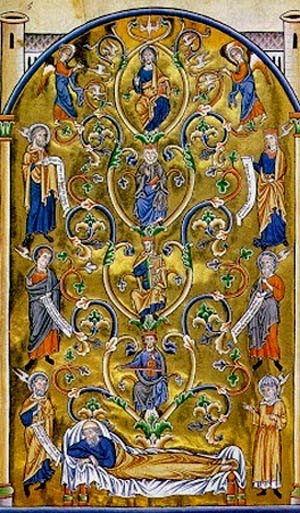 “A shoot shall come out from the stock of Jesse, and a branch shall grow out of his roots.” Isaiah 11:1 Jesse was the father of King David (1 Sam. 16:10–13). David inaugurated a great kingdom, but the greater “David” (Ezek. 34:23–25; Zech. 12:7–10), now only a tender plant (53:2), will rule an incomparably greater kingdom. All that is left of the Davidic dynasty is a stump. The privileged sons of David no less than Assyria are like trees that have been chopped down (Is 10:33, 34). But in spite of this judgement on Judah, the Lord will raise up new leadership from the dynasty of David (Matt. 1:1). Micah had prophesied that the Messiah would be of the house and lineage of David and be born in David’s city, Bethlehem (Micah 5:2). see O Adonai
 Concerning the genealogies… God promised to establish the throne of King Solomon over Israel forever, (1 Chronicles 22:9–10) but the promise was contingent upon obeying God’s commandments (1 Chronicles 28:6–7; 2 Chronicles 7:17–18; 1 Kings 9:4–5). Solomon’s failure to do so is explicitly cited as a reason for the subsequent division of his kingdom (1 Kings 11:4–11). Against King Jehoiakim, Jeremiah prophesied, “He shall have no one to sit on the throne of David,” (Jeremiah 36:30–31) and against his son King Jeconiah, “Write this man childless, a man who will not prosper in his days; for no man of his seed will prosper, sitting on the throne of David or ruling again in Judah.” (Jeremiah 22:24–30) Some see this prophecy as permanently disqualifying Jeconiah from the ancestry of the Messiah (though not necessarily of Joseph) [e.g, Irenaeus, Adversus haereses (“Against Heresies”), p. 3.21.9j].
To Zerubbabel, God declares through Haggai, “I will make you like my signet ring,” in clear reversal of the prophecy against his grandfather Jeconiah, “though you were a signet ring on my right hand, yet I would pull you off.” (Haggai 2:23 (cf. Jeremiah 22:24) Zerubbabel ruled as governor though not as king, and has been regarded by many as a suitable and likely progenitor of the Messiah. Clearly Matthew said that the blood father (begot) of Joseph was Jacob. Matthew had satisfied the Mosaic Law by showing the male ancestry of Jesus by going through Joseph instead of Mary. Keep in mind that this genealogy shows the legal, or royal, or public record, of descent and not the human descent, hence the inclusion of Jeconiah of Solomon. Luke shows the human descent of Christ through David to be Nathan, and not Solomon; thus avoiding the curse of Jeconiah. This alludes to the possibility that Luke’s genealogy is for a different person other than Joseph i.e. but of Mary. For Mary as the birth-giver of Jesus and a Jewess – it would be through her that the genetic Davidic bloodline would be inherited by Christ. Luke as a physician and writing for Gentiles might wish to emphasise this point, as Matthew would want to emphasise the legal point for the Jews following the Mosaic Law; both concur that Christ was born of Mary, a virgin, betrothed to Joseph.
standing as a sign among the peoples;
 He shall stand, or be set up, for an ensign of the people. When Christ was crucified he was lifted up from the earth, that, as an ensign or a beacon, He might draw the eyes and the hearts of all men upon him, John 12:32. His preaching of the everlasting gospel and the salvation He brings, in which the apostles and their successors as standard-bearers likewise by their ministry display the banner of His love, to allure us to Him (Song 1:4), the banner of His truth, under which we engage in the war against sin and Satan. Christ is the ensign to which the faithful children of God scattered abroad are gathered together (John 11:51), and in Him they meet as the centre of their unity. To him shall the Gentiles seek. We read of Greeks that did so (John 12:21; “We would see Jesus”), when Christ spoke of his being lifted up, to draw all men to Himself.
before you kings will shut their mouths, to you the nations will make their prayer:
 “So shall he sprinkle many nations; the kings shall shut their mouths at him: for that which had not been told them shall they see; and that which they had not heard shall they consider.” Isaiah 52:15 Many nations shall be the better for Him, for he shall sprinkle them, and not the Jews only; the blood of sprinkling shall be applied to their consciences, to purify them. He suffered, and died, and so sprinkled many nations; for in His death there was a fountain opened, Zech. 13:1. He shall sprinkle many nations by his heavenly doctrine, which shall drop as the rain and distil as the dew Isaiah 45:8 “Drop down dew, you heavens, from above, and let the clouds rain the just: let the earth be opened and bud forth a Saviour.” Moses’s did so only on one nation (Deut. 32:2), but Christ’s on many nations. He shall do it by baptism, which is the washing of the body with pure water, Heb. 10:22. So that this promise had its accomplishment when Christ sent His apostles to disciple all nations, by baptizing or sprinkling them. As conceived by Christ, the Great Commission linked the missionary activity of the Church with that of Christ Himself (John 14:12). As the first and greatest missionary (Heb 3:1), He came to seek and to save the lost (Luke 19:10). The church’s mission was to be patterned after His (John 20:21). As His ministry included teaching, preaching and healing (Matt 4:23), so would theirs (Acts 4:2; 5:12-16).
Come and deliver us, and delay no longer.

The second great “O” is: O Adonai, et Dux domus Israel, qui Moysi in igne flammae rubi apparuisti, et ei in Sina legem dedisti: veni ad redimendum nos in brachio extento.
English: O Adonai, and leader of the House of Israel, who appeared to Moses in the fire of the burning bush and gave him the law on Sinai: Come and redeem us with an outstretched arm.
It reflects the following prophecies and Scripture:
O Adonai…
 “For the Lord is our judge, the Lord is our ruler, the Lord is our king; he will save us.” Isaiah 33:22 “Adonai” means “Lord” and was the Hebrew word used to replace God’s name YHWH held to be too sacred to pronounce aloud; the repetition of “Adonai” three times is common in the Scriptures, here preceding judge, ruler and king. These attributes summarise the ideal theocracy, to be realised by the Messiah alone; the judicial, legislative, and administrative functions as king to be exercised by Him in person (Isa 11:4; 32:1; Jas 4:12). Jesus came to inaugurate the reign of God on earth “The kingdom of God has come near; repent and believe in the good news” (Mark 1:15), primarily by His rule in the hearts of men (Luke 17:20-21) through His saving redemptive sacrifice on the Cross (Hebrews 9:28). Ultimately we will live with Him in the fullness of the kingdom of God (John 6:40; 1 Corinthians 15) when it comes to earth “Your kingdom come. Your will be done, on earth as it is in heaven” (Matt 6:10). For as was revealed to St John the Beloved concerning the kingdom of God at the end of the ages, when Christ shall reign “Look what I have done,” Christ says from His throne “I have made all things new.” (Revelation 21:5)
and leader of the House of Israel…
who appeared to Moses in the fire of the burning bush…
 And the angel of the Lord appeared unto him in a flame of fire out of the midst of a bush: and he looked, and, behold, the bush burned with fire, and the bush was not consumed. Exodus 3:2 This was no ordinary angel, no created being but in fact “the Angel of the Covenant”, the Second Person of the Trinity Himself, the eternal Word and Son of God i.e. Christ! If we read on we find the “angel” describes Himself as YHWH, and calls himself the God of Abraham, Isaac, and Jacob, a created angel would never do that! Some scholars believe this was a prefigurement of the Incarnation, for certain the Divine Presence is indicated by Moses taking off his sandals. This would seem to tie-in with the proto-martyr Stephen’s own preaching to the Sanhedrin concerning Christ (cf Acts 7:30-53) and the Old Covenant. Consider too these words of the prophet, Isaiah 63:9 “In all their distress he too was distressed, and the angel of his presence saved them. In his love and mercy he redeemed them; he lifted them up and carried them all the days of old.” Consider also the “angel of the Covenant” referred to in the Canon of the Mass, “…We most humbly beseech Thee, Almighty God to command these things be carried by the hands of Thy holy angel to Thy altar on high, in the sight of Thy divine majesty; that as many as partake of the most sacred Body and Blood of Thy Son at this altar, may be filled with every heavenly grace and blessing. Through…”
and gave him the law on Sinai:
 And the Lord said unto Moses, Come up to me into the mount, and be there: and I will give thee tables of stone, and a law, and commandments which I have written; that thou mayest teach them. Exodus 24:12 Jesus said, “Everything must be fulfilled that is written about me in the Law of Moses, the Prophets and the Psalms” (Luke 25:44). In the Exodus God gives Israel new life; they are redeemed not only from the physical oppression of Egyptian slavery but the spiritual bondage and deceit involved in worship of the Egyptian gods. God commands them to worship Himself alone as their true life (Exod. 20:2-3). Accordingly, the law in its total scope sets forth the way of life. True life comes from God and involves fellowship with Him. If the Israelites obey the commandments, they will live (Lev. 18:5; Deut. 28:1-14), and if they disobey they will die (Exod. 19:21-22; 32:9-10; Deut. 6:15; 28:15-68). The ten commandments embody the core of this life. They express what true life is like in our relations directly to God (primarily commandments 1-4) and in our relations to fellow human beings (primarily commands 5-10). Christ then who “is Wisdom” i.e. “life” (see O Sapientia) is “the way of life” encapsulated in the ten commandments.
Come and redeem us with an outstretched arm.

Today marks the beginning of the great “O Antiphons” marking the passing of the “Golden Nights” as the Church prepares herself for the final octave (eight days) towards the Feast of the Nativity. They are recited at Vespers as the Magnificat antiphons and each emphasises a title of the Messiah. They express the hope of the prophets of Israel and the expectation of the Church.
The first great “O” is of Wisdom. O Sapientia, quae ex ore Altissimi prodiisti, attingens a fine usque ad finem, fortiter suaviter disponens que omnia: veni ad docendum nos viam prudentiae.
English: O Wisdom, coming forth from the mouth of the Most High, reaching from one end to the other, mightily and sweetly ordering all things: Come and teach us the way of prudence.
It reflects the following prophecies and Scripture:
O Wisdom, coming forth from the mouth of the Most High,
reaching from one end to the other, mightily and sweetly ordering all things:
Come and teach us the way of prudence.
Nota Bene. Sometimes the character of “Wisdom” is mis-attributed to the Blessed Virgin Mary, largely because of an assumption concerning the use of the feminine gender and perhaps because the Church often uses readings from the books of Proverbs and Sirach (Ecclesiasticus) on Marian festivals in the liturgy. It’s important to appreciate that it is about the Messiah, her son, that the allusion to “Wisdom” is ever made in connection with Our Lady; Our Lady certainly employed “wisdom” and chose “wisely” in accepting and applying herself to the Will of God for her, but it is her son, Christ, who is “Wisdom”.
MASS: Benedícite Dóminum
LESSON: Exodus 23: 20-23
GOSPEL: St Matthew 18: 1-10

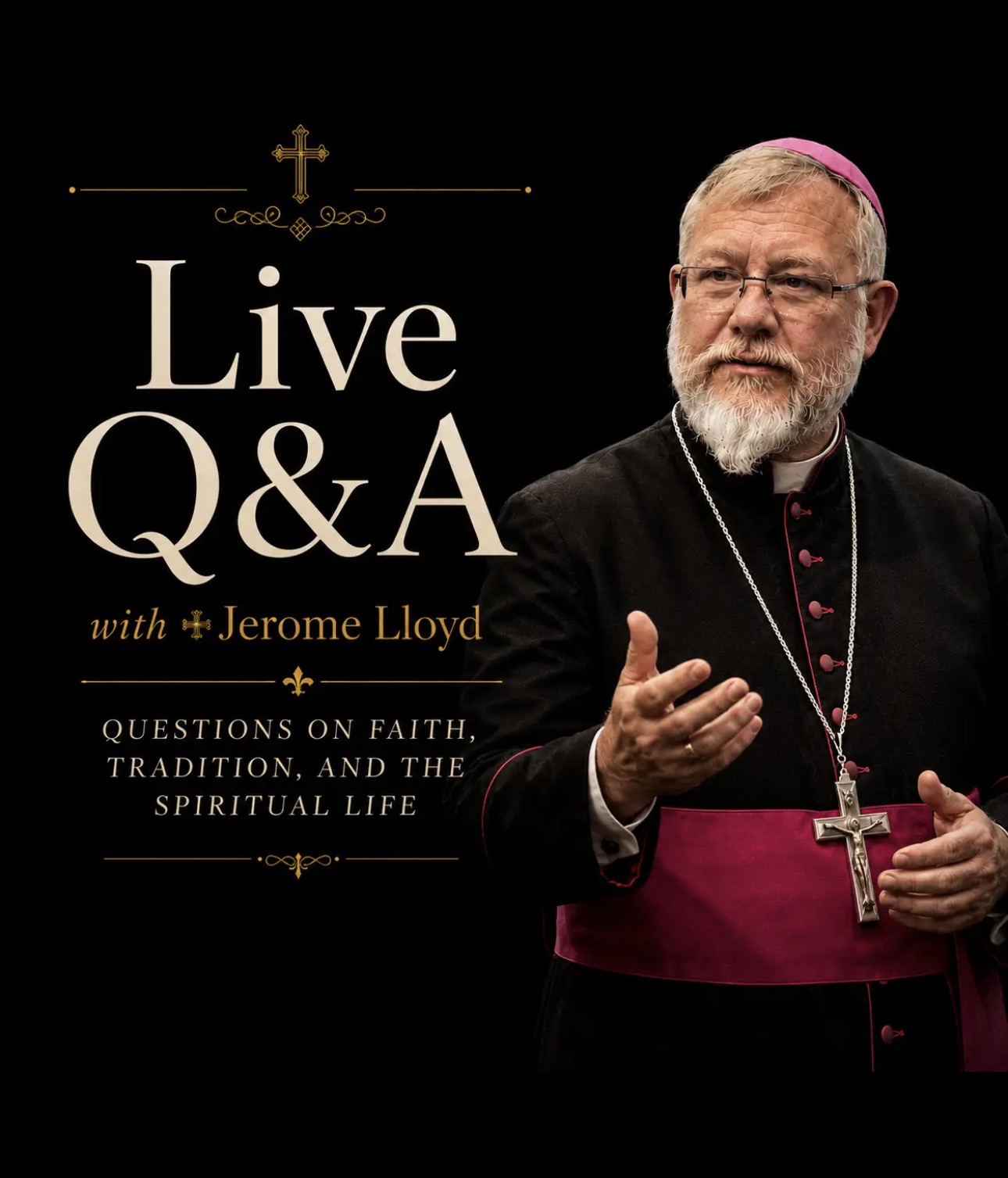
LIVE TODAY · THURSDAY · 5PM GMT
Join ✠ Jerome Lloyd for questions on faith, tradition and the spiritual life.

NOVEMBER • MONTH OF THE HOLY SOULS
Have a traditional Requiem Mass offered for the repose of your departed family, friends and benefactors—whether they died recently or many years ago.
Your Mass stipend also helps support the priest’s ministry and the work of the Old Roman Apostolate.
Suggested stipend: £15 per Mass.
SUPPORT NUNTIATORIA
Help sustain an independent traditional Catholic voice. Your paid subscription supports the writing and publication of Nuntiatoria and the Archbishop’s apostolate.
If you value this ministry, please help keep it growing through regular support.
Become a supporting subscriber
Already a paid subscriber? Thank you for your support. If you currently subscribe free, please consider becoming a paid supporter.
THE TITULAR SEE OF SELSEY
If you value this ministry, please consider making a donation. Your gift helps sustain the Archbishop’s work, including the daily Mass broadcasts on Old Roman TV, Nuntiatoria, and the office, chapel and websites that support this apostolate.
Every contribution, however modest, is gratefully received. Thank you for your generosity and your prayers.
You will be taken to PayPal to make your donation.


