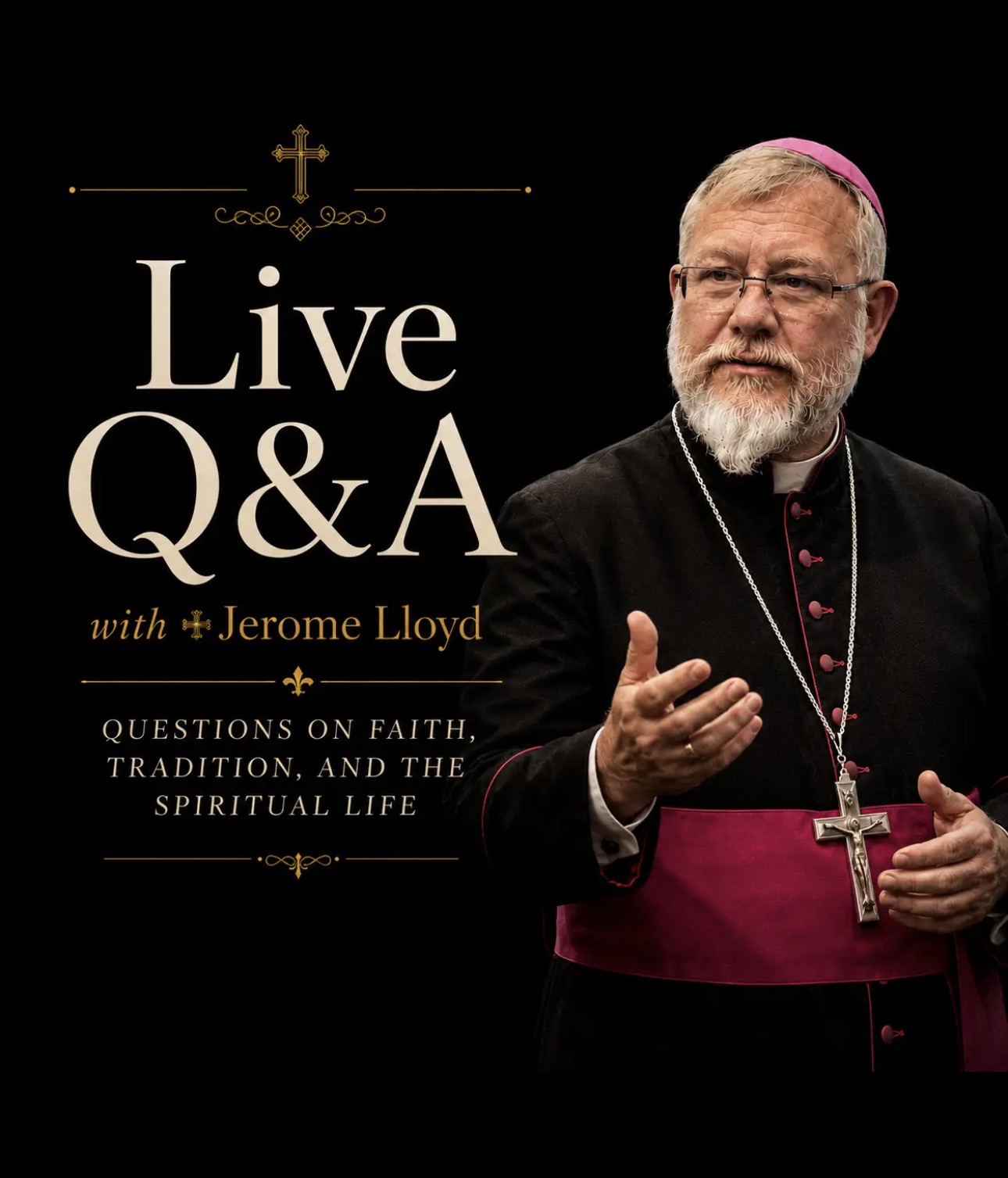
Daily reflections through Holy Week By ✠Jerome OSJV, Primus of the Old Roman Apostolate
Maundy Thursday – The Gift, the Commandment, the Betrayal
It is the first day of the Triduum. The solemn door opens. And we step into a sacred threshold—Maundy Thursday, Feria Quinta in Coena Domini, the day of the Supper, of the Mandatum, of the Priesthood, and of the Holy Eucharist.
This is the only day in the Roman year when the Church dares to speak of glory in the midst of Passiontide. In the Tridentine rite, the sacred ministers clothe themselves in white. The Gloria is sung for the last time. The bells ring out, and then fall silent. And why? Because something is being instituted—not ended. The Passion has not yet begun in blood. It begins in gift.
Tonight, the Church kneels with Christ in the upper room. She listens with awe to the words that create the New Covenant:
“This is My Body… This is My Blood… Do this in commemoration of Me.”
With these few words, Christ empties Himself anew—not merely by taking the form of a servant, but by becoming our Food, hidden under the appearance of bread and wine. The Passover of Israel becomes the Sacrifice of the Lamb. And in this moment, Christ gives the Church what no prophet could give: the Eucharist, the Priesthood, and the Commandment of Charity—all born in one liturgical act.
And yet, beneath the white vestments, a shadow already falls. For the one who will betray Him has already stretched his hand toward the dish. Judas is present. And the Lord knows.
He does not cast him out. He does not expose him. He simply continues to love him, to feed him, to kneel before him.
The Mandatum, the foot-washing preserved in the pre-1955 rite as a separate and optional devotion after the Mass, unveils the humiliation of divine love. Christ does not only command charity—He enacts it. He, who flung stars into space, now bends down and washes the feet of sinful men. He who is the Head becomes the servant.
But even this act is misunderstood. Peter, impetuous and proud, resists. He cannot bear the thought of being served by the one he ought to serve. He forgets that to receive Christ’s love requires humility—the humility to be washed.
And so must we. We must allow ourselves to be washed. To be fed. To be loved—on God’s terms, not ours.
The pre-1955 Missal preserves the sacredness of this night not by diluting it with dramatics, but by enshrining it in awe. The Canon of the Mass remains unchanged, because tonight’s sacrifice is already Calvary—but hidden in mystery, veiled in bread and wine. The Offertory and Communion chants sing of the Chalice of salvation and the Body of the Lord received with reverence and trembling.
And after the Last Gospel, there is no dismissal. The Mass does not end. It is interrupted. Because the Passion has begun.
The Blessed Sacrament is not reposed in the tabernacle. It is carried to the Altar of Repose—ornately veiled, adorned with flowers and candles—but this beauty is fragile. For this is not a feast. It is a vigil.
And the altar is stripped in silence.
Vestments are removed. Linens taken away. The tabernacle is left open and bare.
This is not merely a symbol. It is a liturgical expression of desolation. The Bridegroom is taken from us. The sanctuary is exposed. The household of God is left empty, for He has gone out into the night.
The Church invites us to follow Him in prayer—to remain with Him, if only for an hour, in the garden of His sorrow.
But already we know how the story will unfold. The betrayal is sealed. The sleep has begun. The swords are drawn. And the Passion will now move swiftly.
But tonight, we are still in the Upper Room.
Let us not rush past it. Let us not forget the greatness of the gift.
Tonight, the Lord gives us everything. His Body. His Blood. His Priesthood. His commandment. His kneeling. His silence. His patience. His love.
And He gives it knowing He will be betrayed. He does not give because we are worthy. He gives because He is good.
And so tonight, the Church—poor and trembling as she is—stands in the radiance of this mystery, and prays not to be worthy, but to be faithful.
She prays to remember what the apostles forgot: That love is not a feeling, but a death.
That glory is not triumph, but gift.
That the altar is not a table—it is a Cross.
And that the Bread we receive is not a symbol. It is Christ Himself.
May we never forget what He gave us.
May we never take lightly the words spoken this night.
And may we never again approach the sacred mysteries without awe, without reverence, without humility.
For this is the night in which Christ our God passed from this world to the Father, and gave Himself to those He loved—to the end.
Let us kneel with Him. Let us watch with Him. Let us love Him.
Daily reflections through Holy Week By ✠Jerome OSJV, Primus of the Old Roman Apostolate
Spy Wednesday – The Price of Betrayal, the Silence of the Redeemer
The Church, ever the wise and sorrowing mother, arrives this day at the threshold of unspeakable treachery. It is Wednesday in the Great and Holy Week, a day whose ancient name in the Christian West—Spy Wednesday—still echoes with the hiss of betrayal. It is today, the sacred liturgy reminds us, that Judas Iscariot became a traitor, not by compulsion, not by sudden impulse, but by a will that had already turned away from the Light and had made a pact with the shadows.
He, who once walked among the Twelve, who ate of the multiplied loaves, who saw the dead raised and demons cast out, who received the morsel from Christ’s own hand at table—he is the one who sells the Lord for silver. And yet, the mystery that chills the heart is not only the betrayal, but the setting of it: at table, in intimacy, beneath the same roof where Christ dwelt in love. The treason is not from a stranger, but from a friend. “My friend, wherefore art thou come?”—the gentle rebuke in Gethsemane cuts more deeply than any sword.
The Mass of this day, in the venerable rite of the Roman Church, offers no dramatized retelling, no explanatory commentary. It simply places before us the weight of Scripture, the tension of prophecy, and the voice of the suffering Christ rising in the psalms. The Epistle, taken from the prophet Isaias, does not describe a man broken by violence, but a divine figure clothed in garments red from the winepress—garments stained not by the blood of others, but by His own, for He has chosen to tread the winepress alone. The Fathers saw in this figure none other than Our Lord Jesus Christ, striding alone into the fury of His Passion, His victory hidden beneath bruises, His strength expressed in silence.
Then comes the Passion according to St. Luke: tender, terrible, majestic. It opens with Judas—the same Judas—communing with the priests of the temple, not in prayer, but in commerce. He sells the Light of the world for a sum worthy of a field of blood. From this moment forward, the Gospel unfolds with a quiet gravity that defies commentary. The sleeping disciples, the agony in the garden, the unjust arrest, the mocking and spitting, the denial of Peter—all is told without embellishment, as though the Evangelist, stunned by the reality of the mystery, simply sets it down as it happened.
And what does the Church place on our lips as the priest offers the unbloody Sacrifice? Not a psalm of vengeance, but a psalm of afflicted supplication. From Psalm 101—“Domine, exaudi orationem meam, et clamor meus ad te veniat.” “O Lord, hear my prayer, and let my cry come unto Thee.” This is the prayer of Christ and His Church, not in triumph, but in abandonment. The One who will soon hang upon the Cross does not raise His voice in protest, but in prayer. He does not curse His enemies; He cries to the Father.
And what of Judas? What shall we say of him? He is not a curiosity, a villain from the margins of the Gospel. He is a warning. He is the parable of the Christian who persists in sin, who walks with Christ externally but harbors rebellion within. He is the scandal of sacrilegious Communion. He is the one who receives the Body of the Lord while his mind calculates betrayal. He is every soul that clings to silver rather than surrender. And his final act is not his worst—his worst act is not his betrayal, but his despair.
For Judas might have been saved. He might have run to Calvary, as Peter ran to the tomb. He might have wept, as Peter wept. But he did not believe in mercy. That was his final fall.
Today, we are placed in the company of both men. Peter denies; Judas betrays. But only one returns. Only one is healed. The liturgy does not ask us to scorn Judas. It asks us to examine our own hearts: to ask where we have compromised, where we have clung to resentment, where we have sold Christ in little ways.
And it asks us to return. Now. Before the kiss is given. Before the mob comes. Before the rooster crows.
For we are still in the sanctuary of time. We still walk in the acceptable hour, the day of grace. “Inclina aurem tuam ad me, Domine”—“Incline Thy ear to me, O Lord”—the psalmist cries. And so must we.
Spy Wednesday is not yet Good Friday. It is the final warning, the last call of mercy before the Passion overtakes us. Let us meet it not with silver in our hands, but with tears in our eyes. Let us watch with Christ, before we are found sleeping. Let us pray with Him, before we deny Him. Let us love Him now—while we still can.
Daily reflections through Holy Week By ✠Jerome OSJV, Primus of the Old Roman Apostolate
Holy Tuesday – The Shadow of Betrayal and the Silence of Christ
The Church, in her venerable and ancient liturgy, does not hasten toward Calvary. She tarries. She lingers. Each day of Holy Week, in the classical Roman Rite, is not merely a chronological step closer to the Cross; it is a mystical unveiling of the soul’s interior drama as it draws near to the abyss of divine love and human frailty. And Holy Tuesday, so often overshadowed by the greater liturgical moments that follow it, possesses a weight and gravity that cannot be ignored.
This day is a mirror. It is not yet the moment of betrayal or crucifixion, but it is the moment in which the soul begins to realize how easily it could fail the test. Today, the Church hands us the Passion according to Saint Mark, not to recite like a school lesson, but to consume as a sacrament of truth. It is the shortest and most stripped-down of the Passion narratives—precise, unembellished, like a blade honed on the edge of divine justice. And because of this, it pierces.
The liturgy gives us no grand entrances, no miracles, no discourses. Instead, it presents us with Judas preparing his betrayal, Peter swearing loyalty he will not keep, the disciples failing to watch, and Christ suffering in silence. The Word made flesh speaks almost nothing in His own defense. He does not argue. He does not explain. He stands before His accusers with the silence of truth.
The Church, in her wisdom, has preserved this Gospel in the very heart of Passiontide, that it might confront us with ourselves. Not with who we imagine ourselves to be, but with who we truly are. We are all in the narrative—somewhere. We are at the Last Supper. We are in the garden. We are standing by the fire with Peter. We are asleep when we should be praying. We are asking, with trembling hope or lurking guilt: “Is it I, Lord?”
That haunting question from the mouth of the Apostles is the spiritual signature of this day. And the answer, if we are honest, is yes. Yes, it is I. I have denied You by my silence. I have betrayed You by my sins. I have fled when I should have stood firm.
But the liturgy does not condemn. It reveals. The Passion of Christ is not placed before us to crush us beneath the weight of our failures, but to lead us, as it led Peter, into that salutary sorrow which produces repentance. The same Peter who swore he would never deny the Lord—he who drew his sword, who followed at a distance—this same Peter falls. And it is not the judgment of Christ that breaks him, but the gaze of Christ: silent, sorrowful, piercing, merciful.
It is in that gaze that the Church invites us to dwell today. The Communion antiphon, taken from Psalm 68, expresses not triumph, but humiliation:
Adversum me exercebantur qui sedebant in porta: et in me psallebant qui bibebant vinum: ego vero orationem meam ad te, Domine: tempus beneplaciti, Deus, in multitudine misericordiae tuae.
“They who sat at the gate spoke against Me; and they who drank wine sang against Me. But I—My prayer was to Thee, O Lord: it is the time of Thy good pleasure, O God, in the multitude of Thy mercy.”
Even here, in the midst of mockery and betrayal, the Messiah prays. He does not curse His enemies. He does not curse His weak friends. He turns instead to the Father. In the day of derision, He chooses intercession.
This is how the Church teaches us to suffer.
Not with outrage. Not with cynicism. Not with bitterness. But with prayer. This is the secret strength of Holy Tuesday: its quiet insistence that the true disciple does not scream when he is misunderstood, nor retaliate when he is wounded. He simply turns his face toward Gethsemane and follows the Lord who goes there alone.
But the day is not only about weakness. It is also about hope. The fall of Peter is not final, because his tears are real. He leaves the courtyard weeping—not to hide in despair, but to begin again. The liturgy does not ask us to be perfect. It asks us to be penitent. Judas despaired, Peter repented. Both sinned, but only one allowed himself to be redeemed.
We stand today between them.
The Passion according to Saint Mark ends with Christ delivered into the hands of men. He does not resist. He does not explain Himself. He is, as Isaiah foretold, the Lamb led to the slaughter, silent before His shearers.
And yet, it is this silence that saves. The Word who was made flesh now saves the world without speaking. His silence is not absence—it is power restrained by love.
We are invited to enter that silence. To make it our own. Not merely by observing the events of Holy Week, but by participating in them—through recollection, through contrition, through sacramental confession and holy reception of the altar’s divine victim.
Holy Tuesday is the hinge of Holy Week. It is the moment when the soul must stop pretending that it can follow Christ from a safe distance. It must draw near or fall away. It must weep or turn away in pride. It must confess, “I am Peter,” and let the tears come.
Let them come.
The Church will be waiting for us at the tomb, when the stone is rolled away.
But today, she stands with us at the fire, where the rooster is about to crow.
And she asks, for the last time before the Passion begins in earnest:
Will you follow?
Or will you sleep?
Practical Devotions for the Day
Read and meditate on Mark 14 slowly, asking: “Where am I in this story?”
Make an unhurried examination of conscience. Identify not just sins, but patterns of betrayal: spiritual apathy, moral compromise, avoidance of truth.
Pray the Litany of the Passion or Psalm 50 (Miserere), offering acts of reparation.
If possible, go to Confession—to rise like Peter, not fall like Judas.
Daily reflections through Holy Week By ✠Jerome OSJV, Primus of the Old Roman Apostolate
Holy Monday: The Fragrance of Love, the Shadow of Death
Feria Secunda in Hebdomada Sancta – Tridentine Liturgy (Pre-1955)
If Palm Sunday casts the triumphant but somber shadow of the Cross over the week to come, Holy Monday draws us more intimately into the household of Bethany—into the closeness of friendship, the costly nature of love, and the first outward steps of Christ toward His appointed death.
The traditional Roman liturgy for Holy Monday, unchanged until the mid-twentieth century, is stark, tender, and heavy with impending grief. The chants, readings, and prayers form a mosaic of divine foreknowledge and human response—welcoming Christ with love or plotting against Him in hatred. Each gesture, each word from today’s Mass calls the soul to stand either with Mary of Bethany in adoration, or with Judas in murmuring criticism.
The Liturgical Structure: A Gathering Storm
Holy Monday retains all the Lenten austerity that intensifies in Passiontide. The Mass is offered in violet vestments, without Gloria or Alleluia. The chants are drawn from the Psalms, anticipating suffering yet grounded in hope. The silence grows deeper. The Crucifix remains veiled. The Church is beginning to walk with Christ—not in theory, but in real time.
The Gospel from John 12:1–9 is the central moment of this day. Six days before the Passover, Jesus comes to Bethany—to the house of Lazarus, Martha, and Mary. This visit, in its quiet domestic setting, marks a profound turning point in the Passion narrative. Christ, already marked for death by the high priests, chooses to spend His final days not in hiding, but with friends, entering fully into the human tenderness that will make His Passion all the more painful.
“Mary, therefore, took a pound of ointment of right spikenard… and anointed the feet of Jesus, and wiped His feet with her hair.”
Mary’s Gesture: Extravagance or Prophecy?
The Church Fathers, particularly St. Gregory the Great and Origen, saw in this moment a deeply mystical significance. Mary’s action is not merely emotional—it is liturgical, prophetic, and deeply sacrificial. She pours out precious oil, not on Christ’s head as a king, but on His feet as one already anointed for death.
The value of the ointment—“three hundred denarii,” nearly a year’s wages—scandalizes Judas. To him, such love is wasteful. To Christ, it is beautiful.
“Let her alone: that she may keep it against the day of My burial.”
In this statement, Christ accepts her offering not as sentiment, but as preparation. Mary sees what the others do not: that the road to Jerusalem is the road to the tomb. Her love is not reactive—it is preemptive. Her devotion is not convenient—it is costly.
In contrast, Judas’ words reveal the practical mind detached from love. His feigned concern for the poor masks a heart already lost. In Mary, we see the disciple. In Judas, the betrayer in embryo.
The Epistle: Isaiah’s Suffering Servant
The Epistle from Isaiah 50:5–10 is one of the clearest and most stirring portraits of Christ’s meek acceptance of suffering:
“I have given my body to the strikers, and my cheeks to them that plucked them: I have not turned away my face from them that rebuked me and spit upon me.”
This is not passive resignation. It is active surrender. The Servant does not seek suffering, but neither does He resist it. He knows that to redeem, He must endure—and to endure, He must be rooted in obedience: “The Lord God hath opened my ear, and I do not resist.”
For the faithful, this reading sets the tone: the way of Christ is not one of dramatic resistance or triumphalism, but of loving surrender to the will of the Father. It is a call to spiritual courage—not loud, but steady. Not impulsive, but grounded in contemplation.
Spiritual Intention: To Love Before the Cross
Holy Monday is a day to examine the quality of our love for Christ. Not its warmth or intensity, but its sacrificial character.
Are we like Mary, pouring out what is costly because we know who He is?
Or are we like Judas, calculating the value of everything and seeing devotion as extravagance?
The traditional liturgy does not explain these questions—it asks them, silently and insistently.
Will we anoint Christ with our love now, or only lament when He has passed by?
Holy Monday calls us to love Him while we still have Him. This day in Bethany reminds us that time is short, and that adoration offered now, while Christ is hidden in the tabernacle or disguised in the suffering, is the greatest act of preparation for His Passion.
Lessons and Applications
1. Love must be willing to waste itself Mary’s action is a scandal to utilitarians. But divine love is not measured by cost. It is measured by self-gift. The saints have always understood this. Lavish liturgy, generous charity, hidden prayer, all appear wasteful to the world. But they are the fragrance of true love, filling the house.
2. Judas begins not with betrayal, but with criticism Notice how Judas does not yet leave. He criticizes. He murmurs. He disguises pride as virtue. This is where betrayal often begins—in a hardened heart disguised as realism. The soul tempted to justify withdrawal from God often starts by criticizing the piety of others.
3. Bethany is the school of contemplation Mary does not speak. She acts. And her action becomes a sacrament of preparation. Each time we choose silent, loving adoration, we prepare the way for Christ to enter more deeply into our lives—even if that entry comes by way of the Cross.
Practical Devotions for Holy Monday
Spend time in silence before the Blessed Sacrament, pouring out your heart like Mary’s ointment—without words if need be.
Read John 12:1–9 slowly. Imagine being in the room. What do you smell? See? Feel? What would you do?
Examine your motives. Are you generous with Christ? Or do you grumble internally at the cost of discipleship?
Offer a small act of costly love—a sacrifice of time, attention, or comfort—for no other reason than that He is worthy.
Pray Psalm 35 or Psalm 50 (Miserere), in reparation for past coldness or criticism toward devotion, either your own or others’.
Conclusion: The Fragrance That Fills the Church
The liturgy of Holy Monday is like the spikenard itself: rich, pungent, and clinging. It lingers in the soul. It calls us to a love that is not economical, but extravagant. It reminds us that our Savior is not far away—He is reclining at table with us, waiting to be loved, waiting to be known before He is taken from us.
“Amen, I say to you, wheresoever this Gospel shall be preached in the whole world, that also which she hath done, shall be told for a memorial of her.” (Matt. 26:13)
Let us do likewise. Let us anoint Christ, today, with the perfume of our love—before the tomb is sealed and the world sleeps.
In Conspectu Dei: Reflections on the Holy Week Liturgy “In the sight of God”— emphasizing worship as divine encounter. By ✠Jerome OSJV, Primus of the Old Roman Apostolate
INTRODUCTION
The sacred liturgy is the heart of the Church’s life and the source of all true sanctity. Nowhere is this more evident than in the solemn rites of Holy Week, when the Church accompanies her Divine Spouse through the mysteries of His Passion, Death, and Resurrection. These days are not merely commemorative; they are sacramental, mystical, and transformative.
The following reflections are offered to assist the faithful in entering more deeply into the traditional liturgy—not only in form, but in spirit. They are not academic commentaries, nor practical guides alone, but meditations intended to stir the soul to a fuller participation: not merely by following with the eyes, but by uniting the heart and will to Christ’s saving work.
May these words serve as a small help in approaching the sacred mysteries with greater reverence, understanding, and devotion—so that each soul may be more perfectly conformed to the Crucified and Risen Lord, through the timeless worship of His holy Church.
Liturgical Participation: Communion, Not Imitation
In the sacred liturgy, the faithful are not mere spectators. They are not gathered as a public audience for religious instruction or ceremony. Rather, they are members of the Mystical Body of Christ, mystically united to the action of their Head, the Eternal High Priest, who in every liturgical act offers anew His sacrifice to the Father through sacramental signs.
True participation in the liturgy is not measured by activity or outward visibility. The Church has never taught that sacred worship depends upon the multiplication of gestures or spoken responses by the laity. Rather, participation is principally interior—a movement of faith and love by which the soul unites itself to the Sacrifice of the Altar. As Pope Pius X taught, the faithful participate in the liturgy most fruitfully when they “pray the Mass,” joining their hearts to the sacred action wrought by the priest in persona Christi.
This is not imitation of Christ in a moral sense, but mystical communion with His self-oblation. It is a spiritual act of union with His suffering, His obedience, and His love. The more the faithful assist with reverence and interior devotion, the more they are conformed to Him who offered Himself “a victim, a sacrifice to God for an odour of sweetness”¹.
To assist at the sacred rites during Holy Week is, therefore, to renew our consent to die with Christ—dying to the world, to the flesh, and to our own will—that we may also rise with Him in glory. The external rites are sublime and solemn, but their value is fully realized only when they are interiorly embraced by souls thirsting for union with the Crucified.
Footnotes ¹ Ephesians 5:2; cf. Pope Pius XII, Mediator Dei §§20–21; Roman Catechism, Part II, on the Sacrifice of the Mass.
Sharing in the Paschal Mystery
The Holy Sacrifice of the Mass, and all the rites surrounding it, are not commemorations in the modern, historical sense. They are the perpetuation of the redemptive act of Christ under sacramental veils. The liturgy of the Church does not look back wistfully to Calvary—it makes present the one Sacrifice of the Cross, re-presented in an unbloody manner upon the altar.
This is the sacred mystery at the heart of Holy Week: that what was accomplished once in time is now dispensed through the Church’s liturgy, by the power of Christ and the operation of the Holy Ghost. The ceremonies of this most solemn week are not sentimental reenactments, but sacred channels of divine grace, given to unite the faithful to the sufferings and triumph of the Redeemer.
The liturgy, being sacramental, effects what it signifies. As St. Thomas Aquinas teaches, the sacraments operate ex opere operato, by the very fact of their performance, because it is Christ who acts in them. Yet this grace bears fruit in proportion to the disposition of the soul. The exterior rite is valid and efficacious; but its spiritual harvest is abundant only where there is humility, contrition, and a burning desire to be united to Christ Crucified².
Thus, the liturgical action is not a stage upon which we express ourselves, but the divine means by which Christ expresses His love—and draws us to Himself. We love because He first loved us. We offer because He first offered Himself. This is not a dialogue of equals, but a condescension of mercy to which we respond in adoration and sacrifice.
Footnotes ² cf. St. Thomas Aquinas, Summa Theologiae III, q.83, a.1; Council of Trent, Session XXII, ch.2; Pope Pius XII, Mediator Dei §59.
The Interior Fruitfulness of the Sacred Liturgy
The sacred liturgy is not a vehicle for personal creativity or community self-expression. It is a work of God, a divine action, instituted by Christ and entrusted to His Church. It sanctifies not by emotion or novelty, but by the objective power of grace conferred through the rites as the Church has received them.
The Church has always taught that true and fruitful participation in the liturgy is interior—silent, recollected, devout. While exterior acts have their place, they are ordered to a deeper reality: the union of the soul with Christ’s offering. As Pope Pius XII insisted, “the chief element of divine worship must be interior worship”³.
This is why silence, reverence, and sacred continuity are not aesthetic preferences, but theological necessities. The liturgy is the summit of the Church’s prayer because it is where Christ offers Himself anew through the ministry of His priests. The faithful participate most deeply when they unite their own sacrifices—offered upon the altar of the heart—with that perfect Victim who is daily immolated for the salvation of souls.
The rites of Holy Week thus call each Christian to interior renewal. As the Church passes through the mysteries of the Passion, she calls her children to be conformed to Christ in His humility and His Cross. The sacred signs form us in the likeness of the Son—not through innovation or performance, but through contemplation, self-denial, and loving participation in His redemptive work.
Footnotes ³ Pope Pius XII, Mediator Dei §24; cf. Council of Trent, Session XXII, ch.1; St. John Eudes, The Priest: His Dignity and Obligations.
Christ the Liturgical Centre: The Priest Who Offers, the Lamb Who Is Offered
In every act of sacred worship, it is Christ who is at work. He is the true celebrant of every Mass, the High Priest of the new and eternal covenant. The visible priest acts only in His Person; the sacred ministers are instruments through which the Eternal Priest continues His offering to the Father⁴.
Christ is also the Victim. What He offered once on Calvary is made present again on the altar—mystically, yet really. The liturgy is thus the union of Priest and Victim, the perpetual presentation of the same Sacrifice in an unbloody manner. This is why the Church teaches that the Mass is one and the same sacrifice as that of the Cross⁵.
The faithful, therefore, do not gather around the altar merely to be instructed or encouraged. They approach it in reverence to witness and participate—according to their state—in the act by which the world is redeemed. In this sacred action, Christ glorifies the Father and sanctifies His Church. The altar is Calvary; the sanctuary is a foretaste of heaven.
All things in the liturgy exist to direct our attention to this mystery. The silence, the orientation, the Latin tongue, the sacred vestments—all elevate the mind and heart to Christ. When rightly understood, they allow the faithful to be drawn into that divine action which surpasses all human activity: the self-offering of the Son to the Father, in which we are invited to share.
Footnotes ⁴ cf. Council of Trent, Session XXII, ch.2; Pope Pius XI, Ad Catholici Sacerdotii, §12. ⁵ Roman Catechism, Part II, ch.4; Mediator Dei §68.
The Liturgy as a Foretaste of Glory
The sacred liturgy not only looks back to the Passion; it looks forward to eternity. It is the veil through which we glimpse the heavenly court. The altar is not only the place of sacrifice—it is the threshold of heaven. Every sacred liturgy is a participation in the celestial liturgy, where the angels cry Sanctus, Sanctus, Sanctus before the throne of God⁶.
This is the eschatological character of the liturgy so clearly understood by the Fathers and Doctors of the Church. In it, time meets eternity; earth touches heaven. The sacred rites are patterned upon the eternal worship of the Lamb, and through them, the Church on earth is united with the Church Triumphant. This is why the saints longed for the altar, and why the faithful of old approached it in awe and trembling.
Holy Week reveals this with especial clarity. The sufferings of Christ lead not to annihilation, but to glory. The tomb gives way to the throne. In the sacred liturgy, the faithful do not only mourn their sins; they anticipate their glorification. They learn to desire heaven because they have tasted something of its majesty.
To worship according to the mind of the Church is therefore to be prepared for eternity. The beauty and solemnity of the ancient rites are not ornaments, but reflections of divine order. They form the soul for the heavenly liturgy by immersing it in reverence, humility, and sacrificial love.
Footnotes ⁶ cf. Revelation 4:8; Mediator Dei §§3–4; Dom Prosper Guéranger, The Liturgical Year, Vol. 6 (Passiontide).
The Church Is Made in Worship
The Church, in her visible structure, in her teaching and discipline, in her sacraments and hierarchy, exists for one end: the glory of God and the sanctification of souls. And nowhere is this end more perfectly realized than in the sacred liturgy. It is here that the Church is most truly herself: the Bride united to her Bridegroom, the Body animated by its Head⁷.
In the act of worship, the Church is not only expressing devotion—she is being formed. The faithful are configured to Christ; the priest is conformed to the Eternal High Priest; the Church herself is renewed in her sacred identity. From the altar flows the grace that builds up her unity, strengthens her mission, and sanctifies her members.
This is why tradition insists that the liturgy is received, not invented. It is a divine gift, not a human project. The rites handed down across centuries are not museum pieces but living expressions of the Church’s soul. To preserve them faithfully is not an act of nostalgia—it is an act of fidelity to Christ and the order He has established.
The Church is most herself when she is silent before the mystery, obedient to tradition, and recollected in the presence of God. This is her truest apostolate. From worship rightly offered, all true renewal flows.
Footnotes ⁷ cf. Mystici Corporis Christi, §§60–65; Mediator Dei §24; Roman Catechism, Part II, ch.5.
Conclusion: To Worship in Spirit and in Truth
The sacred liturgy of Holy Week leads the Church into the heart of the Christian mystery: the suffering, death, and resurrection of Our Lord Jesus Christ. These rites, solemn and immemorial, do not merely instruct the mind or stir the emotions—they sanctify the soul and glorify God. They are the appointed means by which Christ’s redemptive work is made present to His Church, and through which the faithful are invited to unite themselves to the saving Victim offered upon the altar.
To participate rightly in this liturgy is to enter into a divine mystery with reverence, humility, and love. It is to acknowledge that we are not the authors of our worship, but its recipients and servants. The priest ascends the altar as Christ, and we ascend with him in spirit, offering ourselves in union with the great oblation. We bring our crosses, our sins, our hopes, and our needs—not as isolated individuals, but as members of the Mystical Body.
This participation is not measured by noise or motion, but by interior surrender. As the Church has always taught, the most fruitful worship is that which conforms the soul to Christ, drawing it into His obedience, His humility, and His self-offering. Whether with missal in hand, Rosary in heart, or gaze fixed silently upon the altar, what matters most is that the soul be truly present—adoring, uniting, and offering itself in faith.
Holy Week is not merely the highest week of the liturgical year; it is the school of the Cross, the furnace of charity, the path to glory. If we enter it with docility, it will not leave us unchanged. For to worship in spirit and in truth is to be made like unto the One we worship: the Lamb who was slain and who now reigns.
Let us then approach these sacred days as pilgrims at the threshold of eternity, prepared to die with Christ, that we may also rise with Him to newness of life.
2a. S. Justini Martyris 3a.Ss. Tiburtii, Valeriani, et Maximi Mm
2a. Contra persecutores Ecclesiae
2a. Contra persecutores Ecclesiae
NA
NA
NA
NA
NOTAE
no Gl. Cr. Pref. de Sancta Cruce
no Gl. Pref. de Sancta Cruce
no Gl. Pref. de Sancta Cruce
no Gl. Pref. de Sancta Cruce
Gl. Cr. Pref. de Sancta Cruce
NA
Gl.no Cr. Pref. et Comm. Paschalis
Gl. Cr. Pref. et Comm. Paschalis
Nota Bene
* Color: Albus = White; Rubeum = Red; Viridis = Green; Purpura = Purple; Niger = Black [] = in Missa privata **Nota Bene: the Ferias of Lent take precedence save for feasts of Double rank or higher; when a higher feast takes precedence, the Lenten Feria is always commemorated by its Collect, Secret and Post-communion prayers, and it’s gospel becomes the Last Gospel instead of that of the Prologue of St John.🔝
In Cruce Salus
In the Cross is Salvation—expresses the central mystery of Holy Week: that through the suffering and death of Christ, the instrument of shame becomes the means of eternal life. As the Church accompanies her Lord to Calvary, she proclaims not defeat, but victory through sacrifice, for it is from the Cross that Christ redeems the world and reigns as King. 🔝
From the Primus
HE ✠Jerome OSJV, Titular Archbishop of Selsey
Carissimi, Beloved in Christ,
Palm Sunday inaugurates the most sacred days of the liturgical year with a liturgy that is itself a mystery of paradox and profundity. The Church, in her ancient wisdom, sets before us the triumphant entry of the King into His City—mounted not on a steed of conquest, but on the meek beast of burden. Hosanna to the Son of David! echoes in our ears, even as the liturgy presses us forward to hear the Crucifige eum that will soon pierce the Friday air. We are not permitted to linger long in sentimentality.
What begins in procession ends in Passion. The joy of the palm quickly yields to the agony of the Cross, not as contradiction, but as consummation. For the same King who is lauded with branches will be crowned with thorns; the same hands that lay cloaks upon the road will soon be stained by sin. The liturgy compels us to walk with Christ not merely to the gates of Jerusalem, but through the gates of the sanctuary, the Holy of Holies—through the torn veil of His flesh.
This week, the Church does not invite us to reenact history as if it were past. She immerses us in it sacramentally, mystically, efficaciously. The liturgy of Holy Week is not theatre. It is the unfolding of divine realities. It is the actualization of the Cross and Resurrection in time. As the traditional Palm Sunday rite so vividly shows—with its solemn blessing of palms, Gospel, Preface, and procession to the church doors—we are not remembering events, we are entering into them.
Indeed, the closed doors of the church, opened only by the crucifix, serve as a catechesis in gesture: the Cross is the key that opens the sanctuary, the bridge between the fallen world and the eternal Temple. As Fr. Gabriel of St. Mary Magdalen teaches, we must relive the Passion in our own flesh. This is not pious metaphor—it is the inescapable logic of love. The disciple is not above his Master. If Christ is glorified through suffering, so too must we pass through death to life.
This is why the traditional Roman liturgy—so rich, so solemn, so unapologetically sacrificial—is not a luxury but a necessity. It forms our souls in the school of the Cross. It teaches us, not with slogans or sentimental novelties, but with the profound pedagogy of signs, symbols, and Scripture, rightly ordered and reverently offered. It gives us Christ, and it gives Him whole.
Palm Sunday, then, is not a celebration in the modern sense. It is a solemn threshold. It beckons us to cross over from the outer court of religious admiration into the inner sanctuary of sacrificial union. As Dom Prosper Guéranger puts it, “The Church opens Holy Week with a twofold triumph: one of joy and one of sorrow.” She gives us the Cross not at the end, but at the beginning—so that we may never forget what kind of King we follow.
Let us therefore make this week a true retreat with Our Lord. Let us clear from our lives the noise of the world and the trivialities of modern distraction. Let us follow Jesus to the Upper Room, to Gethsemane, to the courts of judgment, to Golgotha, and to the tomb—knowing that to follow Him in suffering is to follow Him also into glory.
I urge you to make every effort to attend the traditional liturgies of Holy Week in their full solemnity, where the richness of sign and symbol, of chant and ceremony, speaks more deeply to the heart than any mere words. For it is in the beauty and gravity of these rites that we are most fully conformed to Christ Crucified—and it is only in Him that we will find peace.
Let the motto of this week echo in your homes and hearts: In Cruce Salus—In the Cross is Salvation.
May Our Lady of Sorrows walk with us each step of the way, and may the Precious Blood of Christ wash and strengthen our souls.
Explanatory Liturgical Notes on the Pre-1955 Palm Sunday
The liturgy of Palm Sunday in the pre-1955 Roman Rite is one of the most elaborate and symbolically rich in the Church’s calendar. Prior to the Holy Week reforms of Pius XII, the day was structured around three distinct acts: the Blessing of Palms, the Procession, and the Mass of the Passion. Together, these rites form a solemn prelude to Holy Week, balancing Christ’s triumphal entry with His imminent Passion.
The Blessing of the Palms (The “Dry Mass”) Before 1955, the blessing of palms followed the structure of a complete liturgical service, often referred to as a Missa Sicca (“dry Mass”), because it resembled a Mass in form but did not include a consecration. This included:
Five prayers of blessing, increasing in intensity and theological richness;
A preface, in the style of the Eucharistic preface, praising Christ as King and Redeemer;
A reading from Exodus 15, evoking Israel’s deliverance from Egypt;
A reading from Matthew 21, narrating the entrance of Our Lord into Jerusalem.
The ritual explicitly links the palm branches to the “sacramentals of grace,” asking that all who carry them be shielded by heavenly protection¹. Palms are sprinkled with holy water and incensed, then distributed to the clergy and people while the antiphons Hosanna filio David and Pueri Hebraeorum are chanted.
The Solemn Procession The procession with palms was treated with the highest solemnity, not as a mere dramatic reenactment, but as a sacramental procession expressing the Church’s fidelity to Christ her King.
At its climax, the faithful approach the doors of the church, symbolizing Jerusalem. The subdeacon knocks on the closed doors with the foot of the processional cross, and the choir inside responds with Gloria, laus et honor tibi sit, traditionally sung in alternating verses inside and outside the church. This is rich in typology: the closed doors signify the gates of heaven, opened only by the Passion of Christ².
The procession ends with the singing of the hymn Ingrediente Domino, and the celebrant proceeds to the altar for the principal Mass.
The Solemn Mass of Palm Sunday The Mass that follows is austere and sober. Unlike the joyful tone of the blessing and procession, the focus now shifts entirely to the suffering of Christ.
The Introit (Domine, ne longe facias) and the Tract (Deus, Deus meus) come from Psalm 21 (22), which Christ quotes from the Cross.
The Epistle is Philippians 2:5–11, the great Carmen Christi, in which the humility of Christ is exalted: “He humbled Himself, becoming obedient unto death, even to the death of the Cross.”
The Gradual and Tract intensify the mood of sorrow and supplication.
The Passion according to St. Matthew is chanted by three deacons in turba style: the Chronista (narrator), Christus (words of Our Lord), and the Synagoga (other voices). At the words emisit spiritum, the clergy and faithful kneel in silence.
The Offertory (Improperium exspectavit cor meum) and Communion (Pater, si non potest hic calix) are taken from the Psalms and the Gospels and reflect the agony of Gethsemane and the abandonment of Christ.
Theological and Mystical Themes Traditional commentators like Dom Prosper Guéranger stress that Palm Sunday is the “door to Holy Week”³. It begins with royal acclamation and ends in rejection and suffering, presenting in a single liturgical arc the paradox of the Christian mystery: the exaltation of Christ through humiliation.
Fr. Pius Parsch emphasizes how the liturgy moves the faithful from external celebration to internal participation in the Passion⁴. The faithful are not passive observers; they are invited to enter with palms and tears, with songs and sorrows, into the mystery of redemption. 🔝
¹ Ritus Servandus in Benedictione Palmarum, pre-1955 Missale Romanum. ² Dom Prosper Guéranger, The Liturgical Year, vol. VI, Palm Sunday. ³ Ibid. ⁴ Fr. Pius Parsch, The Church’s Year of Grace, Palm Sunday.
Purok 3 Pintong Bukawe San Mateo Rizal 1850 Rizal, Philippines
Palm Sunday in the Ancient Roman Rite: The Mystery of the King and His Passion
Palm Sunday, or Dominica in Palmis de Passione Domini, stands as a liturgical monument that gathers in a single day the triumph of Christ’s kingship and the agony of His Passion. The grandeur and theological richness of the pre-1955 liturgy—preserved in its full solemnity before the reforms of Bugnini’s commission—communicates through sign, word, and gesture the paradox of Holy Week: that Christ reigns from the Cross, that humiliation is the path to glory, and that the Church walks in His steps from Hosanna to Calvary.
As Dom Prosper Guéranger, O.S.B., observes, the day is a “mystery of contrasts,” wherein “the Church opens Holy Week with a twofold triumph: one of joy and one of sorrow. She is exultant with the multitude in acclaiming her King, yet she already feels the bitterness of the Passion.”¹ The liturgy does not permit a naive optimism; instead, it initiates us into the Paschal mystery with a deep sense of eschatological realism. This is no ordinary triumphal entry, but the solemn procession of the Sacrificial Lamb who comes to lay down His life.
The Blessing and Procession of Palms The day begins not with the Mass but with a complex and symbol-laden blessing of palms, a rite so solemn and lengthy that it has been aptly called a “Mass before the Mass.” It includes a Gospel, a Preface, and prayers rich in typological and sacrificial imagery. Fr. Leonard Goffine, in his Explanation of the Epistles and Gospels, remarks that the palms signify “victory over the prince of death” and are reminders of the martyrs’ crowns.² Yet they are also destined to wither, much like the fickle adulation of the crowd which turns so quickly from “Hosanna” to “Crucify Him.”
The procession itself, in which the faithful follow the crucifix carried aloft beneath the veiled purple of Passiontide, serves as a reenactment of the triumphal entry into Jerusalem. But this liturgical action is not mere remembrance—it is participation. As Fr. Pius Parsch explains, “The Church enters with her Lord into the City of His Passion,” uniting herself with His redemptive work.³ The knocking on the closed doors of the church and the lifting of the cross to open them vividly illustrate that only through the Cross is entry into the New Jerusalem made possible.
The Solemn Mass of the Passion When the Mass begins, a dramatic shift takes place. The vestments are violet, not festive red; the Gloria is omitted; and the tone is somber. The celebrant prays the Collect with bowed head, imploring grace to follow Christ with courage even unto death.
At the heart of the Mass is the Passion according to St. Matthew, sung by three deacons in the traditional tones that convey the gravitas and pathos of the events. It is no accident that this is read in the place of the usual Gospel. The Passion is not merely part of the Gospel—it is its fulfillment. As Dom Benedict Baur, O.S.B., writes, “This Sunday lays the foundation for the entire mystery of the week: it proclaims that the Passion is not defeat, but fulfillment, the royal path to glory.”⁴
The reading of the Passion invites not spectatorship but self-examination. We see in the cowardice of the disciples, the treachery of Judas, the cruelty of the mob, the indifference of Pilate—our own hearts laid bare. As Fr. Gabriel of St. Mary Magdalen, O.C.D., reminds us in Divine Intimacy, “The Passion of Christ must be lived in our own lives. The tragedy of Calvary must be repeated in us: in our flesh, in our suffering, in our sacrifice.”⁵
A Liturgy of Paradox and Prophecy The older form of Palm Sunday encapsulates, with unmatched eloquence, the mystery of Christian kingship: Christ the King is crowned with thorns; His throne is the wood of the Cross; His scepter, a reed. The people who sing His praises are the same who soon demand His death. And yet, through all of this, the Church affirms with unwavering faith that this is the path of divine victory.
To tamper with the rites—as was done in the 1955 simplifications—is to risk flattening this mystery into something humanly intelligible but spiritually impoverished. As Dr. Kwasniewski has often argued, traditional liturgy forms the soul not by appealing to our reason alone but by “saturating the senses, striking the imagination, and drawing us into the cosmic drama of salvation.” The pre-1955 Palm Sunday is precisely such a rite—one that catechizes by symbol and initiates by mystery.
Conclusion: Walking the Way of the Cross In the final analysis, the Palm Sunday liturgy is the entryway not only into Holy Week but into the Christian life itself. It presents us with a choice: will we walk with Christ to Calvary, or will we, like the crowd, flee when the Cross looms near? The traditional rite, in its fullness and solemnity, does not allow us to remain indifferent. It compels a response. Let us, then, take up our palms not merely as symbols of fleeting praise but as pledges of fidelity unto the Cross. 🔝
Footnotes ¹ Dom Prosper Guéranger, The Liturgical Year, Vol. VI: Passiontide and Holy Week. ² Fr. Leonard Goffine, The Church’s Year: Explanation of the Epistles and Gospels. ³ Fr. Pius Parsch, The Church’s Year of Grace, Vol. II: Lent to Pentecost. ⁴ Dom Benedict Baur, The Light of the World, Vol. II: Passiontide and Easter. ⁵ Fr. Gabriel of St. Mary Magdalen, Divine Intimacy, meditation for Palm Sunday.
In the Cross is Salvation As Holy Week unfolds, the Church sets her gaze upon the Cross—not as a symbol of defeat, but as the throne of our victorious King. The motto In Cruce Salus captures in just three words the paradox at the heart of Christianity: that life comes through death, healing through wounds, glory through humiliation. The Cross, once an instrument of Roman terror, has become the very sign by which heaven is opened and man is reconciled to God.
To contemplate the Cross is to confront both the horror of sin and the depths of divine love. In the Passion of Christ, we see the full weight of our transgressions borne by the Innocent One, and yet we also behold the radiant mercy of a God who would rather suffer than see us perish. Each nail, each blow, each drop of blood is a word spoken in the language of love—a love stronger than death, more faithful than betrayal, more enduring than the grave.
The Cross stands at the centre of time and eternity. It is planted at Golgotha but casts its shadow across every human heart. To carry our cross, as Christ commands, is not merely to endure suffering, but to unite ourselves to His redemptive work. It is to allow our wounds to become windows for grace, our sorrows to become seeds of resurrection.
This Holy Week, let us not rush past the Cross on our way to Easter. Let us kneel before it, linger beneath it, embrace it. For it is there—precisely there—that we will find salvation, peace, and the sure hope of glory. In Cruce Salus—In the Cross is Salvation. Let it be not just a motto, but a way of life. 🔝
Sampaloc – Manila PH. Holy Week
Loreto St. Brgy 418 Manila, Philippines
Spiritual Reflection: From Hosanna to the Cross
We begin Holy Week with a paradox. The same crowd that cries Hosanna! will soon shout Crucify Him! The same hands that wave palms in triumph will be folded in fear or raised in violence. Palm Sunday draws us into this tension—not to confuse us, but to awaken us.
We carry palms as a sign of victory, yet the liturgy already veils the Cross in purple. Why? Because the Church teaches us that Christ’s kingship is not of this world. He conquers not by force, but by love; not by wielding the sword, but by bearing the nails. The procession we join today leads not merely into Jerusalem, but to Calvary.
Palm Sunday is a spiritual threshold. It invites us to pass over from admiration to imitation, from watching Christ suffer to uniting our suffering to His. As the liturgies of this sacred week unfold, we will hear His last words, witness His agony, and behold His silence before the mockery of power. But none of this is mere remembrance. It is participation. The Passion is not only Christ’s path—it is ours.
Holy Week is not just a drama played out in history; it is a mirror held before our souls. Are we among the fickle crowd? Do we profess Christ in comfort but abandon Him in trial? Do we seek a triumphant Messiah, but flee from the Crucified One?
Let us follow the Lord not with fleeting fervor, but with faithful steps. Let our “Hosanna” be the beginning of a life offered in love, sacrifice, and obedience. The Cross is not the end of the story—but we must go through it to reach the Resurrection. As we enter Holy Week, let us go with Him all the way—into the garden, up the hill, beneath the wood—and find, in losing our lives with Him, that In Cruce Salus—in the Cross is salvation. 🔝
A sermon for Sunday
by the Revd Dr Robert Wilson PhD (Cantab), Old Roman Apostolate UK
Palm Sunday Almighty and everlasting God, who didst will that our Saviour should take upon him our flesh and suffer death upon the cross, that all mankind should follow the example of his great humility; mercifully grant that we may both follow the example of his patience and also be made partakers of his resurrection.
Today is Palm Sunday and we once again have represented liturgically to us the drama of the events of Holy Week. The Collect recalls how the Saviour not only took upon him our human nature and dwelt among us, but above all came to suffer and to die that all mankind should follow the example of his great humility. We pray that we may both follow the example of his patience and also be made partakers of his resurrection.
The words of the Collect provide a summary of the content of today’s epistle in which St. Paul exhorts the Philippians to follow the example of Christ’s humility. He then expounds on this theme by quoting from what is usually thought to be an early Christian hymn. Christ “who being in form of God, thought it not robbery to be equal with God; but emptied himself, taking the form of a servant, being made in the likeness of men, and in habit found as a man.” Though Christ fully shared in the divine nature he did not think equality with God was something to be grasped at, but he rather emptied himself and took our nature upon him and dwelt among us. God’s almighty power was shown most chiefly in showing mercy and pity, for it is the nature of the divine love to give of itself. “He humbled himself, and became obedient unto death, even the death of the cross.” The extent of the divine compassion is shown in that not only was the Word made flesh and dwelt among us, but that he was also a man of sorrows and acquainted with grief, who was wounded for our transgressions and was chastised for our iniquities. Hence, he became obedient unto death, even the death of the cross. “For which cause God also has exalted him, and given him a name which is above all names: that in the name of Jesus every knee should bow, of those that are in heaven, on earth and under the earth: and that every tongue should confess that the Lord Jesus Christ is in the glory of God the Father.”
Having shown the depth of the divine compassion and humility, the hymn concludes by making the extraordinary claim that the divine name has been bestowed upon Jesus. This is done by quoting from one of the strongest statements of the divine sovereignty in the Bible, in which the prophet Isaiah states that at the name of God every knee should bow and every tongue confess. But now St. Paul (or the hymn from which he is quoting) states that the Lord to whom every knee should bow and every tongue confess is the Lord Jesus Christ. He used the Greek word Kyrios, meaning Lord, which is the word that the Septuagint (the Greek translation of Old Testament which was used by Greek speaking Jews) uses for God. In other words, St. Paul is making absolutely clear that Jesus fully shares in the nature of God.
It is important to emphasise this point because it is often supposed that the message of Jesus was later corrupted by the early Church into one of unnecessary theological complexity by forming doctrines about the Incarnation and the Trinity. Such a statement, though often made, simply does not fit with the evidence. In claiming that Jesus was divine the early Christians were not abandoning monotheism and adopting the cult of a pagan style divine figure. On the contrary they were reaffirming monotheism for they were still worshippers of the one God of Israel, by whom every knee would bow and every tongue would confess. But they now knew that this God had fully revealed himself in Jesus Christ, who fully shared in the nature of God, but had also taken our nature upon himself, and had lived on earth and dwelt among us, even to the extent of suffering and dying for us. The divine nature was most fully revealed, not in power and might, but in showing mercy and pity. All the later elaborations of the debates about the Trinity and the Incarnation that were clarified by the Councils of the early Church are simply elucidations of what St. Paul is saying in today’s epistle.
Today’s epistle also shows that Jesus Christ is not only fully God, but also fully man. Whereas the first Adam had thought that equality with God was something to be grasped at and had consequently fallen into sin, the Second Adam, though he fully shared in the nature of God, did not see this as something to be grasped at but rather humbled himself and so did for us what we could not do for ourselves. He thereby reversed the curse of sin and death that fell upon our race as a consequence of the sin of the first Adam.
As Newman’s great hymn has it:
O loving wisdom of our God When all was sin and shame A second Adam to the fight And to the rescue came
O generous love that he who smote That did in Adam fail Should strive afresh against the foe Should strive and should prevail
Our race has been cursed from the beginning by the sin of pride. It would be redeemed from the sin of pride, of grasping at equality with God, by the humility of God coming in person to rescue us from sin and death. The world saw power in terms of force. Indeed, when St. Paul was writing the cult of the Emperor was the fastest growing religion. In saying that Jesus Christ is Lord he was not simply indulging in a piece of speculative theology but saying that Caesar, the apparent ruler of this world, was not the true Lord. The Roman Empire was based on the cult of the strong leader, the belief that Caesar is Lord. But the Christian faith was based on the one who revealed his power in showing mercy and pity. The kings of the Gentiles, Jesus said, exercise authority and they are called benefactors, but it is not so among you. For in the Kingdom of God the humble will be exalted, the first shall be last and the last first. For the Son of Man came not to be served, but to serve and to give his life as a ransom for many.
O love how deep, how broad how high! How passing thought and fantasy That God, the Son of God should take Our mortal form for mortals sake.
He sent no angel to our race Of higher or of lower place, But wore the form of human frame, And he himself to this world came
For us for wicked men betrayed, Scourged, mocked in crown of thorns arrayed; For us he bore the cross’s death; For us at length gave up his breath.
For us he rose from death again, For us he went on high to reign, For us he sent his Spirit here To guide, to strengthen and to cheer.
All honour, laud and glory be, O Jesu, Virgin born to thee, All glory as is ever meet, To Father and to Paraclete. 🔝
Bratislava – Slovakia. Holy Week
Primaciálne námestie 1 – Bratislava
A Primer for Mission Mass Hosts:Welcoming Visitors During Holy Week
1. The Spirit of the Week: Holy, Not Ordinary Holy Week is the most sacred time in the Church’s year. Visitors may come moved by tradition, curiosity, or spiritual hunger. Some will not have attended in years. Our duty is to welcome them with charity, clarity, and quiet dignity, helping them encounter the mystery of Christ’s Passion through the Church’s ancient rites.
2. First Impressions: A Spirit of Reverence and Peace
Greet all visitors warmly, not loudly. Let your demeanor reflect the holiness of the place and season.
Smile gently, make eye contact, and if appropriate, quietly offer assistance: “Welcome—please let us know if you need a hand with the missal or where to sit.”
If families arrive with children, encourage rather than shame. Help them settle without fuss. Be mindful that a gentle, prayerful environment will often help children settle too.
3. Practical Guidance: Help, Don’t Hover
Provide missals or printed Holy Week guides if available. Explain discreetly how to follow along: “The readings and chants are in the first part; feel free to join as you are able.”
Be aware of the distinct features of Holy Week (e.g. the Palm procession, Veneration of the Cross, extended silence on Good Friday, or the lighting of the Easter fire). Briefly note these to newcomers if appropriate: “There’ll be a moment for silent adoration after the liturgy—please feel free to remain as long as you wish.”
If people look uncertain during processions or devotions, gently invite rather than instruct. “You’re welcome to join the procession—just follow along behind the others.”
4. Foster a Sacred Atmosphere
Maintain a prayerful presence yourself—your reverence gives others permission to pray deeply.
Avoid unnecessary conversation inside the chapel. If explanation is needed, speak in low tones and guide people outside if a longer conversation is needed.
Encourage a spirit of recollection, especially before the liturgy and during the Triduum’s extended silences.
5. Catechetical Sensitivity: Be Ready to Explain
Many visitors may not be familiar with traditional rites. If asked, be ready with short, respectful explanations:
“Why do we kneel at the ‘Et incarnatus est’?” → “It marks the moment the Son of God became man in the womb of Mary—it’s a moment of awe.”
“Why is the altar bare?” → “On Good Friday, the Church enters into mourning—the altar is stripped as Christ was stripped.”
Always answer with joy, not defensiveness—you are planting seeds, not giving lectures.
6. Follow-Up and Farewell
After the liturgy, thank visitors for coming. “We’re so glad you were with us—feel free to come back for the Vigil or Easter morning!”
Offer printed information (Mass times, website, catechism class dates, etc.) discreetly near the door. Have one or two hosts positioned to hand these out or point them out when asked.
If someone expresses interest in learning more, take note and connect them with the priest or catechist after Mass, or offer a way to follow up: “We’d be happy to keep in touch if you’d like.”
7. Above All: Be the Face of the Church Mission Mass hosts are not just welcomers—they are the Church’s outstretched hand. Many who walk in during Holy Week are carrying burdens, questions, or wounds. Your hospitality, rooted in reverence, may be the beginning of a return to grace. 🔝
A Primer for the Laityon Devotional Participation in Passiontide and the Sacred Triduum
Approach: Entering into the Mystery Passiontide and the Sacred Triduum are not merely commemorations of past events but liturgical participation in the saving mysteries of Christ’s Passion, Death, and Resurrection. These are the holiest days of the Church’s year, in which the faithful are invited not simply to remember, but to enter into the mystery of redemption. The proper approach is one of reverent attentiveness, interior silence, and spiritual readiness.
As the veiled crosses and images signal, the Church invites us to withdraw from distractions and fix our gaze inward, toward the Cross. This is not a time for routine attendance, but for deep intentionality. Come to the liturgy as to Calvary: with humility, with sorrow for sin, with love for Christ who suffers for you.
Attitude: Contrition, Contemplation, Confidence
Contrition: Passiontide and the Triduum call for true repentance. Christ’s sufferings were borne out of love for sinners. Let every liturgical word and gesture move you to sorrow for your sins and those of the world.
Contemplation: Attend with a quiet heart. Avoid idle chatter before and after the liturgies. Read the texts beforehand. Ask the Holy Spirit to help you see and hear with the eyes and ears of faith.
Confidence: Christ did not suffer in vain. These are not mournful rituals of defeat, but solemn entrances into the hour of triumph. Participate in confidence that His victory is yours, if you abide in Him.
Intention: Unite Your Heart to the Liturgical Action The priest ascends the altar; you ascend interiorly. His prayers are your prayers. When the liturgy pauses, do not drift—pray. When the priest bows, bow interiorly. When the Passion is proclaimed, stand at the foot of the Cross in your heart. Your intention must be to unite your life—your trials, sorrows, sins, hopes—with Christ crucified.
Offer the liturgy for your own sanctification and for others: the conversion of sinners, the comfort of the suffering, the repose of souls. These days are powerful times for intercessory prayer.
Attention: Be Present to What Is Present Avoid the temptation to treat these days as symbolic pageantry. What is re-presented here is real. The same sacrifice of Calvary is mystically renewed. Christ is present. Attend with the senses of faith sharpened:
At Palm Sunday, see yourself among the crowd: will you shout “Hosanna” or “Crucify”?
At Tenebrae, enter into the deepening darkness with the Church’s cries from the Psalms.
At Holy Thursday, adore the priesthood and the Eucharist with gratitude; remain with Christ in the garden.
At Good Friday, kneel with sorrow at the Cross and let it crucify your pride, sins, and coldness.
At the Easter Vigil, feel the darkness pierced by the Light; listen attentively to the readings; renew your baptism with full assent.
Practical Tips for Participation
Fast and abstain in spirit, not merely in body. Offer these mortifications for a deeper union with Christ.
Prepare ahead by reading the Passion narratives and liturgical texts. Familiarity allows deeper prayer.
Come early, sit in silence, and interiorly place yourself in God’s presence.
Stay after to give thanks, especially on Holy Thursday and Good Friday.
Participate fully: respond, kneel, listen—let every movement be prayer.
Make spiritual communions when sacramental communion is not possible.
Final Disposition: From Contemplation to Transformation The purpose of Passiontide and the Sacred Triduum is not only to honour what Christ has done, but to be changed by it. If you keep watch with Him, die with Him, and rise with Him, then you will live differently.
Let these holy days pierce your heart. Let them reorder your loves. Let them rekindle hope. And above all, let them lead you to love Christ more, and to love as He loved. 🔝
A Primer for the Faithful:Disposition for Holy Week and the Sacred Triduum
Entering the Holiest Days Holy Week is not merely a series of religious observances—it is the Church’s yearly entrance into the mystery of Christ’s Passion, Death, and Resurrection. The faithful are not spectators of a past event, but participants in the very acts by which our salvation was won. The Sacred Triduum (Holy Thursday, Good Friday, and the Easter Vigil) forms the summit of the liturgical year, and calls for a corresponding depth of reverence, attentiveness, and interior transformation.
Interior Disposition: Silence, Sobriety, and Contrition
The heart of Holy Week is not found in busyness or external activity, but in quiet contemplation of the suffering Christ.
In these days, cultivate a spirit of penitence and humility, recognizing that our sins have nailed Christ to the Cross.
Enter into spiritual mourning, especially on Good Friday and Holy Saturday, allowing the sorrow of the Church to shape your prayer.
Avoid distractions, excessive conversation, and frivolity. Let your home and heart reflect the solemnity of these sacred days.
Exterior Focus: Prepare the Body, Sanctify the Day
Fast and abstain more strictly than required; voluntary mortification intensifies one’s union with the suffering Christ.
Dress with modesty and dignity for all liturgies—these are not ordinary days. The faithful should present themselves as though standing before Calvary and the empty Tomb.
Be punctual. Arrive early, remain recollected, and stay for the entirety of the liturgies, including periods of silence and adoration.
Regarding the Liturgies: Active Participation of the Soul
Palm Sunday: Receive and carry the blessed palms as a sign of loyalty to Christ the King. Join the procession prayerfully, recalling how quickly the crowds turned from praise to hatred.
Holy Thursday: At the Mass of the Lord’s Supper, recall both the gift of the Eucharist and the institution of the priesthood. Stay in adoration with the Lord in His agony—”Could you not watch one hour with Me?” (Mt 26:40).
Good Friday: Approach the solemn liturgy as a day of austere mourning. Venerate the Cross with humility and gratitude. Let your heart remain pierced with sorrow through the day.
Holy Saturday: This is a day of sacred stillness. Avoid unnecessary activities. Use the time for prayer, Scripture, and quiet anticipation of the Resurrection.
Easter Vigil: Participate with awe. It is the mother of all vigils, in which the light of Christ shatters the darkness. Renew your baptismal vows with sincerity and thanksgiving.
Spiritual Watchfulness: Remain with the Church
Unite your personal devotion to the Church’s public prayer. Read the Passion narratives. Meditate on the Seven Last Words. Pray the Sorrowful Mysteries.
If you are unable to attend all the liturgies, mark the hours at home with Scripture, silence, and prayer. Keep vigil in your heart.
Teach your children the meaning of these days—not only by words, but by the example of reverence, fasting, and prayer.
Conclusion: From Death to Life The graces of Holy Week are not given for a single season, but to renew the whole of Christian life. By passing through the Passion with Christ, the faithful are made ready to rise with Him. Prepare your soul as you would your home for the coming of a King—for Christ’s victory is not distant history, but the Church’s living inheritance.🔝
Brighton – East Sussex UK. Holy Week
CURRENT AFFAIRS
Catholics Now Outnumber Anglicans Among Gen Z Churchgoers in Britain
A quiet revolution is taking place within Britain’s ecclesial landscape. According to new research commissioned by the Bible Society, young adult Catholics now outnumber Anglicans by more than two to one among regular churchgoers—a demographic reversal without precedent since the Reformation. The findings offer a sobering reflection on the Church of England’s trajectory and point toward a shifting centre of gravity in British Christianity.
From State Religion to Cultural Memory The most arresting headline from the report is this: among those aged 18 to 34 who attend church regularly, 41% are Catholic, compared to just 20% who are Anglican. This dramatic reversal contrasts with the same demographic just six years ago, when Anglicans still held a 30% share, and Catholics trailed at 22%¹.
This change is not limited to youth. Across all age groups, the Church of England’s representation among regular worshippers has fallen from 41% in 2018 to 34% today, while Catholic representation has risen from 23% to 31%. Britain may remain formally Anglican by law and establishment, but its religious future increasingly looks Catholic in practice.
As historian Dr. Dominic Selwood observes, “The Church of England has been in freefall for decades… What we are witnessing now is not just decline but collapse. The sense of inherited religion is gone.”²
The Collapse of Nominal Anglicanism The decline of Anglican affiliation is not merely numerical but conceptual. Anglicanism was long upheld as a cultural institution—less a doctrinal confession than a marker of English identity. But cultural Christianity cannot withstand the pressures of secularism, consumerism, and identity relativism. When faith is not taught, it is not transmitted.
By contrast, Catholicism, with its sacramental structure, moral demands, and global identity, has fared better. Dr. Stephen Bullivant, a leading sociologist of religion, notes that Catholic retention rates are higher precisely because “Catholicism demands more. That’s part of what makes it stick.”³
Immigration as a Catalyst, Not a Cause Much of the Catholic Church’s numerical vitality can be traced to immigration, especially from Poland, the Philippines, Nigeria, and Eastern Europe. Yet this is only part of the story. These communities bring not only numbers but a living piety, one which stands in marked contrast to Britain’s secular ambient culture.
Crucially, the second-generation remains largely observant. Catholic parishes often provide an anchor of identity, rooted not only in ethnicity but in shared belief and practice. These communities are evangelising, simply by existing—through devotions, sacramental life, and moral seriousness.
Fr. Mark Vickers, author of Christians Among the Virtues, observes: “The very things modern Britain has discarded—ritual, authority, objective morality—are what many young people now crave. The Catholic Church, for all her struggles, still possesses these in abundance.”⁴
A Resilient, Sacramental Minority The new statistics also reveal a general increase in regular church attendance, from 3.7 million in 2018 to 5.8 million in 2024. The most growth is seen among the under-25s, especially those from ethnic minorities. This is not a return to Christendom, but it is a sign of post-secular openness to convictional religion.
The late Roger Scruton once warned that “the Church of England has forgotten that it is not supposed to reflect society but challenge it.”⁵ In this sense, it is Catholicism—with its moral clarity on life, sexuality, and salvation—that has remained a true counterculture. In an age of flux, this consistency is becoming its greatest evangelical strength.
Historical Parallels and Unfinished Reformation Historically, the Church of England was born in tension—torn between Protestant theology and Catholic structure. The Elizabethan Settlement was never fully accepted by many of the faithful, leading to centuries of recusancy. In many ways, the current Catholic revival is a resumption of what was violently interrupted in the 16th century.
“Catholicism never disappeared from these islands,” notes Church historian Eamon Duffy. “It went underground. What we see now is not so much a new arrival as a quiet return.”⁶
The Road Ahead The future belongs not to the culturally convenient, but to the spiritually committed. The Catholic Church in Britain now faces a providential moment: to form and lead a new generation of disciples, born not of nostalgia, but of conviction.
The call is clear: invest in catechesis, liturgy, and the formation of missionary parishes. If these young Catholics are not to be lost to apathy or absorbed into a vague spirituality, the Church must offer not less, but more—more truth, more beauty, more challenge, more grace.
As Pope Benedict XVI reminded British Catholics during his historic 2010 visit: “The Church does not grow by strategies. She grows because she witnesses to the truth.” This truth now finds unexpected resonance in the lives of a generation that, against all odds, is choosing to believe. 🔝
¹ Bible Society survey data, 2024, as reported in The Times. ² Selwood, Dominic. Commentary in The Spectator, 2023. ³ Bullivant, Stephen. Mass Exodus: Catholic Disaffiliation in Britain and America since Vatican II. Oxford University Press, 2019. ⁴ Vickers, Mark. Christians Among the Virtues: The Catholic Contribution to Moral Theology. Gracewing, 2020. ⁵ Scruton, Roger. Our Church: A Personal History of the Church of England. Atlantic Books, 2012. ⁶ Duffy, Eamon. The Stripping of the Altars: Traditional Religion in England, 1400–1580. Yale University Press, 1992.
Theodore McCarrick: Death of a Symbol of Crisis in the Modern Church
The death of Theodore McCarrick at the age of 94 closes a chapter in what many traditional Catholics regard as one of the most shameful and revealing scandals in modern Church history. More than a disgraced former cardinal, McCarrick has become a symbol of the moral and doctrinal collapse afflicting the Church’s leadership in the post-conciliar era.
Architect of Decline, Not Renewal McCarrick’s ascent through the American hierarchy—from auxiliary bishop in New York to bishop of Metuchen, archbishop of Newark, and eventually archbishop of Washington and cardinal—was not despite the knowledge of his immoral behavior, but because it was ignored, concealed, or rationalized. Bishops, Vatican diplomats, and even popes were informed of allegations regarding his predatory behavior with seminarians and young men, yet he continued to rise. The Vatican’s own 2020 report confirmed that Pope John Paul II was aware of allegations but chose to believe McCarrick’s denials, a decision many critics see as evidence of misplaced trust and catastrophic clericalism¹.
Diplomacy and Deception: McCarrick’s Role in the China Deal McCarrick played an unofficial yet influential role in fostering relations between the Vatican and the People’s Republic of China. Though no longer in official office, he traveled to China multiple times, engaging in what has been described as “soft diplomacy” on behalf of the Holy See. In a 2016 interview, McCarrick notably praised the writings of Xi Jinping and likened them to Pope Francis’ Laudato Si’, claiming they shared a common concern for “harmony”².
Critics, including Cardinal Joseph Zen of Hong Kong, believe McCarrick’s optimistic diplomacy softened Vatican resistance to Communist demands and laid groundwork for the 2018 provisional agreement between the Vatican and Beijing. That deal, still undisclosed in full, effectively granted the Chinese Communist Party a significant role in appointing bishops. Traditional commentators argue it betrayed Chinese Catholics who have long suffered persecution under a regime that has bulldozed churches, imprisoned priests, and forced underground Catholics to join the state-run “patriotic church”³.
A Primatial Power-Broker As the de facto Primate of the United States during the early 2000s, McCarrick helped shape the modern American episcopate. He sat on key appointment committees, advised the Vatican on episcopal candidates, and was a frequent presence in diplomatic circles. But far from being a spiritual shepherd, McCarrick operated as a political tactician. He openly aligned himself with left-leaning politicians, maintained cordial ties with the Clintons and the Obamas, and was often viewed as the Church’s unofficial envoy to Washington. His vision of the Church emphasized social relevance over supernatural mission—a Church of policy papers rather than penance.
Traditionalists argue that McCarrick’s influence represents the capture of the American hierarchy by a class of careerist prelates whose primary concerns are institutional optics and ideological compatibility, not the salvation of souls.
Clericalism, Secrecy, and the Crisis of Accountability The McCarrick scandal has become shorthand for the deep structural failings within the modern Church. He was known to abuse his status by inviting seminarians to his beach house, forcing them to share beds with him—actions known to several bishops and Vatican officials for years, but not acted upon. While the U.S. bishops adopted the Dallas Charter in 2002 to address clerical sexual abuse, the charter notably excluded bishops from its purview—a loophole that allowed McCarrick to present himself as a reformer while remaining a predator⁴.
Traditional Catholics see McCarrick’s case not as an outlier, but as the product of a corrupted culture of clericalism, bureaucratic inertia, and doctrinal relativism. His laicization in 2019, though historic, was for many too little too late. The damage had already been done—to his victims, to the Church’s credibility, and to the moral authority of the episcopate.
Conclusion: A Warning, Not a Footnote As statements from Church officials upon McCarrick’s death tread cautiously around the legacy of “pain and harm,” traditional Catholics are calling for something deeper: not merely moral accounting, but spiritual reform. McCarrick should not be remembered as an aberration, but as a warning—a cautionary tale of what happens when fidelity to the Gospel is replaced by power games, diplomacy, and deference to the world.
The Church’s purification will not come through press releases or new policies, but through true repentance, fearless transparency, and a return to the perennial truths of the Catholic faith. McCarrick’s legacy should be buried—not with silence, but with reform rooted in tradition. 🔝
¹ Report on the Holy See’s Institutional Knowledge and Decision-Making Related to Former Cardinal Theodore McCarrick, Vatican Secretariat of State, November 2020. ² “Cardinal Theodore McCarrick praises Xi Jinping,” Crux, Feb. 5, 2016. ³ Cardinal Joseph Zen, For Love of My People I Will Not Remain Silent, Ignatius Press, 2019. ⁴ Philip Lawler, The Smoke of Satan: How Corrupt and Cowardly Bishops Betrayed Christ, His Church, and the Faithful… and What Can Be Done About It, TAN Books, 2018.
The World’s Oldest Bishop: A Century of Faith and Service
At 103 years old, Bishop José de Jesús Sahagún de la Parra stands as the oldest living bishop in the Catholic Church. His extraordinary life and ministry span more than a century, from the shadows of the Cristero persecution to the aftermath of the Second Vatican Council. A living bridge between epochs, he remains a daily witness to the Eucharist and to the enduring vitality of the Catholic priesthood.
Born of a Priestly Soil Bishop Sahagún was born on 1 January 1922 in Cotija, Michoacán, a town renowned for its rich Catholic heritage. It was the birthplace of St. Rafael Guízar y Valencia, canonized by Pope Benedict XVI, and Fr. Félix de Jesús Rougier, founder of the Missionaries of the Holy Spirit. Cotija has earned the reputation of being a “cradle of vocations” in Mexico, and Sahagún’s own life affirms that title.
His youth was shaped by one of the most traumatic periods in Mexican Church history. During his childhood, Mexico was still reeling from the Cristero War (1926–1929), a popular uprising against the secularist government’s persecution of clergy, closure of churches, and suppression of Catholic education. Families prayed in secret, seminarians trained underground, and priests faced imprisonment or martyrdom. These experiences deeply impressed upon the young José de Jesús the cost of fidelity to Christ.
He was ordained a priest on 26 May 1946 in the Archdiocese of Morelia, just as the Church in Mexico began recovering publicly from years of religious suppression¹. His early priesthood was marked by pastoral outreach in rural and urban settings, devotion to the Sacred Heart, and a commitment to forming laity and clergy alike in sound doctrine.
Builder of New Dioceses In 1961, Pope John XXIII appointed him the founding bishop of the Diocese of Tula, in the central state of Hidalgo. His consecration came as the Church was preparing to open the Second Vatican Council, and Bishop Sahagún would participate in every session. Today, he is one of only four bishops in the world who remain living participants of the Council, and he is the oldest among them².
The other three are:
Cardinal Francis Arinze (Nigeria), now 92, who attended the Council’s final session after his appointment as coadjutor bishop of Onitsha in 1965³.
Archbishop Victorinus Youn Kong-hi (South Korea), 100, who participated in the second, third, and fourth sessions as bishop of Suwon⁴.
Bishop Daniel Alphonse Omer Verstraete, O.M.I. (Belgium/South Africa), 100, who attended the final session after his appointment as Prefect Apostolic of Western Transvaal⁵.
At Tula, Bishop Sahagún served for 24 years, establishing parishes, training priests, supporting religious communities, and implementing the conciliar reforms with both fidelity and prudence. His episcopate coincided with a time of intense theological discussion and practical upheaval. Unlike many prelates who simply followed trends, Sahagún was known for taking a measured, pastoral approach, seeking to preserve reverence, orthodoxy, and ecclesial identity even amid rapid change.
In 1985, Pope John Paul II appointed him to lead the newly erected Diocese of Lázaro Cárdenas, back in his native Michoacán. There, Bishop Sahagún applied his decades of experience to shepherding a coastal region that required new pastoral strategies for evangelization, catechesis, and social outreach. He retired from active governance in 1993, at the canonical age of 75, after over 32 years of episcopal ministry.
A Priest Forever In retirement, Bishop Sahagún did not disappear from Church life. On the contrary, he continues to celebrate the Holy Sacrifice of the Mass daily, a practice he credits for his enduring strength and clarity of mind. Even now, at 103 years old, he rises in the early morning to pray and offer the Eucharist.
When asked about the secret to his longevity, he simply replies: “The Mass. That’s all. A priest without the Mass has no life.” His testimony has inspired many younger priests and seminarians, not through lectures or headlines, but through the quiet example of unbroken daily fidelity.
Those who visit him describe a man of peace, joy, and simplicity—lucid in mind, serene in soul, and deeply rooted in prayer. His humility defies the grandeur of his historical witness: he is a man who saw the Cristero martyrs in his youth, who listened to the debates of Vatican II, who built up dioceses from nothing, and who now waits in joyful hope for the coming of the Lord.
A Living Testimony Across a Century Bishop Sahagún’s life has spanned ten pontificates—from Pius XI to Francis—and reflects both the trials and the triumphs of the modern Church. He is a living archive of Mexican ecclesial history, a conciliar father, a missionary bishop, and a priest of unbroken Eucharistic devotion.
His life also challenges a Church that has grown forgetful of its own heroes. At a time when priestly identity is often contested, when sacramental life is neglected, and when fidelity to tradition is caricatured as nostalgia, Bishop Sahagún stands as a reminder that perseverance in truth bears fruit across generations.
He is not only the oldest bishop in the world—he is one of its most faithful. 🔝
¹ Ordained in the Archdiocese of Morelia shortly after World War II, amid a renewal of religious life in post-Cristero Mexico. ² As of April 2025, only four bishops who participated in the Council remain alive. ³ Appointed Coadjutor Bishop of Onitsha in 1965; later became Prefect of the Congregation for Divine Worship. ⁴ Appointed Bishop of Suwon in 1963; later became Archbishop of Gwangju. ⁵ Appointed Prefect Apostolic of Western Transvaal in 1965; member of the Oblates of Mary Immaculate.
The Last of the Fathers: What the Living Witnesses of Vatican II Still Teach Us
As the Church journeys deeper into the 21st century, only four bishops remain alive who personally participated in the Second Vatican Council (1962–1965). These men—now aged between 92 and 103—are not merely ecclesiastical footnotes. They are living witnesses to one of the most significant events in modern Church history, and their longevity raises a searching question: what has endured, and what have we forgotten?
A Generation Fading The Second Vatican Council was attended by over 2,500 bishops from every continent. They prayed, debated, and discerned amidst the currents of renewal and controversy. Many of them were forged in the crucibles of world war, persecution, or missionary hardship. Now, only four survive:
Bishop José de Jesús Sahagún de la Parra (103), of Mexico—bishop since 1961, participant in all four sessions of the Council¹.
Archbishop Victorinus Youn Kong-hi (100), of South Korea—first bishop of Suwon, later archbishop of Gwangju, present for the second through fourth sessions².
Bishop Daniel Alphonse Omer Verstraete, O.M.I. (100), Belgian missionary to South Africa, attended the final session as Prefect Apostolic of Western Transvaal³.
Cardinal Francis Arinze (92), of Nigeria—attended the last session after becoming coadjutor bishop of Onitsha in 1965, later a cardinal and prefect of Divine Worship⁴.
They represent four continents and diverse pastoral contexts. They were not academic theologians or celebrity bishops. Rather, they were pastors, missionaries, and builders—men who implemented conciliar reforms on the ground with real people and real problems.
Continuity, Not Rupture Contrary to popular narratives that portray Vatican II as a radical break from the past, these living fathers embody a hermeneutic of continuity. Bishop Sahagún implemented the Council in rural Mexico with a focus on catechesis, liturgical reverence, and diocesan stability. Archbishop Youn guided the Korean Church through explosive growth while preserving Marian devotion and sacramental life. Cardinal Arinze, known for his joyful orthodoxy, became a trusted interpreter of the Council’s liturgical teachings under Pope John Paul II.
None of these bishops promoted rupture. All of them remained committed to the perennial doctrine of the Church, interpreting the Council in light of tradition, not in opposition to it.
Their witness reminds us that Vatican II was not an invention of a new Church, but a call for the renewal of the one, holy, catholic, and apostolic Church—a renewal that demands holiness, not novelty.
What They Leave Behind As these last fathers near the end of their earthly lives, the Church is challenged to recover what they embodied:
Fidelity over fashion: They were faithful stewards, not theological entrepreneurs.
Reverence over relevance: Their implementation of reforms was grounded in awe for the sacred, not in trend-chasing.
Unity over ideology: They upheld communion with the See of Peter, even as they wrestled with local difficulties and global confusion.
Their generation is passing—but their legacy is not lost, if we are willing to reclaim it.
A Time for Retrieval We are now far enough from the Council to begin the work of critical retrieval. Not the polemical rewriting of history, nor the nostalgic rejection of all reform, but a serious, sober look at what the Council said, what it meant, and how it was lived by those who bore the weight of its implementation.
The living fathers are a grace to us precisely because they do not fit the easy categories—liberal or conservative, revolutionary or reactionary. They are reminders that the real task of the Council was the same task entrusted to Peter: strengthen your brethren.
As Bishop Sahagún once said in an interview: “The Council was not an end. It was a means—to help us be faithful to Christ in our time.”
¹ Ordained bishop in 1961; attended all sessions of the Council as Bishop of Tula. ² Appointed bishop of Suwon in 1963; attended the final three sessions. ³ Named Prefect Apostolic of Western Transvaal in 1965; missionary with the Oblates of Mary Immaculate. ⁴ Appointed Coadjutor Bishop of Onitsha in 1965; later cardinal under John Paul II, prefect of Divine Worship.
The Wild Poppies of Belorado: A Case Study in Postmodern Monasticism
Few stories have so vividly captured Spain’s religious imagination—and its ecclesiastical confusion—as the strange and tragic case of the nuns of Belorado. Once a Poor Clare convent of venerable history in the province of Burgos, the community has over the past year descended into liturgical irregularity, administrative controversy, and now a public schism. A recent investigative feature on the program Código 10 has brought the disorder into full view, complete with damning testimony, chaotic visuals, and a picture of religious life so distorted that even secular viewers were left speechless.
Who Are the Belorado Nuns? The convent of Santa Clara de Belorado was originally a reputable foundation of the Poor Clares, the contemplative Franciscan order of cloistered nuns. In recent years, however, the community’s numbers dwindled, and its adherence to the norms of cloistered life began to unravel. In 2023, the convent attracted renewed attention when a new group of women entered or associated with the community, claiming to restore its traditional Franciscan rigor. Yet instead of renewal, it spiraled into self-created autonomy, embracing a kind of do-it-yourself monasticism.
This group now claims to adhere not to the current Code of Canon Law (1983), but to that of 1917—a choice often made by sedevacantist or traditionalist breakaway communities¹. In May 2024, they formally broke communion with the Vatican, declaring that the Holy See was “occupied” and that they would instead seek protection under a new ecclesiastical structure². Their supposed adherence to older Catholic forms masks an erratic and inconsistent reality, as even sympathetic commentators are now forced to admit.
José Cacero: From Ally to Whistleblower One of the most compelling voices on Código 10 was José Cacero, a lay representative of the Pía Unión Sancti Pauli Apostoli, a traditionalist organization that initially attempted to help the Belorado nuns regularize their situation. At first inclined to offer them support, including financial assistance, Cacero eventually withdrew—and now speaks with open dismay.
His testimony is devastating: the nuns claimed enclosure while ignoring all its obligations; they rarely attended Mass, did not pray the Divine Office, refused penance and fasting, and turned the convent into a zoological refuge, housing more than 100 dogs, as well as a donkey and a pony. “They weren’t cloistered,” he said. “They were playing dress-up. They called themselves ‘wild poppies.’” For Cacero, what began as a hope for monastic restoration ended in disappointment and suspicion, including financial appeals that escalated into six-figure requests without guarantees.
Francisco Canals: A Gentle Defender In contrast, Francisco Canals, a journalist and media consultant often sympathetic to alternative religious expressions, appeared on the same program as a more conciliatory voice. Canals acknowledged the presence of the animals and the licensing issues but emphasized that the nuns have since regularized their situation, including obtaining a zoological license in their new location in Asturias. He defended their love of animals, their efforts to study canine training, and their attempts to establish a new kind of contemplative life rooted in Franciscan ecology.
Yet even Canals could not deny that things had gone badly off course in Belorado. What he framed as eccentric devotion or alternative spirituality, Cacero framed as chaotic disobedience and a mockery of religious life.
The Schismatic Fault Line The true scandal here is not merely about animals or fasting—it is about the collapse of ecclesiastical authority and the rise of self-styled “traditional” communities that reject both modernity and hierarchy. The Belorado nuns claim to follow the 1917 Code, yet they ignore its clearest mandates. They claim enclosure, yet broadcast appeals and controversies to the world. They reject the papacy but still wear the trappings of religious life, seeking clergy to say Mass while refusing oversight.
Such movements are not simply misguided; they are spiritually dangerous. They attract vulnerable women, create scandal among the faithful, and sow confusion about what it means to live a religious vocation.
Tradition Is Not a Costume What makes this case so painful is that it touches on real wounds in the Church: the abandonment of tradition in many convents, the laxity of ecclesiastical authorities, and the desperation of Catholics seeking something stable and holy. But the answer to the crisis of modernity is not aesthetic traditionalism without obedience. It is not a monastery that smells like a kennel. And it is not calling yourself a Poor Clare while living like a druid.
The restoration of the Church must begin with truth in charity: charity toward those who are sincerely seeking God, but truth about what consecrated life requires. As Pope Pius XII taught in Sacra Virginitas, religious life is meant to be “a radiant sign of the heavenly kingdom”³—not a haven for disorder, sentimentality, or ideological experiment.
Conclusion: A Wake-Up Call for the Church The Belorado episode should be a wake-up call—not just for Spanish Catholics, but for traditionalists and bishops alike. For bishops: the failure to enforce religious discipline only invites others to take Church law into their own hands. For traditionalists: our defense of the old ways must not become an excuse for cult-like communities that parody monasticism while rejecting Catholic order.
It is time to stop romanticizing fringe movements. The Church needs real saints—not self-proclaimed poppies. 🔝
¹ Codex Iuris Canonici (1917), can. 604–606; cf. 1983 Code, can. 667 §3. The 1917 Code explicitly lays out the norms for papal enclosure and its juridical consequences when violated. ² Declaración del Monasterio de Belorado, 13 May 2024. The nuns claimed sede impedita and invoked episcopal protection from an unnamed prelate. ³ Pius XII, Sacra Virginitas (1954), §22: “The consecrated virgin… is a radiant sign of the heavenly kingdom and the undivided love of the Church for Christ.”
A Royal Visit to the Vatican: Adultery, Confusion, and the Crisis of Witness
King Charles III and Queen Camilla’s recent state visit to Italy concluded with a high-profile audience with Pope Francis at the Vatican on April 9, 2025. Timed to coincide with their 20th wedding anniversary, the occasion was framed by the media as a celebration of diplomacy and faith. But from the standpoint of traditional Catholic moral teaching, the meeting presented a serious scandal, undermining clear Church doctrine on marriage, repentance, and the public witness of Christian leaders.
An Invalid Union Camilla was previously married to Andrew Parker Bowles, a practicing Roman Catholic, in 1973. Their marriage ended in civil divorce in 1995, yet there is no public record of a Catholic annulment being granted. In Catholic theology, the bond of a valid natural marriage—especially between two baptized persons—is indissoluble unless declared null by a competent tribunal. Without such a declaration, Camilla’s 2005 union with Charles must be regarded as invalid and adulterous in the eyes of the Church¹.
Charles, likewise, was married to Princess Diana in 1981. That marriage, solemnized according to the rites of the Church of England, was dissolved in civil law in 1996. Charles and Camilla had long maintained an intimate relationship both during and after their respective marriages². Their own wedding took place not in a church but at the Windsor Guildhall, a civil venue, with a later “service of prayer and dedication” offered at St. George’s Chapel. Yet this, too, failed to provide the sacramental validity which Christian marriage demands³.
According to the unchanging doctrine of the Catholic Church, reiterated in Familiaris Consortio and the Catechism, “contracting a new union, even if recognized by civil law, adds to the gravity of the rupture” and “cannot receive Eucharistic communion as long as this situation persists”⁴.
A Court Once Honorable This scandal would have been unthinkable during earlier reigns. In the mid-20th century, even divorcees—much less unrepentant adulterers—were excluded from royal court. Queen Elizabeth II’s court maintained the formal etiquette that forbade divorced persons from attending official royal functions. Wallis Simpson, the twice-divorced American for whom Edward VIII abdicated, was never styled “Her Royal Highness,” and her marginalization was seen as morally necessary, not merely politically expedient⁵.
Today, the inversion is striking: the reigning monarch and his consort, both publicly unrepentant and sacramentally irregular, are not only admitted to the Vatican but warmly congratulated by the Pope on their anniversary⁶.
The King’s Faith and the Crisis of Religious Identity King Charles III has long voiced an ecumenical and religiously pluralist vision. As far back as 1994, he expressed his desire to be a “Defender of Faith” rather than “Defender of the Faith,” in reference to the traditional Anglican title inherited from Henry VIII. While he later walked back the remark, his coronation included symbolic participation from multiple faith leaders, reflecting his desire to protect and promote a religiously diverse society⁷.
From a Catholic standpoint, this relativistic conception of kingship stands in sharp contrast with the social kingship of Christ. As Pope Pius XI taught in Quas Primas, rulers and nations have a moral obligation to honor and defend the one true Faith. Toleration of error may be permitted under prudential limits, but never equality of truth and falsehood⁸. A monarch who sees himself as a neutral patron of all religions has already ceased to be a Christian ruler in the traditional sense.
The Vatican’s Compromise Pope Francis’ audience with the royal couple took place shortly after both leaders recovered from significant health issues. But rather than serving as a pastoral occasion for conversion, the event became a photo opportunity devoid of moral clarity. No public exhortation to repentance was issued. Instead, the Pope offered congratulations and kind words for their anniversary, treating their union as a cause for celebration rather than sorrow⁹. That a reigning pontiff—who occupies the See of Peter—should offer warm congratulations to a couple living in a state of objective grave sin, without any mention of conversion, repentance, or moral restoration, is deeply troubling. It reflects what Pope Pius XII once warned against: the false mercy which separates compassion from truth¹⁰.
This reflects a broader pattern within the current pontificate: mercy without amendment of life, accompaniment without accountability. Where previous popes upheld the Church’s teachings with clear pastoral discipline—even when unpopular—today’s Vatican all too often substitutes diplomacy for doctrine.
Conclusion For traditional Catholics, the Rome visit of Charles and Camilla encapsulated a deeper crisis. It was not merely a meeting between heads of state, but a reflection of how far both Church and monarchy have drifted from their foundational obligations. When sin is no longer called by its name, and when scandal is embraced under the banner of courtesy, the faithful are left confused and demoralized.
If the Church will not proclaim the truth of Christ’s law on marriage, and if monarchs will not defend the moral order they are sworn to uphold, then both institutions risk losing not only their witness—but their souls. 🔝
Camilla’s marriage to Andrew Parker Bowles (a baptized Catholic) was never annulled publicly. In Catholic teaching, without such an annulment, her current union is invalid (cf. Canon 1141, CIC 1983).
Their adulterous relationship was acknowledged in Andrew Morton’s 1992 biography of Diana and confirmed in the 1994 Jonathan Dimbleby interview with Charles.
Civil marriage followed by a non-sacramental “service of prayer” does not constitute a valid Christian marriage when a previous marriage bond persists (cf. Familiaris Consortio, §84).
Catechism of the Catholic Church, §1650.
See Philip Ziegler, King Edward VIII (Collins, 1990); and Hugo Vickers, Behind Closed Doors: The Tragic, Untold Story of Wallis Simpson.
Reuters, “Britain’s King Charles makes surprise visit to Pope Francis,” 9 April 2025.
Euronews Culture, “How will King Charles III be a new kind of ‘Defender of the Faith’?”, 7 May 2023.
Quas Primas (1925), Pope Pius XI: “It would be a grave error… to say that Christ has no authority in civil affairs.”
Vanity Fair, “King Charles and Queen Camilla Meet with Pope Francis on Their 20-Year Anniversary,” 9 April 2025.
Pope Pius XII, Allocution to the Roman Rota, 1941: “[Mercy] which is divorced from the truth becomes a destructive indulgence, a deviation from the divine law.”
The Poncho and the Power: A Traditionalist Reflection on Pope Francis’ Recent Appearances
In the space of just a few days, Pope Francis has made three carefully staged public appearances. To the untrained eye, these moments may have appeared spontaneous—mere expressions of pastoral closeness or personal devotion. But to those formed by the Church’s liturgical and theological tradition, they reveal something far more calculated: a Pope consciously crafting an image, projecting authority through frailty, and reasserting personal primacy even as his body fails him.
The Stagecraft of Weakness The most dramatic of these appearances came on April 10. Without prior public notice, Pope Francis was wheeled into St. Peter’s Basilica shortly after midday. He was dressed not in his papal cassock, nor even in clerical black, but in a white long-sleeve t-shirt and black trousers, with a striped poncho draped over his shoulders. He wore no zucchetto, no pectoral cross, no ring of the fisherman—none of the visible signs of his office. Yet he was accompanied by Vatican media and the Director of the Holy See Press Office, Matteo Bruni¹. This was no impromptu devotional visit. It was a message.
Francis stopped to inspect the freshly restored Altar of the Cathedra and then was wheeled to the tomb of St. Pius X—patron saint of liturgical tradition, often invoked by traditional Catholics in resistance to modernist trends. One could scarcely imagine a more symbolically loaded setting for such a stark and informal apparition of the modern pontiff.
From Sacred Liturgy to Sentimental Disruption Only days earlier, on April 6, the Pope made his first appearance following a 38-day hospitalization. Defying medical advice to remain isolated for two months, he entered St. Peter’s Square during the final moments of a Jubilee Mass for the Sick. As Archbishop Rino Fisichella prepared to close the celebration, Francis was wheeled in, greeted the faithful, and joined in the final blessing².
To the sentimentalist, this was a touching moment. But to those who hold the sacred liturgy to be theocentric—ordered to the glory of God and not the emotions of men—it was an intrusion. The Mass is not theatre. The priest is not a performer. And the Pope is not above the altar. That the Mass concluded with the interruption of the man rather than the offering of Christ is a troubling sign of inversion. Inserting himself into a liturgical rite—seemingly without forewarning—and presuming to act in a priestly capacity without proper preparation or vesture constitutes a troubling breach of liturgical order and ecclesial discipline.
In 2013, Pope Francis interrupted a Mass celebrated by Cardinal Gerhard Müller, then Prefect of the Congregation for the Doctrine of the Faith, to discuss an investigation concerning Cardinal Cormac Murphy-O’Connor. According to an account by Edward J. Baker in Catholic World Report, Pope Francis summoned Cardinal Müller during the Mass, and upon being informed that the Cardinal was at a solemn point in the liturgy, the Pope reportedly responded, “I don’t mind.”
Since the beginning of his pontificate in 2013, Pope Francis has notably broadened the traditional Holy Thursday foot-washing rite, extending it beyond the customary inclusion of twelve Catholic men to include women, non-Catholics, and individuals of various faiths and backgrounds. In 2016, this departure from long-standing liturgical custom was formalized when the Vatican revised the Roman Missal to permit the washing of the feet of women and persons from diverse communities during the Mass of the Lord’s Supper.
Despite in his 2021 letter accompanying Traditionis Custodes, where Pope Francis acknowledged being “saddened by abuses in the celebration of the liturgy on all sides” – he has several times contravened the rubrics himself. On March 12, 2022, Pope Francis attended a Mass at the Church of the Gesù in Rome, commemorating the 400th anniversary of the canonizations of St. Ignatius of Loyola and St. Francis Xavier. During this liturgy, he preached and concelebrated without wearing the prescribed liturgical vestments—specifically, the alb, stole, and chasuble. This practice is contrary to the norms outlined in the 2004 instruction Redemptionis Sacramentum, which states: “The abuse is reprobated whereby the sacred ministers celebrate Holy Mass or other rites without sacred vestments.”
Unlike his predecessors, Pope Francis has seldom celebrated Mass throughout his pontificate, even prior to his recent illnesses. Rather than offering daily Mass in private, as was the custom of Popes John Paul II and Benedict XVI, Francis has favored concelebrating or presiding at public liturgies, often without acting as principal celebrant. In recent years, this has become even more pronounced, with many papal liturgies involving him only at key moments—homily, greeting, final blessing—while other clergy carry out the Eucharistic sacrifice itself.
Diplomacy in the Midst of Decline The second of these recent events came on April 9, when Pope Francis received King Charles and Queen Camilla in a private audience³. The meeting was cordial, lasting twenty minutes. But it was also strategic. Despite physical decline, Francis reaffirmed his role as spiritual head of state. He showed he remains an actor on the world stage—at once infirm and immovable (see a Royal Visit above).
A Theology of Absence Traditional Catholicism understands the pope not merely as a global moral figure or human symbol, but as the Vicar of Christ: a man whose office participates in divine authority, and whose public signs—vestments, gestures, blessings—should elevate the faithful toward the supernatural.
To appear before the world stripped of all visible ecclesiastical dignity is not humility. It is ambiguity. It is to confuse the person with the office, and to blur the distinction between the mystical Body of Christ and the personality of Jorge Mario Bergoglio. The papal cassock is not a costume. The ring is not jewelry. The zucchetto is not a cap. These are sacramental signs of ecclesial office and continuity, not relics of a bygone era to be dispensed with for optics.
A Master of Narrative Francis has long been hailed by some as The Great Reformer⁴, and derided by others as The Dictator Pope⁵. But in these latest gestures, we see something else entirely: the careful deployment of frailty as political theatre. Pope Francis is a man who governs through surprises, who unsettles his enemies by refusing to conform to expectation, and who has made unpredictability a strategy of governance.
This is not new. But it is intensifying. And as his physical strength wanes, the symbolic gestures grow more pointed. They are not just personal acts. They are acts of rule.
What Is at Stake The danger in all this is not merely aesthetic or sentimental. It is doctrinal. When the papacy becomes an exercise in human relatability rather than a visible sign of Christ’s kingship, the entire structure of the Church is disoriented. A pope in a poncho is still the pope. But he ceases to look like Peter, and begins to look like a frail, aging NGO president. The supernatural is eclipsed by the psychological. The Roman Pontiff becomes one of us—but in doing so, risks ceasing to be above us in order to lift us up.
Conclusion: Be Not Deceived Let no one be fooled. These are not random moments of spontaneity. They are messages. Pope Francis is signaling that he is still present, still governing, and still willing to defy protocol in order to make his point.
Traditional Catholics must not be swept away by sentiment. We are the inheritors of a faith that believes in signs, in offices, in sacred continuity. The pope is not merely a man with a message. He is the visible head of the Mystical Body of Christ on earth. And when he forgets to dress as such, it is the Church that suffers the confusion.
Let us pray for him. Let us pray for the cardinals preparing, quietly, for what will follow. And let us pray for Holy Mother Church, that she may soon recover her clarity of witness, dignity of worship, and supernatural purpose. 🔝
¹ Reuters, “Pope Francis wears black pants, not papal attire, in surprise visit to St. Peter’s Basilica,” April 10, 2025. ² Vatican News, “Pope Francis greets pilgrims at Jubilee Mass for the Sick,” April 6, 2025. ³ Reuters, “King Charles meets Pope Francis in the Vatican,” April 9, 2025. ⁴ Austen Ivereigh, The Great Reformer: Francis and the Making of a Radical Pope, Henry Holt, 2014. ⁵ Henry Sire, The Dictator Pope: The Inside Story of the Francis Papacy, Regnery, 2018.
Kurt Koch and the Liturgical-Papal Reset: Crisis, Unity, and the Future of the Church
As the Catholic Church navigates the uncertainties of synodality and a changing global order, Cardinal Kurt Koch, Prefect of the Dicastery for Promoting Christian Unity, has emerged as one of its most consequential architects of reform. In recent documents and interventions, Koch articulates a vision that links liturgical crisis, papal primacy, and ecumenical dialogue into a cohesive—if controversial—programme. Traditionalist observers, however, warn that this “reset” may signal a departure from the Church’s perennial doctrinal and liturgical foundations.
A Liturgical Crisis at the Heart of the Church Koch reaffirms what Pope Benedict XVI once insisted: that the most profound crisis afflicting the Church is a crisis of worship. “The crisis of the Church is above all a crisis of the liturgy,” he said in a 2012 address, urging the faithful to recover a true sense of the sacred and to restore God, not man, as the centre of Catholic worship¹.
Yet Cardinal Koch’s solution does not lie in a simple return to the Traditional Latin Mass. Instead, he advocates a broader rebalancing: a fusion of reverence and pastoral creativity, tradition and inculturation. Koch has defended the idea of developing “new rites” for particular regions, such as the Amazon, though he insists these must grow organically, rather than be created administratively².
For many traditionalists, this approach raises red flags. They argue that the modern liturgical crisis is not a failure of creativity, but of fidelity—and that attempts to “update” the liturgy in response to cultural conditions often result in desacralization and fragmentation. The pre-conciliar Roman Rite, by contrast, embodies a universal, time-tested theology of sacrifice, hierarchy, and transcendence.
Primacy and Synodality: A Rebalancing of Authority In June 2024, the Dicastery for Promoting Christian Unity released a landmark study document: The Bishop of Rome: Primacy and Synodality in Ecumenical Dialogues and in the Responses to the Encyclical Ut unum sint. This synthesis of over thirty years of dialogue with Orthodox, Anglican, and Protestant communities acknowledges a growing openness to a “universal ministry of unity”—provided that such a ministry is exercised in a more collegial, less juridical form³.
Koch’s interpretation is clear: “The primacy must be exercised in a synodal way, and synodality requires primacy.”⁴ This marks a shift from the First Vatican Council’s strong emphasis on papal jurisdiction and infallibility, toward a model in which the Bishop of Rome acts more as a “servant of unity” in dialogue with other bishops and even non-Catholic ecclesial bodies.
In this context, some theologians propose a “re-reception” or “reformulation” of Vatican I’s definitions, suggesting that the Catholic Church should find new theological language to express papal authority in ways more palatable to other Christian traditions⁵. Critics, however, view such language as dangerously ambiguous—inviting doctrinal relativism under the guise of ecumenism.
A Traditionalist Appraisal: Appeasement or Apostasy? From a traditional Catholic perspective, the entire paradigm advanced by Koch is profoundly concerning. Writing for The Remnant, Michael J. Matt describes the Cardinal’s vision as “a New Age for Liturgy and Papacy,” one that risks trading divine revelation for bureaucratic diplomacy⁶. In Matt’s view, unity cannot be achieved by diluting dogma or reshaping the liturgy into a vehicle for anthropocentric expression. “If the Church is to recover unity,” he argues, “it will be through a return to the unbroken tradition—not through liturgical bricolage or ecumenical appeasement.”
The suggestion of revisiting the definitions of papal infallibility and jurisdiction—dogmas solemnly proclaimed at Vatican I—is seen by traditionalists not as theological development but as an act of doctrinal betrayal. “Once a dogma is defined,” writes theologian Peter Kwasniewski, “its formulation may be deepened, but never overturned or made negotiable.”⁷
Koch’s reluctance to fully embrace the Tridentine Mass is also a point of tension. Traditionalists argue that his critique of the Novus Ordo is muted, and his advocacy for reform within the existing post-conciliar framework fails to acknowledge the spiritual and theological richness of the Roman Rite as it organically developed for centuries.
A Crossroads of Unity or a Crisis of Truth? To Koch’s supporters, these proposals represent a long-overdue recalibration of Church structures for the sake of evangelization and ecumenical reconciliation. To his critics, they signal a deeper unraveling of Catholic identity and coherence. The concern is not simply about the pope’s role or liturgical aesthetics—it is about the integrity of the faith itself.
As the Church enters what some have described as a post-post-conciliar era, the stakes are clear. Will unity be pursued through fidelity to tradition or through accommodation? Can the Church evangelize a fragmented world without first recovering her own liturgical and doctrinal centre? Cardinal Koch has offered one path. Whether it leads to reform or rupture remains the critical question of our time. 🔝
¹ Cardinal Kurt Koch, address to the Ad Fontes conference, 2012. ² Remarks during the Amazon Synod, Vatican News, 2019. ³ The Bishop of Rome: Primacy and Synodality in Ecumenical Dialogues, Dicastery for Promoting Christian Unity, 2024. ⁴ Interview with Vatican News, June 2024. ⁵ Thomas Weinandy, OFM Cap., analysis in Catholic Culture, June 2024. ⁶ Michael J. Matt, “Kurt Koch: A New Age for Liturgy and Papacy?” The Remnant, April 2025. ⁷ Peter Kwasniewski, True Obedience in the Church, Angelico Press, 2020.
Dead Letters or Living Truth?Anthony Esolen’s Warning Against Doctrinal Amputation
In a culture increasingly governed by slogans like “love is love” and “doctrine evolves,” Professor Anthony Esolen issues a timely reminder: Catholic truth does not change. In his recent article for The Catholic Thing, he calls out the abuse of the concept of development, showing how many today invoke it not to deepen understanding, but to reverse it. Doctrinal “development” has become a euphemism for doctrinal betrayal.
When Development Means Denial Esolen begins with a striking analogy: a business partner who rewrites a signed contract by claiming it is “alive” and therefore means the opposite of what was agreed. Or a spouse who reinterprets fidelity as compatible with adultery, because “the vow was intended for our happiness, and I’m happier this way.” This use of “living” language is absurd. A living promise binds; it does not mutate. What is claimed as development here is really nullification¹.
Doctrine Is a Body, Not a Collection Esolen draws on the traditional Catholic view of organic unity in doctrine. Like the human body, the teachings of the Church are not isolated pieces but intimately connected members of one whole. Development must respect that organic unity and never introduce contradiction. The First Vatican Council put it clearly:
“That meaning of the sacred dogmas is perpetually to be retained which our holy mother the Church has once declared; and there must never be a retreat from that meaning under the pretext or in the name of a deeper understanding”².
Here, Esolen points to a critical distinction often overlooked in our time: the difference between explication and alteration. Explication is the legitimate development of doctrine—an unfolding of what is already contained in the deposit of faith, much like a seed growing into a tree. For example, the Church’s later articulation of the doctrine of the Trinity—that the one God exists in three distinct Persons, Father, Son, and Holy Spirit—did not alter the teaching handed down by Christ and the Apostles. It clarified, defined, and defended that truth against emerging heresies. The Nicene and Athanasian Creeds are not novel inventions; they are the Church’s precise explication of what had always been believed, “from the beginning.”
Alteration, by contrast, changes the substance of a doctrine. It is not growth, but substitution. It is the theological equivalent of changing a species: a dog that becomes a fish has not developed—it has ceased to be what it was. This danger was recognized as early as the fifth century by St. Vincent of Lérins, who famously wrote:
“In the Catholic Church itself, we must hold fast to the faith which has been believed everywhere, always, and by all… and allow only that development which is truly in the same doctrine, in the same sense, and in the same judgment”³.
Pope St. Pius X, writing against the Modernists, reiterated this truth in no uncertain terms:
“The evolution of dogmas is a heresy… Dogma is not susceptible of change, nor is it possible to understand it otherwise than the Church has once for all declared”⁴.
To confuse explication with alteration is to betray the body of doctrine under the guise of deepening it. It is, in effect, to dissect the living body rather than nourish it.
The Immutable Moral Law Using the analogy of raising a child, Esolen notes that moral truths—such as the command not to lie—are not invented by the parent, but conveyed in a form the child can understand. As the child matures, he comes to appreciate the reasons behind the rule, but the rule itself does not change. This is consistent with the perennial Catholic understanding that natural law, like divine law, is immutable.
Pope Pius XII, addressing moral theologians, warned:
“The Church has the duty, from Christ Himself, to proclaim and teach moral law… But this law is not subject to the spirit of the age or the opinions of men. It is not a flexible matter but is based on the unchanging nature of man and his final end”⁵.
Sexual Ethics and Doctrinal Integrity Esolen turns to one of the most controversial areas of contemporary moral debate: sexual ethics. He insists that any authentic development of the law against fornication must deepen our understanding of its foundation—that sexual acts are for marriage, ordered to the procreation and education of children, and must be rooted in vowed love between man and woman. This principle is not new. As Pope Pius XI taught in Casti Connubii (1930):
“Every use of matrimony must remain subject to the law of God and of nature… and is gravely sinful if the act is deprived, by human will, of its natural power and purpose”⁶.
Allowing fornication or sodomy does not extend this principle—it denies it. Esolen rightly observes that the acceptance of one inevitably leads to the other, and both imply a rejection of what Christ affirmed when He said, “from the beginning” God made them male and female⁷.
To approve of sexual acts outside of that bond is not to develop doctrine, but to dismember it. Pius XII again warned of this danger:
“It is a grave error to imagine that in the present circumstances the Church could silently surrender certain points of her teaching, particularly on moral issues, in order to gain influence or popularity. What she would gain would be a hollow triumph and a loss of her soul”⁸.
Not Growth, But Amputation Esolen’s conclusion is stark and sobering: what is often called development today is simply theological mutilation. To permit what Christ condemned is not to deepen the faith—it is to cut it off from its source. Just as a body dies when you amputate its vital limbs, so too the faith dies when you separate it from the doctrines that organically constitute its life.
He writes:
“You have not developed anything at all. You have made alterations for personal ends, heedless of the organic implications. You have said, in effect, that you know better than Jesus did. That is not to develop his teaching. Amputation is not growth.”
The Church must never surrender to the pressure of reinterpretation dressed as development. Her life is not in novelty, but in fidelity. 🔝
¹ Esolen, A. “Dead Letters.” The Catholic Thing, 10 April 2025. ² Vatican I, Dei Filius (1870), ch. 4, Denzinger 1800. ³ St. Vincent of Lérins, Commonitorium, ch. 23. ⁴ Pius X, Lamentabili Sane (1907), proposition 21, Denzinger 2051. ⁵ Pius XII, Allocution to the Italian Catholic Union of Midwives, 29 October 1951. ⁶ Pius XI, Casti Connubii (1930), §59. ⁷ Matthew 19:4–6. ⁸ Pius XII, Allocution to the Roman Rota, 1941.
From Rome to Balanga: How the West’s Errors Are Leading the Filipino Church to Ruin
The Body Is Not a Shell: Communion, Confusion, and the Crisis of Witness On the occasion of the solemn Installation and Canonical Possession of the new Bishop of Balanga, Representative Geraldine Roman—born a man, now surgically and hormonally altered to resemble a woman, and openly cohabiting with another man—was publicly given Holy Communion. Not in a hidden chapel, not quietly in the back of a line, but at the apex of liturgical solemnity, in full view of clergy, religious, politicians, and the faithful. This was not an act of mercy. It was a scandal.
Roman is not a penitent. He is a promoter of a lifestyle and ideology directly opposed to Catholic teaching. As the principal author of the Civil Partnership Bill (House Bill No. 6595), Roman has made it his political mission to legalize same-sex unions in the Philippines¹. He has dismissed biological sex as merely “a shell,” and insists, with ecclesiastical approval from certain Jesuits, that God only looks at the heart².
This public reception of Holy Communion, by one so publicly at odds with divine law, was a clear violation of Canon 915 of the Code of Canon Law: “Those who obstinately persist in manifest grave sin are not to be admitted to Holy Communion.”³ It was a moment of pastoral negligence and liturgical desecration. But more than that, it was yet another symptom of the global crisis of Catholic witness in an age of doctrinal confusion.
From Manila to Rome: A Pattern of Compromise The Philippines is not isolated. In Rome itself, we see daily signs of this same compromise. In 2023, Pope Francis received at the Vatican the trans-identifying male partner of Argentina’s ambassador to the Holy See, referring to him as a “fiancée” and embracing the pair in a highly publicized gesture⁴. At the same time, Francis has consistently appointed or promoted public advocates of abortion, most notoriously Dr. Mariana Mazzucato, a self-proclaimed atheist and supporter of abortion “rights,” to the Pontifical Academy for Life⁵.
This once-revered institution—founded by Pope John Paul II to defend the sanctity of life—has in recent years been hollowed out, restructured to include members who deny the Church’s teaching on contraception, euthanasia, and abortion. The former president of the Academy, Archbishop Paglia, openly praised Italy’s most notorious abortionist, Emma Bonino, calling her “a great woman”⁶.
In such an environment, is it any wonder that bishops in the Philippines feel emboldened to do the same? The example from Rome is clear: public dissent no longer precludes sacramental welcome. Contraceptors, abortionists, and transgender activists can now be seen as allies in the Vatican’s “inclusive Church.”
The Filipino Church at a Crossroads During his pastoral visits to the Philippines, the Primus of the Old Roman Apostolate issued a grave warning: that the Filipino Church risks following the West into moral and spiritual collapse. “Your cities are already overflowing with the fruit of liberalism: fatherless children, broken homes, and a street culture soaked in promiscuity and vice,” he said. “Now, under the banners of ‘diversity, equity, and inclusion,’ foreign-funded NGOs and compromised clergy are trying to reshape your moral framework in the image of the West.”
What was once a bulwark of Catholic culture is now threatened by the same ideological toxins that have devastated Europe and North America. Once the family is redefined, once the body is deconstructed, once the sacraments are desacralized—the entire moral edifice collapses. And when bishops confirm confusion instead of correcting it, they become part of the problem.
The Eucharist Is Not a Reward—But It Is a Sign We are often told that the Eucharist “is not a reward for the perfect.” That is true. But it is, and always has been, a visible sign of communion—not only with Christ, but with the doctrine and discipline of His Church. Public dissent from grave moral truths, unrepented and uncorrected, severs that communion. To act otherwise is to make a lie of the Sacrament itself.
To give Communion to someone like Representative Roman—publicly unrepentant, ideologically defiant, and personally engaged in grave scandal—is not an invitation to conversion. It is an endorsement of rebellion. It mocks the Body of Christ and confuses the faithful.
This is not about hate. It is about truth, love, and the salvation of souls. It is about bishops who must be shepherds, not showmen. It is about the Filipino Church choosing fidelity over flattery. And it is about recognizing, with the wisdom of the saints and martyrs, that the body is not a shell. It is the very temple of the Holy Spirit. To mutilate it in the name of self-will is not to become more human—but less so.
The Church must rise, or fall. There is no neutrality in the face of such deception. 🔝
House Bill No. 6595, “An Act Recognizing the Civil Partnership of Couples of the Same Sex,” 17th Congress, Republic of the Philippines.
Rappler, “Geraldine Roman: ‘The body is just a shell’,” quoting advice given by Jesuits at Ateneo de Manila University, accessed April 2025.
Codex Iuris Canonici (1983), Canon 915.
Crux, “Pope Francis greets trans-identifying partner of Argentine ambassador,” July 2023.
Vatican Press Office, “Appointment of new members to the Pontifical Academy for Life,” October 2022.
The Tablet, “Archbishop Paglia praises Italy’s leading abortion advocate,” March 2016.
Pew Research Center, “Just one-third of U.S. Catholics agree with their church that Eucharist is body, blood of Christ,” August 2019.
Northern Irish Bishops Abandon Ship: A Call to Catholic Parents to Resist
The recent acquiescence of Northern Ireland’s Catholic education leadership to the imposition of ideologically-driven sex education marks a profound betrayal of parental rights and moral teaching. In the face of a government mandate that seeks to normalize abortion access and sexual autonomy among schoolchildren—even in Catholic schools—the bishops have remained not only silent but complicit.
What is being imposed? Since June 2023, secondary schools in Northern Ireland have been required to implement a new Relationships and Sexuality Education (RSE) curriculum. This includes “access to abortion and contraception services” without parental consent, under directives issued by the Secretary of State for Northern Ireland to comply with UN-backed obligations under the Convention on the Elimination of All Forms of Discrimination against Women (CEDAW)¹.
This curriculum, modelled on ideologies promoted by international bodies such as the World Health Organization and the International Planned Parenthood Federation, promotes a sexual ethics in direct conflict with Catholic doctrine. It does not merely inform—it forms, shaping children’s understanding of sex, the body, and personal identity around a secular and permissive worldview.
Where are the shepherds? Rather than resisting these mandates, the Catholic Schools’ Trustee Service (CSTS)—the official body responsible for Catholic education in Northern Ireland—has issued guidance that implicitly accepts the RSE framework². The CSTS Board includes Archbishop Eamon Martin, Primate of All Ireland, and is chaired by Bishop Donal McKeown of Derry.
Their published materials offer no explicit condemnation of the new curriculum, nor do they call for Catholic schools to reject or resist it. The language is bureaucratic and conciliatory, evading the moral clarity Catholics expect from their bishops. Crucially, there is no mention of mortal sin, of the Church’s authoritative teachings on human sexuality, or of parents’ rights as defined by Catholic doctrine³.
What are the consequences? The moral and spiritual consequences are grave. Children are encouraged to view contraception and abortion as normal aspects of adolescent life. Parental authority is undermined. The Church’s teaching on the dignity of the human body and the purpose of human sexuality is not merely ignored—it is implicitly denied⁴.
Catholic schools are becoming indistinguishable from their secular counterparts, not because they are under persecution, but because their own leadership has surrendered the mission of Catholic education.
What must parents do? The Church affirms that parents are the primary educators of their children, especially in matters of faith and morals⁵. This is not a negotiable principle—it is rooted in divine law and enshrined in the magisterium.
Parents must act decisively:
Withdraw children from RSE programs where the content contradicts Catholic moral teaching.
Demand full transparency from Catholic schools about what is being taught, by whom, and using which materials.
Challenge CSTS leadership, urging them to fulfill their pastoral duty rather than administrative compliance.
Establish and support independent Catholic schools or homeschooling cooperatives, grounded in the Catechism and loyal to the Magisterium.
Instruct children themselves in the virtue of chastity, the dignity of the body, and the evil of abortion.
A final word When bishops fail, the laity must rise. This is not rebellion—it is fidelity to the Church’s perennial teaching. Ireland’s faithful have resisted unjust laws and clerical accommodation before. They must do so again.
To parents: the salvation of your children is at stake. To bishops: your silence will not be forgotten.
¹ Northern Ireland Office, “Sexual and Reproductive Health Education in Northern Ireland Schools,” June 2023. Mandated to implement recommendations from the UN CEDAW Committee. ² Catholic Schools’ Trustee Service, “Guidance for Post-Primary Schools on RSE Delivery under the 2023 Regulations,” December 2023. No critical engagement with the morality of content. ³ Catechism of the Catholic Church, §§ 2221–2231. Also Gravissimum Educationis (1965), n. 3: “Since parents have conferred life on their children, they have a most solemn obligation to educate their offspring.” ⁴ Pontifical Council for the Family, The Truth and Meaning of Human Sexuality (1995), esp. nn. 65–70: “No material should ever be presented which fails to be clearly aligned with Catholic moral teaching.” ⁵ Familiaris Consortio (1981), n. 36: “The right and duty of parents to give education is essential… and cannot be completely delegated to others or usurped by others.”
Is the Old Roman Apostolate “Catholic Fundamentalist”?
A recent article at The Catholic Thing warns against a rising trend of Catholic fundamentalism—a term used to describe an overly rigid, institutionalist, or reactionary form of the faith. Pope Francis has described such attitudes as a kind of “idolatry” that resists legitimate development of doctrine and the living work of the Holy Spirit in the Church¹. The critique is broadly aimed at those who collapse the Kingdom of God into mere institutional form, resist aggiornamento, or insist on what the article calls “excessive certitude.”
Where does the Old Roman Apostolate (ORA) fit into this critique?
A Superficial Fit
From a distance, the ORA could appear to match some of the traits outlined. It:
Rejects postconciliar innovations and liturgical reforms;
Upholds the traditional Latin liturgy and the perennial magisterium;
Critiques ecumenism, religious liberty, and certain theological developments of Vatican II;
Operates in an irregular relationship with the postconciliar hierarchy.
To some observers, this may suggest a rigid or reactionary posture. Like the SSPX, the ORA risks being dismissed as “fundamentalist” by those who conflate fidelity to tradition with intransigence.
A Deeper Look: Not Fundamentalist, but Traditional However, the ORA departs sharply from true Catholic fundamentalism in several key respects.
It is not anti-intellectual. The ORA affirms the development of doctrine in the Newmanian sense: organic, faithful, and consistent with prior magisterium². It critiques modernism not out of fear of thought, but out of fidelity to truth.
It is not biblicist. Unlike Protestant fundamentalists—or even certain radical traditionalist groups—the ORA grounds its claims not in private interpretation of Scripture, but in apostolic succession, patristic consensus, and dogmatic continuity³.
It is not reactionary. The ORA does not idealize a golden past, but maintains that the deposit of faith must be lived fully in every age, without rupture. It sees itself as standing with the Church of all centuries, not as a nostalgic sect.
It is not separatist. The ORA, while critical of postconciliar ruptures, desires eventual reconciliation with Rome. Like the SSPX, it sees irregularity as a canonical problem, not a theological one. Its stance is principled, not schismatic.
Tradition is Not Rigidity The article at The Catholic Thing rightly warns against mistaking fundamentalism for faith. But the reverse is also true: one must not mistake tradition for rigidity. In a time of confusion, the fidelity of traditional movements like the ORA offers a form of resistance in continuity—an effort not to retreat from the modern world, but to call it back to Christ through the unchanging truths of the faith.
In that light, the ORA is not a threat to ecclesial unity but a witness to the enduring vitality of the Catholic tradition. 🔝
¹ Pope Francis, Address to Participants in the International Conference on Catechesis, September 27, 2013. ² John Henry Newman, An Essay on the Development of Christian Doctrine, 1845. ³ Cf. St. Vincent of Lérins, Commonitorium, ch. 2: “We hold that faith which has been believed everywhere, always, by all.”
When the Data Demons Come Knocking: Stonewall’s Exorcism Claims Demand More Than Faith
Stonewall’s latest commissioned survey makes the sensational claim that one in ten LGBTQ+ individuals in the United Kingdom has experienced an “exorcism” intended to change their sexual orientation or gender identity. Their dataset suggests over 8% of LGBTQ+ people have undergone such rites in the past five years alone. If taken at face value, that equates to more than 24,000 LGBTQ+ exorcisms per year—compared with just 41,915 religious weddings recorded in the UK in 2022¹. That would imply that for every two weddings, there is one demonic deliverance. Stonewall describes the figures as “alarming.” That is putting it mildly.
Statistical Miracles—or Statistical Mischief? Stonewall’s report, produced by Opinium, dramatically outpaces the UK government’s own National LGBT Survey of 2017, which found that 2% of respondents had undergone any form of “conversion therapy.”² That discrepancy alone should raise red flags. Are we to believe that there has been a fivefold increase in conversion practices—by way of exorcism, no less—within just a few years, and during a time when such practices have been under intense public scrutiny?
Notably, these claimed exorcism rates show no dip during Covid lockdowns, despite sharp declines in religious activity. The wedding rate halved in 2020; the exorcism rate, apparently, did not budge. We are left with a picture of a country that has all but abandoned religious matrimony—yet hosts a thriving underground of ritual deliverance targeting the LGBTQ+ population. It strains belief.
What a Real Exorcism Involves To those unfamiliar with Catholic practice, “exorcism” may conjure images of Hollywood dramatics or folk rituals. But the Church’s teaching and discipline are far more sober—and highly regulated. According to the Rituale Romanum and the norms reaffirmed by the Congregation for the Doctrine of the Faith in De Exorcismis et Supplicationibus Quibusdam (1999), no exorcism may be performed without the express permission of the diocesan bishop.³
Before a bishop grants such permission, several conditions must be met:
Psychological and medical assessments: The subject must be thoroughly evaluated to rule out mental illness, trauma, or physical conditions. Only when natural causes are excluded may demonic possession be seriously considered.
Discernment and investigation: The priest or pastoral minister must investigate claims of possession with spiritual prudence and pastoral care. This often involves multiple interviews, witness testimonies, and private prayer.
A trained and approved exorcist: Only a priest specially appointed by the bishop, with theological knowledge, moral integrity, and appropriate spiritual formation, may perform the rite.
Use of the official rite: The 1999 rite (or the 1614 traditional form) must be followed. Unauthorized improvisation is forbidden.
These norms ensure that exorcism is a rare, cautious, and thoroughly investigated response to extreme spiritual affliction—not a casual or routine pastoral tool. In the UK, the number of officially appointed and qualified exorcists is small, and the Church’s own reports indicate that true possession is extremely rare.
It is, therefore, absurd to imagine that thousands of exorcisms could be taking place each year in any mainstream religious context—let alone specifically targeting LGBTQ+ individuals in such vast numbers.
The Politics of Memory Given that, the most likely explanation for Stonewall’s figures is motivated response bias. Since 2017, Stonewall has made banning “conversion therapy” its flagship political campaign. In that context, survey respondents may have viewed dramatic responses as acts of solidarity or as tools for pushing political action.
Indeed, the demographic breakdown supports this theory. While only 0.5% of respondents aged 50+ report such experiences, 16% of 18–24-year-olds do. London, with its activist culture, shows nearly double the national average. This is not the profile of a spiritual phenomenon. It is the profile of a social panic—internal to a politicised movement.
From Kinsey to Culture War This is not the first time advocacy has skewed statistics. The oft-repeated claim that “10% of the population is gay” comes from Alfred Kinsey’s deeply flawed 1940s studies, based on biased samples including male prostitutes and prisoners.⁴ More reliable data from the 2021 Census shows the LGB+ population in England and Wales at just 3.4%.⁵ Similarly, Stonewall’s role in inflating the trans population in places like Newham—figures later discredited by the Office for Statistics Regulation⁶—shows a pattern of advocacy-first, evidence-second.
Truth and the Christian Mind Theologically, this matter is not just academic. Truth is a moral category. “Truth is beautiful in itself,” teaches the Catechism, and bearing false witness—whether by speech, omission, or exaggeration—“is a failure in justice and charity”⁷. If Stonewall’s claims are founded more on ideological narrative than evidence, then they are not only misrepresentations—they are injustices.
Moreover, the framing of exorcism as a kind of hate crime not only mischaracterizes a sacred rite but cheapens the Church’s long and prayerful discernment regarding spiritual warfare. Exorcism is not a weapon of oppression. It is a solemn appeal to Christ’s authority against the real presence of evil.
Conclusion Stonewall’s claims about a wave of LGBTQ+ exorcisms do not withstand scrutiny—statistical, sociological, or ecclesial. They conflict with established facts, misrepresent Catholic practice, and appear to serve a political rather than pastoral goal. Catholics must respond with clarity and charity: clarity in defense of truth, and charity in resisting false narratives that deepen mistrust and division. And those in media and government must stop giving uncritical platforms to sensationalist claims that collapse under the weight of even the most basic scrutiny. 🔝
Office for National Statistics, Marriages in England and Wales: 2022
Government Equalities Office, National LGBT Survey: Summary Report, July 2018
De Exorcismis et Supplicationibus Quibusdam, Congregation for Divine Worship and the Discipline of the Sacraments, 1999
Alfred Kinsey, Sexual Behavior in the Human Male, 1948
Office for National Statistics, Sexual orientation and gender identity census data, 2021
Office for Statistics Regulation, Review of Gender Identity Statistics, March 2023
Catechism of the Catholic Church, §2468, §2471
Witnesses to Reality: The Darlington Nurses and the Crisis of Truth in Medicine
Tribunal Delayed, NHS Warned This week, an Employment Tribunal judge in Newcastle issued a stark warning to the NHS Trust responsible for employing the now widely known “Darlington Nurses,” declaring that the Trust “does so at its peril” if it continues to hinder legal proceedings¹. Despite eighteen months of opportunity to investigate the matter, the Trust sought another adjournment of the case, which was granted until October.
The nurses, supported by the Christian Legal Centre and represented by Pavel Stroilov, initiated legal action in May 2024. They allege that they were compelled to undress in front of a male colleague identifying as a woman named “Rose.”² The Trust claims its internal procedures are still ongoing, but critics argue the delays are part of a broader institutional refusal to confront the implications of gender ideology in clinical settings.
Coverage of the hearing drew widespread media attention, with national reports in ITV, BBC, Daily Mail, The Independent, and GB News³.
Chief Executive Andrea Williams said: “How difficult can it be for the NHS to acknowledge the simple reality that men are men and women are women? Instead, equality and diversity policies are being weaponised against dedicated nurses who are simply asking for common sense to prevail.”⁴
A Culture at War with the Body The case has once again exposed a central contradiction in the modern medical establishment: the commitment to biological science is now forced to coexist with ideological claims that deny the givenness of human nature. The nurses’ simple request for single-sex privacy has become a flashpoint in the larger struggle between truth and ideology.
At the heart of this conflict lies a theological question: What does it mean to be human? The Christian tradition answers with clarity and consistency. “God created man in His own image… male and female He created them”⁵. This binary complementarity is not merely biological, but sacramental, revealing divine intention and pointing toward vocation.
The current crisis demonstrates what Pope Benedict XVI warned of in his 2012 address to the Roman Curia: that gender ideology constitutes a revolt against creation itself. “According to this philosophy, sex is no longer a given element of nature,” he said, “but a social role we choose for ourselves.”⁶ This shift, the late pope explained, leads to the destruction of the family and the eclipse of the human person.
Faithful Resistance in the Workplace The Darlington Nurses, by standing firm in truth, represent not only themselves but thousands of silent professionals facing similar pressures in hospitals, schools, and public services across the country. Their case is a sign of hope—and a test of conscience for the Christian faithful.
Clergy, educators, and chaplains must urgently address the growing moral confusion in workplaces. Christians cannot be complicit in policies that undermine the reality of the body, nor can they quietly accept redefinitions of male and female that deny divine truth. The task is not to incite conflict, but to witness clearly—to speak the truth in love (Ephesians 4:15), even when the cost is high.
A Call to Prayer and Public Witness The Christian Legal Centre has called for continued prayer and support for the nurses, that their case would help awaken the public to the moral and spiritual cost of gender ideology. We echo that call and urge every reader of Nuntiatoria to see in this case a providential summons.
Let us pray that Britain will once more affirm the truth of creation, that our institutions will recover courage and clarity, and that all those who suffer under false ideologies will be restored in body and soul. 🔝
¹ Employment Tribunal ruling, Newcastle, April 2025. ² Statement from the Christian Legal Centre, May 2024. ³ Media reports: ITV News (2 April 2025), BBC North East, Daily Mail (3 April 2025), The Independent, GB News. ⁴ Andrea Williams, quoted in Christian Concern media release, April 2025. ⁵ Genesis 1:27. ⁶ Benedict XVI, Address to the Roman Curia, 21 December 2012. ⁷ Catechism of the Catholic Church, §2333–2334; cf. Ephesians 4:15.
The Nurse, the Paedophile, and the Pronoun PoliceA moral and cultural reckoning in the NHS
The moral clarity of this case is as stark as its institutional betrayal. A Christian nurse, racially abused by a violent, biologically male sex offender, is the one punished—not for any act of cruelty or negligence, but for referring to that man as “Mr.”
This is not a satire. This is NHS policy.
The Facts of the Case Jennifer Melle, 40, has served as a nurse in the NHS for over a decade. On the night of May 22, 2024, she was working in the A&E department at St Helier Hospital in Carshalton, Surrey. One of the patients admitted was a transgender-identifying inmate known in court records as “Mr X.” This individual is a biological male who had been convicted of luring underage boys into sexual acts by impersonating a teenage girl online¹.
During a consultation with a doctor, Melle referred to the patient using male pronouns and the honorific “Mr.” The patient overheard and reacted with violent aggression. Guards had to restrain him after he launched into a tirade of verbal abuse, including racial slurs directed at Melle².
Despite this, it was Melle who faced disciplinary action. Her Trust launched an investigation, concluded that her refusal to use the patient’s preferred pronouns could constitute a breach of the Nursing and Midwifery Council Code, and issued a final written warning³. She was then moved to a different ward—what she regarded as a demotion. When she publicly shared her story, the Trust suspended her, claiming a possible data protection violation, and barred her from the hospital⁴.
She has now filed legal claims against the Trust for harassment, religious discrimination, and human rights violations⁵.
Institutional Cowardice in the Face of Ideology There was a time, not long ago, when the NHS might have defended its staff against violent, racist patients. There was a time when a nurse—especially a black woman—might have expected protection after being racially abused by a convicted sex offender. That time, it seems, has passed.
Jennifer’s case reveals the totalitarian logic now embedded in our public institutions: biological facts are offensive, Christian beliefs are dangerous, and the feelings of a convicted paedophile must be protected—even at the expense of truth, dignity, and common sense.
Indeed, this is the result of policy, not accident. The NHS’s Equality, Diversity, and Inclusion guidelines are no longer merely about avoiding unjust discrimination. They are about enforcing a radical vision of gender identity that collapses the distinction between man and woman, truth and lie, victim and perpetrator.
The Role of Conscience and Faith Melle has made clear that her decision to use male pronouns was not an act of spite, but one of conscience. As a Christian, she believes in the created order—that God made man male and female⁶. She cannot, in good faith, affirm a falsehood. And she should not be compelled to do so.
This raises serious concerns about religious freedom in public service. Are Christians now to be excluded from the caring professions unless they renounce their beliefs at the door? Are statements of biological reality now deemed incompatible with professional ethics?
Scripture commands that we “speak the truth in love” (Ephesians 4:15), and this is precisely what Melle did. She cared for her patient. She followed clinical protocols. She did not shout, accuse, or degrade. But she would not lie. And for this, she is treated as the offender.
The Silence of the Shepherds It is worth noting what has not happened. The bishops of the Church of England, which still claims establishment status, have said nothing. NHS chaplaincy departments, which routinely offer gender-affirming “spiritual support,” have been silent. Even many Catholic prelates, who are quick to speak on climate change or border policy, have avoided addressing this obvious injustice.
Why? Because to speak the truth now carries risk. But that is precisely why it must be done. Jennifer Melle’s case is not about pronouns. It is about whether Christians have a place in public life. Whether women can speak plainly. Whether truth is allowed to exist.
The Political Response and What Must Follow To her credit, Conservative Equalities Minister Kemi Badenoch has denounced the situation as “completely crazy.”⁷ But a lone comment in the press is not enough. This case must be a catalyst for the reform of NHS inclusion policies, and for the legal protection of conscience rights across all public professions.
If a nurse can be suspended for calling a male sex offender “Mr,” then no one is safe. Doctors, teachers, prison officers, social workers—any who refuse to conform to gender ideology—are vulnerable. This is not just about fairness. It is about the preservation of rational public discourse.
We Must Not Look Away Jennifer Melle is being punished not because she failed to care, but because she refused to lie. Her witness is a gift to the Church and a challenge to the nation. If we abandon her, we abandon the truth itself. And if we stay silent now, we guarantee the persecution of many more to come.
Let her courage be met with solidarity, and her suspension with a national outcry. For it is not she who has disgraced her profession—it is the institutions that have bowed to delusion. 🔝
¹ The Telegraph, “Nurse suspended for calling transgender paedophile ‘Mr’,” April 6, 2025. ² Daily Mail, “NHS nurse suspended after calling transgender paedophile ‘Mr’,” April 6, 2025. ³ Nursing and Midwifery Council Code of Conduct; Epsom and St Helier University Hospitals NHS Trust internal review findings. ⁴ Christian Concern, “Christian nurse suspended for telling her story,” April 6, 2025. ⁵ Christian Legal Centre, official statement on ongoing legal proceedings, April 2025. ⁶ Genesis 1:27; cf. Catechism of the Catholic Church §2333. ⁷ GB News, “Kemi Badenoch: ‘Completely crazy’ to punish nurse for stating biological truth,” April 7, 2025.
Labour Government Waters Down Pledge on Grooming Gang Inquiries
In January 2025, the Labour government, under Home Secretary Yvette Cooper, announced a plan to fund up to five local inquiries into child sexual exploitation by grooming gangs. The initiative was backed by £5 million and intended to mirror the 2022 Telford inquiry, which had revealed extensive institutional failures in handling abuse cases¹. The move was initially presented as a key step in restoring justice for victims and trust in local authorities.
8 April 2025: “Flexible Approach” Replaces Firm Inquiries On 8 April 2025, Home Office Minister Jess Phillips informed Parliament that the government would no longer guarantee five local inquiries. Instead, after receiving “feedback” from local authorities, the Labour government adopted a “flexible approach”—allowing councils to use the funding for a broader range of safeguarding measures, including victims’ panels, audits of historical abuse cases, or community engagement initiatives².
The reversal provoked immediate backlash. Robbie Moore, Conservative MP for Keighley, called it “a complete and utter disgrace,” accusing the government of **“kicking it into the long grass”**³. Opponents also complained they were given just 45 minutes’ notice before the announcement, further fuelling suspicion about the government’s sincerity⁴.
Rupert Lowe’s Inquiry: A Parallel Effort Begins In response to growing frustration, Independent MP Rupert Lowe launched The Rape Gang Inquiry on 28 March 2025—ten days before the Labour reversal was formally announced. Lowe’s crowdfunded initiative pledged to uncover the “vile truth” about grooming gangs and institutional cover-ups. “Allegations of racism or Islamophobia will not stop us,” Lowe declared⁵.
Within the first ten days, the campaign had raised over £500,000, showing broad public support. The inquiry will proceed in three phases: (1) collecting written and oral evidence, (2) public hearings, and (3) publication of a full report. Proceedings will be live-streamed, and surplus funds are pledged to charities supporting grooming victims⁶.
The project has garnered cross-party attention and is widely seen as a grassroots response to perceived government indifference. Supporters argue that Lowe’s inquiry offers the transparency and seriousness lacking in the government’s revised strategy.
January 2025: Calls for a National Inquiry Rebuffed The controversy surrounding grooming gangs had already escalated earlier in the year. In January 2025, tech entrepreneur Elon Musk posted on X (formerly Twitter) that Jess Phillips “deserves to be in prison” for refusing to support a national inquiry⁷. Though Prime Minister Keir Starmer condemned the comment as “lies and disinformation,” the episode underscored mounting public frustration with what critics see as political reluctance to confront uncomfortable truths.
Creation of a Child Protection Authority As part of its broader safeguarding plans, the Labour government also pledged to establish a Child Protection Authority—a new body designed to provide national oversight of child protection services. This move is in line with recommendations from the Independent Inquiry into Child Sexual Abuse (IICSA), whose final report was published in October 2022⁸. Nevertheless, critics argue that bureaucratic reform cannot substitute for the hard accountability that formal inquiries would bring.
Conclusion Labour’s decision to scale back its initial pledge on grooming gang inquiries has cast serious doubt on its commitment to transparency and justice. With the government’s strategy now reliant on local discretion and vague mechanisms, victims’ groups and the general public have turned to alternative avenues such as Rupert Lowe’s inquiry. Without formal, independent investigations, many fear that the same institutional failures exposed in Rotherham, Rochdale, Telford, and elsewhere may once again be swept under the rug. 🔝
¹ Telford Inquiry Report (July 2022): Identified decades of systemic failings by police, social services, and council leaders in addressing child sexual exploitation. ² Jess Phillips MP, House of Commons Statement, Hansard, 8 April 2025. ³ Robbie Moore MP, quoted in GB News, 8 April 2025. ⁴ The Telegraph, “Labour Drops Grooming Gang Inquiry Plans,” 8 April 2025. ⁵ Rupert Lowe MP, Crowdfunder launch post and LinkedIn statement, 28 March 2025. ⁶ The Rape Gang Inquiry, Crowdfunder page, April 2025. ⁷ Elon Musk, post on X (Twitter), 13 January 2025; reported by The Independent and GB News. ⁸ IICSA Final Report, October 2022: Recommended a national child protection agency and statutory oversight body.
Taxing Conscience: The Ideological Drive Behind VAT on School Fees
In the ongoing war against excellence and parental responsibility, the UK government has once again revived the proposal to apply Value Added Tax (VAT) to independent school fees, framing it as a matter of social justice. Yet behind the slogans lies a troubling moral inversion: those who already subsidize a failing system are now accused of not paying their “fair share.” The argument is not only flawed—it is dishonest.
The Ideological Premise The central claim, as aired in recent legal proceedings, is that parents who send their children to independent schools must begin “paying their fair share” to support the state education system.¹ But this is a deeply misleading assertion. These parents already contribute to the state system through general taxation—like everyone else. What distinguishes them is not tax evasion, but sacrifice: they choose to pay twice, once through taxation and again through fees.
The economic reality is clear: every pupil in an independent school is one less burden on the state’s overstretched resources. In fact, estimates suggest that the UK’s independent sector saves the state education system more than £4 billion annually.² To penalize parents for alleviating public expenditure is a perverse inversion of public policy rationale.
From Redistribution to Punishment What’s at stake here is not merely fiscal logic but moral philosophy. The VAT proposal does not emerge from an economic necessity—its projected yield is modest in the context of national education spending—but from an egalitarian impulse to flatten distinctions of choice and aspiration.³ It is not about funding the state system; it is about undermining the alternative.
This is the logic of envy, not equity. By imposing VAT on school fees, the state is not redistributing wealth to the poor, but punishing a particular moral act: the prioritisation of children’s formation over convenience, consumption, or conformity. The decision to invest in a child’s education, particularly in institutions with a distinct ethos or moral vision, becomes suspect in a society that cannot tolerate visible difference.
The False Rhetoric of Fairness To justify this move, government lawyers have advanced an argument that deserves closer scrutiny: that parents must be made to “support the state system” by being taxed further for opting out.⁴ But such logic, if taken seriously, would demand extra taxation on anyone who chooses not to use a public service. Should citizens who don’t use the NHS be taxed more? Should those who travel by bicycle pay road tax? Of course not. Taxation is already pooled; what is being proposed here is not taxation, but penalty.
Moreover, the notion that independent schools are enclaves of privilege is wildly inaccurate. Many independent schools operate on tight margins, serve diverse student bodies, and provide generous bursaries and scholarships.⁵ The net effect of VAT will not be to make the system more equal, but to push middle-income families out of the independent sector, increasing demand on state schools and reducing educational diversity.
Legal Ethics and Professional Integrity From a legal perspective, the framing of such an argument should concern advocates of sound jurisprudence. As noted by the legal commentator in the original video, lawyers are not required to believe every argument they present—but they must not advance arguments that are knowingly misleading or without integrity.⁶ To assert that these parents do not contribute their “fair share” when they demonstrably do, and then seek to justify punitive taxation on that basis, skirts dangerously close to an abuse of legal reasoning in service of ideology.
A Christian Consideration From a Catholic perspective, the principle of subsidiarity is paramount. The family is the first school of virtue, and the first educator of children.⁷ When the state obstructs families in this natural duty—either by monopolising curricula or by penalising those who seek a better or more faithful education—it violates the social order established by God.
The Church has always affirmed the right of parents to choose the means of education for their children, especially when it comes to religious and moral formation.⁸ To tax that choice more heavily, simply because it is not the state’s own provision, is to undermine parental authority and discourage excellence.
Conclusion: A Test of Freedom The VAT on school fees is not about budgetary justice—it is a test of liberty. It is a referendum on whether the state can tolerate educational diversity, religious conviction, or parental initiative. It is an attack not on privilege, but on the very idea that education is a responsibility before God and not merely a service rendered by the state.
Catholics must resist the subtle tyranny of envy disguised as fairness. We are called to form our children in truth and virtue, and to support one another in doing so. If the price of freedom is double taxation, we must bear it boldly. But we must also speak plainly: a society that punishes good parents is a society at war with itself. 🔝
¹ Argument presented in proceedings concerning VAT on school fees, as discussed by barrister commentator in April 2025 video transcript. ² Independent Schools Council, “The Economic Impact of Independent Schools in the UK,” Oxford Economics, 2018. ³ The Labour Party has proposed VAT on school fees as part of its fiscal platform, claiming it would “level the playing field” in education. However, the estimated revenue (~£1.6 billion) is marginal compared to the national education budget. ⁴ See legal commentary on the ethical obligations of lawyers not to present arguments lacking integrity or factual support. ⁵ Many independent schools report that upwards of 30% of pupils receive financial aid; several are charities with religious missions or academic specialisms not found in the state sector. ⁶ Legal Ethics and Professional Conduct Code, Bar Standards Board, Core Duty 3: “You must act with honesty and integrity.” ⁷ Gravissimum Educationis (1965), §3: “Since parents have given children their life, they are bound by the most serious obligation to educate their offspring and therefore must be recognized as the primary and principal educators.” ⁸ Familiaris Consortio (1981), §36: “Parents have the right to choose in complete freedom the kind of education which they wish to give their children.”
The Coming Storm: Civil Conflict in Britain Is No Longer Unthinkable
In a stark and wide-ranging interview with Christian Darnton, war studies professor David Betts argued that the United Kingdom—and much of Western Europe—is facing a probable descent into civil conflict. The conversation, aired on The Christian Darnton Report, lays bare a disturbing analysis: that the social fabric of Britain has been irreparably damaged by decades of multicultural policy, economic decline, and identity politics—and that the tipping point may already be behind us.
The Threat Within “The primary threat to the security and prosperity of the West is not external in origin, but internal,” Betts warns. He estimates that a civil war is “well north of 50/50 likely” to occur in Britain or a comparable Western country within the next five years. This is not speculative rhetoric—it is the considered view of a man whose academic career has been spent analyzing the breakdown of states.
Rather than formal battle lines, he expects a kind of metastasizing violence: “urban infrastructure will be attacked, large cities will become unlivable, and you’ll get a patchwork of economically and culturally diminished ethnic statelets.”¹
Multiculturalism and the Collapse of Social Cohesion At the root of this forecast is the failure of multiculturalism. Betts refers to the early 2010s, when even establishment centrists like Merkel and Cameron admitted the model was broken. “Multiculturalism has led to the draining of social capital, the acceleration of factional polarization,” he says. “It’s a stunning accomplishment—to have so thoroughly inverted the social order of once stable national entities.”
The collapse of “pre-political loyalty”—shared cultural identity prior to any party allegiance—is what makes democratic life unworkable. “Without that shared ‘we’, you’ll never have an uncontested election,” he notes. “Elections become battles between tribes, not competitions between policies.”
Downgrading and Identity Grievance Betts highlights a particularly volatile phase he calls “downgrading”—where a once-majority population is losing status but remains large enough to act. “There’s a combination of urgency and grievance,” he explains, “among a community that perceives itself to be losing its country, its norms, even its language.”
He adds, “The most dangerous situation is one in which the dominant majority is trending toward minority status but still has the numbers to form a mass movement.” That’s when the temptation to mobilize along ethnic lines—not political ideals—becomes overwhelming.
Expectation Gaps and Economic Decline Overlaying this demographic decline is a growing “expectation gap,” particularly among young people. “There’s a defeated mood. They’ve done everything right—gone to the right schools, worked hard—and they still can’t buy homes or start families.”
Stagnant wages, ballooning debt, and generational disillusionment form the economic background. “We are in a period of systemic, probably structural economic decline,” he notes, “and the money’s running out.”
Digital Tribalism and Imported Violence Technology exacerbates the fragmentation. Where past immigrant populations eventually integrated, today’s diasporas are sustained by 24/7 access to homeland media and grievance narratives. “There is no incentive to integrate,” says Betts. “You can now live in the Armenian, Nigerian, or Pakistani media sphere from anywhere.”
He references the 2013 murder of British soldier Lee Rigby: “His killers were British-born, but in one sentence they shifted from talking about ‘we’ the British, to ‘we’ the global Islamic community.” It’s an emblematic case of bifurcated identity and retribalization.
Government Paralysis and the End of Political Solutions On the question of what the state can do, Betts is blunt: “They can’t. Humpty Dumpty has already fallen off the wall.” The government response, he says, is “frantic, incompetent, and inadequate.” With a diminished army, overstretched police, and hollow political leadership, “normal politics has lost the ability to cure itself.”
Asked if a future electoral victory could change things, he replied simply: “No. There’s no plausible path for reversal through the existing system.”
The Path Forward: Local Trust in a Failing System So what is to be done? Betts offers a single prescription: rebuild local trust. “You need to know your neighbours. If things go bad, the ability of any one person to defend themselves is limited. Even the toughest of us has to sleep.”
The 2011 London riots, he reminds us, nearly overwhelmed the police with a few thousand people. “Now imagine 20,000 on the streets, every two weeks, through the winter.”
In Nuntiatoria, we have long maintained that a society without faith, identity, or order is a society on borrowed time. David Betts’ secular analysis reaches the same conclusion by another route. What we are watching is not a temporary crisis—it is a long decline toward fragmentation.
There is still time to prepare. But there may be no time left to prevent.🔝
¹ David Betts, Interview with Christian Darnton, The Christian Darnton Report, April 2025. ² Ibid. Betts compares likely scenarios to Colombia, El Salvador, and the Northern Ireland conflict. ³ David Cameron (2011) and Angela Merkel (2010) both declared multiculturalism a failed model. ⁴ Betts, op. cit. See his explanation of downgrading as the most dangerous phase in social fragmentation. ⁵ Referring to the 2022 Leicester unrest between Hindu and Muslim groups. ⁶ OECD youth economic data supports the generational disparity cited. ⁷ ONS data for 2025 places UK debt-to-GDP ratio above 100%. ⁸ Redacted 2022 Canadian Security Intelligence Service (CSIS) report warned of youth-led unrest. ⁹ Lee Rigby’s murderers delivered a manifesto explicitly linking their act to foreign conflicts and identity.
The New Virtue Is Vice: How We Abandoned Morality and Made Everything Worse
It’s a strange world we’ve made, where it’s more offensive for a woman to refuse to undress in front of a man than for a man to demand entry into her private space — simply by claiming to be one of her. Where it is considered more scandalous to object to public fornication than to commit it. Where the people who still believe in modesty, chastity, or moral boundaries are labeled dangerous, intolerant, or repressive.
This isn’t liberation. It’s inversion. We haven’t just drifted from propriety. We’ve turned it upside down. In this cultural moment, it isn’t sin that causes outrage — it’s the refusal to celebrate sin.
When Restraint Is Treated as Harm The new morality punishes the old. Say nothing, and you’re safe. But say no, and you’re dangerous. A woman defending her boundaries? Transphobe. A parent protecting a child from sexualised content? Bigot. A Christian refusing to bow to the gods of modern appetite? Fundamentalist.
In the UK, women have been expelled from political parties for insisting that biological sex matters. They were branded as bigots, shunned by colleagues, treated — in their words — “like lepers.”³ This isn’t a conflict of ideas. It’s a deliberate war against natural law.
When We Act Like Animals, We Become Less Than Human Today’s ethic is built on instinct. We’re told: if it feels good, do it. If animals do it, it must be natural. If it’s natural, it must be good. But this is not freedom. It’s regression.
Man is not a beast. He is made in the image of God⁴ — endowed with reason, conscience, and the capacity for sacrifice. Animals follow appetite. But the human being is called to virtue — to will the good, even when it costs.
Instead, we are told to obey our urges, and to distrust anyone who suggests we should master them. The result is a culture that mocks chastity, undermines marriage, and normalises pornography and promiscuity — all in the name of being “real.”
The Great Unmooring Pope Pius XII warned in 1946 that “the greatest sin of our time is that men have lost the sense of sin.”¹ Today we’ve lost something deeper still: the ability to call anything wrong at all.
Even secular researchers are catching on. A 2024 study from the University of Chicago’s NORC found that support for pornography, casual sex, and cohabitation has increased sharply — but so has public anxiety over infidelity and family breakdown.⁶ The world wants the fruit of fidelity without the roots of virtue.
Meanwhile, Western governments tiptoe around public decency while other nations, like Saudi Arabia, struggle to define cultural identity through modesty laws.⁷ The West doesn’t even try. It has declared war on boundaries — and reaped a harvest of confusion.
The Mental Health Fallout It’s often said that the old moral order was emotionally repressive. But what if the new one is worse? What if, in casting off the wisdom of the Ten Commandments, we’ve created not a freer world — but a more anxious, cynical, and unstable one?
We now have the data to back that up.
The Centre for Mental Health reports soaring rates of anxiety, depression, and eating disorders in British youth — especially among those most immersed in sexualised and identity-driven online culture.⁸
Pornography consumption has been linked to social withdrawal, emotional distress, and clinical depression.⁹
Teenage pregnancy remains a key risk factor for mental illness, academic failure, and even suicidal ideation.¹⁰
A 2022 study found that adolescent mothers who miscarry are significantly more likely to attempt suicide.¹¹
The Cass Review in the UK exposed the mental health crisis underlying the explosion in gender clinic referrals — especially among girls suffering from trauma, poor body image, and online manipulation.¹²
This isn’t health. This is moral injury masquerading as self-expression.
What We’ve Forgotten — and Must Recover There is nothing wrong with deference when it arises from mutual respect. Nothing wrong with agreeing to disagree on cultural norms. Nothing wrong with expecting dress standards or moral boundaries. Uniforms don’t oppress; they unite. Modesty doesn’t erase the self; it protects it.
There is nothing oppressive about the word no. Boundaries make freedom meaningful. Authority is not authoritarianism. And self-mastery is not repression — it is the essence of maturity.
But a culture that cannot tell the difference between virtue and violence, between order and oppression, will raise children who are emotionally brittle and spiritually lost.
A Final Word: It’s Time to Relearn Reverence The early Christians were not martyred for being wicked. They were martyred for being good — in a world that had grown allergic to goodness. They were mocked, imprisoned, exiled, killed — and in the end, their witness won the world.
So too must ours.
St. Paul called Christians to modestia — not only modest dress, but an interior reverence that shaped one’s whole bearing.² If we want to rebuild anything — homes, parishes, nations — we must recover that reverence. We must learn again how to blush. How to honour what is sacred. How to speak the truth, even when it offends.
Because the alternative is not freedom. It is collapse. 🔝
¹ Pope Pius XII, Radio Message, 26 October 1946 ² 1 Timothy 2:9; Philippians 4:5 ³ The Times (UK), March 2024 ⁴ Genesis 1:27 ⁵ Veritatis Splendor, §50 ⁶ NORC, “Trends in Sexual Morality,” 2024 ⁷ AGSIW, “The Public Decency Law and the Shaping of the Saudi Identity,” 2019 ⁸ The Times, March 2025 ⁹ Kowalewska et al., Current Addiction Reports, 2021 ¹⁰ Tarimo et al., BMC Pregnancy and Childbirth, 2022 ¹¹ Sangalang et al., Children and Youth Services Review, 2022 ¹² The Guardian, April 2024
Why We Struggle With Free SpeechA fragile virtue in retreat — and why Christians must defend it
The doctrine of free speech, once celebrated as the crowning achievement of Western liberty, is rapidly falling out of favour. Across the Anglosphere, once-proud defenders of liberty now seem timid, inconsistent, or even hostile toward the ideal. In the UK, arrests for “causing annoyance or anxiety” have become shockingly commonplace. A report by The Times revealed that nearly 30 people a day are being detained for such vague infractions. Among the most disturbing cases was that of two parents arrested and held for 11 hours for nothing more than critical WhatsApp messages and persistent emails to their children’s school. Elsewhere, a group of Quaker women was recently arrested for gathering peacefully to share a meal and discuss climate change and Gaza.
What would once have seemed like the stuff of dystopian fiction is now treated as routine. And those who would once have looked to the United States as a haven for unflinching free speech—fortified by its ironclad First Amendment—are increasingly disappointed. Under Donald Trump, the White House excluded unfriendly media outlets and barred adversarial law firms from federal buildings. Meanwhile, Elon Musk, having once declared himself a “free speech absolutist,” has used his platform, X, to silence Turkish journalists and political opponents. Even the American Right—once the loudest voice defending free expression against woke overreach—is now abandoning the principle when it no longer serves its interests.
Freedom for Me but Not for Thee Poll after poll reveals the same pattern: when asked in the abstract, people overwhelmingly support the idea of free speech. But once the hypothetical becomes concrete, their enthusiasm withers. Conservatives often object to perceived insults against their nation, religion, or monarchy. Progressives recoil at what they see as speech offensive to marginalised groups. In both cases, speech is valued not as a right, but as a weapon—a means of self-expression that must not fall into enemy hands.
This inconsistency should not surprise us. As James Marriott writes, “Most people do not like free speech as much as they think they do.”¹ Support for free speech, more often than not, is not grounded in principle but in self-interest. The Left fought for it when it was on the cultural margins; the Right now does the same. But when either gains power, censorship becomes tempting.
A Tribal Instinct, Not a Rational Habit The deeper problem, however, may not be ideological hypocrisy but human nature itself. Neuroscience confirms what Christian anthropology has always taught: the human person is fallen, defensive, and fearful when challenged. Sarah Gimbel, a cognitive neuroscientist, found that subjects shown evidence contradicting their political beliefs exhibited brain activity akin to someone facing a wild animal². We are not hardwired for rational debate; we are hardwired for survival within tribes.
Free speech, in this light, is not a natural human instinct but a civilisational achievement—one requiring enormous discipline, trust, and cultural maturity. It has emerged only rarely and never without resistance. As a moral and social practice, it presupposes the virtues of patience, humility, and courage—virtues now in short supply.
Ancient Taboos, Modern Equivalents Almost every society in history has restricted speech in some way. The word “taboo” itself comes from the Polynesian tapu, referring to forbidden speech and actions that could disrupt tribal harmony. In parts of southern Africa, for example, a woman is forbidden from uttering any sound that corresponds to the name of her father-in-law. Such codes, though strange to modern ears, served a functional purpose: they protected group identity, reinforced hierarchy, and minimised conflict. Contemporary “speech codes” on university campuses or in HR departments often serve the same purpose: preserving a moral order, however newly defined, and punishing deviation from it.
Christianity, too, knows the power of speech. The Logos—Christ, the Word—was sent into the world not as an abstract principle but as a person. Christian preaching transformed the ancient world, yet it did so at great cost. From the apostles martyred in Rome to priests imprisoned under totalitarian regimes, the history of the Church is filled with saints and martyrs who spoke the truth despite cultural taboos and state threats. The Christian cannot be silent when silence becomes complicity.
A Postwar Illusion? We are tempted to think of free speech as a settled Western value. In fact, its current form is extraordinarily recent. Until 1960, D.H. Lawrence’s Lady Chatterley’s Lover was banned in Britain. The Lord Chamberlain exercised theatrical censorship until 1968. Blasphemy laws remained on the books until 2008. The liberalisation of speech laws after the Second World War was, in many ways, a byproduct of the Cold War: the West needed to present itself as a beacon of liberty in contrast to Soviet repression. Free expression became a rallying point that could unite both libertarians and traditionalists.
But that geopolitical scaffolding has since collapsed. With the fall of the Berlin Wall, free speech lost its strategic usefulness. In the digital age, the proliferation of offensive, crude, and polarising content makes the principle harder to defend. As Marriott observes, it is far easier to rally public sympathy for a Czech dissident playwright than for a bigoted YouTuber or meme-sharing teenager. The more grotesque or unserious the offender, the easier it is to justify censorship.
The Catholic Defence of Truthful Speech From a Catholic perspective, freedom of speech is not an absolute right to say whatever one wishes. Rather, it is ordered toward truth. The Church does not defend blasphemy or slander, nor does she pretend that all ideas are morally equivalent. But she insists that the human person possesses the right and duty to seek, speak, and bear witness to the truth, even when such speech is unpopular or dangerous³.
The Second Vatican Council’s Dignitatis Humanae affirms that this right arises not from the state, but from the nature of the person created in the image of God⁴. The Church Fathers, too, speak of speech not merely as a legal liberty but as a spiritual vocation. St. Augustine warns that “lying lips are an abomination to the Lord,” yet he also insists that truth must be spoken with boldness and charity.
We may therefore say: a society hostile to free speech is not merely illiberal—it is spiritually sick. It cuts itself off from the testimony of saints and prophets, silences those who cry out for justice, and strangles the natural impulse to seek God.
A Moment of Reckoning Marriott is right to say that the current climate is dispiriting. It is difficult to feel like a hero when defending the right of a crank to post crude jokes online. But if free speech is truly a fragile and recent achievement, then its defence must be principled, not sentimental. The Christian who hopes to evangelise a confused and hostile culture must care about speech not for its own sake, but because the Word became flesh—and gave us a mission to speak truth in love⁵.
Conclusion The new intolerance toward speech is not merely a legal matter. It is a symptom of cultural exhaustion and spiritual cowardice. But our response must not be silence. It must be witness. The Christian must speak—not as a provocateur, but as a herald. Not to win arguments, but to proclaim the truth that sets men free. 🔝
¹ James Marriott, “Why we can’t seem to cope with free speech,” The Times, April 7, 2025. ² Sarah Gimbel, “The neural basis of motivated reasoning: an fMRI study,” Psychological Science, 2010. ³ Catechism of the Catholic Church, 2471–2473. ⁴ Dignitatis Humanae (1965), §§2–3. ⁵ Ephesians 4:15.
Pilgrimage to Rome & the Holy Door – November 2025
Join the Titular Archbishop of Selsey on a deeply spiritual pilgrimage to Rome in the Jubilee Year 2025. This five-day journey will offer pilgrims the opportunity to deepen their faith, visit some of the most sacred sites of Christendom, and participate in the graces of the Holy Year, including the passing through the Holy Door at St. Peter’s Basilica.
What to Expect
🛐 Daily Mass & Spiritual Reflection Each day will begin with the celebration of Holy Mass in the Eternal City, surrounded by the legacy of the early Christian martyrs and the countless Saints who sanctified its streets. This will be followed by opportunities for prayer, reflection, and spiritual direction.
🏛 Visits to the Major Basilicas Pilgrims will visit the four Papal Basilicas, each housing a Holy Door for the Jubilee Year:
St. Peter’s Basilica – The heart of Christendom and the site of St. Peter’s tomb.
St. John Lateran – The cathedral of the Pope, often called the “Mother of all Churches.”
St. Mary Major – The oldest church in the West dedicated to Our Lady.
St. Paul Outside the Walls – Housing the tomb of St. Paul the Apostle.
⛪ Pilgrimage to Other Sacred Sites
The Catacombs – Early Christian burial sites and places of refuge.
The Holy Stairs (Scala Sancta) – Believed to be the steps Jesus climbed before Pilate.
The Church of the Gesù & the tomb of St. Ignatius of Loyola.
The Church of St. Philip Neri, renowned for his joyful holiness.
🌍 Exploring the Eternal City The pilgrimage will include guided sightseeing to some of Rome’s historic and cultural treasures, such as:
The Colosseum and the memories of the early Christian martyrs.
The Roman Forum and the heart of ancient Rome.
The Pantheon and its Christian transformation.
Piazza Navona, the Trevi Fountain, and other landmarks.
🍽 Time for Fellowship & Reflection Pilgrims will have opportunities to enjoy the unique culture and cuisine of Rome, with time set aside for fellowship, discussion, and personal devotion.
Practical Information
Estimated Cost: Up to €15000-2000, covering accommodation, guided visits, and entry to sites.
Travel Arrangements: Pilgrims must arrange their own flights or transport to and from Rome.
Limited Spaces Available – Those interested should register their interest early to receive further details.
📩 If you are interested in joining this sacred journey, express your interest today!
Practical Guidance for Observing the Traditional Catholic Fast
The Purpose of Fasting The discipline of fasting is not merely a historical curiosity or an obsolete practice from a bygone era. It is, rather, an essential element of the Christian life, a means of mastering the passions, atoning for sin, and disposing the soul to deeper prayer and contemplation. Our Lord Himself declared that certain evils can only be overcome through “prayer and fasting” (Matt. 17:20), and the saints throughout history have attested to its spiritual efficacy. The traditional Lenten fast, practiced for well over a thousand years, offers a concrete framework for bodily discipline that strengthens the soul in its pursuit of holiness.
For those who wish to restore this ancient practice in their own lives, careful preparation is essential. The transition from modern eating habits to the rigor of traditional fasting requires both a proper mindset and practical strategies. What follows is a detailed guide to implementing the traditional fast in daily life.
Gradual Preparation: The Gesima Transition Because fasting is a discipline that affects both body and soul, it should not be undertaken in an abrupt or careless manner. The Church, in Her wisdom, historically provided a preparatory period—the Gesima Sundays—to ease the faithful into the rigors of Lent. One should begin by reducing food intake incrementally, avoiding excessive indulgence in the days leading up to Ash Wednesday. Practical steps include:
Eliminating snacks and unnecessary meals. The traditional fast allows for only one full meal and two collations; therefore, reducing unnecessary eating before Lent will make the transition smoother.
Adopting abstinence on Wednesdays and Fridays. Since Lent requires full abstinence from meat (except in later mitigations), one can begin this practice in the Gesima period.
Removing rich foods from the diet. Abstaining from desserts, alcohol, and processed foods before Lent helps lessen the shock of fasting.
This period of preparation ensures that Ash Wednesday does not arrive as an unbearable burden but as the natural intensification of a practice already underway.
The Structure of the Traditional Lenten Fast The classical discipline of Lent consists of the following:
One principal meal per day, traditionally taken after noon but later permitted at midday.
Two smaller collations, which together may not equal the main meal in quantity.
Complete abstinence from meat throughout Lent, with possible exceptions on Sundays in certain historical periods.
No consumption of eggs, dairy, or animal fats in stricter observances, though later dispensations allowed for their use.
Fish and shellfish permitted, along with olive oil and, in some traditions, wine in moderation.
Practical Implementation: Meal Planning and Diet Adjustments Because the traditional fast imposes serious dietary restrictions, advance planning is necessary to ensure both sustenance and adherence to the discipline.
1. Meal Composition The principal meal should be simple but nutritious, avoiding excessive seasoning or luxury. Traditional Lenten foods include:
Legumes (lentils, beans, chickpeas) provide essential protein.
Fish and seafood, when permitted, add variety without breaking the fast.
Nuts and seeds (almonds, walnuts, flaxseed) are useful for maintaining energy levels.
For collations, small portions of bread, fruit, or broth are ideal, ensuring sustenance without violating the spirit of fasting.
2. Avoiding Accidental Violations Modern food production has made it increasingly difficult to avoid animal products. Many processed foods contain hidden dairy or meat derivatives. One should carefully read labels and, where possible, opt for homemade meals using traditional ingredients. In households with children, ensuring that the pantry is stocked with fasting-friendly foods will reduce the temptation to break discipline.
3. Drinking and Hydration Water should remain the primary beverage. Herbal teas and, in some traditions, a moderate amount of wine are permitted. Caffeinated drinks such as coffee should be taken in moderation, if at all, as they can stimulate appetite and interfere with the mortifying aspect of fasting.
Managing Fasting While Working or Studying One of the most common objections to fasting is the difficulty of maintaining energy levels while engaged in work or study. It is true that physical and mental exertion require sustenance, but experience shows that the body adjusts over time. A few considerations can make the practice more manageable:
Consuming high-protein foods (such as lentils or nuts) during the principal meal will sustain energy levels.
Drinking plenty of water prevents fatigue caused by dehydration.
Avoiding overindulgence in carbohydrates reduces the risk of energy crashes.
Getting sufficient sleep aids in maintaining stamina during fasting.
For those engaged in manual labor, the Church has always permitted dispensations. In such cases, fasting should be adapted according to necessity, maintaining a spirit of penance even if the full observance is impractical.
Spiritual Accompaniment: Fasting with Prayer and Almsgiving Fasting is never a merely external practice. It must be accompanied by increased prayer and works of charity, lest it become an empty ritual. The saints consistently warn against a legalistic approach to fasting, urging instead a focus on spiritual renewal. St. John Chrysostom teaches that true fasting is not merely abstinence from food but the mortification of the will, the subjugation of sinful tendencies, and the cultivation of virtue¹.
During Lent, one should:
Increase prayer, particularly meditation on the Passion. The Sorrowful Mysteries of the Rosary, the Stations of the Cross, and the Imitation of Christ provide fruitful meditations.
Practice silence and recollection. Avoiding unnecessary distractions, reducing time spent on entertainment, and fostering an atmosphere of prayer at home contribute to the penitential spirit.
Give alms. The money saved from fasting should be used to help the poor or support worthy causes. Almsgiving is the natural fruit of fasting, turning personal sacrifice into concrete charity.
Restoring the Traditional Fast in the Modern World The near-total abandonment of traditional fasting disciplines in the postconciliar Church has resulted in a weakening of Catholic identity and asceticism. In previous centuries, fasting was understood as an act of communal obedience to divine law, binding the entire Church together in a common effort of penance. Today, it has become a personal option, often neglected or reduced to trivial acts of self-denial.
Those who wish to reclaim the traditional fast must do so intentionally, understanding that they are participating in a venerable practice that sanctified generations of Catholics before them. This will require discipline, perseverance, and a willingness to embrace the discomforts that fasting entails. Yet the fruits of this effort are abundant: greater interior peace, mastery over the passions, and a deeper union with Christ Crucified.
Let the faithful, then, take up again the ancient observance, not as a mere historical curiosity, but as a living discipline that strengthens the soul, purifies the heart, and prepares us for the glory of Easter. 🔝
St. Basil the Great, On Fasting, Homily I: “Do you fast? Give me proof of it by your works. If you see a poor man, have mercy on him. If you see an enemy, be reconciled with him. If you see a friend receiving honors, do not envy him. Let not only the mouth fast, but also the eye, the ear, the feet, and the hands, and all the members of our bodies.”
Dom Prosper Guéranger, The Liturgical Year, Vol. 4, Septuagesima: “The Church, with maternal solicitude, prepares her children for the rigors of Lent by a gradual ascent. She strips away the alleluia, clothes herself in violet, and marks the passage from the joy of Epiphany to the penance of Ash Wednesday.”
Code of Canon Law 1917, Can. 1252 §2: “The law of fasting prescribes that only one full meal a day be taken, but it does not forbid a small amount of food in the morning and in the evening, observing the approved customs of the place.”
St. Thomas Aquinas, Summa Theologica, II-II, q. 147, a. 8: “Abstinence from flesh meat and from all things that come from flesh is part of the Church’s fast, as being more conducive to the suppression of lust.”
Dom Guéranger, The Liturgical Year, Vol. 5, Lent: “The relaxation of the ancient fast to include a morning and evening collation was granted out of necessity for those who could not endure the full rigor of the old discipline.”
Rouen Cathedral archives, La Tour de Beurre: “The indulgences granted for the use of butter during Lent funded the construction of the famous ‘Butter Tower,’ a monument to both devotion and the pragmatic concessions of ecclesiastical discipline.”
Pope Paul VI, Paenitemini (1966), III.III: “The obligation of fasting is reduced to Ash Wednesday and Good Friday. The faithful are encouraged to undertake voluntary acts of penance beyond these prescribed days.”
Code of Canon Law 1917, Can. 1254: “All the faithful who have completed their twenty-first year are bound to observe fasting days, unless excused by illness or other grave cause.”
St. John Chrysostom, Homilies on the Gospel of Matthew, Homily 57: “What good is it if we abstain from eating birds and fish, but devour our brothers?”
Join the Old Roman Apostolate Forum!
🔹 Faithful. Traditional. Uncompromising. 🔹
Looking for a place to discuss, learn, and live out the Catholic Faith as handed down through Sacred Tradition? www.oldroman.live is the official discussion forum of the Old Roman Apostolate, bringing together clergy, religious, and laity committed to preserving the One, Holy, Catholic, and Apostolic Church in its unchanging truth.
Why Join?
📜 Engage in Catholic Discussion📜 Explore doctrine, moral theology, liturgy, and history from a fully traditional perspective. ✝️ Grow in Faith & Spirituality✝️ Participate in prayer threads, catechesis, and reflections on Catholic life. 📢 Stay Updated📢 Get the latest Apostolate news, clergy announcements, and mission updates. 🗣 Fraternal Community🗣 Connect with like-minded Catholics who uphold the Traditional Latin Mass and perennial teachings.
Whether you’re a longtime traditional Catholic or just discovering the beauty of authentic Catholicism, this forum is your home.
🌍 Be part of the Old Roman Apostolate today!🌍 Sign up now at www.oldroman.live and join the conversation!
Archbishop Mathew’s Prayer for Catholic Unity Almighty and everlasting God, Whose only begotten Son, Jesus Christ the Good Shepherd, has said, “Other sheep I have that are not of this fold; them also I must bring, and they shall hear My voice, and there shall be one fold and one shepherd”; let Thy rich and abundant blessing rest upon the Old Roman Apostolate, to the end that it may serve Thy purpose by gathering in the lost and straying sheep. Enlighten, sanctify, and quicken it by the indwelling of the Holy Ghost, that suspicions and prejudices may be disarmed, and the other sheep being brought to hear and to know the voice of their true Shepherd thereby, all may be brought into full and perfect unity in the one fold of Thy Holy Catholic Church, under the wise and loving keeping of Thy Vicar, through the same Jesus Christ, Thy Son, who with Thee and the Holy Ghost, liveth and reigneth God, world without end. Amen.
If you appreciate this newsletter, Nuntiatoria and Old Roman TV, and value the effort and time involved in their creation, please consider supporting us with a donation below. Your generosity enables us to continue providing thoughtful and enriching content. Every contribution, no matter the size, makes a meaningful difference. Thank you for your support!
Alternatively, please consider showing your support by sharing it with others. Referring friends, colleagues, or family members helps our readership grow and ensures that our content continues reaching those who will value it most.
When TikTok refused to promote a video titled The Key to the Christian Life: Mastery of the Self, the reason they gave was telling. The content, they said, was “politically and religiously sensitive.”
Not hateful.
Not inflammatory.
Not misleading.
Just religiously sensitive.
In a digital world saturated with confusion, vulgarity, and ideological chaos, this is what gets flagged: a calm, reasoned presentation about virtue, discipline, and the Ten Commandments. A message calling people to personal holiness. A talk urging people to become what God made them to be.
That’s the threat now.
And that tells us something very important: we are over the target.
The Gospel Is Always a Threat to Lies
What TikTok—and much of the modern world—fears is not religion as such. Plenty of saccharine, vague spirituality makes it through the algorithmic filters. What they fear is conviction. Clarity. The idea that some things are true and others are not. That some actions lead to life and others to death. That holiness is not only real—but demanded.
They fear what the world has always feared: the Gospel in full. The Gospel that says repent. That says deny yourself. That says be perfect, as your heavenly Father is perfect.
To a culture built on indulgence, that is subversive.
To a society that calls vice “freedom,” a call to self-mastery is intolerable.
This Is Not a Bug—It’s a Feature
We do not complain about this rejection. We highlight it. We name it. We use it.
Because when a platform that promotes every imaginable vice decides that virtue is the problem, it reveals more about the platform than about the content.
This is what faithfulness costs now—not imprisonment, not yet martyrdom, but exclusion. Suppression. “This message doesn’t fit.” “This video can’t be promoted.”
Good.
It is far better to be rejected for speaking truth than accepted for flattering lies.
Let the Censorship Speak
TikTok has done us a favor. They’ve shown us that the call to holiness—the central theme of Christian life—is now countercultural enough to be suppressed.
Let that sink in: calling people to follow the Ten Commandments is now edgy.
So be it.
We will not water it down. We will not retreat. If “Mastery of the Self” is too religious for TikTok, then we are in exactly the right place. The light is shining, and the darkness does not comprehend it.
What You Can Do
Share the video. Speak the truth. Don’t hide your faith to avoid friction—proclaim it to cause conversion.
And above all: live the message. That’s what the world cannot ignore.
Because holiness is not a theory. It’s not a slogan. It’s a fire. And that fire is how the world is changed.
Let the platforms tremble. Let the censors panic. Let the truth ring louder than ever:
Freedom begins with self-mastery. Holiness is a choice. And the time to choose is now.
The Key to the Christian Life: Mastery of the Self, Why Holiness Is Not Impossible—and Why the World Depends on It By ✠Jerome OSJV, Primus of the Old Roman Apostolate
INTRODUCTION
Carissimi, beloved in Christ Laudetur Jesus Christus! We stand today at the threshold of Passiontide, gazing not merely at a season, but at a mystery—the mystery of God’s love, clothed in weakness, crowned in thorns, nailed in silence.
The Church, in her wisdom, veils the crucifix today. And perhaps that troubles us. We ask: why hide the very image that saves? But let me suggest that the veil is not hiding the Cross from us—it is hiding us from the truth of it.
You see, we do not understand the Cross—not really. We sentimentalize it. We wear it around our necks like jewelry, while refusing to carry it in our hearts. The veil reminds us: the Cross is not yet fully known to us. And so, we are asked to behold it—not with our eyes, but with our faith.
The Key to the Christian Life: Mastery of the Self
At its heart, the Christian life is not a mysterious code or an unattainable spiritual acrobatics. It is, quite simply, self-control. That is the whole trick. Holiness is not a magic gift doled out to a few lucky souls—it is the fruit of learning to govern oneself.
To be a Christian is to take control of one’s emotions, one’s instincts, one’s gifts and limitations—what the ancients called the passions. It is to become master of your predilections, your inclinations, your talents, your appetites, and even your sensitivities. All of these are the raw material of potential… of who we might become.
What distinguishes us from the animals is not strength or instinct, but reason: the ability to reflect, to deliberate, to act not only within but beyond the constraints of impulse and empirical experience.
This rational capacity is not just utilitarian—it is teleological. It exists to orient us toward what is higher, what is good, what is true. And supremely, it exists to lead us to God.
Self-Discipline Is Not Denial—It Is Direction
The Gospel and the saints urge self-discipline not because God delights in denial for its own sake, but because discipline is the door to our destiny. Every “no” to the flesh is a “yes” to the spirit. Every refusal of sin is an opening to grace. Holiness is not about repression—it is about right orientation. It is the harnessing of all we are—body, mind, and soul—toward the one end for which we were made: communion with God.
Seen this way, the Ten Commandments are not restrictions—they are liberations. They prohibit only what wounds ourselves or others. There is no good thing they forbid. They are not a cage, but a guardrail, protecting the freedom of the children of God.
The World, the Flesh, and the Lie of Powerlessness
The world tells us that self-restraint is unnatural, that virtue is an ideal but not a possibility, that indulgence is freedom and chastity is repression. But this is the ancient lie. The body can lie. Our selfish will can lie. Temptation dresses itself up as authenticity. But if we give in to the lower self, we are not free—we are slaves.
The saints are those who got over themselves. Who silenced the tantrums of the ego. Who chose righteousness when it was hard, purity when it was mocked, truth when it cost everything. And they did it not by superhuman strength, but by grace—and by choice.
Holiness Is Always a Choice
There is nothing about the pursuit of holiness that is impossible. It is difficult, yes. But not impossible. “Be ye perfect,” Christ says—not to taunt us, but to invite us. The way of virtue is always open. At every moment, you can choose the good. That is your power. That is your freedom. That is your dignity.
To be godly does not require brilliance, nor status, nor some mystical experience. It requires this: the decision to do what is right. Every time.
And when you fall, it requires the humility to rise again and make the decision anew.
The Ten Commandments Are Not Restrictions—They Are Liberations
The modern world often hears the Ten Commandments as a list of prohibitions, a moral straitjacket designed to limit freedom and suppress desire. But this is a profound misunderstanding. The Commandments are not burdens imposed from without—they are liberations spoken from the heart of a loving God who knows what makes for true human flourishing.
Each commandment guards something sacred. Each one protects a vital dimension of life and love. They do not restrict the good; they define it. They do not inhibit human potential; they release it from the chaos of sin and the tyranny of selfishness.
“Thou shalt have no other gods before Me” liberates us from idolatry, from the soul-crushing slavery of false masters—whether money, power, vanity, or pleasure—and grounds us in the worship of the one true God who alone gives life.
“Thou shalt not take the name of the Lord thy God in vain” protects the holiness of speech and the integrity of our relationship with the divine. It frees our tongues from flippancy, deception, and misuse of what is sacred.
“Remember the Sabbath day” is not a burden but a gift: an invitation to rest, to worship, to be reminded that we are more than what we produce. It liberates us from the idol of work and from forgetfulness of eternity.
“Honour thy father and thy mother” affirms the sanctity of family and the gift of generational continuity. It is not a rule for submission, but a path to harmony, stability, and gratitude.
“Thou shalt not kill” is self-evidently protective—but it also affirms the infinite worth of every human life. It declares that no life is expendable, and that justice is not ours to take by violence.
“Thou shalt not commit adultery” safeguards the integrity of love and the beauty of marital fidelity. It frees us from the destructive lie that pleasure is more valuable than covenant, and that desire is more important than devotion.
“Thou shalt not steal” honors the dignity of work, the right to private property, and the responsibility of stewardship. It restrains the grasping impulse and calls us to mutual respect and justice.
“Thou shalt not bear false witness” upholds truth as the foundation of all human trust and society. It liberates our speech from manipulation and preserves the honor of others.
“Thou shalt not covet” cuts to the root of so many sins: discontent, envy, greed. It is the commandment of interior freedom. To obey it is to be free not only from wrongdoing, but from the restless hunger that spoils joy and peace.
In short, the Ten Commandments forbid nothing that is for our good. They prohibit only what harms: what harms the self, what harms others, what harms communion with God. There is not one commandment that, rightly understood, restricts anything holy, noble, generous, or life-giving. These laws are not chains but signposts. They do not say “You may not live,” but “Here is the way to life.” They are the spiritual grammar of love—both love of God and love of neighbour.
To follow them is not to be shackled, but to be free indeed.
If Everyone Lived the Ten Commandments…
If every soul on earth truly lived the Ten Commandments, the world would indeed be perfect. There would be no violence, no betrayal, no theft, no lies, no exploitation, no envy. God would be worshipped, the family honoured, the truth upheld, and every human life cherished. That is not fantasy—it is the ideal God Himself revealed as the path to human flourishing. It is the outline of sanctity, the moral architecture of a just and peaceful world.
But we live in a fallen world, where sin wounds even our best intentions. Perfection here may elude us. Yet imagine—not a world where everyone is perfect—but a world where everyone is striving to live the Commandments. Where people do not dismiss virtue as impossible or old-fashioned, but take it seriously. Where families encourage one another in holiness. Where neighbours cheer one another on in truthfulness, fidelity, chastity, generosity, reverence, and worship.
Imagine a culture where the prevailing spirit is not competition in sin, but cooperation in righteousness—where we are not scandalized by others’ goodness, but moved by it; not threatened by virtue, but inspired to imitate it.
That would be no utopia—but it would be a world transformed. A nearly perfect reality, attainable not by force or fantasy, but by the mutual pursuit of what is truly good.
And that—that—is God’s will. Not only that we individually obey His law, but that we desire and help others to obey it too. “Exhort one another daily,” says the Apostle, “that none of you may be hardened by the deceitfulness of sin” (Hebrews 3:13). The Commandments are not a private code—they are the common foundation of a redeemed humanity.
So let us not despair over the world’s fallenness. Let us build up a culture of striving. Let us will the good for one another, and help each other toward it. That is how the kingdom of God grows—soul by soul, family by family, community by community.
Until one day, that ideal will no longer be a dream—but a reality, fully revealed in the light of His glory.
This Is the Answer to Society’s Problems Today
The Ten Commandments are not relics of a bygone age—they are the enduring answer to the crises of our time. They formed the moral bedrock of Western civilisation, the foundation of what we call the Judeo-Christian world. From them came the dignity of the person, the sanctity of life, the honour of the family, the principle of justice, and the call to responsibility before God.
If that civilisation has faltered, it is not because the Commandments failed—it is because we stopped striving to live them. We abandoned the path, and then wondered why we are lost. We dismantled the moral compass, and then blamed the darkness. But the solution is not more theories, more programs, or more politics—it is a return.
If we came back—not perfectly, but sincerely—to the Commandments as the common rule of life, society could be transformed again. If we once more taught our children to honour their parents, to speak the truth, to revere the sacred, to respect the property and dignity of others, to guard their hearts against envy and lust—if we turned our hearts to the living God and taught others to do the same—then the rot could be reversed, the decay healed, and the beauty of Christian civilisation rekindled.
This is not nostalgia. It is vision. Not naïve idealism, but a sober and hopeful realism. We have the blueprint. It is ancient, yet always new.
The only question is whether we have the courage to return to it.
And that return begins—not with governments, not with institutions—but with individuals. With you. With me. With the choice to live, and to encourage others to live, according to the law of God written not only on stone, but on the heart of every human soul.
We Tried to Make Virtue Out of Sin
In our modern age, we have not merely abandoned the moral law—we have inverted it. We tried to make virtue out of sin, to baptize selfishness and crown it as righteousness. We were told that the pursuit of personal pleasure, self-expression, and unrestrained autonomy was the highest good. That to deny oneself was repression, and to indulge every appetite was liberation.
We rebranded pride as self-esteem, lust as love, greed as ambition, envy as fairness, and wrath as justice. We told ourselves that the old moral codes were outdated, that commandments were chains, and that freedom meant doing what we want, when we want, to whom we want.
But freedom divorced from truth is not freedom—it is slavery to the self. When we made selfishness righteous, we hollowed out virtue. We ceased to pursue what was good and began to worship what was pleasurable. And in doing so, we have reaped what we sowed: broken homes, shattered communities, isolated individuals, a culture sick with anxiety, confusion, and despair.
The irony is stark: we rejected the Commandments as too hard—and now live in a world made harder by sin.
Yet even now, the path back is not closed. It is still there, waiting: the path of repentance, of truth, of virtue. A return to calling good good and evil evil. A return to the God who alone defines righteousness—not by feelings, but by love grounded in truth.
And if we would recover society, we must begin by recovering that truth—starting in the soul.
We Don’t Need to Overthrow the World—We Need to Change Ourselves
There is a great temptation in times of cultural collapse to look outward—to seek grand solutions, political revolutions, systemic overhauls. And while politics has its place, it is not the starting point. We do not need to bring down governments or refashion entire systems. Those things will follow if hearts are changed. What we need first, and most urgently, is to change ourselves.
The crisis we face is not merely institutional—it is moral, spiritual, personal. We are not suffering from a lack of policy but a lack of virtue. And virtue cannot be legislated into being. It must be cultivated, soul by soul, family by family, community by community.
What would transform the world is not ideological conquest, but personal conversion. Men and women who choose to live the truth, to uphold what is good, to restrain their passions, to discipline their appetites, to seek God’s will above their own.
And as we seek this transformation, we must not punish weakness but encourage striving. We must recover the distinction between failing and refusing to try. The former deserves patience and support; the latter, honest correction. But even correction must be oriented not to shame, but to rehabilitation. Holiness is not about perfection from the start—it is about the will to keep rising when we fall.
We must learn again to be a people of both truth and mercy. Not soft in our standards, but strong in our compassion. A society that upholds the good and helps the fallen return to it is a society on the road to renewal.
The world is changed not by programs or protests, but by people—people who choose to become what God made them to be. That is the beginning of everything. That is how cultures are rebuilt: not from the top down, but from the inside out.
No One Denies the Goodness of Jesus
Across cultures and centuries, even among those who reject Christianity, one thing is rarely denied: the goodness of Jesus. His compassion, His wisdom, His courage in the face of power, His mercy toward the sinner, His unwavering commitment to truth and love—these shine even through the haze of skepticism. The world may dispute His divinity, but it does not easily dismiss His virtue. And this is no accident. God did not reveal Himself as a theory, a moral code, or an abstract ideal. He became man. He took on flesh, entered history, and walked among us—so that we might have a person to follow. A face to look upon. A voice to hear. A life to imitate.
Jesus is not a symbol of goodness—He is goodness incarnate. He shows us, not only what God is like, but what man is meant to be. He is the pattern of holiness made visible, the commandments lived out perfectly in love.
God knew we needed more than rules—we needed a relationship. More than principles—we needed a Person. Not just a ladder to climb, but a hand to grasp.
And so He came.
To follow Jesus is not to chase after an unreachable ideal. It is to walk behind the One who has gone before us, who knows the path because He is the path. His goodness is not a challenge thrown down in judgment, but an invitation extended in mercy: Come, follow Me.
Conclusion
In Christ we have the “fulfillment of the Law” (cf. Matthew 5:17)—not its abolition, but it’s perfection.
We have in Him not just the One who spoke the commandments, but the One who lived them.
He is the Law in motion. The Word made flesh. The Commandments walked out in sandals, written not on tablets of stone, but on the beating heart of a sinless Man.
In Him, we see what it means to love God with all the heart, all the mind, all the soul, all the strength.
In Him, we see what it means to honour one’s mother, to bless one’s persecutors, to speak no falsehood, to covet nothing.
In Him, the will of the Father becomes a life poured out for others.
And so He does not simply tell us to follow the Law—He leads us in it. He goes before us. He makes the impossible possible, because He gives us more than example—He gives us grace.
And now, dear brethren, as we go forth into Passiontide and draw near to the Cross, let us not follow at a distance. Let us follow closely. Intimately. Let us take up His commandments—not as burdens, but as the path of love.
Because in the end, it is not rules that save us—it is a Person.
And that Person is Jesus Christ—crucified, risen, and reigning—who is Himself the Way, the Truth, and the Life (John 14:6).
Follow Him—and you will walk not only through the shadow of death, but into the dawn of resurrection.
Use this veiled Passiontide to learn to follow Him and His embodied living of the Commandments, seeing Him with the eyes of faith. Amen.
To the beloved faithful of the Old Roman Apostolate
Carissimi
As we cross the threshold into Passiontide, the Church, in her maternal wisdom, begins to draw the veil over the face of her suffering Spouse. With the gravity of one who knows the hour is near, she prepares us not merely to recall the Passion of the Lord, but to enter it, to dwell within its mystery, to participate anew in the great drama of redemption. The sacred liturgy, especially in its traditional Roman form, offers not abstract theology but enfleshed truth — truth that speaks in signs and silences, gestures and omissions, in what is said and in what is no longer said.
Among these signs, subtle yet profound, is the shifting place of Psalm 42, Judica me, Deus, a psalm that forms the threshold prayer of the priest in the Mass throughout the year, but which is now deliberately silenced — and then made to reappear, not as the priest’s own private preparation, but as the public proclamation of Christ’s own entry into His Passion. I offer the following meditation to illuminate this sacred gesture and to draw out the spiritual significance it holds for our own participation in the liturgy of these most holy days. May it assist both clergy and faithful to enter more deeply into the mind of the Church, and through her, into the Sacred Heart of the Redeemer.
In the traditional Roman Rite, Passion Sunday inaugurates a profound shift in the spiritual landscape of Lent — a shift not merely seasonal or devotional, but sacrificial and sacerdotal. With the veiling of sacred images, the Church signals her entry into the hidden mystery of the Passion: the Bridegroom begins to withdraw from view, even as He prepares to ascend the mount of offering. This moment is marked with quiet solemnity by a liturgical detail easily overlooked, yet theologically luminous: the relocation of Psalm 42, Judica me, Deus.
Until Passion Sunday, this psalm — “Judge me, O God, and distinguish my cause from the nation that is not holy” — forms the heart of the priest’s private preparation at the foot of the altar, as part of the Preparatio ad Missam. From Septuagesima through the Fifth Sunday of Lent, it remains in place. Only on Passion Sunday is it conspicuously omitted — not as a Lenten gesture of penance, but as a Passiontide gesture of mystery. From this Sunday forward, the Judica me disappears from the priest’s prayers and is instead elevated to the public proclamation of the Introit of the Mass1.
This is no mere rubrical curiosity, but a liturgical transfiguration. The voice of the individual priest is quieted, so that the voice of the Eternal High Priest might resound. As the Church sings Judica me at the beginning of the Holy Sacrifice, it is no longer the voice of the minister preparing for Mass; it is the voice of Christ Himself, standing at the threshold of His Passion. “Why hast Thou cast Me off? And why do I go sorrowful, whilst the enemy afflicteth Me?” Here is Gethsemane, prefigured; here is the Cross, foreshadowed. “I will go to the altar of God”: here is the obedience of the Son unto death2.
The traditional liturgy is here doing something profoundly theological: it marks not merely the continuation of Lent, but a new and deeper phase — Passiontide — in which the High Priest begins His liturgical entry into the Holy of Holies. This is emphasized by the Epistle of the day, taken from Hebrews: “Christ being come, an High Priest of the good things to come, by a greater and more perfect tabernacle… entered once into the holies, having obtained eternal redemption”3. The High Priest is Christ, and the altar is no longer merely the table of offering, but the wood of the Cross. The Mass of Passion Sunday stands at the threshold of this sacrificial ascent.
The relocation of the Judica me from the priest’s lips to the voice of the Church is the liturgical moment in which Christ takes full possession of the rite. The veiled crosses, the hushed tones, the intensification of the readings — all signify that the divine action is now taking centre stage. The priest no longer prays in anticipation of Christ’s action; now, Christ Himself prays in and through the liturgy. Ipse Christus agere incipit — Christ Himself begins to act.
Dom Guéranger notes that Passiontide marks “the solemn opening of the mysteries of the Passion,” in which the liturgy now becomes a direct participation in the redemptive work of the Savior4. The silence of the psalm at the foot of the altar becomes its proclamation at the head of the Church: the Lamb is stepping forward, and He does not go unwillingly. “I will go to the altar of God” — not the golden altar of the Temple, but the rough wood of Golgotha.
That the modern rites have suppressed this liturgical choreography altogether — omitting Psalm 42 from the New Mass entirely — is emblematic of a broader loss. The faithful are no longer mystagogically led into the mystery; they are instead given plain speech and procedural efficiency. But the traditional Roman Rite, in its very structure, teaches us how to perceive the hidden Christ — veiled, suffering, yet sovereign.
The Judica me is no longer the priest’s threshold prayer, because the liturgy itself has now become the threshold of the Passion. The Eternal High Priest goes to the altar, and we go with Him.
Let us, then, beloved in Christ, heed the wisdom of the Church, who veils her sanctuaries not out of despair, but out of reverence; who silences certain prayers not to impoverish the liturgy, but to make room for the voice of the High Priest Himself. In a time when so much of the sacred has been obscured not by veils but by neglect, not by reverent silence but by liturgical reductionism, we must redouble our fidelity to the tradition that nourished the saints and formed the martyrs. The sacred liturgy in its ancient form is not a relic of the past, but the living voice of Christ, speaking now as ever, in signs that are clear to the eyes of faith.
As we accompany our Lord toward His altar — which is His Cross, and through it, the heavenly sanctuary — may we learn to make our own the words of the Psalm: Introibo ad altare Dei, ad Deum qui laetificat juventutem meam. And may we never forget that in the Mass, above all in this solemn season, Christ Himself is the One who ascends — and we, if we are united to Him, ascend with Him, through suffering, into glory.
May the sorrowful and Immaculate Heart of Mary, who stood at the foot of the true altar, obtain for us the grace to remain faithful unto the end.
In Christo sacerdote et hostia,
I.X.
Brichtelmestunensis Dominica de Passione MMXXV A.D.
Oremus
Quǽsumus, omnípotens Deus, famíliam tuam propítius réspice: ut, te largiénte, regátur in córpore; et, te servánte, custodiátur in mente. Per Dóminum nostrum Jesum Christum, Fílium tuum: qui tecum vivit et regnat in unitáte Spíritus Sancti Deus, per ómnia sǽcula sæculórum. R. Amen
Look graciously upon Your household, almighty God, we beseech You, that by Your grace we may be governed in body, and by Your protection safeguarded in mind. Through Jesus Christ, thy Son our Lord, Who liveth and reigneth with thee, in the unity of the Holy Ghost, God, world without end. R. Amen.
Missale Romanum (1962), Ordo Missae and Dominica de Passione, Introitus. See also Rubricae Generales, Tit. IV, §1: “A Dominica Passionis usque ad Sabbatum Sanctum inclusive, in principio Missae non dicitur Psalmus Judica me Deus.” ↩︎
Psalm 42:4: Et introibo ad altare Dei: ad Deum qui lætificat juventutem meam. In patristic tradition, this verse is interpreted Christologically, especially by Cassiodorus and the Fathers of Gaul. ↩︎
Hebrews 9:11–12, Epistle of Passion Sunday in the traditional Roman Missal. Cf. St. Thomas Aquinas, Summa Theologiae, III, q. 22, a. 2: “Christus fuit sacerdos secundum quod humanam naturam assumpsit.” ↩︎
Dom Prosper Guéranger, The Liturgical Year, Vol. 6: Passiontide and Holy Week (tr. Dom Laurence Shepherd), p. 87: “The holy Church begins, today, a new period, in her liturgical year. It is called Passiontide. This morning, the badge of mourning appeared on all the sacred images in her temples.” ↩︎
Please note that all material on this website is the Intellectual Property (IP) of His Grace, the Titular Archbishop of Selsey and protected by Copyright and Intellectual Property laws of the United Kingdom, United States and International law. Reproduction and distribution without written authorisation of the owner is prohibited.
2a.Feria VI infra Hebd IV Passionis 3a.S. Leonis I Papæ Conf. et Eccle. Doc.
2a. Contra persecutores Ecclesiae
NA
NOTAE
no Gl. Cr. Pref. de Sancta Cruce
no Gl. Cr. Pref. de Sancta Cruce
Gl. Cr. Pref. de Sancta Cruce
Gl. Pref. de Sancta Cruce
noGl. Pref. de Sancta Cruce
Gl. Cr. Pref. BMV
Gl. Pref. de Sancta Cruce
no Gl. Cr. Pref. de Sancta Cruce
Nota Bene
Proprium Ultimum Evangelium**
* Color: Albus = White; Rubeum = Red; Viridis = Green; Purpura = Purple; Niger = Black **Nota Bene: the Ferias of Lent take precedence save for feasts of Double rank or higher; when a higher feast takes precedence, the Lenten Feria is always commemorated by its Collect, Secret and Post-communion prayers, and it’s gospel becomes the Last Gospel instead of that of the Prologue of St John.🔝
Velata Gloria
Velata Gloria (Veiled Glory) perfectly expresses the mystery of Passiontide, when the Church veils sacred images and the liturgy turns toward the hidden sorrow and majesty of Christ’s suffering. 🔝
From the Primus
HE ✠Jerome OSJV, Titular Archbishop of Selsey
Carissimi, Beloved in Christ,
As we enter the solemn days of Passiontide, our eyes are drawn to the veiled crucifixes and shrouded images in our chapels. This visual silence of the sacred is no mere aesthetic; it is a profound catechesis. The Church, with maternal wisdom, withdraws the visible signs of Christ’s glory that we might search more deeply for His presence in suffering, contradiction, and apparent defeat. The motto we meditate on this Passiontide is taken from this sacred logic: Velata Gloria — Veiled Glory.
It is a motto that must shape not only our interior disposition during these two weeks, but also our entire Christian discipleship—especially in the present darkness.
A Church Under Judgment, a Faithful Under Trial The visible Church is undergoing a painful humiliation. The faithful cannot help but observe with dismay the continued inconsistencies in the exercise of justice and governance in the Holy See: sweeping canonical actions against traditional communities while open dissent and scandal flourish unchecked. The Vatican’s silence in the face of open Eucharistic sacrilege by high-profile political leaders, or the scandalous involvement of bishops in political manipulations, disorients many souls. As shepherds, we must not fail to acknowledge this pain. The Church is being purified—not in abstract spiritual generalities, but in very real ecclesial humiliations.
Here too, velata gloria is at work. We must see this not as abandonment, but as Christ permitting the pruning of His vine, as in Gethsemane. Dom Guéranger, writing of Passiontide, reminds us that the Church “enters with her Spouse into the garden of agony.” She must suffer in Him and with Him, even in the face of betrayal from within.
Moral Madness and the Scandal of the Innocents In the secular realm, we see ever more clearly the face of a culture that has lost its grasp on reason and nature. The case of the British toddler reportedly suspended from nursery for “transphobia” is only the most absurd sign of a wider pathology: an ideology that has turned against reality and now punishes even the innocence of children when it does not conform.
We are seeing, too, the failure of state institutions to protect the young from real predators—most grievously in the case of Stephen Ireland, where convicted sex offenders were allowed school access in the name of “inclusive education.” When children are exposed to perversion in the name of tolerance, but punished for innocence in the name of “anti-discrimination,” the culture has reached a moral inversion crying out to heaven.
Threats to the Domestic Church The domestic sphere, once considered sacred and private, is now under suspicion. Parents are increasingly vilified for teaching the natural law in their homes. Labour-led councils in the UK have already signaled their willingness to limit religious education or family autonomy when it conflicts with state ideology. Christian households may soon be challenged not only in the public square, but in their own living rooms.
In all this, the Christian must not despair. The veiling of glory is not its absence.
Faithful Response: Interior Fortitude and the Glory of Hidden Holiness Now is the time for clarity, not compromise; for recollection, not reaction. The Cross is our lens. The Church was born not in imperial palaces but in catacombs. The faith was handed on not through mass media but in whispered catechesis and family fidelity. We may be entering such times again.
Let us then do what the Church has always done when the glory of Christ is hidden:
Sanctify the Home: Make the home a visible sanctuary. Pray daily as a family. Use visible signs—icons, crucifixes, the rosary, sacred images—to surround your children with truth. If society shames the home, let us glorify it. Strengthen the Will: Teach your children not merely what to believe, but why it is good to suffer for the truth. Christ is our model: not triumphant by force, but faithful unto death. Study and Speak: Equip yourself to speak clearly and courageously in the public forum and in your personal circles. Learn the perennial teaching of the Church and communicate it with charity and clarity. Suffer Well: Offer up your trials for the purification of the Church and the conversion of the world. Christ’s glory was veiled on Good Friday—but His obedience changed history.
Conclusion: Awaiting the Unveiling The veils will be lifted. Perhaps not by political victory, nor by hierarchical reform, nor even by cultural awakening. But they will be lifted in the soul of every Christian who perseveres in fidelity and faith. The unveiled Cross on Good Friday is not only a liturgical gesture—it is the Church’s pledge that the hidden glory will be revealed.
Until that day, dear faithful, do not be afraid. The darkness is not final. The silence is not abandonment. The Cross is not defeat.
Velata Gloria. The glory is veiled, but it is not gone.
In the traditional Roman Rite, the last two weeks of Lent form a distinct liturgical season called Passiontide (Tempus Passionis), beginning with Passion Sunday. During this time, the Church turns her full attention to the sufferings of Christ, preparing us for the Sacred Triduum.
Key features of Passiontide in the Tridentine liturgy include:
Veiling of crosses and sacred images, recalling how Christ “hid Himself” (John 8:59). This visual silence heightens our longing to behold Him anew on Good Friday.
Omission of joyful elements like the Gloria Patri and Judica me, reflecting the growing sorrow of the Church.
A shift in tone from general penitence to intense focus on the Passion of Christ as High Priest and Victim, especially in the prayers and readings (e.g., Hebrews 9; John 8).
A stronger call to interior union with the suffering Christ, not merely through emotion, but through participation in the sacred drama of the liturgy.
Passiontide teaches that God’s glory is hidden beneath suffering. It invites us to walk silently with Christ toward Calvary, trusting that what is veiled now will be revealed in glory. 🔝
The Fifth Sunday of Lent:PassionSunday
The Veiled Glory of the Cross: Passion Sunday and the Turning Toward Calvary With Passion Sunday, the Church enters a period of intensified sobriety and mystic preparation. The final two weeks of Lent, traditionally known as Tempus Passionis, mark a clear shift in the liturgical psyche: from penitence to Passion, from the desert to the threshold of Calvary. The gradual veiling of crosses and images in the churches—a custom rooted in medieval piety and codified in the Tridentine Missal—signals a new stage in our pilgrimage: Christ begins to hide Himself, even as He presses closer to His supreme manifestation of love.
Dom Prosper Guéranger observes that “the holy Church now veils the image of her divine Spouse,” as if to echo the Gospel’s haunting words: “Jesus hid Himself and went out of the temple” (John 8:59)¹. This concealment is not merely visual but spiritual; it is the liturgy’s way of entering into the mystery of Christ’s growing solitude, the mounting resistance of the world to His presence, and the deliberate movement toward the Cross.
Fr. Leonard Goffine explains the meaning of the veils in his Instruction on the Church Year: “The veiling of the crucifix expresses the sorrow of the Church over the Passion and death of Jesus, and her mourning for the sins of men which were the cause of such suffering.”² This visual silence, so to speak, brings the faithful into a deeper interior recollection. The Bridegroom withdraws His countenance, that we might follow Him with longing to the heights of Golgotha.
The Gospel of Opposition: The Liturgical Combat The Gospel appointed for this Sunday—John 8:46–59—is a confrontation. Christ declares His divinity, and the Jews, scandalized, take up stones to kill Him. This moment, says Dom Benedict Baur, is a decisive unveiling of the true cause of the Passion: “the hatred of divine truth by the powers of darkness.”³ Here the liturgy reveals the cosmic dimension of Christ’s sufferings—not as a tragic accident, but as the collision of truth and lies, of love and hatred.
As Fr. Gabriel of St. Mary Magdalen notes in his spiritual classic Divine Intimacy, “This Gospel places before our eyes the immediate cause of the Passion of Jesus: the hatred of His enemies, which reached its climax when Jesus solemnly affirmed His divinity.”⁴ He continues: “In the face of such hostility, Jesus did not escape from death but went toward it, offering Himself with perfect obedience to the will of the Father.”
The great Dominican liturgist Fr. Pius Parsch sees in this Sunday’s Collect and Epistle the interior logic of Passiontide: the Collect begs that we may be “taught by Thy Passion,” while the Epistle (Hebrews 9:11–15) speaks of Christ as the High Priest who, entering not the earthly temple but the heavenly sanctuary, offers not the blood of goats, but His own Precious Blood.⁵ Thus, the liturgy is not merely preparing us to witness the Passion; it is preparing us to be instructed by it, to enter into it through interior participation.
Veiling the Cross to Reveal the Mystery The paradox of Passiontide is that the Cross is veiled just as the Church begins to speak of it more intensely. This is no contradiction. As Guéranger teaches, “The Church is wise and deep in her pedagogy: she veils the Cross so that our hearts may burn with desire to see it unveiled on Good Friday, when the full drama of salvation is presented.”⁶
Kwasniewski himself, in commenting on this practice, remarks: “The veiling intensifies the unveiling. The removal of sacred images from our sight—briefly, poignantly—allows the icon to regain its force by reminding us of what it means to not see, to not understand, to be veiled ourselves. And it prepares us to lift our gaze again on Good Friday with purified eyes.”⁷
It is this pedagogy of desire—so absent in modern liturgy—that characterizes Passiontide. The faithful must walk in darkness, in anticipation, through the narrowing hallway of Holy Week toward the resplendent brightness of Easter. The veils are not denial but invitation.
The Priesthood and the Altar: Culmination in the High Priest Hebrews 9, read in today’s Epistle, speaks of Christ as “the High Priest of the good things to come,” entering “by His own blood” into the sanctuary. The liturgical climax of Passion Sunday is not only the veiling of the Cross but the lifting up of Christ as Priest and Victim. As Fr. Gabriel notes, “He is both the Lamb and the High Priest: He offers, and He is offered.”⁸
This mystery is incarnated at the altar each day in the traditional Mass, where the priest, clothed in violet vestments, takes on the very character of the Mediator. As Dom Baur writes: “The priest stands at the threshold of eternity, repeating the one eternal sacrifice; the Mass during Passiontide is the visible unfolding of the invisible love that will soon be nailed to the Cross.”⁹
In this sense, every gesture of the traditional liturgy—its silences, its genuflections, its veiling—becomes prophetic. The Mass becomes the Mount of Calvary, and Passion Sunday becomes the first lifting of the curtain.
Conclusion: Preparing the Heart to See Thus, Passion Sunday is the beginning of the great unveiling through veiling. The liturgy withdraws signs in order to deepen our hunger for the Sign of Signs—the Crucified Christ. We are called to enter more profoundly into His loneliness, His rejection, and His priesthood.
As Guéranger reminds us in his meditations for Passiontide: “The time is short. Let us be serious and prepare. Calvary is not far. Let us run to it, not as spectators, but as disciples. The Cross is veiled today, but soon it will be raised. And when it is raised, let it find us kneeling.”🔝
¹ Dom Prosper Guéranger, The Liturgical Year, Volume VI: Passiontide and Holy Week (Dublin: James Duffy, 1870), p. 163. ² Fr. Leonard Goffine, The Church’s Year (New York: Benziger Brothers, 1880), p. 266. ³ Dom Benedict Baur, The Light of the World: Reflections on the Sunday Gospels (Herder, 1953), Passion Sunday chapter. ⁴ Fr. Gabriel of St. Mary Magdalen, Divine Intimacy, trans. Discalced Carmelite Nuns (TAN Books), Passion Sunday meditation. ⁵ Fr. Pius Parsch, The Church’s Year of Grace, Volume II (Liturgical Press, 1957), p. 194–195. ⁶ Guéranger, The Liturgical Year, p. 165. ⁷ Peter Kwasniewski, Reclaiming Our Roman Catholic Birthright: The Genius and Timeliness of the Traditional Latin Mass (Angelico Press, 2020), p. 184. ⁸ Fr. Gabriel, Divine Intimacy, Passion Sunday. ⁹ Dom Benedict Baur, The Light of the World, Passion Sunday reflection.
“Velata Gloria” a Motto for the fifth week of Lent
Velata Gloria – Veiled Glory A Passiontide Reflection
With the Fifth Sunday of Lent, the Church enters the solemn heart of the Lenten journey—Passiontide, the fortnight of deeper withdrawal, silence, and spiritual intensity. The motto Velata Gloria, meaning Veiled Glory, captures with stark beauty the mystery that unfolds in these days: a mystery hidden, yet more fully revealed; a glory concealed, yet more deeply present.
In the liturgy, the glory is veiled. From Passion Sunday onwards, the crucifixes and sacred images are covered, and the Alleluia has long since fallen silent. This is not an absence but a preparation. The veils do not remove beauty; they heighten it. They teach the heart to hunger, to remember that we see now only through a glass, darkly (1 Cor 13:12), and that the revelation of divine glory is always preceded by concealment.
Dom Prosper Guéranger writes: “The Church veils the image of her divine Spouse, that our hearts may burn with greater longing for the moment when He is revealed on the Cross.” Here, glory is not denied but deferred—delayed in time so as to be more deeply received in the soul. The veil, like the parables, is mercy in mystery.
In the Passion of Christ, the glory is veiled. The Eternal Word, through whom all things were made, is rejected, insulted, spat upon. The One who raised the dead is hunted by the living. The King of Glory is silenced by His people. And yet—this is precisely where His glory is most fully manifest. “And I, if I be lifted up from the earth, will draw all things to Myself” (John 12:32). The Cross is not only a throne of suffering—it is the throne of glory, shrouded in the appearance of defeat.
St. Augustine declared: “He conquered not by fighting, but by suffering.” In this paradox—where humiliation becomes exaltation—we glimpse what velata gloria truly means. The glory of God is hidden in the weakness of the Cross, and we must learn to recognize it not by sight, but by faith.
In the Christian soul, the glory is veiled. Passiontide is not only a liturgical observance; it is a personal invitation. The veiled images are mirrors of the veiled interior: we do not always see the work of grace in our lives. Our virtues are imperfect. Our prayers feel weak. Our penance may seem fruitless. Yet precisely here—in the struggle, in the silence, in the hiddenness—glory is at work.
St. Paul teaches that we carry this treasure in earthen vessels (2 Cor 4:7). The Christian life is not a constant ascent of visible holiness, but a continual deepening of hidden surrender. The more the soul conforms itself to Christ crucified, the more it is clothed in the veil of Passiontide. And beneath that veil, the glory of divine charity burns, unseen but eternal.
Velata Gloria thus becomes both a motto and a mirror. It tells us what to expect in the Church, in Christ, and in ourselves during these days. Expect concealment. Expect contradiction. Expect silence. But believe—firmly—that beneath the veil, glory is present. That in Christ’s Passion, the Father is glorified. That in our trials, grace is at work.
When the veils are lifted on Good Friday, it will not be to show us what we already knew. It will be to unveil what we never imagined: that glory is not only beyond suffering, but within it. 🔝
Spiritual Reflection for the Fifth Sunday in Lent
With Passion Sunday, the Church enters the sacred period of Passiontide, the final fortnight of Lent. The mood of the liturgy changes perceptibly: the focus narrows from general penance to the Passion of our Lord Jesus Christ. The crucifixes are veiled, the Gloria Patri is suppressed in the Mass and Office, and the Psalm Judica me is omitted from the prayers at the foot of the altar. These omissions are not liturgical minimalism—they are purposeful silences, evoking the growing mystery of Christ’s suffering and the world’s rejection of Him.
Veiling the Cross: A Call to Deeper Faith The veiling of images is rooted in the Gospel of the day: “Jesus hid Himself and went out of the temple” (John 8:59). This gesture is a visual meditation. As Dom Guéranger writes, “The Church veils the image of her divine Spouse so that the faithful may yearn more deeply to behold Him in the glory of His Passion.”
We are reminded that the glory of the Cross is not always apparent. It is often hidden, just as Christ’s divinity was veiled beneath His suffering humanity. The Catechism of the Council of Trent explains that Christ’s Passion was not only an act of redemption but a lesson in humility and obedience:
“In His Passion, Christ wished to endure every suffering to teach us obedience, humility, patience, and the contempt of earthly things.” (Roman Catechism, I, 5, 13)
The Gospel: Conflict with Truth The Gospel (John 8:46–59) presents Christ in open conflict with His enemies. He declares, “Before Abraham was made, I AM”—a clear affirmation of His eternal divine nature. The Jews respond with violence, preparing to stone Him. Here we witness the beginning of the outward rejection of the Incarnate Word.
The Penny Catechism teaches:
Q. 348. Why did the Jews put Jesus Christ to death? A. Because they would not believe that He was the Son of God.
This Sunday, we are confronted with that same challenge: Do we truly believe in Christ’s divinity—not only in comfort, but in suffering?
Interior Application: The Cross in the Christian Soul In Passiontide, the Church invites each soul to take on the form of the Crucified. The veiled cross is not absent; it is simply hidden. So too, the grace at work in our lives is often concealed beneath trials, silence, or apparent failure.
The Roman Catechism reminds us: “The faithful should be taught that the Passion of Christ is not only the principal mystery of our redemption, but also the model of the Christian life.” (Roman Catechism, II, 5, 17)
This is echoed by St. Paul: “If we suffer with Him, we shall also be glorified with Him” (Romans 8:17). Passiontide urges us to embrace suffering as a participation in the redemptive love of Christ. The Christian must learn to see hidden glory—Velata Gloria—in daily crosses.
Silence, Sorrow, and Expectation The suppression of the Gloria Patri during Passiontide is liturgical sorrow, not despair. It is the sorrow of a Bride mourning the sufferings of her Bridegroom. Yet even in this, hope is present. The silence prepares us for the great unveiling on Good Friday, when the crucifix is lifted high and adored. The veiled glory of Christ’s Passion becomes the revealed glory of our salvation.
Let us walk these final steps of Lent with Christ, carrying our own crosses with faith. The world may mock the Cross or turn away from its demands, but we, like Our Lady at the foot of Calvary, remain steadfast. For it is written: “The message of the Cross is foolishness to those who perish, but to us who are saved it is the power of God” (1 Corinthians 1:18).
Examination for Passiontide:
Do I meditate daily on the Passion of Christ with love and gratitude?
Do I reject suffering, or do I unite it with Christ’s Cross?
Have I accepted interior silence, detachment, and repentance during Lent?
Conclusion The Fifth Sunday of Lent marks a holy concealment. The Cross is veiled, but not absent. Christ is hidden, but not gone. The Passion is near. Let us prepare to stand with Him, not only in word, but in heart—so that when the veil is lifted, we may behold His glory not as strangers, but as faithful disciples who have walked with Him to the foot of the Cross. 🔝
A sermon for Sunday
by the Revd Dr Robert Wilson PhD (Cantab), Old Roman Apostolate UK
Passion Sunday
Christ being come, a high priest of good things to come, by a greater and more perfect tabernacle, not made with hands, that is, not of this creation: neither by the blood of goats or of calves, but by his own blood, entered once into the Holies, having obtained eternal redemption. For if the blood of goats or of oxen, or the ashes of an heifer, being sprinkled, sanctify such as are defiled, to the cleansing of the flesh: how much more shall the blood of Christ, who by the Holy Ghost, offered himself unspotted unto God, cleanse our conscience from dead works, to serve the living God?
Today is Passion Sunday, in which we mark the approach of Holy Week and Easter and enter into the most solemn part of this season of Lent. It is therefore appropriate that we hear today from the Epistle to the Hebrews of how Christ has fulfilled in his own person the hope of the old covenant for atonement for sin, through the perfect sacrifice of himself on our behalf.
But what does it mean to speak of Christ as the fulfilment of the sacrificial system of the old testament? In order to answer this question we need to first understand how the Jewish sacrificial system worked. This is not easy for us to do because the offering of animal sacrifices to God seems perhaps the part of the old testament that is most remote from our understanding of worship today. The sacrificial system and the Holiness code of the Book of Leviticus seems to us to be hard to comprehend so we are apt to pass it over and focus on other books of the Old Testament. While this may be true for us today it was very different for the ancient world. Whereas we find the sacrificial system the strangest aspect of the religion of Israel, to the ancient world it would have seemed the easiest part of the faith of Israel to understand. Sacrifice was part of the worship of the ancient world. The peculiarity of the religion of Israel was not that it involved sacrifice, but that the Israelites worshipped only one God, rather than the plurality of gods and goddesses that other ancient peoples worshipped. The desire to achieve atonement through animal sacrifice was itself quite familiar.
But how did the sacrificial system work in practice? There were burnt offerings and peace offerings and sin offerings. The sacrifices were performed in the Temple in Jerusalem by priests who were sons of Aaron. The specifically priestly action was not the death of the victim (although that was obviously part of the sacrificial process) but the offering of the blood of the victim upon the altar (the blood symbolised life- hence the prohibition of drinking blood). The most solemn day of the year was the Day of Atonement, when the high priest offered sacrifice, first for his own sins and then for the sins of the people, and then entered into the Holy of Holies (the most sacred part of the Temple) and offered the blood of the victim upon the altar.
But there was one crucial problem. Though they offered the sacrifices as a means of atonement for the sins of the people the priests, including the high priest, were themselves sinners and needed atonement as much as anybody else. That was why this act of ceremonial cleansing by means of blood happened every year. The people therefore hoped for a new covenant in which sins would finally be forgiven and communion between God and his people restored permanently.
What the Epistle to the Hebrews is saying is that this hope has now been fulfilled in the life, death and resurrection of Jesus. He has offered himself as both priest and victim. He did not, like the high priest on the Day of Atonement, need to offer sacrifice first for his own sins and then for the sins of the people. He is the true high priest and by a greater and more perfect tabernacle and not with the blood of bulls and goats, but with his own blood, has entered into the true holy of holies, having obtained eternal redemption for us. “And therefore he is mediator of the new testament: that by means of his death, for the redemption of those transgressions which were under the former testament, they that are called may receive the promise of an eternal inheritance, in Christ Jesus our Lord.”
Now that he is risen, ascended and glorified, he is able to intercede on our behalf, our true high priest and the true propitiation for our sins until the end of time. Even priests could not eat the sin offering on the Day of Atonement, but we now have an altar in which those who under the old covenant ministered in the tabernacle had no right to eat. This is the Christian Eucharist, the Mass, in which the sacrifice which Christ offered once for all in time and history and now pleads before God in the heavenly sanctuary is made present to us. We no longer need different sacrifices, but receive atonement for our sins from the one perfect sacrifice.
St. John Chrysostom states “What then? Do we not offer daily? Certainly we offer thus, making a memorial of his death. How is it one and not many? But it was offered once, like that which was carried into the holy of holies… For we ever offer the same person, not today one sheep, and next day a different one, but ever the same offering. Therefore the sacrifice is one. By this argument then, since the offering is made in many places, does it follow that there are many Christs? Not at all, for Christ is everywhere one, complete here and complete there, a single body. Thus, as when offered in many places he is one body and not many bodies, so also there is one sacrifice. One high priest is he who offers the sacrifice which cleanses us. We offer even now that which was then offered, which cannot be exhausted. This is done for memorial of that which was then done, for “Do this” said he for the remembrance of me. We do not offer a different sacrifice like the high priest of old, but we ever offer the same. Or rather we offer the memorial of the sacrifice.”
In the words of William Bright’s great hymn,
“Once, only once, and once for all, His precious life he gave; Before the Cross in faith we fall, And own it strong to save.
One offering, single and complete, With lips and heart we say; And what he never can repeat He shows forth day by day.
For as the priest of Aaron’s line Within the holiest stood, And sprinkled all the mercy shrine With sacrificial blood;
So he, who once atonement wrought, Our Priest of endless power, Presents himself for those he bought In that dark noontide hour.
His Manhood pleads where now it lives On heaven’s eternal throne, And where in mystic rite he gives Its presence to his own.
And so we show thy death, O Lord, Till thou again appear, And feel, when we approach thy board, We have an altar here. 🔝
The Desirability of ExperiencingPassiontide and the Sacred Triduum in a State of Grace
To participate fruitfully in the liturgies of Passiontide and the Sacred Triduum, the faithful should strive to be in a state of grace—that is, free from mortal sin and united to God through sanctifying grace. This is not merely an ideal, but a spiritual necessity for those who desire to receive the interior fruits of these most sacred days.
Why the State of Grace Matters The liturgies of Passiontide and the Triduum are not mere religious ceremonies or historical remembrances. They are living mysteries. Through them, the Church enters into the very events of Christ’s Passion, Death, and Resurrection—not as spectators, but as participants. But to truly participate in these mysteries, we must be spiritually disposed.
Mortal sin severs our communion with God. It deadens the soul. While one may still be present physically at the liturgy, the soul remains unreceptive, like stony ground that cannot receive the seed. To approach the Cross with a deadened conscience is to risk becoming like those who stood nearby on Calvary, yet remained unmoved.
The Sacred Triduum Demands a Living Faith These liturgies—especially the Adoration of the Cross on Good Friday and the renewal of baptismal vows at the Easter Vigil—are most powerful when undertaken by those who are alive in grace. The Triduum is not only a commemoration of Christ’s saving work; it is also a time for our renewal. But how can we be renewed if we are not first reconciled?
It is a tragic contradiction to venerate the Cross while still embracing the very sins for which Christ died. And it is a grave danger to receive Holy Communion at the Easter Vigil or on Easter Sunday while knowingly in mortal sin—for such an act is itself a sacrilege (cf. 1 Cor 11:27-29).
Confession: The Door to Grace and Participation Therefore, the Church urges all the faithful to make a good confession during Lent, especially before Holy Week begins. The confessional is the gateway to the Upper Room, the Garden of Gethsemane, and the foot of the Cross. In Confession, we die with Christ so that we may rise with Him.
Do not delay. Do not treat this as a formality. Go to confession with a contrite heart, confess sincerely, receive absolution with gratitude—and then approach the Sacred Triduum with clean hands and a pure heart.
What Grace Enables A soul in grace is not only free from the burden of mortal sin; it is alive. It can weep at the Passion, rejoice at the Resurrection, and receive graces that transform. In grace, we are no longer passive observers of salvation, but true heirs of the promises won for us on the Cross.
To experience Passiontide and the Triduum in grace is to enter into Christ’s death with Him, and to rise again in Him. This is the heart of the Christian life.
“Behold, now is the acceptable time; behold, now is the day of salvation.” (2 Cor 6:2)
A Primer for the Laityon Devotional Participation in Passiontide and the Sacred Triduum
Approach: Entering into the Mystery Passiontide and the Sacred Triduum are not merely commemorations of past events but liturgical participation in the saving mysteries of Christ’s Passion, Death, and Resurrection. These are the holiest days of the Church’s year, in which the faithful are invited not simply to remember, but to enter into the mystery of redemption. The proper approach is one of reverent attentiveness, interior silence, and spiritual readiness.
As the veiled crosses and images signal, the Church invites us to withdraw from distractions and fix our gaze inward, toward the Cross. This is not a time for routine attendance, but for deep intentionality. Come to the liturgy as to Calvary: with humility, with sorrow for sin, with love for Christ who suffers for you.
Attitude: Contrition, Contemplation, Confidence
Contrition: Passiontide and the Triduum call for true repentance. Christ’s sufferings were borne out of love for sinners. Let every liturgical word and gesture move you to sorrow for your sins and those of the world.
Contemplation: Attend with a quiet heart. Avoid idle chatter before and after the liturgies. Read the texts beforehand. Ask the Holy Spirit to help you see and hear with the eyes and ears of faith.
Confidence: Christ did not suffer in vain. These are not mournful rituals of defeat, but solemn entrances into the hour of triumph. Participate in confidence that His victory is yours, if you abide in Him.
Intention: Unite Your Heart to the Liturgical Action The priest ascends the altar; you ascend interiorly. His prayers are your prayers. When the liturgy pauses, do not drift—pray. When the priest bows, bow interiorly. When the Passion is proclaimed, stand at the foot of the Cross in your heart. Your intention must be to unite your life—your trials, sorrows, sins, hopes—with Christ crucified.
Offer the liturgy for your own sanctification and for others: the conversion of sinners, the comfort of the suffering, the repose of souls. These days are powerful times for intercessory prayer.
Attention: Be Present to What Is Present Avoid the temptation to treat these days as symbolic pageantry. What is re-presented here is real. The same sacrifice of Calvary is mystically renewed. Christ is present. Attend with the senses of faith sharpened:
At Palm Sunday, see yourself among the crowd: will you shout “Hosanna” or “Crucify”?
At Tenebrae, enter into the deepening darkness with the Church’s cries from the Psalms.
At Holy Thursday, adore the priesthood and the Eucharist with gratitude; remain with Christ in the garden.
At Good Friday, kneel with sorrow at the Cross and let it crucify your pride, sins, and coldness.
At the Easter Vigil, feel the darkness pierced by the Light; listen attentively to the readings; renew your baptism with full assent.
Practical Tips for Participation
Fast and abstain in spirit, not merely in body. Offer these mortifications for a deeper union with Christ.
Prepare ahead by reading the Passion narratives and liturgical texts. Familiarity allows deeper prayer.
Come early, sit in silence, and interiorly place yourself in God’s presence.
Stay after to give thanks, especially on Holy Thursday and Good Friday.
Participate fully: respond, kneel, listen—let every movement be prayer.
Make spiritual communions when sacramental communion is not possible.
Final Disposition: From Contemplation to Transformation The purpose of Passiontide and the Sacred Triduum is not only to honour what Christ has done, but to be changed by it. If you keep watch with Him, die with Him, and rise with Him, then you will live differently.
Let these holy days pierce your heart. Let them reorder your loves. Let them rekindle hope. And above all, let them lead you to love Christ more, and to love as He loved. 🔝
A Practical Primerfor Catholics Entering Passiontide
As the final two weeks of Lent begin, Passiontide invites us into the very heart of Christ’s suffering and the mystery of our redemption. Traditionally marked by the veiling of statues and crucifixes, this solemn time shifts the Church’s gaze directly to the Passion of Our Lord. Here’s how Catholics can enter more deeply and fruitfully into Passiontide.
Understand the Spirit of Passiontide Passiontide comprises the last two weeks of Lent. The first week is often called “Passion Week,” culminating in Palm Sunday; the second is “Holy Week,” leading to the Sacred Triduum. While all of Lent is penitential, Passiontide intensifies our contemplation of the Cross and prepares us to accompany Christ through His final days.
From this point on, the liturgy becomes more sombre. The Gloria Patri is omitted in the Divine Office, and crosses and sacred images are veiled in violet. These signs invite the faithful to interior silence, to “hide” in the wounds of Christ, and to walk with Him toward Calvary.
What You Should Be Doing
Deepen Your Penances If your Lenten practices have become lax, now is the time to renew them with earnestness. Consider:
Adding a fast day or two beyond the minimum
Giving up conversation or entertainment for a portion of the day
Taking on a hidden act of service or mortification
Go to Confession Resolve to make a thorough and sincere confession before Holy Week. Use an extended examination of conscience, especially focusing on sins against charity, purity, and prayer.
Attend Daily Mass if Possible The readings during Passiontide are profoundly rich—full of typology, fulfilled prophecy, and intense moments in Christ’s life. If daily Mass is not possible, read the readings and collect prayers at home.
Pray the Stations of the Cross Regularly Meditating on the Stations during Passiontide is a powerful way to enter into the sufferings of Christ. Do them slowly, preferably on Fridays, and linger in silence between each station.
Engage with the Passion Narratives Read and reread the Passion accounts from the Gospels (especially John 18–19 and Matthew 26–27). Read them prayerfully and slowly, perhaps aloud. Place yourself in the scenes.
Veil or Remove Decorations at Home If you are able, veil crucifixes and sacred images in your home. This ancient custom heightens the dramatic unveiling of Christ crucified on Good Friday and the resurrection joy of Easter.
What You Should Be Thinking
Christ’s Suffering is Personal Passiontide invites you to recognize that Christ suffered for you. Not in a vague sense, but in the concrete reality of your sins, your salvation, and your need for His mercy.
We Are Called to Die With Christ The Christian life is not about self-improvement—it is about crucifixion and resurrection. What must die in your soul? What remains un-surrendered?
God’s Justice and Mercy Meet at the Cross The Cross is where sin is truly judged and truly forgiven. Let this shape your understanding of God’s holiness and love—He neither overlooks sin nor abandons sinners.
The Passion Reveals the True Nature of Love “Greater love hath no man than this…” (John 15:13). Let Passiontide renew your understanding of love as sacrifice, not sentiment.
What You Should Be Praying
The Seven Penitential Psalms These ancient psalms express the heart of repentance and sorrow. Consider praying one each day of Passion Week.
The Litany of the Passion Or any litany that draws you into the sufferings of Christ—His wounds, His Precious Blood, His Sorrows.
The Sorrowful Mysteries of the Rosary Pray them slowly, with intentional meditation on each scene. Consider praying the Rosary daily during Passiontide.
Stabat Mater Dolorosa This hymn places you beside Our Lady at the foot of the Cross. A powerful Passiontide devotion, especially when prayed alongside the Stations.
Jesus Prayer or Acts of Contrition Throughout the Day Keep short prayers on your lips: “Lord Jesus Christ, Son of God, have mercy on me, a sinner.” “O my Jesus, mercy!” “We adore Thee, O Christ, and we bless Thee, because by Thy holy Cross Thou hast redeemed the world.”
What You Should Be Anticipating Holy Week is not a mere liturgical event—it is the holiest week of the year. Prepare now to clear your schedule, reduce distractions, and enter deeply into the Triduum. Be ready to fast more strictly on Good Friday and Holy Saturday. Pray to be present at the Cross like St. John and Our Lady, not hiding like the others. Offer up these last two weeks for others, especially those most in need of mercy, those suffering, or those dying.
Final Word: Keep Watch With Him As Passiontide begins, Our Lord enters His final hours. He turns to His disciples and says, “Could you not watch with Me one hour?” (Matthew 26:40). Passiontide is your time to respond—not merely with sentiment, but with prayer, penance, and love. Walk with Christ, stand beside His Mother, and prepare your soul for the glory of the Resurrection.
Liturgical Lawfare: How Modernists Weaponised Canon Law to Impose a Revolution
The Vindication of Fr. Gregory Hesse and the Justified Distance of Tradition-Keeping Catholics
Expanded and adapted from Dr. Peter Kwasniewski’s article, “Does a priest need permission to offer the Traditional Latin Mass?”, published April 3, 2025, on his Substack, Tradition and Sanity.
A Language of Control In recent decades, a quiet but devastating weapon has been deployed against the Church’s liturgical tradition: the bureaucratic distortion of canon law. Today, bishops routinely declare that priests must seek their permission to offer the Traditional Latin Mass (TLM). Priests themselves often echo this claim, believing they lack the faculties to celebrate the old rite unless explicitly granted. But as Dr. Peter Kwasniewski’s article published today makes clear, this juridical framework is a fiction—a modernist illusion used to suppress the Church’s own venerable liturgy.
This strategy is best understood as lawfare: the manipulation of legal language and hierarchical authority to impose an ideological revolution under the guise of obedience and discipline. It is a system built not on true law but on administrative overreach and theological rupture. And it is precisely the scenario foreseen and denounced decades ago by the late Rev. Dr. Gregory Hesse, whose prophetic warnings now stand fully vindicated.
Quo Primum: Binding and Perpetual Fr. Gregory Hesse, a canon lawyer and former theological secretary to Cardinal Stickler, consistently taught that Pope St. Pius V’s Quo Primum (1570) was not a mere disciplinary act, but a binding legal and liturgical norm issued in perpetuum—for all time. In numerous lectures and interviews, Fr. Hesse argued that this bull established the Tridentine Mass as the standard liturgy of the Roman Rite and explicitly prohibited anyone, including future popes, from altering or forbidding its use¹.
He often quoted the critical language of Quo Primum:
“No one whosoever is forced or coerced into altering this Missal… We declare and ordain that nothing must be added to, omitted from, or changed about this Missal…”
Fr. Hesse maintained that the rite codified by Pius V was not a novelty, but the organic development of the Roman Rite going back to the time of Pope Gregory the Great and beyond. Any attempt to replace or suppress it—such as that undertaken after Vatican II—was, in his view, not only theologically reckless but juridically invalid.
Paul VI and the Great Ambiguity The cornerstone of the modernist legal illusion is Missale Romanum (1969), in which Pope Paul VI introduced the Novus Ordo Missae. For decades it was widely presumed that this apostolic constitution abrogated the traditional Mass and mandated the new one. But the Latin text of the document does no such thing.
Paul VI writes only that the new Missal is published (“in lucem edimus”) and hopes it will be gradually introduced (“sperantes fore ut… inducatur”). It lacks the mandatory legal formulae necessary for abrogation or imposition of universal obligation. As canonists John Salza and Robert Siscoe demonstrate in True or False Pope? (pp. 493–524), there is no juridical act of suppression, nor any replacement of the existing law established by Quo Primum².
The Congregation for Divine Worship, not the Pope himself, issued implementation documents such as Celebrationes Eucharisticae in 1970. These administrative acts attempted to restrict the older rite without the force of law. The confusion was compounded by mistranslations and a general unwillingness to confront the legal vacuum at the heart of the reform.
Fr. Hesse anticipated this precise problem. He repeatedly warned that modern hierarchs were relying on rhetorical force, not juridical authority, to push through the most radical liturgical rupture in Church history.
The 1986 Commission and Summorum Pontificum In 1986, Pope John Paul II convened a secret commission of nine cardinals to address two key questions:
Was the traditional Roman Rite ever juridically suppressed?
May any priest in good standing offer it without special permission?
The answer, eight to one, was clear: the Tridentine Mass was never suppressed, and priests may offer it freely. Cardinal Alfons Stickler, a member of the commission and close friend of Fr. Hesse, later confirmed in an interview:
“No bishop may forbid a Catholic priest from saying the Tridentine Mass. The Mass of St. Pius V has never been suppressed.”³
This hidden truth was publicly acknowledged by Pope Benedict XVI in Summorum Pontificum (2007), which declared:
“This Missal was never juridically abrogated and, consequently, in principle, was always permitted.”⁴
Traditionis Custodes and Canonical Shell Games Despite this clarity, Pope Francis issued Traditionis Custodes (2021), reversing the juridical presumptions of Summorum Pontificum by claiming that the Novus Ordo is now the “unique expression” of the Roman Rite. Yet, as Fr. Réginald-Marie Rivoire, FSVF, demonstrates in his tract Does “Traditionis Custodes” Pass the Juridical Rationality Test?, this motu proprio rests on a false premise: that the old Mass was ever abrogated⁵.
Traditionis Custodes does not contain the juridical language necessary to suppress an existing liturgical law. It asserts episcopal control but fails to establish new law. Its effect is administrative, not legislative—yet it is being wielded as if it had the force to erase the Roman Rite’s own sacred history.
Here, again, Fr. Hesse’s analysis proves prescient: the document governs not by law but by pressure. It is modernist lawfare—confuse, restrict, isolate—without ever directly confronting the enduring rights of priests and faithful.
The Justified Distance of Traditional Catholics This ecclesiastical campaign of misinformation and intimidation explains why traditionalist Catholics—such as those of the Old Roman Apostolate—maintain a prudent distance from the postconciliar regime. That distance is not rooted in pride or disobedience, but in fidelity to the truth. When bishops act ultra vires, exceeding their lawful powers, and when priests internalize obligations that do not exist, resistance becomes a moral obligation.
The right to the Traditional Latin Mass is not a concession; it is a patrimony. It is not a privilege of the few, but the inheritance of the many. And it was never, in law or doctrine, taken away.
Conclusion: The Restoration Begins with Truth Fr. Gregory Hesse warned that the modernist establishment within the Church would use the appearance of authority to overturn tradition, knowing that most would be too confused—or too obedient—to resist. His arguments, long dismissed by the mainstream, are now vindicated by canonists, commissions, and even popes.
The Traditional Latin Mass was never abrogated. It remains licit. It cannot be forbidden. Those who claim otherwise perpetuate a lie—one which must be named, exposed, and rejected.
The work of restoration begins not with negotiation, but with clarity. 🔝
¹ Gregory Hesse, interviews and lectures, The Catholic Restoration and The Remnant, archived online; cf. Super Flumina Babylonis. ² John Salza and Robert Siscoe, True or False Pope? (St. Augustine Press, 2015), Chapter 16. ³ Interview with Cardinal Alfons Stickler, Latin Mass Magazine, Spring 1995. ⁴ Pope Benedict XVI, Summorum Pontificum, 2007, Art. 1. ⁵ Fr. Réginald-Marie Rivoire, FSVF, Does “Traditionis Custodes” Pass the Juridical Rationality Test? (2022), FSVF Publications.
A Church on the Brink? Synodality, Decentralization, and the Risk of Schism
As Pope Francis’s pontificate enters what many see as its final chapter, the Catholic Church finds itself walking a theological and pastoral tightrope. Under the banner of synodality and pastoral accompaniment, the Holy Father has initiated a series of reforms intended to make the Church more responsive, inclusive, and context-sensitive. But critics, including respected ethicists and senior clergy, warn that these reforms—particularly the drive for decentralization and regional doctrinal variation—may risk sowing division rather than unity.
The Rise of Synodality The concept of synodality, central to Francis’s ecclesiology, means “journeying together”—bishops, clergy, religious, and laity listening to each other under the guidance of the Holy Spirit. The recent Synod on Synodality (2021–2024), formally titled For a Synodal Church: Communion, Participation, and Mission, sought to embody this process through local, continental, and universal phases of consultation and discernment¹.
For the first time in history, lay people and women were granted voting rights at a Synod of Bishops, signaling a significant shift in ecclesial participation. The synod’s final report called for greater transparency, decentralization, and lay involvement while affirming communion with the Petrine office². Still, many contentious issues—women’s ordination, the role of LGBTQ+ Catholics, and the authority of episcopal conferences—were deferred for future discussion, indicating unresolved tensions in the Church’s attempt to balance tradition with reform.
Doctrinal Regionalization: A Step Too Far? One of the most hotly debated outcomes of the synodal process is the push for “doctrinal regionalization.” Ethicist Fr. Andrzej Kobyliński has warned that allowing bishops’ conferences to diverge on doctrinal matters risks fracturing the Church along ideological lines³. While the decentralization of governance—such as decisions on liturgical translations via Magnum Principium (2017)—has been welcomed by some as overdue subsidiarity, the prospect of decentralized doctrine has provoked alarm.
During the Synod’s October 2024 assembly, proposals to grant doctrinal authority to bishops’ conferences were met with major resistance. Opponents feared that what is intended as pastoral flexibility could evolve into a de facto theological pluralism⁴. The result would be a Church where moral teachings vary by geography, eroding the universality of Catholic doctrine.
The Amazonian Synod and the Limits of Reform These fears are not theoretical. The 2019 Synod for the Pan-Amazon Region proposed ordaining viri probati (mature married men) and called for greater recognition of women’s ministry. Environmental concerns and the rights of indigenous peoples also featured prominently. Yet in his apostolic exhortation Querida Amazonia (2020), Pope Francis declined to authorize married priesthood or the female diaconate, opting instead to emphasize lay leadership and cultural sensitivity⁵.
Reactions were mixed. While some saw this as prudent restraint, others interpreted it as a retreat from reform under pressure from conservative critics. Nevertheless, the Amazonian Synod cemented the pattern: bold synodal proposals followed by measured papal responses—reforms tempered by Rome’s concern for unity.
Traditionis Custodes and Liturgical Tensions Meanwhile, Francis’s 2021 motu proprio Traditionis custodes curtailed the use of the Traditional Latin Mass, reversing Benedict XVI’s broader permissions. Francis asserted that the post-Vatican II liturgy is the “unique expression” of the Roman Rite, framing traditional liturgical attachment as a threat to unity⁶. Cardinal Raymond Burke and other prelates challenged the move, warning it would alienate faithful Catholics and exacerbate liturgical and ideological fault lines within the Church.
This liturgical centralization stands in stark contrast to the decentralizing trend elsewhere, revealing an inconsistency in Rome’s approach to governance. For many traditional Catholics, Traditionis custodes signaled not unity but suppression.
The Fiducia Supplicans Crisis Perhaps the most dramatic rupture came with Fiducia supplicans (2023), a document approved by Pope Francis permitting non-liturgical blessings of same-sex couples. Although the Vatican insisted this did not equate to approval of same-sex marriage, the backlash was swift. Cardinal Gerhard Müller condemned the document as “sacrilegious and blasphemous,” and numerous episcopal conferences, particularly in Africa, refused to implement it⁷.
In effect, Fiducia supplicans introduced doctrinal regionalization through praxis. Though the teaching on marriage remained intact formally, the pastoral application now varies by continent. This episode exemplifies how ambiguity, even when intended pastorally, can functionally fracture Church teaching and discipline.
Unity in Diversity—or Disunity in Disguise? Supporters of synodality argue that these reforms aim to retrieve the early Church’s participatory ethos and reimagine ecclesial governance for a global age. Yet the consistent absence of theological clarity—combined with de facto doctrinal divergence—risks eroding the integrity of the magisterium.
The essential paradox remains: How can the Church maintain universal communion if its regions teach and practice the faith differently? For critics like Kobyliński, synodality is no longer just a method—it is becoming a battleground. “If we don’t find a common language and preserve doctrinal unity,” he warns, “we risk seeing the Church split into conservative and progressive branches, each with its own theology and praxis”³.
Conclusion The Church today stands at a crossroads. Pope Francis has opened space for dialogue and discernment unprecedented in recent memory. But unless this dialogue is rooted in clarity and continuity with the perennial Magisterium, it risks becoming a solvent rather than a catalyst of unity. Reform is not schism—but reform without boundaries can become its forerunner.
The challenge ahead is immense: to build a truly synodal Church without compromising Catholic truth. If the reform process continues to drift from doctrinal cohesion, the much-feared specter of schism may not remain hypothetical. 🔝
¹ Synod on Synodality, Vatican Synod Office. See: https://www.synod.va/en/the-synod-on-synodality/what-is-the-synod-about.html ² Final Document of the 2023 Synod Assembly, October 2023. ³ Fr. Andrzej Kobyliński, cited in Essanews, “Pope’s Reforms Spark Fears of Schism,” March 2025. ⁴ National Catholic Register, “Synod Proposal to Decentralize Doctrinal Authority Met with Major Pushback,” October 2024. ⁵ Pope Francis, Querida Amazonia, February 2020. ⁶ Traditionis custodes, Apostolic Letter, July 2021. ⁷ Fiducia supplicans, Dicastery for the Doctrine of the Faith, December 2023.
The Turning Tide in the Rupnik Case: From Papal Rehabilitation to Lourdes’s Response
Background: A Celebrated Artist, A Hidden Scandal Fr. Marko Rupnik, a Slovenian Jesuit until 2023, rose to global prominence as a religious artist. His mosaics adorn major Catholic landmarks, from the Vatican’s Redemptoris Mater chapel to the Basilica of the Rosary at Lourdes. But his legacy has come under intense scrutiny following allegations of sexual, psychological, and spiritual abuse, particularly targeting women in consecrated life and collaborators in his artistic circle. These allegations span over three decades.
While the Dicastery for the Doctrine of the Faith (DDF) initially declined to prosecute due to the statute of limitations under canon law, public outcry and further revelations prompted broader ecclesial action. In 2023, the Society of Jesus expelled Rupnik, citing disobedience and lack of remorse. However, the case took a surprising turn later that year.
Papal Intervention and Rehabilitation Despite his expulsion from the Jesuits and the serious nature of the allegations, Pope Francis personally intervened. In what many critics have called a “rehabilitation,” Francis permitted Rupnik’s incardination into the Diocese of Koper, Slovenia, effectively restoring him to active ministry. This move bypassed standard canonical vetting procedures and raised serious concerns about transparency and the Church’s willingness to hold prominent figures accountable¹.
The Pope later defended his decision, stating that Rupnik’s request for incardination was handled “normally,” and claiming that the case had been reconsidered. Yet no new exonerating evidence was produced publicly, and the original victims were never consulted. This decision deeply undermined the credibility of institutional reform efforts and sent a chilling message to survivors and reform advocates alike².
Lourdes: A Pastoral Response of Moral Weight In stark contrast to the Vatican’s equivocation, the Sanctuary of Our Lady of Lourdes—one of the most visited Catholic shrines in the world—has taken decisive action. On March 31, 2025, the shrine began covering Rupnik’s mosaics on the doors of the Rosary Basilica.
The decision was made by Bishop Jean-Marc Micas, who stated that Lourdes must be a place of healing “for all,” including those hurt by clerical abuse. The coverings bear the motto of the Jubilee Year: “With Mary, Pilgrims of Hope 2025.” Far from a mere cosmetic adjustment, this is a public rejection of complicity in the face of scandal and a concrete act of solidarity with victims³.
Micas emphasized that the Church must not “pretend nothing happened.” This marks the first major public sanctuary to visibly distance itself from Rupnik’s artistic legacy—a precedent that could influence other institutions with his mosaics.
Victim Reparations and Vatican Delay In parallel, the Jesuit order has offered reparations to approximately 20 victims. These gestures, communicated by Father Johan Verschueren, range from psychological and spiritual support to financial aid—tailored individually to the needs of each woman. While limited in scope, the reparations are a long-overdue recognition of harm⁴.
Meanwhile, the DDF has concluded its investigation and is working to appoint external judges for a full canonical trial. But the delay has raised concerns about justice deferred. Cardinal Victor Manuel Fernández, Prefect of the DDF, has acknowledged the difficulties in assembling a tribunal—though observers note that similar hurdles did not prevent Rupnik’s rapid incardination.
Toward a Reckoning These developments underscore an internal divide in the Church’s response to abuse: between a curial reluctance to act decisively against prominent insiders and local episcopal courage, as seen at Lourdes. They also highlight how the cult of artistic prestige and spiritual authority can be manipulated to shield abusers.
The Rupnik case also reopens theological questions: Can sacred art be separated from the sins of its creator? Should beauty created through coercion be retained in places of worship? And most pressing: Is the institutional Church prepared to choose truth and healing over reputation and convenience?
¹ Pope Francis’s intervention was confirmed by the Diocese of Koper in October 2023. Despite allegations, he was accepted as a diocesan priest with Rome’s blessing. ² Victims’ groups and canon lawyers criticized the move as inconsistent with Pope Francis’s stated commitment to accountability, particularly after the McCarrick reforms. ³ Reuters, Catholic shrine in Lourdes covers artwork by priest accused of abuse, 31 March 2025. ⁴ Associated Press, Jesuits offer reparations to women who accuse artist-priest Rupnik of abuse, 28 March 2025.
When Justice Is Gagged: The Libero Milone Case and the Crisis of Vatican Transparency
The Vatican’s ongoing legal entanglement with its former auditor general, Libero Milone, has taken a grim and revealing turn. In March 2025, the Vatican tribunal ordered Milone to excise approximately 25 pages of documentation from his appeal—a move framed as a safeguard against “immoral and indecent” material that could damage the “good name” of high-ranking officials¹. What emerges from this episode is not merely a legal dispute, but a deeper ecclesial and moral crisis: a Church hierarchy struggling to live up to its own professed standards of justice, transparency, and reform.
The Silencing of a Watchdog Libero Milone was appointed by Pope Francis in 2015 as the Holy See’s first-ever auditor general, a cornerstone of the Vatican’s much-publicized financial reform. His mandate was clear: to audit and investigate internal finances across departments, rooting out inefficiencies and corruption. Yet by 2017, Milone was forced to resign under what he described as duress, accused of having “exceeded his mandate”². He now contends that his ousting was orchestrated after he uncovered serious financial mismanagement at the highest levels of the Curia.
His appeal for wrongful dismissal is scheduled for May 2025. However, the court’s recent order forbids the inclusion of critical evidence—testimonies, documents, and financial records—which allegedly point to grave misconduct. According to the judges, these materials could harm the reputations of certain unnamed officials and are therefore “inadmissible”³.
Romano Vaccarella, Milone’s lead attorney and a former judge on Italy’s constitutional court, resigned in protest. He characterized the court’s decision as a “violation of fundamental legal principles,” arguing that shielding reputations at the expense of truth makes a mockery of justice⁴.
What the Vatican Doesn’t Want You to See The redacted portions of Milone’s filing reportedly detail a catalogue of internal obstruction, financial misappropriation, and institutional negligence. One particularly damning claim involves the Vatican-run Bambino Gesù Hospital, where over €2.5 million in donations earmarked for a new pediatric oncology ward disappeared⁵. Another case involves the illegal involvement of the Vatican in the acquisition of two failing Italian hospitals—a financial disaster tied to both the Secretariat of State and APSA (the Administration of the Patrimony of the Apostolic See)⁶.
In his public statements, Milone has likened his experience to George Orwell’s Animal Farm, lamenting a culture of elite impunity: “All animals are equal, but some animals are more equal than others.”⁷ This Orwellian sentiment now appears prophetic as Vatican justice seems to function less as an impartial system and more as a shield for the powerful.
From Financial Reform to Farce The Vatican’s treatment of Milone cannot be dismissed as an isolated procedural quirk. It must be read in the context of years of scandal, including the Cardinal Becciu affair, the London property debacle, and the financial mismanagement tied to the IDI hospital bailout⁸. Time and again, whistleblowers and auditors have been suppressed while those implicated in wrongdoing are quietly retired, reassigned, or protected behind walls of institutional secrecy.
Indeed, Pope Francis’s much-lauded reforms have often faltered precisely because the mechanisms of transparency—auditors, external agencies, lay experts—are neutered once they come too close to revealing systemic rot. In the Milone case, the optics are devastating: the Vatican, with one hand, claims a commitment to reform, and with the other, forbids those pursuing reform from naming names or presenting evidence.
A Judicial System in Crisis The Vatican tribunal’s directive, in effect, elevates reputation above justice, protecting institutional interests rather than upholding due process. This sets a perilous precedent: that in the world’s smallest but most symbolically significant state, legal action may proceed only if it does not discomfort the powerful.
Such an approach makes a mockery of both canon and civil law, and risks transforming the Vatican legal system into an ecclesiastical version of a show trial—where the verdict is preordained and the facts are filtered through bureaucratic censors. As Vaccarella rightly noted, justice cannot flourish where truth is selectively excluded.
The Deeper Cost For the Catholic faithful, this is more than an internal Vatican squabble. It is a matter of witness. The Church teaches that truth is not merely a value among others but the very foundation of moral life. When the Church cannot bear to hear the truth about itself, it ceases to be credible as a moral voice in the world.
The suppression of Milone’s evidence is, in effect, a suppression of accountability. It undermines the very reform Pope Francis claimed to champion, and it signals to would-be whistleblowers that their courage will be punished, not honored.
What Must Be Done The Holy See must allow Milone to present his full case. The Vatican’s judicial process must be independent, transparent, and open to scrutiny—not beholden to curial politics or reputational management. True reform demands humility: the willingness to admit wrongdoing, to expose failure, and to endure scandal in the name of truth.
The Church cannot afford to sacrifice justice for expediency, or transparency for decorum. If the Vatican fears what Milone knows, it is not his fault—it is its own.
“He who does evil hates the light,” said our Lord (John 3:20). The Church must not join the evildoers in fearing exposure. It must choose the light. 🔝
¹ Vatican judges ruled Milone’s appeal must exclude “immoral and indecent” evidence to protect reputations. See Pillar Catholic, March 2025. ² Milone claims he was forced out after uncovering internal financial misconduct. Complicit Clergy, March 24, 2025. ³ The tribunal ordered removal of 25 pages of documents from Milone’s filing. National Catholic Register, March 2025. ⁴ Romano Vaccarella resigned as Milone’s counsel, citing judicial bias. National Catholic Register, ibid. ⁵ Disappearance of €2.5 million in hospital donations was one incident cited. Complicit Clergy, ibid. ⁶ The Vatican’s illegal involvement in hospital acquisitions was detailed in Milone’s evidence. National Catholic Register, ibid. ⁷ Milone compared Vatican justice to Animal Farm. See The Australian, March 2025. ⁸ Cardinal Becciu’s 2020 resignation followed allegations of embezzlement and nepotism. See Wikipedia: Giovanni Angelo Becciu.
A Frail Pontiff and a Paralyzed Vatican: Who Governs the Church Now?
As Pope Francis continues to recover from a grave respiratory illness, growing concerns are being voiced about the governance of the Catholic Church during a period many now describe as one of unprecedented papal fragility and institutional drift. The question looms large: in a Vatican where power is increasingly centralized in one man, what happens when that man is too sick to govern?
Ailing Shepherd On February 14, 2025, Pope Francis was admitted to hospital with what Vatican sources initially described as “a mild flu.” In reality, the pontiff was suffering from acute double pneumonia and polymicrobial respiratory infection, later compounded by early-stage kidney failure¹. Over the following five weeks, he remained largely out of sight, receiving treatment that included high-flow oxygen and non-invasive mechanical ventilation. He was discharged only on March 23, under strict medical instructions to rest for at least two months at the Casa Santa Marta.
Despite ongoing fatigue and a fungal infection of the airways, the Pope has made selective appearances, concelebrating Mass in his private chapel and authorizing a few key decisions, such as the canonization of new saints from Venezuela and Papua New Guinea². Yet his frailty is evident. During a recent Palm Sunday liturgy, Francis delegated the entire liturgy to Cardinal Claudio Gugerotti, choosing only to offer a brief homily from a seated position. According to Italian medical commentators, such behavior is consistent with an ongoing convalescence and continued reliance on oxygen therapy³.
A Paralysed Vatican While Pope Francis’s illness invites sympathy, it also raises uncomfortable institutional questions. The governance of the Church—already marked by ambiguities surrounding the role of the Pope Emeritus and an aging College of Cardinals—now faces an added uncertainty: a Pope who is mentally alert but physically incapacitated, reluctant to delegate but unable to act fully.
In theory, the Secretariat of State, led by Cardinal Pietro Parolin, oversees daily operations⁴. Yet Vatican watchers describe an atmosphere of hesitation and informal power vacuums. One source close to the Curia noted, “Nobody knows whether to wait for a papal decision or act in his name. The whole machine slows down.” Others point to the lack of a functioning vicegerent or clear constitutional provision for the Pope’s temporary incapacity.
Critics of Centralization This moment has emboldened longstanding critics of Pope Francis’s governance style. Cardinal Gerhard Müller, former prefect of the Congregation for the Doctrine of the Faith, has warned that the papacy under Francis has “exceeded the limits of doctrinal development,” referring pointedly to synodal processes and ambiguities surrounding same-sex blessings. “He has already uttered plenty of material heresies,” Müller said in a 2023 interview⁵, highlighting the risk of unchecked papalism when the Pope is both powerful and unwell.
Author H.J.A. Sire, in his controversial 2017 book The Dictator Pope, characterized Francis’s rule as “government by fear,” in which ideological allies are promoted while dissenting voices are marginalized⁶. “What happens when the dictator is bedridden?” Sire asks in a recent Substack column. “You are left with the same climate of fear—only now with no one at the helm.”⁷
A Crisis Foretold For many traditionalists, the current malaise exposes the theological deficiencies of a hyper-personalized papacy. The Second Vatican Council’s elevation of collegiality has, ironically, led to a papacy more centralized than ever before. Synods are announced as democratic but choreographed from above. Bishops’ conferences await Rome’s signal before acting. Now, with Rome silent, paralysis sets in.
Some theologians are calling for reforms—not of the perennial magisterium, but of the canonical framework governing the papal office. Suggestions include the introduction of a temporary regency in cases of incapacity or even a constitutional mechanism for declaring sede impedita, a status in which the Pope is recognized as unable to govern without formally abdicating⁸.
The Way Forward Pope Francis has previously indicated that he would resign if he became too ill to fulfill his office, but he has also expressed skepticism about repeating the precedent set by Benedict XVI⁹. Meanwhile, speculation swirls about possible successors and the shape of the next conclave.
In this moment of uncertainty, the faithful are called not only to prayer for the Pope’s recovery but also to sober reflection on the structures of ecclesial governance. A Church that professes her head to be Christ cannot permit her human head to become a bottleneck—or worse, a cipher—when action is most needed.
For now, the Church watches, waits, and prays. But the questions raised by this moment will not fade quietly with Francis’s recovery or demise. They cut to the heart of how the Petrine office is understood—and how it must be preserved for the sake of unity and truth. 🔝
¹ AP News, “Pope Francis Released from Hospital after Pneumonia,” March 23, 2025. ² Vatican News, “Francis Approves Canonizations from Venezuela and Papua New Guinea,” March 2025. ³ Il Messaggero, “Medici: Il Papa sta migliorando ma serve cautela,” March 2025. ⁴ Holy See Press Office, “Daily Bulletin of the Vatican Secretariat of State,” February–March 2025. ⁵ Die Tagespost, Interview with Cardinal Gerhard Müller, July 2023. ⁶ H.J.A. Sire, The Dictator Pope (Regnery, 2017). ⁷ H.J.A. Sire, “Rome Without a Rudder,” Sire Substack, March 2025. ⁸ La Civiltà Cattolica, “Il Governo della Chiesa in Situazioni Straordinarie,” February 2024. ⁹ Corriere della Sera, Interview with Pope Francis, December 2022.
The Death of Catholic Spain: Secularisation, Disaffiliation, and the Mission Ahead
In a stark intervention reported by The Catholic Herald, Archbishop Luis Argüello declared that “Catholic Spain no longer exists.” The statement, delivered at the opening of the Spanish Bishops’ Conference’s 127th plenary assembly, is no rhetorical exaggeration. It is a sober acknowledgment of a nation once evangelised by saints, now swept by secularism—and increasingly post-Christian in both culture and identity¹.
The Baptismal Font Runs Dry Argüello, the Archbishop of Valladolid and current president of the Spanish Episcopal Conference, admitted that the centuries-long assumption—“I’m Catholic because I was born in Spain”—has collapsed. Catholicism can no longer rely on cultural momentum.
He noted that of Spain’s 22,921 parishes, some 23,000 baptismal fonts stand as silent witnesses to a spiritual desert. Many “have no water,” not due to infrastructure failure, but due to the lack of a living Christian community able to bring forth new believers. In cities, baptism is reduced to a social rite. In rural villages, the Sunday Eucharist is no longer possible.
He also warned that Catholic charities risk becoming mere NGOs, beholden to state funding and bureaucratic regulations, their distinctive witness to Christian charity growing faint.
Spain Tops the Global Disaffiliation Charts The Archbishop’s warning is dramatically reinforced by data from the Pew Research Center’s March 2024 report, Around the World, Many People Are Leaving Their Childhood Religions². Pew’s global survey of nearly 80,000 adults across 36 countries reveals that Spain leads Europe in the loss of Christian affiliation:
35% of adults raised Christian in Spain now describe themselves as religiously unaffiliated—the highest in Europe.
40% of all Spanish adults have switched from their childhood religion entirely³.
The vast majority are not converting to other religions, but entering a state of spiritual disaffiliation, relativism, or agnosticism.
Other Western nations show similar patterns: Sweden and Germany (29% disaffiliation), the Netherlands (28%), Canada and the UK (26%), and the United States (19%). In stark contrast, nations like the Philippines, Nigeria, and Hungary show high Christian retention rates.
The Age Divide and Latin America’s Warning The generational gap is clear. In thirteen countries—particularly across Latin America and Europe—adults under 35 are significantly more likely to have left religion than those over 50⁴. The effects of secularisation and poor catechesis are now cascading into full apostasy among younger generations.
Commentary: The Spirit of Vatican II and the Collapse of Cultural Catholicism The cultural death of Catholic Spain did not begin in secular legislation or media influence alone. It began within the Church, in a self-inflicted wound. The decades-long capitulation to “the spirit of Vatican II”—a nebulous mandate for doctrinal ambiguity, liturgical innovation, and moral minimalism—has borne bitter fruit.
Spain, like much of post-conciliar Europe, embraced the illusion that the Church must modernise to survive. In practice, this meant sacrificing Tradition to fashion, catechesis to consensus, and witness to worldly acceptance. The Mass was de-sacralised, religious education reduced to values-talk, and the missionary impulse replaced by “accompaniment”—often with no clear destination.
The Church in Spain failed to form disciples and instead fostered religious consumers, whose faith evaporated once Catholicism ceased to offer anything distinct from the surrounding culture. The result? Dry fonts. Empty pews. Disoriented youth.
From Christendom to Mission Archbishop Argüello’s remarks—and the Pew findings—only confirm what Pope Benedict XVI foresaw: the Church is now a missionary remnant in lands once called Catholic. We must act accordingly.
This means re-evangelising not only the public square but the very structures of the Church. Parishes must stop functioning like service stations and rediscover the ancient model of intentional Christian communities. Bishops must preach Christ with clarity, not as a lifestyle choice, but as the crucified and risen Lord. Charity must flow from the altar, not the tax office.
Most of all, the Church must recover her liturgical and doctrinal soul. The spiritual waters will not return unless the fonts are restored to their rightful place: not as cultural artifacts, but as gates to eternal life. 🔝
¹ The Catholic Herald, “Catholic Spain No Longer Exists, Says Archbishop,” March 2024. ² Pew Research Center, Around the World, Many People Are Leaving Their Childhood Religions, March 2024. ³ Ibid. ⁴ Ibid.
The Desecration at Topeka:What the Kansas Black Mass Tells Us About Modern America
On March 28, 2025, a grotesque parody of Catholic worship was enacted on the steps of the Kansas State Capitol. A self-described “Black Mass,” performed by a Satanist group called the Satanic Grotto, culminated in the public desecration of what was alleged to be a consecrated Eucharistic host—an act that would have once stirred entire nations to grief or penance. But in Topeka, this vile display occurred under the protection of the law, with only a remnant of faithful Catholics gathered across the street in prayer¹.
A Black Mass is not merely a Satanist ritual. It is a deliberate inversion and mockery of the Catholic Mass, typically involving profane language, blasphemous imagery, and the desecration of the Eucharist. Traditionally, it was intended to ridicule the Holy Sacrifice of the Mass and to offer offense to God as a form of spiritual rebellion². The central feature of a full Black Mass is the profanation of a consecrated host—though in many modern cases, this is symbolic or simulated rather than actual. In Topeka, the host used was identified as a priest’s host, larger and thinner than those typically distributed to the laity. Such hosts are normally either consumed immediately by the priest during Mass or reserved securely in the tabernacle. It is therefore unlikely—though not impossible—that the host used in the ritual had been validly consecrated³.
The event turned violent when an unnamed Catholic man, witnessing the desecration, rushed forward and consumed the host in an attempt to safeguard its sanctity. He was assaulted by the leader of the ritual, Michael Stewart, who was later arrested after punching another counter-protester inside the Capitol rotunda⁴. The scene was caught on video and has since been widely shared online⁵. But beneath the viral outrage lies a deeper question: how did we arrive at a moment where a Black Mass could be publicly staged at a state capitol?
Who Is Behind the Black Mass? The Satanic Grotto is a relatively obscure offshoot of the broader modern Satanist movement. Unlike the Church of Satan founded by Anton LaVey in the 1960s—which is atheistic and largely performative—groups like the Satanic Grotto often include elements of occult practice and spiritualized rebellion⁶. Stewart, the group’s founder, is a flamboyant and confrontational figure who has made a name for himself by appropriating Christian symbols to provoke controversy and assert what he calls “freedom from religious tyranny.”⁷
In practice, the Grotto’s activism follows the template established by the Satanic Temple, a separate and more media-savvy organization known for installing mock religious monuments to protest public displays of the Ten Commandments or nativity scenes. Both movements cloak themselves in the language of civil liberties, but their real target is not religion in general—it is Christianity, and above all, Catholicism⁸.
A Public Desecration with Public Approval In the past, Satanic rituals of this kind were hidden affairs—private provocations carried out by fringe cultists. The shift toward public “Black Masses” began in earnest a decade ago, with high-profile events in Oklahoma City (2014) and Houston (2021), both met by massive Catholic opposition⁹. What changed in Kansas is the normalization. The Topeka event was permitted by the state, held on public grounds, and reported in some corners of the media with neutral or even favorable framing. It was no longer a fringe outburst but a tolerated, even protected, expression of “religious pluralism.”¹⁰
The irony, of course, is that the Satanic Grotto owes its very right to gather in protest to the Christian civilization it seeks to invert. The constitutional protections they appeal to are themselves the fruits of a culture shaped by the Church. And yet, that culture is now so hollowed out that it cannot muster the moral clarity to say: this is wrong.
The Catholic Response—and the Man Who Acted In the face of this desecration, the Catholic response was at once heroic and humble. Archbishop Joseph Naumann of Kansas City called on the faithful to gather in reparation and led a Eucharistic Holy Hour at Assumption Church, directly opposite the Capitol¹¹. Hundreds attended. Organizations such as the American Society for the Defense of Tradition, Family and Property (TFP) organized public rosaries¹². Their witness was peaceful, prayerful, and powerfully countercultural.
But the most arresting image of the day was the lone man who rushed to recover the Eucharist from desecration—an act of profound courage and faith. In the face of mockery, in full view of cameras and police, he bore personal risk to defend the Body of Christ. His name remains unknown, and perhaps rightly so. His act was not for fame but for the Lord.
A Mirror to Our Times What happened in Topeka is a mirror held up to modern America. It reveals a spiritual vacuum, a collapse of moral seriousness, and the triumph of spectacle over sanctity. It also reveals the resilience of the faithful remnant—those who still believe that the Eucharist is the Real Presence of Christ and who are willing to suffer for that belief.
There is an urgent need for Catholics to wake up to the cultural and spiritual battlefield we now inhabit. The public square is no longer neutral; it is contested ground. And while legal protections may still exist, cultural legitimacy is rapidly eroding. We must respond not with fear or bitterness, but with clarity, courage, and unwavering fidelity.
If the world stages its blasphemies in the open, then let us proclaim Christ in the open too—more boldly, more visibly, and with the holiness that alone can conquer the darkness. 🔝
¹ Our Sunday Visitor, “As Kansas Catholics Pray, a Satanic Group’s Black Mass Turns Violent With Arrests,” 28 March 2025. ² Fr. Herbert Thurston, The History of the Black Mass, The Month, 1912. ³ Based on public commentary and visual analysis, including remarks by Dr. Taylor Marshall and Eucharistic ministers; see also Canon 934 §1–2. ⁴ Catholic News Agency, “Leader of Black Mass Arrested at Kansas Capitol After Punching Protester,” 28 March 2025. ⁵ YouTube, “Catholic Hero Saves Eucharist from Desecration – Dr. Taylor Marshall,” 29 March 2025. ⁶ Anton LaVey, The Satanic Bible, Avon Books, 1969. ⁷ Kansas Reflector, “Loud, Boisterous Rival Protests of Religious Freedom Among Catholics and Satanists Turn Violent,” 28 March 2025. ⁸ Lucien Greaves (The Satanic Temple), interviews and press releases, 2013–2023. ⁹ National Catholic Register, “Thousands Protest Satanic Black Mass in Oklahoma City,” 2014; LifeSiteNews, “Houston Archbishop Condemns Satanic Event at Brash Brewery,” 2021. ¹⁰ KCUR, “Black Mass at Kansas Capitol Ends with Arrests, Protesters and a Punch to the Face,” 28 March 2025. ¹¹ Archdiocese of Kansas City in Kansas, Public Statement, 27 March 2025. ¹² America Needs Fatima, “Protest Report: Black Mass in Topeka, Kansas,” 29 March 2025.
A Sign from Arizona? The Alleged Miracle Attributed to Cardinal Pell
After a life marked by courage, controversy, and fidelity to the Church, the name of Cardinal George Pell is now being spoken in connection with a possible miracle—an event that may herald the beginning of his path toward canonization.
A Drowning, a Prayer, a Recovery In June 2023, 18-month-old Vincent Robinson of Phoenix, Arizona, suffered a near-fatal accident. The toddler fell into a backyard swimming pool and was submerged long enough to stop breathing. By the time emergency services arrived and revived him, he had been without a pulse for approximately 52 minutes¹. The prognosis was grim: prolonged cardiac arrest, lung trauma, and the high likelihood of severe brain damage or death.
Faced with this crisis, Vincent’s parents turned to prayer. They had met Cardinal George Pell during a visit to Sydney in 2021 and were deeply moved by his spiritual strength and suffering. With their child’s life hanging in the balance, they asked for Pell’s intercession—imploring the late cardinal to pray for their son’s recovery².
Astonishingly, Vincent not only survived but was discharged from hospital with no neurological impairment, no organ damage, and no lingering complications. Medical professionals were left without a scientific explanation. Some described the recovery as “miraculous”³.
The Road to Sainthood This extraordinary case has prompted growing discussion about Cardinal Pell’s possible cause for canonization. According to the norms of the Catholic Church, a verified miracle—typically an inexplicable healing—is required for beatification, and a second for canonization⁴. The criteria are rigorous: the event must be instantaneous, complete, lasting, and defy all scientific explanation.
While the Vatican has made no official statement, Archbishop Anthony Fisher OP of Sydney publicly mentioned the incident in a speech at Campion College, drawing attention to the family’s prayers to Pell and the outcome⁵. If formally submitted and approved, this event could serve as the first miracle in a future cause for Cardinal Pell’s sainthood.
By custom, a five-year waiting period must elapse after a candidate’s death before a cause may be introduced⁶. Exceptions have occurred—Pope John Paul II waived the period for Mother Teresa⁷, and Pope Benedict XVI did the same for John Paul II himself⁸. Cardinal Pell died in January 2023, so the earliest his cause could be opened under ordinary procedure is 2028.
Faith, Suffering, and Fidelity Cardinal Pell was no stranger to suffering. His unjust imprisonment, subsequent acquittal, and public vilification marked him as a modern confessor—one who bore reproach not for wrongdoing but for his fidelity to Catholic truth. His support for liturgical tradition, his firm defence of the Magisterium, and his criticism of doctrinal confusion made him both respected and reviled.
He upheld the post-Vatican II Magisterium while affirming the legitimacy and value of the Traditional Latin Mass⁹. At the same time, he distanced himself from traditionalist groups like the Society of St. Pius X, maintaining that full communion with Rome and acceptance of the Council were essential to Catholic fidelity¹⁰.
Now, if the Arizona healing is formally recognized, it may cast his witness in a new light—not only as a courageous bishop and faithful servant, but as an intercessor in heaven.
Toward the Altar? The Church, ever cautious in these matters, will take time to investigate. But among the faithful—particularly those inspired by Pell’s integrity and endurance—the news from Arizona has sparked hope and anticipation. The image of a confessing cardinal becoming a conduit of divine healing would be a fitting vindication for a life lived in service of truth.
Whatever comes of the formal process, this event invites the Church to reflect more deeply on the fruit borne of suffering accepted in union with Christ. As the case unfolds, many will be watching—not just for Rome’s decision, but for signs of grace that continue to flow from the life and witness of George Cardinal Pell. 🔝
¹ The Australian, “US toddler’s miraculous survival after prayers to George Pell,” March 2024. ² Catholic News Agency, “Archbishop credits Cardinal Pell’s intercession for miraculous survival of Arizona toddler,” March 2024. ³ Ibid. ⁴ Congregation for the Causes of Saints, Sanctorum Mater (2007), norms 38–43. ⁵ Archbishop Anthony Fisher OP, address at Campion College, cited in The Australian, March 2024. ⁶ Sanctorum Mater, norm 9. ⁷ Pope John Paul II, decree waiving waiting period for Mother Teresa, 1999. ⁸ Pope Benedict XVI, decree waiving waiting period for John Paul II, 2005. ⁹ Cardinal George Pell, homily at Ss. Trinità dei Pellegrini, Rome, October 2014. ¹⁰ Catholic World Report, “Cardinal Pell defends Pope Francis, criticizes SSPX,” November 2013.
The Truth Behind the CRS Basket: Catholics Deserve Accountability
As the USCCB invites the faithful once again to support Catholic Relief Services (CRS) through the annual Lenten appeal, a sobering question must be asked: What, exactly, are we being asked to support? For nearly two decades, CRS has faced credible accusations of undermining Catholic teaching while trading on the Church’s name. The faithful deserve full transparency before placing their widow’s mite in the basket.
The 2008 Flipchart Scandal A pivotal, though often overlooked, moment in this pattern of misconduct occurred in 2008, when the esteemed moral theologian Dr. Germain Grisez publicly exposed a CRS-produced and distributed flipchart in Africa that promoted condom use. This was not merely a partnership gone awry or a case of poor oversight. The material bore CRS’s logo and was used in field operations funded and managed by the agency itself¹.
In correspondence with then-Archbishop Timothy Dolan, who chaired the CRS board at the time, Grisez warned that the flipchart was contrary to Catholic moral teaching. Dolan thanked him for raising the issue and promised a review by the USCCB’s doctrinal committees, asking Grisez to withhold publication. But Grisez, already at press, proceeded—deeply concerned that CRS’s behavior revealed a disturbing contradiction: the agency judged the material unworthy of bearing its logo, yet claimed it did not violate Church teaching².
The CRS response was a masterclass in obfuscation. Ownership of the material was denied. Responsibility was redirected to local partners. The scandal, they insisted, was a misunderstanding. But the evidence showed CRS’s own staff had produced and distributed the flipchart, which openly instructed users in condom use³.
A Pattern of Deception This was not an isolated incident. In the years since, multiple investigations by watchdog organizations—most notably the Lepanto Institute—have documented CRS partnerships with NGOs promoting contraception, abortion, and sterilization. CRS has repeatedly claimed these partnerships are necessary to secure funding or achieve development goals. But moral compromise cannot be baptized as pragmatic charity.
Each time a new scandal arises, CRS falls back on the same playbook: deny involvement, invoke bureaucratic complexity, and appeal to the USCCB’s oversight. Yet the pattern is unmistakable. The original sin of the 2008 flipchart was not the worst offense—it was the beginning of a systemic posture of evasion, in which faithful Catholics are misled in order to protect institutional reputation and funding streams.
Entanglement with Secular Power CRS’s entanglement with USAID and other secular funding bodies has raised persistent concerns. With billions in U.S. tax dollars funneled through CRS over the years, critics argue that the agency has become more accountable to Washington bureaucracies than to Catholic bishops or lay donors. Reports have shown that a significant percentage of CRS’s income derives not from pews, but from federal grants—grants often conditioned on cooperation with “comprehensive” sexual health programs that contradict Catholic teaching⁴.
The Bishops’ Burden To be clear: the laity are not attacking the bishops by raising these concerns. On the contrary, they are appealing to their shepherds. The bishops have a sacred duty to guard the deposit of faith, and to ensure that charitable arms operating in the Church’s name reflect her moral vision. When oversight fails, the result is not merely scandal—it is complicity.
It is no longer sufficient to claim that CRS “does not directly fund” immoral programs. Catholic teaching does not permit material cooperation in evil simply because intermediaries are used. And faithful Catholics should not be asked to entrust their donations to an agency whose public record includes misrepresentation, moral compromise, and disdain for accountability.
A Call for Reform—or Withholding Support Until Catholic Relief Services undergoes serious reform—rooted not in public relations but in repentance and doctrinal fidelity—Catholics of good conscience may be justified in withholding their donations and directing them to alternative organizations that uphold the fullness of Catholic teaching. As stewards of God’s gifts, we are not only responsible for generosity, but for discernment.
It is no act of rebellion to ask hard questions. It is an act of fidelity to the Gospel. 🔝
¹ Grisez, Germain. Letter to Archbishop Timothy Dolan, 2008. Accessed via Lepanto Institute archives. ² Dolan, Timothy. Response to Dr. Grisez, 2008. USCCB internal correspondence. Grisez published the exchange with permission. ³ Lepanto Institute. “The Condom Chart: CRS in Africa”, 2014. Documented materials and field reports show CRS production and deployment of the flipchart. ⁴ Population Research Institute. “CRS and USAID: Following the Money”, 2020. Analysis shows that CRS received over $1.2 billion in federal grants over a ten-year period, with numerous programmatic overlaps with reproductive health initiatives.
Sanctuary or Subversion? A Catholic Critique of “Know Your Rights” Immigration Workshops
Catholic charitable organizations in the United States have increasingly offered “Know Your Rights” workshops to undocumented immigrants. These sessions, often portrayed as acts of compassion, aim to teach immigrants how to respond during encounters with law enforcement—what to say, how to resist removal, and how to avoid self-incrimination. While they claim to defend human dignity, such programs frequently cross a critical line: they undermine legitimate civil authority, encourage disobedience, and compromise the Church’s witness to truth and justice.
The Church Must Defend Both Justice and Charity Catholic social doctrine upholds the inviolable dignity of every human being, regardless of legal status. But this truth must not be used to excuse the flouting of just laws. St. Paul’s warning is unambiguous: “Let every soul be subject to higher powers: for there is no power but from God” (Rom. 13:1). Immigration enforcement, carried out within lawful and reasonable bounds, is a proper expression of God-ordained civic authority.
The Catechism of the Catholic Church teaches: “Political authorities, for the sake of the common good… may make the exercise of the right to immigrate subject to various juridical conditions.”¹
This aligns with Pope Leo XIII’s affirmation that civil society must be governed by justice: “Rights must be religiously respected, and every man must be maintained in that state of life in which the law, either of nature or of the land, has placed him.”²
Programs that educate undocumented persons on how to resist or evade lawful enforcement risk transforming pastoral accompaniment into active subversion. This is not mercy—it is moral confusion.
False Mercy Undermines the Moral Order Charity without truth is sentimentality. When Catholic organizations focus solely on the rights of migrants—without calling them to responsibility, restitution, and moral accountability—they risk deforming conscience and neglecting the virtue of justice, which demands giving each his due: to God, to neighbor, and to society.³
Pope Pius XI warned: “Justice is the very foundation of all government. To render to each what is his own is a rule of strictest justice.”⁴
To aid someone in resisting lawful authority or concealing their legal status—without any intention of resolving that condition—may constitute material cooperation with injustice. It fosters disorder both in society and in the moral life of the individual.
The Politicization of Charity Catholic institutions should never become proxies for political ideology. And yet, some charities seem more committed to activist goals than to the formation of Christian conscience. In doing so, they instrumentalize the poor and undocumented, turning them into symbols in a broader ideological conflict.
Pope Benedict XVI reminded us: “Charity must be rooted in truth, which is the light that gives meaning and value to charity.”⁵
Likewise, Pius XII cautioned: “The Church’s social doctrine is not a program of subversion… It is a call to the moral law and justice, not to the slogans of the moment.”⁶
Programs that sidestep legal obligations while presenting the Church as a sanctuary from lawful accountability compromise ecclesial credibility and cause scandal among the faithful.
Toward a Just and Catholic Response The Church can and must accompany undocumented immigrants—but that accompaniment must be ordered toward conversion, resolution, and truth. A properly Catholic approach would:
Teach not only rights, but moral duties and civic responsibility
Assist immigrants in pursuing legal regularization or, when necessary, voluntary repatriation
Emphasize personal conversion and integrity, not resistance
Provide support in ways that are lawful, pastoral, and faithful to the Church’s moral teaching
Pope Pius XII wrote: “It is not enough to help the poor materially; their souls must also be led to the knowledge of divine truth and their lives conformed to the demands of justice and morality.”⁷
Mercy must be married to mission. Compassion must be disciplined by conscience.
Restoring Ecclesial Integrity The Church’s mission is not to offer asylum from justice, but to proclaim the Gospel—which calls all, including immigrants, to live in truth. While the State must avoid cruelty and injustice, the Church must avoid giving the impression that civil law is a matter of personal preference.
Pope John Paul II summarized the balance best: “Illegal immigration should be prevented, but the dignity of every human person must always be respected.”⁸
In this light, “Know Your Rights” workshops must be reevaluated. If they promote evasion, resistance, or refusal to regularize one’s status, they risk becoming a betrayal of both justice and mercy. Catholic charity must be orderly, moral, and directed to the eternal good of those it serves. 🔝
¹ Catechism of the Catholic Church, §2241 ² Leo XIII, Rerum Novarum (1891), §29 ³ Thomas Aquinas, Summa Theologiae, II–II, q. 58–59 ⁴ Pius XI, Divini Redemptoris (1937), §51 ⁵ Benedict XVI, Caritas in Veritate (2009), §3 ⁶ Pius XII, Natalis Trecenti Exeunte (1944), Address to the Catholic Association of Italian Workers ⁷ Pius XII, Evangelii Praecones (1951), §53 ⁸ John Paul II, Ecclesia in America (1999), §65
A Tale of Two Funds: What the Government’s Budget Says About the Soul of the Nation
This spring, as cathedrals echoed with the music of Lent and minarets filled with the calls of Ramadan, a quiet line in the UK’s budget sparked an unexpected national controversy. On the one hand, the government announced it would halve the funding for the maintenance of historic places of worship—cutting the Listed Places of Worship Grant Scheme from £42 million to £23 million, and introducing, for the first time in its history, a cap on how much a single building can reclaim¹. On the other hand, it unveiled a £117 million package for mosque security, to be spent over the next four years².
To the casual observer, these might appear to be unrelated budget items. One deals with the bricks and mortar of centuries-old religious buildings; the other with physical safety in the face of contemporary threats. But juxtaposed as they now are—one a cut, the other a cash injection—they have become lightning rods for a deeper unease about national priorities, cultural memory, and the future of faith in Britain.
The Church Left in the Cold The backlash was swift. Church leaders warned that up to 1,000 historic churches could face closure, particularly in rural communities where congregations are small and fundraising capacity limited³. Critics noted that while grand cathedrals may survive, it is the parish church—at the heart of village life for centuries—that now faces an existential threat.
The pain is not just financial. For many, it signals something more profound: a retreat from the Christian identity woven into the fabric of British life. The Listed Places of Worship scheme is technically open to all faith groups, but in practice, over 90% of the buildings that benefit are Christian churches⁴, the majority of them Anglican or Catholic. These are not marginal institutions—they are the very stones of national memory. That the government would slash support for them while simultaneously expanding protections for mosques struck many as evidence of an ideological shift, or at least a failure to honour the foundations of its own civilisation.
Mosque Protection: A Different Category? Supporters of the mosque funding were quick to point out that the threat to Muslim communities is very real. In the wake of global tensions and domestic incidents of Islamophobic abuse, Muslim leaders have reported a surge in threats to safety. The security funding is intended not to signal cultural preference, but to respond to tangible risk. Reinforced doors and CCTV systems are a matter of public order, not theology.
But the symmetry—or asymmetry—remains troubling to many. A Church of England that once crowned monarchs and shaped law now finds itself lobbying for survival in the Treasury spreadsheet. It receives less than half the amount granted to protect mosque buildings from potential attacks—despite representing the overwhelming majority of listed religious structures, and being the only church officially established under the Crown.
The Heritage–Security Divide And what of the argument that church maintenance is “heritage,” while mosque security is “safeguarding”? It’s a distinction with real consequences. If churches are seen as mere relics of the past, they may not be deemed worthy of serious investment, especially by secular governments or those with an eye to multicultural credentials. Yet church buildings are not simply museums of faith; they are the heartbeat of many communities, hosting everything from food banks and youth outreach to weddings, funerals, and Christmas carols.
The government, perhaps unintentionally, has shone a light on a deeper national question: What does Britain want to preserve? What does it believe is worth protecting?
A Question of Identity There is no denying that Muslim communities have a right to safety and dignity in worship. The issue is not about denying them that right—but rather, asking why the Christian legacy of the nation seems to be treated as optional, even expendable. That a £117 million security fund is politically uncontroversial, while a £19 million cut to church maintenance passes with barely a shrug from most media outlets, tells us something sobering about where the cultural winds are blowing.
Britain is not just losing churches; it may be losing the memory of why they mattered in the first place. 🔝
¹ UK Treasury Budget 2025/26; scheme changes announced in March 2025. The cap of £25,000 per building marks the first limitation since the scheme’s inception in 2001. ² UK Home Office, “Protecting Places of Worship Scheme”, March 2025. £117 million committed over four years for Muslim institutions. ³ Church of England Buildings Division, statement to Sky News, March 2025. ⁴ Reuters Fact Check, February 2025: over 90% of claims made under the Listed Places of Worship Grant Scheme are by Christian churches, primarily Anglican and Roman Catholic.
The Sacrifice of Innocence: When Ideology Suspends a Toddler
In the twilight of a civilization that once venerated truth and protected childhood, Britain has reached a new nadir. According to recently released data from the Department for Education, a child no older than four has been suspended from a state nursery for “abuse against sexual orientation and gender identity.”¹ What in previous ages would have been cause for disbelief is now state policy. A toddler—likely incapable of abstract reasoning, much less malice—is declared an offender against the spirit of the age.
This is not an isolated case. During the 2022–23 academic year, 94 pupils in English primary schools, including children in Year 1 (ages 5–6) and Year 2 (ages 6–7), were suspended or permanently excluded for similar alleged offences.² In certain local authorities—Essex, Birmingham, Bradford—the numbers reached double digits.³ The allegations remain vague, as do the supposed infractions. One need not stretch the imagination to suppose that a child may have said “boys can’t be girls” or used the “wrong” pronoun. In saner times, this would prompt a gentle correction or a redirection toward kindness. In ours, it leads to formal exclusion.
What we are witnessing is not discipline, but doctrine enforcement. A regime that disavows metaphysical truth has nevertheless birthed its own creed—and demands its imposition, even upon children barely past the age of reason. The state, once the guarantor of basic order, now appoints itself as high priest of the new religion, punishing even toddlers who fail to genuflect before its idols.
“It’s unforgivable,” said Helen Joyce of the advocacy group Sex Matters, “for children’s vital early education to be so traumatically disrupted by school leaders who prioritise activists’ demands over their charges’ wellbeing.”⁴ One can hardly disagree. But more than educational malpractice, this is a moral inversion. It punishes the innocent to placate the powerful. It is the sacrifice of the child on the altar of ideology.
St. Paul saw this with prophetic clarity: “Professing themselves to be wise, they became fools… God gave them up to a reprobate mind”⁵—a mind that cannot distinguish between natural innocence and ideological guilt. The ideology now animating Britain’s educational elite claims to be liberating, but it is in fact enslaving: it binds children to a false anthropology and punishes those who—by the very simplicity of their nature—resist it.
What then must we do? First, we must name the lie. A three-year-old cannot be “homophobic.” A child who blurts out that “girls are girls and boys are boys” is not an oppressor, but a signpost to the truth that modern man has forgotten. The Catholic tradition does not fear this truth; it celebrates it as the work of God, who made man male and female. The innocence of a child is not a blank canvas for postmodern experimentation—it is a sacred trust, one that bears within it the image of the Creator.
Second, we must prepare to resist. Schools that once formed citizens now initiate novices into a cult of unreality. Catholic parents and teachers must be ready to suffer for refusing to bow to this cult. For it is better to be punished with Christ than to be praised by the world for abandoning His little ones.
Finally, we must recover our sense of spiritual gravity. Our Lord did not mince words: “Whoever causes one of these little ones who believe in me to sin, it would be better for him if a great millstone were hung around his neck and he were thrown into the sea.”⁶ This is not sentimentalism—it is the terrible mercy of God, who takes the innocence of children with utmost seriousness, and expects us to do likewise.
In a time when suspension replaces shepherding, and ideology trumps innocence, we are called to a holy defiance—not of authority per se, but of the counterfeit authority that has lost its way. We are not revolutionaries. We are restorers. And we will begin, as all true renewal begins: by protecting the child. 🔝
Footnotes ¹ Department for Education data, 2022–23 academic year, cited in Daniel Martin, “Toddler Suspended for ‘Transphobia’,” The Telegraph, 31 March 2025. ² Ibid. ³ Ibid. ⁴ Helen Joyce, quoted in The Telegraph, 31 March 2025. ⁵ Romans 1:22, 28. ⁶ Luke 17:2.
Faith in the Dock: What the Glawdys Leger Judgment Means for Religious Education in England
The recent High Court ruling in R (Glawdys Leger) v Secretary of State for Education [2025] EWHC 665 (Admin) marks a critical moment in the evolving relationship between religious freedom, education, and state oversight. At the heart of the case lies a tension that strikes to the core of modern liberal democracies: can a teacher in a faith-based school articulate traditional religious beliefs on moral issues without running afoul of equality legislation or professional disciplinary codes?
Glawdys Leger, a Religious Education teacher at a Church of England secondary school, responded to a student’s question in class by explaining that, according to Christian teaching, homosexual acts are considered sinful. This answer, rooted in centuries of Christian doctrine, resulted in a referral to the Teaching Regulation Agency. Although she was not barred from teaching, the Professional Conduct Panel found her guilty of “unacceptable professional conduct” and published that finding online¹. Leger sought judicial review, arguing that the publication infringed on her rights under Articles 9 and 10 of the European Convention on Human Rights—the freedoms of religion and expression².
The High Court dismissed her claim. While the judge acknowledged that Leger’s remarks were sincere and made within a Church of England context, the court nonetheless concluded that her words had the potential to cause “distress” to pupils, particularly LGBTQ+ students. It held that the interference with her rights was lawful, proportionate, and justified in order to uphold confidence in the teaching profession and protect vulnerable students³.
Doctrine or Discrimination? At first glance, the judgment may appear balanced. It affirms the legitimacy of both religious belief and the state’s interest in safeguarding children. But on closer inspection, it raises urgent questions about the future of religious education in England—and especially the freedom of teachers within faith-based schools to faithfully represent their tradition’s moral teachings.
It is worth asking: what exactly is a Church of England school, or any faith-based institution, if its staff cannot express what the Church teaches? The notion that a Christian educator might be penalised for explaining Christianity’s position on sexual ethics—within a Religious Education class, no less—would have seemed unthinkable a generation ago. The ruling sets a troubling precedent. It implies that even within religious institutions, doctrinal fidelity must bow to the shifting moral consensus of the secular state⁴.
A Narrowing Space for Faith The court emphasised the need to provide a “broad and balanced” curriculum. But is that balance truly achieved when one worldview—progressive secularism—is treated as normative, and religious perspectives are only permitted to the extent that they do not conflict with the dominant ideology? In practice, this means that Christian ethics must be framed apologetically, or in the past tense, as though they no longer apply. Any suggestion of ongoing moral relevance—especially regarding contested matters like sexuality—is treated as harmful or discriminatory⁵.
To be clear, no one disputes that schools must be safe and respectful places for all pupils. But this principle must not be wielded as a blunt instrument to silence religious conviction. A mature and pluralistic society should be able to distinguish between hateful conduct and the sincere expression of deeply held beliefs. The judgment in Leger blurs that distinction, effectively equating the articulation of traditional Christian morality with professional misconduct.
Theological and Ecclesial Ramifications Moreover, the decision reveals an increasingly narrow view of the role of faith in public life. Teachers in faith schools are not mere civil servants delivering content; they are meant to bear witness to a living tradition. That tradition has the right to speak in its own voice, not merely echo state-mandated platitudes. If religious educators must now preface every doctrinal statement with a disclaimer—or worse, avoid such topics altogether—what is left of religious freedom in education?
This case also raises theological concerns. It is not simply about free speech or employment law. It strikes at the mission of the Church to teach the truth in season and out of season (cf. 2 Timothy 4:2). If Christian teachers are forbidden from teaching Christianity faithfully, we are witnessing not neutrality but an inversion: secular dogma replacing religious truth, under the guise of safeguarding and inclusion⁶.
A Call to Clarity and Courage In the end, the judgment in Glawdys Leger is not just a legal decision—it is a cultural watershed. It tells religious believers, especially educators, that their convictions are tolerable only insofar as they are silent or self-censored. It tells parents that faith-based schooling may no longer guarantee faith-based formation. And it tells the Church that its voice, even within its own institutions, is conditional.
It is time for Christian communities to respond—not with outrage, but with clarity and courage. We must insist that faith-based education be genuinely faith-based. We must advocate for legal protections that safeguard religious teaching and conscience. And above all, we must form educators who are not only faithful to their vocation, but also ready to face the pressures that come with speaking the truth in a culture increasingly hostile to it. 🔝
¹ R (Glawdys Leger) v Secretary of State for Education [2025] EWHC 665 (Admin), available at crimeline.co.uk. ² See Articles 9 and 10, European Convention on Human Rights, incorporated via the Human Rights Act 1998. ³ The court found the interference “prescribed by law,” “in pursuit of a legitimate aim,” and “necessary in a democratic society,” fulfilling the standard test under ECHR jurisprudence. ⁴ The Church of England affirms marriage as between a man and a woman and regards homosexual acts as inconsistent with biblical teaching, though recent synodical debates have caused confusion about public messaging. ⁵ This echoes concerns raised by the Catholic Education Service and the Christian Institute regarding the chilling effect of “inclusivity” measures when applied without religious literacy. ⁶ See Pope Benedict XVI, Address to the Roman Curia, December 22, 2008: “In the name of tolerance, tolerance is being abolished.” Also cf. Dignitatis Humanae (1965), which defends religious liberty within limits compatible with public order.
The Hidden Playbook:How Trans Lobbyists Quietly Redefined Childhood
In 2019, a little-known document titled Only Adults? Good Practices in Legal Gender Recognition for Youth quietly made its way into the hands of activist groups across the globe. Co-authored by international law firm Dentons, the Thomson Reuters Foundation, and the youth-focused LGBTQ+ network IGLYO, the document was never intended for wide public readership. But it deserves one—because it offers a rare look behind the curtain at how a radical transformation of law, childhood, and family life has been orchestrated in stealth.
Far from being a neutral piece of legal analysis, Only Adults? functions as a political strategy manual. It outlines concrete, step-by-step tactics for how to advance laws allowing children to change their legal gender, even without parental consent, and how to do so with minimal public scrutiny. It is, in effect, a blueprint for institutional capture, written not by fringe activists, but under the banners of some of the most powerful legal and media institutions in the Western world.
How to Change a Country Without Telling It Among the most disturbing admissions in the document is its advice to “avoid excessive press coverage” when campaigning for legal gender recognition for minors¹. In other words, keep the public in the dark until it’s too late to object. It recommends tying these efforts to more broadly accepted reforms like same-sex marriage in order to obscure their real focus³. This is not democratic persuasion—it is quiet revolution.
Such tactics may explain why changes to school guidance, medical policies, and even national laws have accelerated in recent years with little debate and less resistance. The aim is clear: avoid a culture war by never letting one begin. What results is not peace, but deception.
The Family as an Obstacle The document is equally candid about its treatment of parents as adversaries. It explicitly criticises jurisdictions that require parental consent for a minor’s legal gender change, and praises systems that allow children to bypass their families². In this worldview, a child’s desire to transition is presumed valid and urgent, while parental caution or disagreement is cast as oppressive. There is no room for discernment, no protection for natural authority, and no recognition that children are, by their very nature, not autonomous adults.
For Christians, this is an assault not only on parental rights but on the very anthropology of the family. Children are not the property of the state, nor pawns in ideological campaigns. They are persons-in-formation, entrusted to parents—not politicians, lobbyists, or lawyers—for their moral and spiritual development.
The Institutional Strategy The report doesn’t limit itself to legislative lobbying. It openly advises that activists focus their efforts on “professional associations, medical institutions, and education systems”, where ideological change can be embedded long before the public notices⁴. This is the so-called “long march through the institutions”: train the teachers, rewrite the school policies, issue the new healthcare guidelines—and by the time any democratic scrutiny arrives, the new regime is already installed.
These tactics have borne fruit. In Britain, schools have adopted “affirmation” policies without parliamentary oversight. Medical bodies have rewritten protocols to facilitate transition for children, even as whistleblowers raise concerns about long-term harm. And most worryingly, public discourse has been so tightly policed that parents and professionals fear even to question the direction of travel.
The Respectable Face of Radicalism That Only Adults? was published with the endorsement of Dentons and the Thomson Reuters Foundation adds another layer of concern. These are not fringe organisations. Dentons is one of the largest and most powerful law firms in the world. Thomson Reuters is widely seen as a standard-bearer of journalistic professionalism. When such institutions lend their credibility to campaigns that subvert transparency, marginalize parents, and reshape legal definitions of personhood, we are no longer witnessing grassroots reform—we are witnessing the consolidation of elite ideological control.
Why This Matters Now Five years later, the effects of this strategy are everywhere. Safeguarding failures, rising rates of adolescent gender confusion, the chilling of professional dissent—all are downstream of a movement that has deliberately avoided democratic consent. The report’s methods have gone mainstream, and yet the public remains largely unaware of their origin.
The Christian response cannot be passive. We are called not only to charity, but to truth in charity. To speak clearly, to act protectively, and to uphold the God-given structures of creation and family. As Catholic social teaching insists, the state exists to serve the family, not to replace it. Any law, policy, or campaign that undermines this natural order must be named—and resisted.
This is not just about “trans rights.” It is about who gets to define reality, especially for the most vulnerable. And if we do not confront that question head-on, we will find ourselves living under answers we never agreed to. 🔝
¹ Only Adults? Good Practices in Legal Gender Recognition for Youth, p. 20. ² Ibid., p. 16–17. ³ Ibid., p. 14. ⁴ Ibid., p. 19.
The Tin Ear of Justin Welby: Abuse, Accountability, and the Crisis of the Established Church
On 31 March 2025, Justin Welby gave his first major interview since stepping down as Archbishop of Canterbury in November 2024. Speaking to Laura Kuenssberg on the BBC, Welby broke months of silence following the publication of the Makin Report—a devastating independent review into the Church of England’s handling of abuse perpetrated by the late John Smyth QC. Yet rather than offering clarity, healing, or accountability, Welby’s remarks, particularly his suggestion that he would have forgiven Smyth if the latter were still alive, have reignited fury from survivors and further scandalised the Church’s moral credibility.
A Decade of Mishandling and Misdirection John Smyth, a prominent evangelical barrister and once chair of the Iwerne Trust, was revealed to have perpetrated horrifying abuse on an estimated 115–130 boys and young men, primarily in elite Christian summer camps during the 1970s and 1980s. The abuse was brutal and ritualistic—beatings administered in the name of spiritual discipline. Despite multiple complaints and internal reports, Smyth was allowed to continue his activities largely unimpeded, including overseas where further abuse occurred in Zimbabwe and South Africa. He died in 2018 without facing justice.
The Church of England, including senior bishops, repeatedly failed to intervene. Though Welby had worked with Smyth in the late 1970s at the Iwerne camps, he has maintained that he knew nothing of the abuse until decades later. However, the Makin Report, published in November 2024, raised serious questions about institutional knowledge and deliberate inaction. It described the Church’s handling of the case as an “active cover-up,” accusing it of protecting reputations rather than children. Ten clergy members now face disciplinary action in light of the findings.
Forgiveness Without Repentance? Welby’s BBC interview was widely anticipated, expected to be a moment of reckoning. Instead, it became a flashpoint for renewed outrage. His claim that he would have forgiven Smyth, though presented within a theological framework of divine mercy, appeared gravely out of touch given the Church’s decades-long failure to protect victims or deliver justice. Survivors’ groups described the remark as “deeply insulting,” accusing Welby of centering the abuser rather than the abused. The comment has been interpreted not as an act of pastoral generosity, but as a continuation of the institutional impulse to smooth things over with spiritual platitudes.
Moreover, Welby admitted he was “overwhelmed” by the scale of abuse and failed to act effectively. While an honest acknowledgment of weakness, it underscores what many see as a fundamental abdication of moral leadership. One survivor commented, “We were overwhelmed too—but no one was listening.”
Clericalism and the Crisis of the Established Church Welby’s remarks reflect deeper pathologies within the Church of England: clericalism, evasion, and a faltering grasp of public moral authority. His tone in the Kuenssberg interview was described by Damian Thompson and Rev. Fergus Butler-Gallie on The Spectator’s Holy Smoke podcast as that of “a man still more concerned with ecclesial optics than with truth and justice.” The scandal has drawn unfavourable comparisons with the Catholic Church’s own failures, but also highlighted how the Church of England—despite its national establishment—has avoided some of the reforms forced upon Rome.
Unlike the Catholic Church, which has begun to implement worldwide safeguarding norms under pontifical mandate, the Church of England remains resistant to external accountability. Efforts to establish an independent safeguarding body were defeated at General Synod earlier this year, sparking outrage among survivors and reform advocates. Welby had previously pledged his support for such reforms, but critics allege that he failed to back them when it counted.
Succession and the Future of Anglican Leadership Welby’s resignation, though long expected, has left the Church in a precarious position. The Crown Nominations Commission, tasked with selecting his successor, is now under intense scrutiny. Will it opt for another technocratic figure, shaped more by managerialism than by pastoral depth? Or will this crisis finally prompt a return to prophetic leadership—willing to confront the Church’s sins rather than conceal them?
As Welby exits public office, his legacy remains contested. To some, he is a sincere and spiritually-minded leader overwhelmed by the weight of modern ecclesial crises. To others, he epitomises the Church’s inability to reckon with evil in its midst. What is clear is that his parting interview has not offered closure, but a renewed call for justice—one the Church of England can no longer afford to ignore. 🔝
¹ The Makin Report (2024), Independent Review into the Church of England’s response to John Smyth QC. ² BBC Sunday with Laura Kuenssberg, 31 March 2025. ³ The Guardian, “Justin Welby says he forgives serial abuser John Smyth,” 30 March 2025. ⁴ The Times, “Justin Welby: I failed to tackle overwhelming abuse in Church,” 30 March 2025. ⁵ The Spectator, Holy Smoke podcast: “The Tin Ear of Justin Welby,” 1 April 2025. ⁶ General Synod vote on independent safeguarding body, February 2025. ⁷ Living Church, “Makin Report leads to charges against 10 clergy,” February 2025.
Labour Council Moves to Criminalise Street Preachers— A Warning for All Who Cherish Liberty
The Labour-run Rushmoor Borough Council in Hampshire has launched what some legal experts are calling the most sweeping attempt in modern British history to criminalise Christian street preaching. The council’s proposed injunction would have made it a criminal offence to engage in long-standing public Christian practices such as prayer, hymn-singing, and evangelisation in the town centres of Aldershot and Farnborough.
The justification? Complaints from local businesses and residents that the preachers were noisy, “hostile,” or distressing. The council, citing the Public Order Act 1986, claimed that religious speech in public spaces could constitute harassment or alarm—regardless of intent or traditional protections for religious liberty¹. The move set alarm bells ringing not just among Christians, but among free speech advocates of all political stripes.
What the Injunction Proposed The draft injunction sought to criminalise:
Praying for or laying hands on individuals in public (even with consent);
Distributing religious leaflets or Bibles without prior permission;
Approaching individuals to discuss religion or belief;
Preaching any message deemed “hostile” to protected characteristics such as sex, sexual orientation, gender reassignment, or religion².
Violations could have led to unlimited fines and up to two years in prison³.
One local preacher, stunned by the language of the injunction, remarked: “When I first read it I thought: ‘They must have made a mistake.’ I felt complete unbelief that it was saying you can’t have religious discussions, you can’t pray or sing, and people have to come to you, you can’t go to them and share the gospel, which Christians have done freely in this country for centuries.”
A Legal Line Crossed The Christian Legal Centre, which is supporting the preachers in court, noted that the council had been developing this policy for two years in near-total secrecy. Andrea Williams, CEO of the Centre, warned that this is not merely about local nuisances: *”We stand with the Christian preachers in Aldershot and Farnborough. The proposed injunction is disproportionate and unlawful, and we will challenge any other legislation the council tries to bring in which attempts to silence and criminalise the Christian faith.”*⁴
This echoes the 1999 Redmond-Bate v DPP decision, in which the High Court ruled that free speech includes the right to offend. As Lord Justice Sedley stated: *“Free speech includes not only the inoffensive but the irritating, the contentious, the eccentric, the heretical, the unwelcome and the provocative.”*⁵
Temporary Climbdown, Long-Term Implications Following mounting pressure—including from local Conservative councillors, Christian organisations, and civil liberties advocates—the council has temporarily withdrawn the injunction and pledged to consult further⁶. However, the fact that it advanced so far reveals the fragility of freedoms many take for granted.
If Christians praying in public can be treated as a public order offence today, what will tomorrow bring?
A Broader Cultural Shift What Rushmoor Council’s actions reveal is not merely political overreach but a cultural animus toward Christianity itself. The belief that public proclamation of the Gospel must be curbed for the comfort of secular sensibilities is fast becoming bureaucratic orthodoxy. This is not neutral governance—it is ideological policing.
In a society where Drag Queen Story Hour is publicly funded but street preaching is criminalised, we must ask: which worldview is truly being “imposed”?
The Council’s move should be a warning to all who value liberty. Christians should not be treated as a problem to be managed. They are citizens with constitutional rights and an ancient mission. Whether the Gospel is welcomed or rejected, it must remain free to be proclaimed.
As the Apostle Peter declared before the Sanhedrin, “We must obey God rather than men.” (Acts 5:29) 🔝
¹ Public Order Act 1986, Part 1 – Offences Relating to Public Order.² Draft Injunction text, Rushmoor Borough Council (2025), as published by Christian Concern. ³ Christian Post, UK Labour Council Seeks to Imprison Street Preachers, March 2025. ⁴ Statement from Christian Legal Centre, March 2025. ⁵ Redmond-Bate v Director of Public Prosecutions [1999] EWHC Admin 733. ⁶ Rushmoor Borough Council press release, 29 March 2025.
Police Raid Quaker Meeting House: An Unprecedented Violation of Conscience and Sacred Space
A police raid on the Westminster Quaker Meeting House has drawn widespread criticism from civil liberty advocates, religious leaders, and legal observers, who warn that the incident marks a dangerous escalation in the criminalisation of conscience and the breakdown of respect for religious spaces in the United Kingdom.
At approximately 7:30 p.m. on Wednesday evening, between 20 and 30 officers of the Metropolitan Police, some reportedly armed with tasers, forcibly entered the Quaker building without prior notice. They arrested six young women attending a welcome meeting hosted by Youth Demand, a campaign group known for its calls for climate action and an arms embargo on Israel.
Eyewitness accounts and media reports state that the attendees were unarmed and seated, eating breadsticks and hummus while discussing Gaza and environmental concerns¹.
Pattern of pre-emptive enforcement This incident is not without precedent. Days earlier, six police officers arrested two parents in their home for messages critical of their daughter’s school, shared in a private WhatsApp group². Both cases have prompted concern over what critics describe as “pre-emptive enforcement”—arresting individuals not for actions, but for perceived intent under broad protest legislation.
The young women were charged with “conspiracy to cause a public nuisance,” a charge made possible by laws introduced in recent years that significantly expanded police powers to respond to protest-related activities before they occur.
No crime had been committed. No property was damaged. No disruption was underway. This is not due process. It is thought crime dressed as public order.
The target: a Christian space The raid took place inside a building used for decades by the Religious Society of Friends (Quakers). While not consecrated in the Roman Catholic sense, the Westminster Meeting House functions as a recognised place of Christian worship and reflection. The building also hosts community activities, including counselling, art classes, and quiet worship.
“This kind of raid has not occurred in a Quaker meeting house since the persecutions of the 17th century,” said Paul Parker, Recording Clerk for Quakers in Britain³.
Observers say the raid raises significant questions about the status of religious sanctuaries in modern Britain, especially in light of the long-standing cultural and legal tradition of treating places of worship with deference and restraint—even after the abolition of formal sanctuary rights in 1623⁴.
Historical memory: Friends and Recusants The Quakers, emerging in the 17th century during England’s Civil War, were among the earliest religious groups to be imprisoned, fined, and publicly punished for their beliefs. Their witness to peace and spiritual inwardness often drew the suspicion of civil authorities. That such a group would again be treated as a security threat is deeply telling.
For Catholics, the episode evokes an even longer memory. Under England’s penal laws, Catholics were barred from public office, fined for non-attendance at Anglican services, and forbidden from celebrating or attending Mass. Priests were hunted and executed. Laypeople were punished simply for offering them hospitality.
These were not isolated abuses, but a coherent and sustained effort to criminalise Christian fidelity when it conflicted with state power. The danger lies not only in the act of repression itself, but in forgetting that it has happened before.
Political response divided Baroness Natalie Bennett, former leader of the Green Party, publicly condemned the raid, comparing it to “smashing into Westminster Abbey.” She called the police action “absolutely dreadful” and criticised the “extremely repressive” protest laws introduced under the previous Conservative government. She further criticised the Labour Party for failing to repeal those laws while in power⁵.
Paul Scully MP offered a more cautious defence of the police response, suggesting the action was likely based on intelligence. However, he conceded that the approach appeared “disproportionate” and admitted that the image of six women peacefully assembled in a Quaker space was difficult to reconcile with allegations of mass disruption⁶.
A shifting standard of enforcement Civil liberties organisations and faith leaders have raised concerns about what appears to be a double standard in the enforcement of law. While Christian spaces and individuals are increasingly subjected to police scrutiny—even for silent prayer or street preaching—other religious venues, despite credible evidence of hate speech, extremist preaching, or security service concerns, remain untouched.
There are buildings in this country where sermons calling for violence have been delivered. Places where national intelligence agencies have flagged potential radicalisation. Yet those doors are not broken down. Their leaders are not arrested without warning. Their sacred spaces are left intact.
What is being punished is not violence, but conviction. Not criminality, but moral clarity.
Catholic implications Catholic teaching on marriage, family, life, and the nature of man is already viewed with hostility in many sectors of public life. There is no reason to believe the Church will be spared future targeting under similar pretexts. The charge will not be “heresy,” but “hate.” The method will not be inquisitorial, but administrative.
The Catechism of the Catholic Church teaches that “man has the right to act in conscience and in freedom… He must not be forced to act contrary to his conscience”⁷. Yet it is precisely this right—long assumed in post-war democracies—that is now under sustained pressure.
If Catholics do not defend it—first for others, and then for themselves—they will soon find they have lost it altogether.
A nation on trial Reflecting on the events, Archbishop Jerome of Selsey remarked, “The police may have broken down the door of a meeting house. But it is not the Quakers who are on trial. It is the moral order of the nation.”
He continued, “Let us remember. Let us speak. Let us stand. Because the man who kneels only to God—will never kneel to tyranny.”🔝
¹ The Sunday Times, 30 March 2025, “Met Police raid Quaker meeting house.” ² TalkTV, 28 March 2025, “Parents arrested over school criticism in private group chat.” ³ Paul Parker, Quakers in Britain, press comments, 30 March 2025. ⁴ Sanctuary as a legal right was abolished under King James I in 1623, though its cultural significance endured for centuries. ⁵ Baroness Natalie Bennett, TalkTV panel, 30 March 2025. ⁶ Paul Scully MP, interview on TalkTV, 30 March 2025. ⁷ Catechism of the Catholic Church, §1782.
A Light in the Darkness: Why Rupert Lowe’s Grooming Gang Inquiry Matters
In a country battered by institutional cowardice, the courage to confront painful truths is a rare thing. This month, that courage came not from government, but from a private citizen: former Reform UK MEP Rupert Lowe, who has launched an independent national inquiry into the rape gang scandal—a systemic and decades-long failure to protect vulnerable girls, many of them white and working class, from organised sexual exploitation by gangs composed largely of Pakistani Muslim men.
Lowe’s inquiry aims to answer three essential questions: what happened, how did it happen, and why was it allowed to happen? It is an indictment of the British political class that such an initiative had to be privately crowdfunded. Yet, tellingly, the public response has been overwhelming. The initial funding goal of £100,000 was surpassed within hours, with over 2,000 individual donors contributing—proof that the British people have not forgotten what their leaders want them to ignore.
Structure and Integrity The inquiry will proceed in three phases: (1) evidence collection; (2) public hearings; and (3) the publication of a report with a public Q&A session. A qualified panel will oversee proceedings, supported by a legal advisory team. Witnesses will be offered safeguarding and anonymity protections, and the process of evidence submission will be secured. Hearings will be livestreamed, and all expenditure will be transparently reported. Surplus funds will be donated to charities supporting victims of child sexual exploitation¹.
In his announcement, Lowe expressed public regret for the failure of his former party to act:
“Promises were made by my former party about holding an inquiry, and those promises were not kept… I tried to push behind the scenes but evidently I did not go far enough, and for that I am sorry.”²
Who Failed? The inquiry is not simply about the perpetrators—it is about those who failed to act, denied the abuse, or even shut down inquiries into it. Political commentator Connor Tomlinson, who has contributed to research efforts, identified several key public figures whose roles deserve scrutiny:
Sean Davies, Labour MP for Telford and former leader of Telford Town Council, which in 2016 stated: “We do not feel at this time that a further inquiry is necessary.”
Shan Wright, Rotherham councillor responsible for children’s services (2005–2010), later South Yorkshire Police and Crime Commissioner.
Helen Briley, who claimed the focus on Asian grooming gangs was too narrow. She is now Deputy Director for Unaccompanied Asylum-Seeking Children at the Home Office.
Tom Harding, West Mercia Police Superintendent in 2018, dismissed the Telford grooming gang scandal as “sensationalised.” He now works as Director of Operational Standards at the College of Policing.
Jim McMahon, former leader of Oldham Council, where a grooming inquiry was shut down. He now serves as Deputy to Angela Rayner, the Labour Deputy Leader³.
This is a scandal not merely of abuse, but of advancement—failing upwards—with those responsible continuing to hold positions of power and influence in the very institutions that abandoned the victims.
A Political Vacuum Both major parties have refused to confront the grooming gang scandal. Labour MPs were recently whipped by Keir Starmer to vote against a new national inquiry, arguing that previous investigations were sufficient⁴. But as survivors like Sammy Woodhouse and Samantha Smith have testified, justice remains undelivered. Woodhouse, who voted for Reform UK and offered to help the party free of charge, said only Lowe reached out to her.
Reform UK, meanwhile, stands accused of weaponising the issue for political gain without follow-through. Nigel Farage, long vocal on the matter, has yet to endorse Lowe’s inquiry. While some hope he will offer support at future events, the silence has already cost him politically and morally.
As Tomlinson notes, this failure is strategic as well as moral. “The votes are all to the right,” he argues, pointing to the public appetite for deporting foreign criminals, including grooming gang members. Reform, he says, codes as the anti-woke, tough-on-migration party—but to retain that perception, it must act, not merely talk⁵.
From Online Pressure to Real Change Dismissive references to the “very online right” betray a lack of understanding about how public consciousness is now shaped. It was through interactions on Twitter/X—between anonymous accounts, researchers like Max Tempest, and public figures like Elon Musk—that the grooming gang scandal returned to national prominence. Without that viral pressure, this inquiry would not be happening. To mock these online voices is to ignore the mechanism through which truth has once again forced itself into the public square.
A Conscience for the Nation Lowe’s inquiry will not deliver complete justice. It cannot imprison the perpetrators or force guilty officials to testify. But it can document, expose, and mobilise. It can bring light to the darkness of wilful neglect. Most importantly, it can show the girls and families affected that they have not been forgotten.
This is a national moral obligation. Those who care about truth, justice, and the protection of the innocent must get behind it—financially, publicly, and prayerfully. As Lowe himself said:
“We shouldn’t have to do this. It should be the government. But as we know, that is not happening. So that responsibility now lies with us.”⁶ 🔝
¹ Rupert Lowe, “The Rape Gang Inquiry,” Crowdfunder UK, 2025. ² Ibid. ³ Connor Tomlinson, remarks on Dan Wootton Outspoken, March 2025. ⁴ The Sun, “Keir Starmer will order Labour MPs to vote against new national inquiry into Asian rape grooming gangs,” March 2025. ⁵ Dan Wootton Outspoken, March 2025 episode. ⁶ Rupert Lowe, public statement, March 2025.
Pilgrimage to Rome & the Holy Door – November 2025
Join the Titular Archbishop of Selsey on a deeply spiritual pilgrimage to Rome in the Jubilee Year 2025. This five-day journey will offer pilgrims the opportunity to deepen their faith, visit some of the most sacred sites of Christendom, and participate in the graces of the Holy Year, including the passing through the Holy Door at St. Peter’s Basilica.
What to Expect
🛐 Daily Mass & Spiritual Reflection Each day will begin with the celebration of Holy Mass in the Eternal City, surrounded by the legacy of the early Christian martyrs and the countless Saints who sanctified its streets. This will be followed by opportunities for prayer, reflection, and spiritual direction.
🏛 Visits to the Major Basilicas Pilgrims will visit the four Papal Basilicas, each housing a Holy Door for the Jubilee Year:
St. Peter’s Basilica – The heart of Christendom and the site of St. Peter’s tomb.
St. John Lateran – The cathedral of the Pope, often called the “Mother of all Churches.”
St. Mary Major – The oldest church in the West dedicated to Our Lady.
St. Paul Outside the Walls – Housing the tomb of St. Paul the Apostle.
⛪ Pilgrimage to Other Sacred Sites
The Catacombs – Early Christian burial sites and places of refuge.
The Holy Stairs (Scala Sancta) – Believed to be the steps Jesus climbed before Pilate.
The Church of the Gesù & the tomb of St. Ignatius of Loyola.
The Church of St. Philip Neri, renowned for his joyful holiness.
🌍 Exploring the Eternal City The pilgrimage will include guided sightseeing to some of Rome’s historic and cultural treasures, such as:
The Colosseum and the memories of the early Christian martyrs.
The Roman Forum and the heart of ancient Rome.
The Pantheon and its Christian transformation.
Piazza Navona, the Trevi Fountain, and other landmarks.
🍽 Time for Fellowship & Reflection Pilgrims will have opportunities to enjoy the unique culture and cuisine of Rome, with time set aside for fellowship, discussion, and personal devotion.
Practical Information
Estimated Cost: Up to €15000-2000, covering accommodation, guided visits, and entry to sites.
Travel Arrangements: Pilgrims must arrange their own flights or transport to and from Rome.
Limited Spaces Available – Those interested should register their interest early to receive further details.
📩 If you are interested in joining this sacred journey, express your interest today!
Practical Guidance for Observing the Traditional Catholic Fast
The Purpose of Fasting The discipline of fasting is not merely a historical curiosity or an obsolete practice from a bygone era. It is, rather, an essential element of the Christian life, a means of mastering the passions, atoning for sin, and disposing the soul to deeper prayer and contemplation. Our Lord Himself declared that certain evils can only be overcome through “prayer and fasting” (Matt. 17:20), and the saints throughout history have attested to its spiritual efficacy. The traditional Lenten fast, practiced for well over a thousand years, offers a concrete framework for bodily discipline that strengthens the soul in its pursuit of holiness.
For those who wish to restore this ancient practice in their own lives, careful preparation is essential. The transition from modern eating habits to the rigor of traditional fasting requires both a proper mindset and practical strategies. What follows is a detailed guide to implementing the traditional fast in daily life.
Gradual Preparation: The Gesima Transition Because fasting is a discipline that affects both body and soul, it should not be undertaken in an abrupt or careless manner. The Church, in Her wisdom, historically provided a preparatory period—the Gesima Sundays—to ease the faithful into the rigors of Lent. One should begin by reducing food intake incrementally, avoiding excessive indulgence in the days leading up to Ash Wednesday. Practical steps include:
Eliminating snacks and unnecessary meals. The traditional fast allows for only one full meal and two collations; therefore, reducing unnecessary eating before Lent will make the transition smoother.
Adopting abstinence on Wednesdays and Fridays. Since Lent requires full abstinence from meat (except in later mitigations), one can begin this practice in the Gesima period.
Removing rich foods from the diet. Abstaining from desserts, alcohol, and processed foods before Lent helps lessen the shock of fasting.
This period of preparation ensures that Ash Wednesday does not arrive as an unbearable burden but as the natural intensification of a practice already underway.
The Structure of the Traditional Lenten Fast The classical discipline of Lent consists of the following:
One principal meal per day, traditionally taken after noon but later permitted at midday.
Two smaller collations, which together may not equal the main meal in quantity.
Complete abstinence from meat throughout Lent, with possible exceptions on Sundays in certain historical periods.
No consumption of eggs, dairy, or animal fats in stricter observances, though later dispensations allowed for their use.
Fish and shellfish permitted, along with olive oil and, in some traditions, wine in moderation.
Practical Implementation: Meal Planning and Diet Adjustments Because the traditional fast imposes serious dietary restrictions, advance planning is necessary to ensure both sustenance and adherence to the discipline.
1. Meal Composition The principal meal should be simple but nutritious, avoiding excessive seasoning or luxury. Traditional Lenten foods include:
Legumes (lentils, beans, chickpeas) provide essential protein.
Fish and seafood, when permitted, add variety without breaking the fast.
Nuts and seeds (almonds, walnuts, flaxseed) are useful for maintaining energy levels.
For collations, small portions of bread, fruit, or broth are ideal, ensuring sustenance without violating the spirit of fasting.
2. Avoiding Accidental Violations Modern food production has made it increasingly difficult to avoid animal products. Many processed foods contain hidden dairy or meat derivatives. One should carefully read labels and, where possible, opt for homemade meals using traditional ingredients. In households with children, ensuring that the pantry is stocked with fasting-friendly foods will reduce the temptation to break discipline.
3. Drinking and Hydration Water should remain the primary beverage. Herbal teas and, in some traditions, a moderate amount of wine are permitted. Caffeinated drinks such as coffee should be taken in moderation, if at all, as they can stimulate appetite and interfere with the mortifying aspect of fasting.
Managing Fasting While Working or Studying One of the most common objections to fasting is the difficulty of maintaining energy levels while engaged in work or study. It is true that physical and mental exertion require sustenance, but experience shows that the body adjusts over time. A few considerations can make the practice more manageable:
Consuming high-protein foods (such as lentils or nuts) during the principal meal will sustain energy levels.
Drinking plenty of water prevents fatigue caused by dehydration.
Avoiding overindulgence in carbohydrates reduces the risk of energy crashes.
Getting sufficient sleep aids in maintaining stamina during fasting.
For those engaged in manual labor, the Church has always permitted dispensations. In such cases, fasting should be adapted according to necessity, maintaining a spirit of penance even if the full observance is impractical.
Spiritual Accompaniment: Fasting with Prayer and Almsgiving Fasting is never a merely external practice. It must be accompanied by increased prayer and works of charity, lest it become an empty ritual. The saints consistently warn against a legalistic approach to fasting, urging instead a focus on spiritual renewal. St. John Chrysostom teaches that true fasting is not merely abstinence from food but the mortification of the will, the subjugation of sinful tendencies, and the cultivation of virtue¹.
During Lent, one should:
Increase prayer, particularly meditation on the Passion. The Sorrowful Mysteries of the Rosary, the Stations of the Cross, and the Imitation of Christ provide fruitful meditations.
Practice silence and recollection. Avoiding unnecessary distractions, reducing time spent on entertainment, and fostering an atmosphere of prayer at home contribute to the penitential spirit.
Give alms. The money saved from fasting should be used to help the poor or support worthy causes. Almsgiving is the natural fruit of fasting, turning personal sacrifice into concrete charity.
Restoring the Traditional Fast in the Modern World The near-total abandonment of traditional fasting disciplines in the postconciliar Church has resulted in a weakening of Catholic identity and asceticism. In previous centuries, fasting was understood as an act of communal obedience to divine law, binding the entire Church together in a common effort of penance. Today, it has become a personal option, often neglected or reduced to trivial acts of self-denial.
Those who wish to reclaim the traditional fast must do so intentionally, understanding that they are participating in a venerable practice that sanctified generations of Catholics before them. This will require discipline, perseverance, and a willingness to embrace the discomforts that fasting entails. Yet the fruits of this effort are abundant: greater interior peace, mastery over the passions, and a deeper union with Christ Crucified.
Let the faithful, then, take up again the ancient observance, not as a mere historical curiosity, but as a living discipline that strengthens the soul, purifies the heart, and prepares us for the glory of Easter. 🔝
St. Basil the Great, On Fasting, Homily I: “Do you fast? Give me proof of it by your works. If you see a poor man, have mercy on him. If you see an enemy, be reconciled with him. If you see a friend receiving honors, do not envy him. Let not only the mouth fast, but also the eye, the ear, the feet, and the hands, and all the members of our bodies.”
Dom Prosper Guéranger, The Liturgical Year, Vol. 4, Septuagesima: “The Church, with maternal solicitude, prepares her children for the rigors of Lent by a gradual ascent. She strips away the alleluia, clothes herself in violet, and marks the passage from the joy of Epiphany to the penance of Ash Wednesday.”
Code of Canon Law 1917, Can. 1252 §2: “The law of fasting prescribes that only one full meal a day be taken, but it does not forbid a small amount of food in the morning and in the evening, observing the approved customs of the place.”
St. Thomas Aquinas, Summa Theologica, II-II, q. 147, a. 8: “Abstinence from flesh meat and from all things that come from flesh is part of the Church’s fast, as being more conducive to the suppression of lust.”
Dom Guéranger, The Liturgical Year, Vol. 5, Lent: “The relaxation of the ancient fast to include a morning and evening collation was granted out of necessity for those who could not endure the full rigor of the old discipline.”
Rouen Cathedral archives, La Tour de Beurre: “The indulgences granted for the use of butter during Lent funded the construction of the famous ‘Butter Tower,’ a monument to both devotion and the pragmatic concessions of ecclesiastical discipline.”
Pope Paul VI, Paenitemini (1966), III.III: “The obligation of fasting is reduced to Ash Wednesday and Good Friday. The faithful are encouraged to undertake voluntary acts of penance beyond these prescribed days.”
Code of Canon Law 1917, Can. 1254: “All the faithful who have completed their twenty-first year are bound to observe fasting days, unless excused by illness or other grave cause.”
St. John Chrysostom, Homilies on the Gospel of Matthew, Homily 57: “What good is it if we abstain from eating birds and fish, but devour our brothers?”
Join the Old Roman Apostolate Forum!
🔹 Faithful. Traditional. Uncompromising. 🔹
Looking for a place to discuss, learn, and live out the Catholic Faith as handed down through Sacred Tradition? www.oldroman.live is the official discussion forum of the Old Roman Apostolate, bringing together clergy, religious, and laity committed to preserving the One, Holy, Catholic, and Apostolic Church in its unchanging truth.
Why Join?
📜 Engage in Catholic Discussion📜 Explore doctrine, moral theology, liturgy, and history from a fully traditional perspective. ✝️ Grow in Faith & Spirituality✝️ Participate in prayer threads, catechesis, and reflections on Catholic life. 📢 Stay Updated📢 Get the latest Apostolate news, clergy announcements, and mission updates. 🗣 Fraternal Community🗣 Connect with like-minded Catholics who uphold the Traditional Latin Mass and perennial teachings.
Whether you’re a longtime traditional Catholic or just discovering the beauty of authentic Catholicism, this forum is your home.
🌍 Be part of the Old Roman Apostolate today!🌍 Sign up now at www.oldroman.live and join the conversation!
Archbishop Mathew’s Prayer for Catholic Unity Almighty and everlasting God, Whose only begotten Son, Jesus Christ the Good Shepherd, has said, “Other sheep I have that are not of this fold; them also I must bring, and they shall hear My voice, and there shall be one fold and one shepherd”; let Thy rich and abundant blessing rest upon the Old Roman Apostolate, to the end that it may serve Thy purpose by gathering in the lost and straying sheep. Enlighten, sanctify, and quicken it by the indwelling of the Holy Ghost, that suspicions and prejudices may be disarmed, and the other sheep being brought to hear and to know the voice of their true Shepherd thereby, all may be brought into full and perfect unity in the one fold of Thy Holy Catholic Church, under the wise and loving keeping of Thy Vicar, through the same Jesus Christ, Thy Son, who with Thee and the Holy Ghost, liveth and reigneth God, world without end. Amen.
If you appreciate this newsletter, Nuntiatoria and Old Roman TV, and value the effort and time involved in their creation, please consider supporting us with a donation below. Your generosity enables us to continue providing thoughtful and enriching content. Every contribution, no matter the size, makes a meaningful difference. Thank you for your support!
Alternatively, please consider showing your support by sharing it with others. Referring friends, colleagues, or family members helps our readership grow and ensures that our content continues reaching those who will value it most.
Help sustain an independent traditional Catholic voice. Your paid subscription supports the writing and publication of Nuntiatoria and the Archbishop’s apostolate.
If you value this ministry, please help keep it growing through regular support.
Already a paid subscriber? Thank you for your support. If you currently subscribe free, please consider becoming a paid supporter.
THE TITULAR SEE OF SELSEY
Support the Archbishop’s ministry
If you value this ministry, please consider making a donation. Your gift helps sustain the Archbishop’s work, including the daily Mass broadcasts on Old Roman TV, Nuntiatoria, and the office, chapel and websites that support this apostolate.
Every contribution, however modest, is gratefully received. Thank you for your generosity and your prayers.


 Subscribe to my channel