Décimo séptimo Kaléndas Februárii. Luna

romanmartyrology

Décimo séptimo Kaléndas Februárii. Luna. The Sixteenth Day of January. The Night of the Moon. 

Romæ, via Salária, natális sancti Marcélli Primi, Papæ et Mártyris; qui, ob cathólicæ fídei confessiónem, jubénte Maxéntio tyránno, primo cæsus est fústibus, deínde ad servítium animálium cum custódia pública deputátus, et ibídem, serviéndo indútus amíctu cilícino, defúnctus est.
At Rome, on the Salarian Way, the birthday of Pope St. Marcellus I, a martyr for the confession of the Catholic faith.  By command of the tyrant Maxentius he was beaten with clubs, then sent to take care of animals, with a guard to watch him.  In this servile office, dressed in haircloth, he departed this life.

Marróchii, in Africa, pássio sanctórum quinque Protomártyrum Ordinis Minórum, scílicet Berárdi, Petri atque Othónis Sacerdótum, Accúrsii et Adjúti Laicórum; qui, ob Christiánæ fídei prædicatiónem ac Mahuméticæ reprobatiónem legis, post vária torménta et ludíbria, a Saracenórum Rege, scissis gládio capítibus, enecáti sunt.
In Morocco in Africa, the martyrdom of the five Protomartyrs of the Order of Friars Minor, Berard, Peter, and Otto who were priests, and Accursius and Adjutus who were lay brothers.  For preaching the Catholic faith, and because of their hatred of the Mohammedan Law, after various torments and mockeries by the Saracen king, they were beheaded.
Rhinocolúræ, in Ægypto, sancti Melæ Epíscopi, qui, sub Valénte exsílium et ália grávia pro fide cathólica passus, in pace quiévit.
At Rhinocolura in Egypt, the holy bishop St. Melas, who rested in peace after suffering exile and other painful trials for the Catholic faith during the reign of Emperor Valens.

Areláte, in Gállia, sancti Honoráti, Epíscopi et Confessóris; cujus vita tam doctrína quam miráculis fuit illústris.
At Arles in France, St. Honoratus, bishop and confessor, whose life was renowned for learning and for miracles.

Opitérgii, in Venetórum fínibus, sancti Titiáni, Epíscopi et Confessóris.
At Oderzo near Venice, St. Titian, bishop and confessor.
Fundis, in Látio, sancti Honoráti Abbátis, cujus méminit beátus Gregórius Papa.
At Fondi in Lazio, St. Honoratus, abbot, mentioned by Pope St. Gregory.

In castro cui nomen Macériæ, ad Altéjam flúvium, in Gállia, sancti Furséi Confessóris; cujus corpus ad monastérium Perónæ póstmodum translátum est.
At Froheins, in the diocese of Amiens in France, St. Fursey, confessor, whose body was afterwards transferred to the monastery of Peronne.

Romæ sanctæ Priscíllæ, quæ se súaque pio Mártyrum obséquio mancipávit.
At Rome, St. Priscilla, who devoted herself and her goods to the service of the martyrs.

Et álibi aliórum plurimórum sanctórum Mártyrum et Confessórum, atque sanctárum Vírginum.
R.  Deo grátias.
And elsewhere in divers places, many other holy martyrs, confessors, and holy virgins.
R.  Thanks be to God.

January XVI.
St. Marcellus, Pope and Martyr
St. Macarius the Elder, of Egypt
St. Honoratus, Archbishop of Arles, Abbot
St. Fursey, Abbot in Ireland
SS. Five Friars, Minors, Martyrs
St. Henry, Hermit

FOR NEWS OF CONTEMPORARY MARTYRS…

Open Doors – The world’s largest outreach to persecuted Christians in the most high-risk places.

Foundation for Relief and Reconciliation in the Middle East – providing humanitarian relief in Iraq through St George’s Church and Clinic.

Voice of the Persecuted – Informing the world of Christian persecution, one of the worst humanitarian crises on the planet, today.

Décimo octávo Kaléndas Februárii. Luna.

romanmartyrology

Décimo octávo Kaléndas Februárii. Luna. The Fifteenth Day of January. The Night of the Moon. 

Sancti Pauli, primi Eremítæ, Confessóris; qui quarto Idus Januárii inter beatórum ágmina translátus fuit.
St. Paul, the first hermit, who was carried to the home of the blessed on the tenth of this month.

In território Andegavénsi beáti Mauri Abbátis, qui fuit discípulus sancti Benedícti; et, hujus disciplínis usque ab infántia erudítus, quantum in eis profécerit, inter ália quæ apud eum pósitus gessit (res nova et post Petrum fere inusitáti), pédibus super aquas incédens patefécit.  In Gállias inde ab ipso Benedícto diréctus, ibi, constrúcto célebri monastério, cui quadragínta annis præfuit, miraculórum glória clarus, in pace quiévit.
In the diocese of Angers, blessed Maurus, abbot and disciple of St. Benedict.  Beginning his discipline in infancy, he made great progress with so able a master, for while he was still under the saint’s instruction he miraculously walked upon the water, a prodigy unheard of since the days of St. Peter.  Sent later to France by St. Benedict, he built a famous monastery, which he governed for forty years, and after performing striking miracles, he rested in peace.

In Judæa sanctórum Hábacuc et Michǽæ Prophetárum, quorum corpora, sub Theodósio senióre, divína revelatióne sunt repérta.
In Judea, the holy prophets Habakkuk and Micah, whose bodies were found by divine revelation in the days of Theodosius the Elder.

Cárali, in Sardínia, sancti Ephísii Mártyris, qui, in persecutióne Diocletiáni, sub Flaviáno Júdice, plúrimis torméntis divína virtúte superátis, demum, abscíssis cervícibus, victor migrávit in cælum.
At Cagliari in Sardinia, St. Ephisius, martyr, who, in the persecution of Diocletian and under the judge Flavian, having, by the assistance of God, overcome many torments, was beheaded and ascended to heaven.
Anágniæ sanctæ Secundínæ, Vírginis et Mártyris; quæ sub Décio Imperatóre passa est.
At Anagni, St. Secundina, virgin and martyr, who suffered under Emperor Decius.

Nolæ, in Campánia, sancti Máximi Epíscopi.
At Nola in Campania, St. Maximus, bishop.
Arvérnis, in Gállia, sancti Boníti, Epíscopi et Confessóris.
In Auvergne in France, St. Bonitus, bishop and confessor.

In Ægypto sancti Macárii Abbátis, qui fuit discípulus beáti Antónii, ac vita et miráculis celebérrimus éxstitit.
In Egypt, St. Macarius, abbot, disciple of St. Anthony, very celebrated for his life and miracles.
Alexandríæ beáti Isidóri, sanctitáte vitæ, fide et miráculis clari.
At Alexandria, blessed Isidore, renowned for holiness of life, faith, and miracles.

Constantinópoli sancti Joánnis Calybítæ, qui aliquándiu in ángulo domus patérnæ, deínde in tugúrio, ignótus paréntibus, habitávit; a quibus in morte ágnitus, miráculis cláruit.  Ipsíus corpus póstea Romam translátum, et in Insulæ Tiberínæ Ecclésia, in ejus honórem erécta, collocátum est.
At Constantinople, St. John Calybita.  For some time living unknown to his parents in a corner of their house, and later in a hut on an island in the Tiber, he was recognized by them only at his death.  Being renowned for miracles, his body was afterwards taken to Rome and buried on the Island in the Tiber, where a church was subsequently erected in his honour.

Et álibi aliórum plurimórum sanctórum Mártyrum et Confessórum, atque sanctárum Vírginum.
R.  Deo grátias.
And elsewhere in divers places, many other holy martyrs, confessors, and holy virgins.
R.  Thanks be to God.

January XV.
St. Paul, the First Hermit
St. Maurus, Abbot
St. Main, Abbot, Native of England
St. John Calybite, Recluse
St. Isidore of Alexandria, Priest and Hospitaller
St. Isidore of Scété, Priest and Hermit
St. Bonitus, Bishop of Auvergne, Confessor
St. Ita, or Mida, Virgin of Ireland, Abbess

FOR NEWS OF CONTEMPORARY MARTYRS…

Open Doors – The world’s largest outreach to persecuted Christians in the most high-risk places.

Foundation for Relief and Reconciliation in the Middle East – providing humanitarian relief in Iraq through St George’s Church and Clinic.

Voice of the Persecuted – Informing the world of Christian persecution, one of the worst humanitarian crises on the planet, today.

Séptimo Idus Januárii. Luna.

romanmartyrology

Séptimo Idus Januárii.  Luna. The Seventh Day of January. The Night of the Moon.

Relátio púeri Jesu de Ægypto. The return of the Child Jesus from Egypt. Nicomedíæ natális beáti Luciáni, Ecclésiæ Antiochénæ Presbyteri et Mártyris; qui, satis clarus doctrína et eloquéntia, passus est, ob Christi confessiónem, in persecutióne Galérii Maximiáni, sepultúsque est Helenópoli, in Bithynia. Ipsíus autem laudes sanctus Joánnes Chrysóstomus celebrávit. The birthday of blessed Lucian, a priest of the Church of Antioch and martyr, who was distinguished for his learning and eloquence. He suffered at Nicomedia for the confession of Christ, in the persecution of Galerius Maximian, and was buried at Helenopolis, in Bithynia. His praises have been proclaimed by St. John Chrysostom. Antiochíæ sancti Cleri Diáconi, qui pro confessiónis glória, sépties tortus ac diu macerátus in cárcere, ad últimum, gládio decollátus, martyrium consummávit. At Antioch, St. Clerus, deacon, who, for having professed faith in Christ, was seven times tortured, kept in prison a long while, and at length his martyrdom was ended by decapitation. In civitáte Heracléa sanctórum Mártyrum Felícis et Januárii. In the city of Heraclea, the holy martyrs Felix and Januarius. In Dánia sancti Canúti, Regis et Mártyris. In Denmark, St. Canute, king and martyr. Papíæ sancti Crispíni, Epíscopi et Confessóris. At Pavia, St. Crispin, bishop and confessor. In Dácia sancti Nicétæ Epíscopi, qui feras et bárbaras gentes, Evangélii prædicatióne, mites réddidit ac mansuétas. In Dacia, St. Nicetas, bishop, who made fierce and barbarous nations humane and meek by preaching the Gospel to them. In Ægypto beáti Theodóri Mónachi, qui, témpore Constantíni Magni, flóruit sanctitáte; cujus méminit sanctus Athanásius in vita sancti Antónii. In Egypt, St. Theodore, a saintly monk, who flourished in the time of Constantine the Great. He is mentioned by St. Athanasius in his Life of St. Anthony.

Eódem die sancti Juliáni Mártyris. The same day, St. Julian, martyr.

Et álibi aliórum plurimórum sanctórum Mártyrum et Confessórum, atque sanctárum Vírginum. And elsewhere in divers places, many other holy martyrs, confessors, and holy virgins.

R. Deo grátias. R. Thanks be to God.

Butler’s Lives of the Saints:
St. Lucian, Priest and Martyr
St. Cedd, Bishop of London
St. Kentigerna, Widow, of Ireland
St. Aldric, Bishop of Mans, Confessor
St. Thillo, Recluse
St. Canut

ORCCE Ordo: Secunda die infra Octavam Epiphaniae ~ Feria major

Nota Bene: 

Another Year Begins As Pastor Saeed Continues to Suffer in Iran

PRAYER ALERT: PERSECUTION: Multiple Attacks Against Nigerian Christian Village, Insurgents Caught

NIGERIA: Islamists Burn And Destroy Christian Village, 600 Families Displaced

Libyan Christians Asking For Day of Prayer/Sunday Jan. 5, 2014

Kaléndis Januárii. Luna

romanmartyrology

Kaléndis Januárii. Luna. The First Day of January. The Night of the Moon. 

Circumcísio Dómini nostri Jesu Christi, et Octáva Nativitátis ejúsdem.

The Circumcision of our Lord Jesus Christ, and the octave of his Nativity.

Romæ pássio sanctæ Martínæ, Vírginis et Mártyris; quæ, sub Alexándro Imperatóre, divérsis tormentórum genéribus cruciáta, tandem, gládio percússa, martyrii palmam adépta est.  Ipsíus vero festum tértio Kaléndas Februárii recólitur.

At Rome, under Emperor Alexander, St. Martina, virgin, who endured various kinds of torments, and being beheaded, received the palm of martyrdom.  Her feast is kept on the 30th of this month.

Cæsaréæ, in Cappadócia, deposítio sancti Basilíi, cognoménto Magni, Epíscopi, Confessóris et Ecclésiæ Doctóris; qui, témpore Valéntis Imperatóris, doctrína et sapiéntia insignítus omnibúsque virtútibus exornátus, mirabíliter effúlsit, et Ecclésiam advérsus Ariános et Macedoniános inexpugnábili constántia deféndit.  Ejus autem festívitas potíssimum ágitur décimo octávo Kaléndas Júlii, quo die Epíscopus ordinátus est.

At Caesarea in Cappadocia, the death of St. Basil the Great, bishop, confessor, and doctor of the Church, renowned for his learning and wisdom and gifted with every virtue, who during the reign of Emperor Valens wonderfully displayed his talents as he defended the Church with great constancy against the Arians and Macedonians.  His feast, however, is appropriately kept on the 14th of June, the day on which he was consecrated bishop.

Apud montem Senárium, in Etrúria, natális sancti Bonfílii Confessóris, e septem Fundatóribus Ordinis Servórum beátæ Maríæ Vírginis, quam cum idem impénse coluísset, ab ipsa in cælum repénte evocátus est.  Illíus porro ac Sociórum festum prídie Idus Februárii celebrátur.

In Tuscany, on Mount Senario, St. Bonfilius, confessor, one of the seven founders of the Order of the Servites of the Blessed Virgin Mary, who, having honoured her devoutly, was suddenly called to heaven by her.  His feast, with that of his companions, is kept on February 12th.

Romæ sancti Almáchii Mártyris, qui, cum díceret: « Hódie Octávæ Domínici diéi sunt, cessáte a superstitiónibus idolórum et a sacrifíciis pollútis », proptérea, jubénte Præfécto Urbis Alípio, a gladiatóribus occísus est.

At Rome, St. Almachius, martyr, who, by the command of Alipius, governor of the city, was killed by the gladiators for saying, “Today is the Octave of our Lord’s birth; put an end to the worship of idols, and abstain from unclean sacrifices.”

Item Romæ, via Appia, corónæ sanctórum mílitum trigínta Mártyrum, sub Diocletiáno Imperatóre.

In the same city, on the Appian Way, the crowning with martyrdom of thirty holy soldiers under Emperor Diocletian.

Apud Spolétum sancti Concórdii, Presbyteri et Mártyris; qui, tempóribus Antoníni Imperatóris, primo cæsus fústibus, dehinc equúleo suspénsus, ac póstea macerátus in cárcere, ibíque Angélica visitatióne confortátus, demum gládio vitam finívit.

At Spoleto, in the time of Emperor Antoninus, St. Concordius, priest and martyr, who was beaten with clubs, then stretched on the rack, and after a long confinement in prison, where he was visited by an angel, lost his life by the sword.

Eódem die sancti Magni Mártyris.

The same day, St. Magnus, martyr.

In Africa beáti Fulgéntii, Ruspénsis Ecclésiæ Epíscopi, qui, témpore Wandálicæ persecutiónis, ob cathólicam fidem eximiámque doctrínam, ab Ariánis multa perpéssus et in Sardíniam relegátus est; atque tandem, ad própriam Ecclésiam redíre permíssus, vita et verbo clarus, sancto fine quiévit.

In Africa, St. Fulgentius, bishop of Rusp, who suffered much from the Arians, during the persecution of the Vandals, for holding the Catholic faith and teaching an excellent doctrine.  After being banished to Sardinia, he was permitted to return to his diocese, where he ended his life by a holy death, leaving a reputation for sanctity and eloquence.

Teáte, in Aprútio citerióre, natális sancti Justíni, ejúsdem civitátis Epíscopi, sanctitáte vitæ ac miráculis clari.

At Chieti in Abruzzo, the birthday of St. Justin, bishop of that city, illustrious for holiness of life and for his miracles.

In território Lugdunénsi, monastério Jurénsium, sancti Eugéndi Abbátis, cujus vita virtútibus et miráculis plena refúlsit.

In the diocese of Lyons, in the monastery of St. Claude, St. Eugendus, abbot, whose life was eminent for virtues and miracles.

Apud Silviníacum, in Gállia, sancti Odilónis, Abbátis Cluniacénsis, qui primus Commemoratiónem ómnium Fidélium Defunctórum, prima die post festum ómnium Sanctórum, in suis monastériis fíeri præcépit; quem ritum póstea universális Ecclésia recípiens comprobávit.

At Souvigny in France, St. Odilo, abbot of Cluny, who was the first to prescribe that the commemoration of all the faithful departed should be made in his monasteries the day after the feast of All Saints.  This practice was afterwards received and approved by the universal Church.

Romæ natális sancti Vincéntii Maríæ Strambi, Epíscopi Maceraténsis et Tolentíni, Congregatiónis a Cruce et Passióne Jesu Sodális, pastoráli zelo præclári, quem Pius Papa Duodécimus inter Sanctos rétulit.

At Rome, the birthday of St. Vincent Maria Strambi, Bishop of Macerata and Tolentino, of the Order of Passionists, renowned for his pastoral zeal, whom Pope Pius XII numbered among the saints.

Alexandríæ deposítio sanctæ Euphrósynæ Vírginis, quæ in monastério virtúte abstinéntiæ ac miráculis cláruit.

At Alexandria, the departure from this world of St. Euphrosyna, virgin, who was renowned in her monastery for the virtue of abstinence, and for the gift of miracles.

Et álibi aliórum plurimórum sanctórum Mártyrum et Confessórum, atque sanctárum Vírginum.

R.  Deo grátias.

And elsewhere in divers places, many other holy martyrs, confessors, and holy virgins.

R.  Thanks be to God.

January I.
The Circumcision of Our Lord
St. Fulgentius, Bishop and Confessor
St. Odilo, or Olon, Sixth Abbot of Cluni
St. Almachus, or Telemachus, Martyr
St. Eugendus, in French Oyend, Abbot
St. Fanchea, or Faine, Virgin, of Ireland
St. Mochua, or Moncain, alias Claunus, Abbot in Ireland
St. Mochua, alias Cronan, of Bella, Abbot in Ireland

FOR NEWS OF CONTEMPORARY MARTYRS…

Open Doors – The world’s largest outreach to persecuted Christians in the most high-risk places.

Foundation for Relief and Reconciliation in the Middle East – providing humanitarian relief in Iraq through St George’s Church and Clinic.

Voice of the Persecuted – Informing the world of Christian persecution, one of the worst humanitarian crises on the planet, today.

Tértio Kaléndas Januárii. Luna.

romanmartyrology

Tértio Kaléndas Januárii.  Luna. The Thirtieth Day of December. The Night of the Moon.

Romæ natális sancti Felícis Primi, Papæ et Mártyris, qui sub Aureliáno Príncipe Ecclésiam rexit.  Ipsíus tamen festum tértio Kaléndas Júnii celebrátur. At Rome, the birthday of St. Felix I, pope and martyr, who governed the Church during the reign of Emperor Aurelian.  His feast day is celebrated on the 30th of May. Spoléti item natális sanctórum Mártyrum Sabíni, Assisiénsis Epíscopi, atque Exsuperántii et Marcélli Diaconórum, ac Venustiáni Præsidis cum uxóre et fíliis, sub Maximiáno Imperatóre. Ex ipsis Marcéllus et Exsuperántius, primum equúleo suspénsi, deínde fústibus gráviter mactáti, postrémum, abrási úngulis et láterum exustióne assáti, martyrium complevérunt; Venustiánus autem non multo post, simul cum uxóre et fíliis, est gládio necátus; sanctus vero Sabínus, post detruncatiónem mánuum et diútinam cárceris maceratiónem, ad mortem usque cæsus est. Horum martyrium, licet divérso exstíterit témpore, una tamen die recólitur. At Spoleto, the birthday also of the holy martyrs Sabinus, bishop, Exuperantius and Marcellus, deacons, and also Venustian, governor, along with his wife and sons, under Emperor Maximian. Marcellus and Exuperantius were first racked, then severely beaten with rods; afterwards being torn with iron hooks, and burned in the sides, they fulfilled their martyrdom. Not long after, Venustian was put to the sword with his wife and sons. St. Sabinus, after having his hands cut off, and being a long time confined in prison, was scourged to death. The martyrdom of these saints is commemorated on the same day, although it occurred at different times. Alexandríæ sanctórum Mansuéti, Sevéri, Appiáni, Donáti, Honórii et Sociórum Mártyrum. At Alexandria, the Saints Mansuetus, Severus, Appian, Donatus, Honorius, and their martyr companions. Thessalonícæ sanctæ Anysiæ Mártyris. At Thessalonica, St. Anysia, martyr. Ibídem sancti Anysii, ejúsdem civitátis Epíscopi. Likewise, St. Anysius, bishop of the same city. Medioláni sancti Eugénii, Epíscopi et Confessóris. At Milan, St. Eugene, bishop and confessor. Ravénnæ sancti Libérii Epíscopi. At Ravenna, St. Liberius, bishop. Aquilæ, in Vestínis, sancti Rainérii Epíscopi. At Aquila, in Abruzzi, St. Rainer, bishop.

Et álibi aliórum plurimórum sanctórum Mártyrum et Confessórum, atque sanctárum Vírginum. And elsewhere in divers places, many other holy martyrs, confessors, and holy virgins.

R. Deo grátias. R. Thanks be to God.

Butler’s Lives of the Saints:
St. Sabinus, Bishop of Assisium, and His Companions, Martyrs
St. Anysia, Martyr
St. Maximus, Confessor

ORCCE Ordo: Dominica Infra Octavam Nativitatis

Nota Bene: 

Christians Not Target of Baghdad Bombings, Iraqi Officials Say

Different faiths distributed Red Roses and Christmas Cards at the Churches of Rawalpindi and Islamabad city

Central African Republic Christians petition for President’s removal

Coptic Church Forced to Close Due to Violence From Muslim Brotherhood Backed Aggressors

Christian Syrian Refugees Denied Visas to West

Christians being attack on Christmas in Mideast

Reverend Peter Jasper Akinola RESCUED : Nigeria’s Anglican Leader Kidnapped by Gunmen

VIDEO reports: Iraq bombings target Christians on Christmas

Joy and fear for Christians in Sri Lanka

Egyptian Copts to celebrate Christmas ‘no matter the circumstance’

O Immanuel

Dec-23-o-emmanuel

The seventh great “O” is: O Emmanuel, Rex et legifer noster, exspectatio gentium, et Salvator earum: veni ad salvandum nos Domine Deus noster.

English: O Emmanuel, God with us, our King and lawgiver, the expected of the nations and their Savior: come to save us, O Lord our God.

It reflects the following prophecies and Scripture:

O Emmanuel, God with us, our King and lawgiver, the expected of the nations and their Saviour:

  • immanuel03Therefore the Lord himself shall give you a sign; Behold, a virgin shall conceive, and bear a son, and shall call his name Immanuel. Isaiah 7:14 [also Isaiah 8:8; Isaiah 8:10] The Hebrew word ‘virgin’ occurs seven times in the Old Testament. It means a young woman of marriageable age, normally a virgin (Gen. 24:43). The Septuagint (the Greek translation of the Old Testament made about 150 b.c.) translated with a word more specifically meaning “virgin.” The New Testament understands Isaiah to be designating the Virgin Mary (Matt. 1:23). See “The Virgin Birth of Jesus” at Luke 1:27. Immanuel means “God with us.” The name conveys God’s promise to save, bless, and protect His children. Tradition identifies the child as the Messiah, a divine personage whose birth is above nature. It equates the Child named “Immanuel” with the Child possessing God’s titles in 9:6, and with the “Branch” of ch. 11.
  • Isaiah7.14Behold, a virgin shall be with child, and shall bring forth a son, and they shall call his name Emmanuel, which being interpreted is, God with us. Matthew 1:23 Jesus’ conception by a virgin is miraculous, announcing that God will soon redeem His people and is present with them. This quotation is the first of a number of Old Testament references Matthew uses to show that Jesus fulfills the Old Testament. A parallel thought is found in  John 1:14 And the Word was made flesh, and dwelt among us, (and we beheld his glory, the glory as of the only begotten of the Father,) full of grace and truth. Highlighting the fulfilment of the Messianic prophecies in Christ (see O Adonai)
  • And I will shake all nations, and the desire of all nations shall come: and I will fill this house with glory, saith the LORD of hosts. Haggai 2:7 (see O Rex gentium)

come to save us, O Lord our God.

  • Again the Church expresses the prayer of the redeemed who recognise Christ as the “Word” i.e. the “logos”, the “Ruach Elohim” the Creator with God of the world, see O Sapientia.

O Rex gentium

Dec-22-O-King-of-Nations1

The sixth great “O” is: O Rex gentium, et desideratus earum, lapisque angularis, qui facis utraque unum: veni, et salva hominem, quem de limo formasti.

English: O King of the gentiles and their desired One, the cornerstone that makes both one: come, and deliver man, whom you formed out of the dust of the earth.

It reflects the following prophecies and Scripture:

O King of the gentiles and their desired One,

  • council_in_heaven2And they sing the song of Moses the servant of God, and the song of the Lamb, saying, Great and marvellous are thy works, Lord God Almighty; just and true are thy ways, thou King of saints. Revelation 15:3 Most probably the song of deliverance after the passage of the Red Sea (Exodus 15.), to which this bears a general resemblance. Moses is called the “servant of God” in Exodus 14:31 and elsewhere. The song of Moses is also the song of the Lamb; the Old Testament and the New Testament Churches are one. Saying, Great and marvellous are thy works, Lord God Almighty (cf. Exodus 15:7, “And in the greatness of thine excellency thou hast overthrown them;” also Psalm 111:2; Psalm 139:14). This song, like that in Revelation 4:8, is addressed to the “Lord God Almighty.” Christ is in this song addressed as a divine person, as Lord of all, God over all, blessed for ever, the Almighty God, as His works declare Him to be; His works of creation, providence, and redemption, which are all great and marvellous, particularly the accomplishment of the glorious things spoken of His church, and the destruction of His enemies, which are here designed (see O Adonai and O Clavis David).

the cornerstone…

  • The Corner StoneTherefore thus saith the Lord GOD, Behold, I lay in Zion for a foundation a stone, a tried stone, a precious corner stone, a sure foundation: he that believeth shall not make haste. Isaiah 28:16 [comp. The stone which the builders refused is become the head stone of the corner. Psalm 118:22] In contrast with the insecure refuge and false ground of confidence whereon the nobles relied, the prophet puts forward the one sure “Rock” on which complete dependence may be placed – which he declares that Jehovah is laying, or “has laid,” in Zion as a tried stone, a precious corner stone, a sure foundation. The imagery is, no doubt, drawn from the practice of Oriental kings, and notably Solomon, to employ foundation-stones of enormous size and weight at the corners of buildings. Some of those uncovered at the corners of Solomon’s temple by the Palestine Exploration Fund are more than thirty-eight feet long, and weigh above a hundred tons (see ‘Our Work in Palestine,’ pp. 38, 115). But the reference cannot, of course, be to the material structure of the temple as Israel’s true refuge. Rather, Jehovah himself would seem to be the Rock (Isaiah 26:4; Isaiah 30:29, etc.) intended; and hence the application to Christ by the writers of the New Testament (Romans 9:33; Ephesians 2:20; 1 Peter 2:6-8) was natural and easy.

…that makes both one:

  • High_Priest_Jesus_heaven_Ark-of-the-Covenant“Jesus saith unto them, Did ye never read in the scriptures, The stone which the builders rejected, the same is become the head of the corner: this is the Lord’s doing, and it is marvellous in our eyes?” Matthew 21:42 [Mark 12:10; Luke 20:17] By the Old Testament saints, and by saints in all ages, who have ventured their souls on Him, and laid the whole stress of their salvation upon Him, and have been saved by Him; and by Satan, and his principalities and powers, by his temptations of Him in the wilderness, and by his attacks upon Him in the garden, and on the cross, and found Him to be an immovable stone, and were broken by Him; and by His divine Father, who tried His faithfulness by trusting Him with all His elect, and the salvation of them; and His great strength, by laying upon Him all their sins, and the punishment due unto them. Some render it, “a stone of trial”, or “a trying stone” by which men are tried, and discovered to be what they are, whether believers or unbelievers, sincere Christians or hypocrites; which may be known by their conduct and behaviour to Christ; if they come to Him as a living stone, and He is precious to them, they are true believers; but if He is to them a stone of stumbling, and a rock of offence, they are unbelievers, and reprobate persons, 1 Peter 2:4,
  • This is the stone which was set at nought of you builders, which is become the head of the corner. Acts 4:11 So the Apostles preach themselves that Christ is the foundation of all their ministry, so that the churches “…are built upon the foundation of the apostles and prophets, Jesus Christ himself being the chief corner stone” Ephesians 2:20

come, and deliver man, whom you formed out of the dust of the earth.

  • So the Church expresses the prayer of the redeemed who recognise Christ as the “Word” i.e. the “logos”, the “Ruach Elohim” the Creator with God of the world, see O Sapientia.

O Oriens

Dec-21-o-dayspring

The fifth great “O” is: O Oriens, splendor lucis aeternae, et sol iustitiae: veni, et illumina sedentes in tenebris et umbra mortis.

English: O dawn of the east, brightness of light eternal, and sun of justice: come, and enlighten those who sit in darkness and in the shadow of death.

It reflects the following prophecies and Scripture:

O dawn of the east, brightness of light eternal, and sun of justice:

  • desert_sunriseBut unto you that fear my name shall the Sun of righteousness arise with healing in his wings; and ye shall go forth, and grow up as calves of the stall. Malachi 4:2 The sun which is righteousness, who radiates the healing rays of salvation. This Divine righteousness shall shine forth upon them that live in holy fear of the the Name of God, filling and flooding them with joy and light, healing all wounds, removing all miseries, making them incalculably blessed. The Fathers generally apply the title of “Sun of Righteousness” to Christ, who is the Source of all justification and enlightenment and happiness, and who is called  “The Lord our Righteousness.” (Jeremiah 23:6)
    The happiness of the righteous is illustrated by a homely image drawn from pastoral pursuits. They had been, as it were, hidden in the time of affliction and temptation; they shall go forth boldly now, free and exulting, like calves driven from the stall to pasture (comp. Psalm 114:4, 6; Song of Solomon 2:8, 17).
  • Through the tender mercy of our God; whereby the dayspring from on high hath visited us, Luke 1:78 So praises Zacharias in his noble hymn, all this tender care for Israel (though really for all humanity, if he hadn’t guessed it) is owing to the deep love of God. Whereby “the Dayspring from on high hath visited us.” In his temple service at Jerusalem the priest must have seen the ruddy dawn rise grandly over the dark chain of the distant mountains, and lighting up with a blaze of golden glory the everlasting hills as they stood around Jerusalem. This same thought has ever been held by the Church who in her worship bids us face East towards the Lord. The thought which pictured the advent of Messiah as a sunrise was a favourite with the prophets, “Arise, shine; for thy light is come, and the glory of the Lord is risen upon thee. For behold… Gentiles shall come to thy light, and kings to the brightness of the; rising” (Isaiah 60:1-3). “Unto you that fear my Name shall the Sun of Righteousness arise with healing in his wings” (Malachi 4:2).

come, and enlighten those who sit in darkness and in the shadow of death.

  • walkedindarknessThe people that walked in darkness have seen a great light: they that dwell in the land of the shadow of death, upon them hath the light shined. Isaiah 9:2 All the world was “in darkness” when Christ came; but here the Jews especially seem to be intended. “The Light of the world,” “the Sun of righteousness,” “the true Light, which lighteth every man that cometh into the world,” “first broke on man in that northern tract” by the way of the sea, “when Jesus came forward to teach and to preach in “Galilee of the Gentiles.” For thirty years He had dwelt at Nazareth, in Zebulon. There He had first come forward to teach in a synagogue (Luke 4:16-21); in Galilee He had performed His first miracles (John 2:11; John 4:54); at Capernaum. “Upon the sea coast, in the borders of Zabulon and Nephthalim,” He commenced His preaching of repentance (Matthew 4:13-17). The “light” first streamed forth in this quarter, glorifying the region on which contempt had long been poured, before bursting forth across the world, through the rays of the apostolic mission reaching through the ages to every quarter of the globe through their preaching of the Gospel.

O Clavis David

dec-20-o-key-of-david

The fourth great “O” is: O Clavis David, et sceptrum domus Israel; qui aperis, et nemo claudit; claudis, et nemo aperit: veni, et educ vinctum de domo carceris, sedentem in tenebris, et umbra mortis.

English: O Key of David and sceptre of the House of Israel; you open and no one can shut; you shut and no one can open: Come and lead the prisoners from the prison house, those who dwell in darkness and the shadow of death.

It reflects the following prophecies and Scripture:

O Key of David and sceptre of the House of Israel;

  • sceptre“For unto us a child is born, unto us a son is given: and the government shall be upon his shoulder: and his name shall be called Wonderful, Counsellor, The mighty God, The everlasting Father, The Prince of Peace.” Isaiah 9:6 (comp. Isaiah 7:14-16, where the promise of “a child,” “a son,” is first made – a child who was, like this Child, to be “God with us”). The word translated “government” (misrah) occurs only here and in verse 7, it is probably to be connected with sat, “prince,” and Israel. Government was regarded as a burden, to be born on the back or shoulders, and was sometimes symbolized by a key laid upon the shoulder. Vizier means “burdened.” The Latin writers often speak of the civil power as borne on the shoulders of magistrates (Cic., ‘Orat. pro Flacc,’ § 95; Plin., ‘Paneg.,’ § 10).
    “His name shall be called.” It is not important whether we view what follows as one name or several. Isaiah does not mean that the “Child” should bear as a name, or names, any of the expressions, but only that they should be truly applicable to him.
    “Wonderful” The Messiah would be “wonderful” in His nature as God-Man; in His teaching, which “astonished” those who heard it (Matthew 7:28); in His doings (Isaiah 25:1); in the circumstances of His birth and death; in His resurrection, and in His ascension. “Wonder” would be the first sentiment which His manifestation would provoke, and hence this descriptive epithet is placed first.
    “Counsellor” As the Word, as Wisdom itself, as He who says, “Counsel is mine, and sound wisdom: I am Understanding” (Proverbs 8:14), He is well named “Counsellor.” None will ever seek His counsel in vain, much less repent of following it.
    “The mighty God” The term “El”, God, had been previously applied to the Messiah only in Psalm 45:6. It denotes in Isaiah absolute divinity; it is never used hyperbolically or metaphorically.
    “The Everlasting Father”  If the term “Father,” applied to our Lord, sits uncomfortably with us, we must remember that the distinction of three Persons in the Godhead had not yet been revealed (in Scripture). But the reference here is indeed to the Everlasting Father, the one Creator, Preserver, Protector of mankind who is absolutely eternal.
    “The Prince of Peace” A “Prince of Peace” had been long shadowed forth, as in Melchizedek, “King of Salem,” i.e. “of Peace;” and again in Solomon, “the peaceful one;” and Isaiah himself had already prophesied the peacefulness of the Messiah’s kingdom (Isaiah 2:4). Compare the song of the angels at our Lord’s birth (Luke 2:14). If the peacefulness has not vet very clearly shown itself, our Lord’s kingdom has yet to come into the hearts of most men. Christ is a Prince, often so called, Ezekiel 34:24 He is so by birth, being the King’s Son, the Son of God, and by office, power, and authority; He is so a Prince as that He is a King; He is exalted to be a Prince and a Saviour; and He is a Prince superior to kings, being the Prince of the kings of the earth, Acts 5:31 and He is called the “Prince of peace”, because he is the author of peace; just as He is said to be the “Prince of life”, Acts 3:15 for the same reason: He is the author of peace between Jew and Gentile, by abrogating the ceremonial law, the enmity between them, and by sending the Gospel to both, and making it the power of God to salvation to some of each of them, and by bringing them into the same Gospel church state, and making them partakers of the same privileges and blessings, internal and external, Ephesians 2:14 and He is the author of peace between God and sinners; He has made it by the blood of the cross, having the chastisement of their peace laid upon Him, in consequence of a covenant of peace He made with his Father, who was in Him reconciling the world to Himself.
  • “His authority shall grow continually, and there shall be endless peace for the throne of David and his kingdom. He will establish and uphold it with justice and with righteousness from this time onwards and for evermore.” Isaiah 9:7 The Messiah’s kingdom shall ever increase more and more; there shall be no limits to it; ultimately it shall fill the world (comp. Matthew 28:18, 19). The continual spread of Christianity tends to the accomplishment of this prophecy. That the Messiah is to sit on the throne of David, suggests, but does not absolutely imply, His Davidic descent. That descent is, however, announced with sufficient clearness in Isaiah 11:1, 10 (see O Radix Jesse). A gradual establishment of the kingdom would seem to be implied, such as is taught also in the parables of the mustard seed and the leaven. The kingdom is to be both universal in respect of extent and in respect of duration eternal. God’s jealousy of his own honour, which is bound up with the prosperity and final triumph of his people over all their enemies, will assure the performance of all that is here prophesied.
  • Key_David_Bookcover“I will place on his shoulder the key of the house of David; he shall open, and no one shall shut; he shall shut, and no one shall open.” Isaiah 22:22 The first mention of the key of the house of David is found in the book of Isaiah, in a description of the duties of Eliakim, the royal chamberlain of King Hezekiah of Judah: And it shall come to pass in that day, that I will call my servant Eliakim the son of Hilkiah: And I will clothe him with thy robe, and strengthen him with thy girdle, and I will commit thy government into his hand: and he shall be a father to the inhabitants of Jerusalem, and to the house of Judah. And the key of the house of David will I lay upon his shoulder; so he shall open, and none shall shut; and he shall shut, and none shall open. (Isaiah 22:20-22) The key of the house of David is symbolic for the government of Eliakim in Isaiah 22 (v.21), which is a type or symbol of the government of Jesus Christ as described in Isaiah 9. Note also that according to Isaiah, the government or kingdom of Jesus Christ is established, or founded, on a work of judgement (Isa 9:7). This is an important aspect of the key of the house of David.The key of the house of David, possessed by Christ, opens two important doors. In the travelling Tabernacle of Moses, there were two “doors”. Through the first door was the Holy Place, the first apartment. This is the door opened first chronologically in Revelation 4:1, in the heavenly Tabernacle, with the key of David. “After this I looked, and, behold, a door was opened in heaven: and the first voice which I heard was as it were of a trumpet talking with me; which said, Come up hither, and I will show thee things which must be hereafter. And immediately I was in the spirit; and, behold, a throne was set in heaven, and one sat on the throne.” Rev 4:1-2 The scene that John sees in heaven after the first door is opened, is a throne room (Rev 5:6-11).  In this scene, the one on the throne is God the Father, and the Lamb as it had been slain is Jesus, returning to His Father from His crucifixion. There is a book or scroll with seven seals which only Jesus as the slain Lamb can open, and the seals are opened in sequence from Rev. 6:1 to 8:1. Christ as the sacrificed Lamb is the only one qualified to receive the title deed to the Kingdom, containing the names of all the saved, the Lamb’s book of life. The type of this in the Old Testament is the kinsman redeemer Boaz, who by purchasing the land of Naomi, also took Ruth as his wife. Jesus is our kinsman redeemer, who by His sacrifice bought back ownership of the earth, which Adam had forfeited to Satan at the fall. By this, Jesus also takes those faithful believer’s He has redeemed as His bride, restoring to them their inheritance. “For such as be blessed of him shall inherit the earth; and they that be cursed of him shall be cut off.” Psalm 37:22
    The second door opened the veil or door from the Holy Place into the Most Holy. On the Day of Atonement the high priest entered the Most Holy apartment of the Sanctuary or Temple, which was symbolic of the judgement of God’s people. In the Most Holy was the Ark of the Covenant, containing the standard of judgement the Ten Commandments of God (Exodus 20:2-17). The last of the seven churches is called Laodicea “a people judged” because they are living in the time of the judgement. This event is also described in Daniel: “I beheld till the thrones were cast down [set in place], and the Ancient of days [God the Father] did sit, whose garment was white as snow, and the hair of his head like the pure wool: his throne was like the fiery flame, and his wheels as burning fire. A fiery stream issued and came forth from before him: thousand thousands ministered unto him, and ten thousand times ten thousand stood before him: the judgement was set, and the books were opened.” Dan 7:9-10 The books being opened in the judgement are the evidence, to include the Lamb’s book of life (Rev. 3:5), which is Christ’s last will and testament: “And for this cause he [Christ] is the mediator of the new testament, that by means of death, for the redemption of the transgressions that were under the first testament, they which are called might receive the promise of eternal inheritance. For where a testament is, there must also of necessity be the death of the testator. For a testament is of force after men are dead: otherwise it is of no strength at all while the testator liveth.” Hebrews 9:15-17 Those being judged are the professed people of God, those who claim to be the heirs of Christ, the rightful inheritors of eternal life: “For the time is come that judgement must begin at the house of God: and if it first begin at us, what shall the end be of them that obey not the gospel of God?” 1 Peter 4:17 And every one that hath forsaken houses, or brethren, or sisters, or father, or mother, or wife, or children, or lands, for my name’s sake, shall receive an hundredfold, and shall inherit everlasting life.” Matthew 19:29 

you open and no one can shut; you shut and no one can open:

  • heaven...“Then Jesus came to them and said, “All authority in heaven and on earth has been given to me.” 

    Matthew 28:18 Jesus here asserts that He, as Son of man, has received from the Father supreme authority in heaven and earth, over the whole kingdom of God in its fullest extent. This is not given to Him as Son of God; for, as God, naught can be added to Him or taken from Him; it is a power which He has merited by His incarnation, death, and Passion (Philippians 2:8-10), which was foretold in the Old Testament (Psalm 2:8; Psalm 8:5-8 & Daniel 7:13, 14), and with which he was imbued on the day that He rose victorious from the grave. The power is exercised in His mediatorial kingdom, and will continue to be exercised till He has put all enemies under His feet, and destroyed death itself (1 Corinthians 15:24-27); but His absolute kingdom is everlasting; as God and Man He reigns forever and ever. This mediatorial authority extends not only over men, so that He governs and protects the Church, disposes bureau events, controls hearts and opinions; but the forces of heaven also are at his command, the Holy Spirit is bestowed by Him, the angels are in His employ as ministering to the members of His body. It is with this authority that He imbues His apostles and their successors in the Church

    “And I will give to thee the keys of the kingdom of heaven. And whatsoever thou shalt bind upon earth, it shall be bound also in heaven: and whatsoever thou shalt loose on earth, it shall be loosed also in heaven.”  Matthew 6:19,

  • And to the angel of the church of Philadelphia write: These things saith the Holy One and the true one, he that hath the key of David, he that openeth and no man shutteth, shutteth and no man openeth: I know thy works. Behold, I have given before thee a door opened, which no man can shut: because thou hast a little strength and hast kept my word and hast not denied my name. Revelation 3:7-8 Like the Philadelphians in Revelation 3 (see above ref the key of David), we must never deny the Lord, nor be overly proud of our attempts at holiness, remembering always from Whom our strength is supplied. “The keys of the kingdom of heaven” (Matthew 16:19) are not to be confounded with “the key of knowledge” in Christ’s rebuke to the hypocritical Pharisees “Woe unto you, lawyers! for ye have taken away the key of knowledge: ye entered not in yourselves, and them that were entering in ye hindered.” Luke 11:52. The keys belong to Christ, but have been committed to His Church, but not unreservedly. If the Church errs in binding or loosing, He cancels the judgement. Binding and loosing, in the common language of the Jews, signified to forbid and to allow, or to teach what is lawful or unlawful. The Church may open where Christ will shut, and shut where Christ will open. He alone openeth so that none shall shut, and shutteth so that none can open.

Come and lead the prisoners from the prison house, those who dwell in darkness and the shadow of death.

  • “…To open the blind eyes, to bring out the prisoners from the prison, and them that sit in darkness out of the prison house.” Isaiah 42:7. Though in Christ, the Messiah has the power to heal both physical as well as spiritual blindness, it is the latter we should interpret here.
    “Come and lead the prisoners” we might understand as those Jews shut up under the law, i.e. entrapped by ignorance and hypocrisy, tied to the “letter and not the spirit” of the law (cf 2 Corinthians 3:6); “from the prison house” we may understand as those entrapped and enslaved by sin and Satan; “those who dwell in darkness” i.e. the Gentiles, destitute of all divine knowledge, having not known the prophets and the law as had the Jews.

O Radix Jesse

dec-19-o-radix

The third great “O” is: O Radix Jesse, qui stas in signum populorum, super quem continebunt reges os suum, quem Gentes deprecabuntur: veni ad liberandum nos, jam noli tardare.

English: O Root of Jesse, standing as a sign among the peoples; before you kings will shut their mouths, to you the nations will make their prayer: Come and deliver us, and delay no longer.

It reflects the following prophecies and Scripture:

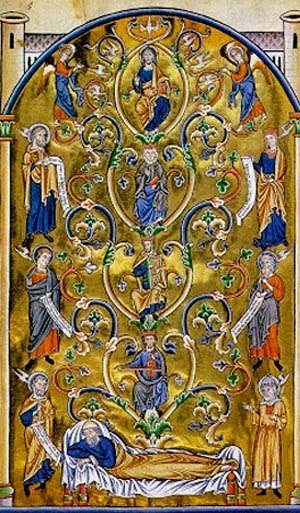
O Root of Jesse…

  • root2bof2bjesse“A shoot shall come out from the stock of Jesse, and a branch shall grow out of his roots.” Isaiah 11:1 Jesse was the father of King David (1 Sam. 16:10–13). David inaugurated a great kingdom, but the greater “David” (Ezek. 34:23–25; Zech. 12:7–10), now only a tender plant (53:2), will rule an incomparably greater kingdom. All that is left of the Davidic dynasty is a stump. The privileged sons of David no less than Assyria are like trees that have been chopped down (Is 10:33, 34). But in spite of this judgement on Judah, the Lord will raise up new leadership from the dynasty of David (Matt. 1:1). Micah had prophesied that the Messiah would be of the house and lineage of David and be born in David’s city, Bethlehem (Micah 5:2). see O Adonai
  • “A record of the origin of Jesus Christ, the son of David, the son of Abraham: Abraham begot Isaac…” Matthew 1:1–17 and continues on until …and Jacob begot Joseph, the husband of Mary, of whom was born Jesus, who is called Christ. Thus there were fourteen generations in all from Abraham to David, fourteen from David to the exile to Babylon, and fourteen from the exile to the Christ. Matthew emphasizes, right from the beginning, Jesus’ title Christ—the Greek rendering of the Hebrew title Messiah—meaning anointed, in the sense of an anointed king. Jesus is presented first and foremost as the long-awaited Messiah, who was expected to be a descendant and heir of King David, so the genealogy serves the essential purpose of demonstrating this line of descent. Thus, Matthew begins by calling Jesus son of David, indicating his royal origin, and also son of Abraham, indicating that he was a Jew; both are stock phrases, in which son means descendant, calling to mind the promises God made to David and to Abraham.
  • “And Jesus himself began to be about thirty years of age, being (as was supposed) the son of Joseph, which was the son of Heli…” Luke 3:23-38 Luke places his genealogy at the beginning of the public life of Jesus (Luke 3:23-38) and his account ascends from Joseph to Adam or and to God. This genealogy descends from the Davidic line through Nathan, who is an otherwise little-known son of David, mentioned briefly in the Old Testament (1 Chronicles 3:5; but also see Zechariah 12:12). The prophecy of Nathan (2 Samuel 7:12–16) understood as foretelling a son of God who would inherit the throne of his ancestor David and reign forever is quoted in Hebrews (Hebrews 1:5) and strongly alluded to in Luke’s account of the Annunciation (Luke 1:32–35). Likewise, the Psalms (Psalms 89:3-4; Psalms 132:11) record God’s promise to establish the seed of David on his throne forever, while Isaiah (Isaiah 16:5) and Jeremiah (Jeremiah 23:5-6) speak of the coming reign of a righteous king of the house of David. David’s ancestors are also understood as progenitors of the Messiah in several prophecies. Isaiah’s description of the branch or root of Jesse (Isaiah 11:1–10) is cited twice by Paul as a promise of the Christ (Acts 13:23; Romans 15:12). 
  • O-Radix-Jesse-1Concerning the genealogies… God promised to establish the throne of King Solomon over Israel forever, (1 Chronicles 22:9–10) but the promise was contingent upon obeying God’s commandments (1 Chronicles 28:6–7; 2 Chronicles 7:17–18; 1 Kings 9:4–5). Solomon’s failure to do so is explicitly cited as a reason for the subsequent division of his kingdom (1 Kings 11:4–11). Against King Jehoiakim, Jeremiah prophesied, “He shall have no one to sit on the throne of David,” (Jeremiah 36:30–31) and against his son King Jeconiah, “Write this man childless, a man who will not prosper in his days; for no man of his seed will prosper, sitting on the throne of David or ruling again in Judah.”  (Jeremiah 22:24–30) Some see this prophecy as permanently disqualifying Jeconiah from the ancestry of the Messiah (though not necessarily of Joseph) [e.g, Irenaeus, Adversus haereses (“Against Heresies”), p. 3.21.9j].

    To Zerubbabel, God declares through Haggai, “I will make you like my signet ring,” in clear reversal of the prophecy against his grandfather Jeconiah, “though you were a signet ring on my right hand, yet I would pull you off.” (Haggai 2:23 (cf. Jeremiah 22:24) Zerubbabel ruled as governor though not as king, and has been regarded by many as a suitable and likely progenitor of the Messiah. Clearly Matthew said that the blood father (begot) of Joseph was Jacob. Matthew had satisfied the Mosaic Law by showing the male ancestry of Jesus by going through Joseph instead of Mary. Keep in mind that this genealogy shows the legal, or royal, or public record, of descent and not the human descent, hence the inclusion of Jeconiah of Solomon. Luke shows the human descent of Christ through David to be Nathan, and not Solomon; thus avoiding the curse of Jeconiah. This alludes to the possibility that Luke’s genealogy is for a different person other than Joseph i.e. but of Mary. For Mary as the birth-giver of Jesus and a Jewess – it would be through her that the genetic Davidic bloodline would be inherited by Christ. Luke as a physician and writing for Gentiles might wish to emphasise this point, as Matthew would want to emphasise the legal point for the Jews following the Mosaic Law; both concur that Christ was born of Mary, a virgin, betrothed to Joseph.

standing as a sign among the peoples;

  • “On that day the root of Jesse shall stand as a signal to the peoples; the nations shall inquire of him, and his dwelling shall be glorious.” Isaiah 11:10 The prophet makes a further reference to the days of the Messiah and the accession of the Gentiles to His kingdom, which the apostle Paul follows, Rom. 15:12; There shall be a root of Jesse; and he that shall rise to reign over the Gentiles, in him shall the Gentiles trust. Here is the crux of this prophecy, speaking of Christ as the root of Jesse, or a branch out of his roots (Isa. 11:1), and also, a root out of a dry ground, Isa. 53:2. He is the root of David (Rev. 5:5), the root and offspring of David Rev. 22:16.
    crucifixion-silhouette-kent-sorensenHe shall stand, or be set up, for an ensign of the people. When Christ was crucified he was lifted up from the earth, that, as an ensign or a beacon, He might draw the eyes and the hearts of all men upon him, John 12:32. His preaching of the everlasting gospel and the salvation He brings, in which the apostles and their successors as standard-bearers likewise by their ministry display the banner of His love, to allure us to Him (Song 1:4), the banner of His truth, under which we engage in the war against sin and Satan. Christ is the ensign to which the faithful children of God scattered abroad are gathered together (John 11:51), and in Him they meet as the centre of their unity. To him shall the Gentiles seek. We read of Greeks that did so (John 12:21; “We would see Jesus”), when Christ spoke of his being lifted up, to draw all men to Himself.
    His rest shall be glorious. The triumph of the Cross make even His death glorious and His resurrection and His ascension too after which He sits at the right hand of God and in the Church, that Mount Zion of which Christ has said, “This is my rest”, and in which he resides. This, though despised by the world, having upon it the beauty of holiness, is truly glorious, a glorious high throne, Jeremiah 17:12. Both Jews and Gentiles shall be gathered to Him, Isaiah 11:11. As God delivered His people, and gathered them out of all the countries where they were scattered (Ps. 106:47; Jer. 16:15, 16), so He will a second time by the powerful working of the Spirit of grace with the Word. The outcasts of Israel and the dispersed of Judah (Isa. 11:12), the diaspora to whom the apostles’ preached, the twelve tribes that were scattered abroad (Jas. 1:1; 1 Pet. 1:1), shall flock to Christ; and probably more of those scattered Jews were brought into the church, in proportion, than had remained in Israel. Many of the nations, the Gentiles, shall be brought in by the lifting up of the ensign, the Jews were jealous of Christ’s going to the dispersed among the Gentiles and of His teaching the Gentiles, John 7:35.
  • “And again, Esaias saith, There shall be a root of Jesse, and he that shall rise to reign over the Gentiles; in him shall the Gentiles trust.” Romans 15:12. That they should believe in Christ (Rom. 15:12), quoted from Isa. 11:10; where observe, First, The revelation of Christ as the Gentiles’ king. He is here called the root of Jesse, that is, such a branch from the family of David as is the very life and strength of the family: compare Isa. 11:1. Christ was David’s Lord (as God), and yet withal He was the Son of David (Matthew 1:1–17; Luke 3:23-38; Matt. 22:45), for he was the root and offspring of David, Rev. 22:16. Christ, as God, was David’s root; Christ, as man, was David’s offspring.—And he that shall rise to reign over the Gentiles. When Christ rose from the dead, when He ascended on high, it was to reign over the Gentiles. Secondly, The recourse of the Gentiles to Him: In Him shall the Gentiles trust. Faith is the soul’s confidence in Christ and dependence on Him. The method of faith is first to seek Christ for a Saviour; and, finding Him able and willing to save, then to trust in Him.

before you kings will shut their mouths, to you the nations will make their prayer:

  • “Thus saith the Lord, The labour of Egypt, and merchandise of Ethiopia and of the Sabeans, men of stature, shall come over unto thee, and they shall be thine: they shall come after thee; in chains they shall come over, and they shall fall down unto thee, they shall make supplication unto thee, saying, Surely God is in thee; and there is none else, there is no God.” Isaiah 45:14 Sabeans i.e. descendants of Seba (Gen. 10:7); Africans (Isa. 43:3). They were “men of stature,” and engaged in merchandise (Isa. 45:14). Their conversion to the Lord was predicted (Ps. 72:10). The nations will come to worship the one God (Zech. 8:23; Eph. 3:6). Encouragement given to the believing Jews, who trusted in God and continued instant in prayer, assuring them that God would in due time accomplish this work by the hand of Cyrus, Isa. 45:11-15. A challenge given to the worshippers of idols and their doom read, and satisfaction given to the worshippers of the true God and their comfort secured, with an eye to the Mediator, who is made of God to us both righteousness and sanctification, Isa. 45:16-25. And here, as in many other parts of this prophecy, there is much of Christ and of gospel grace.
  • 9732976“So shall he sprinkle many nations; the kings shall shut their mouths at him: for that which had not been told them shall they see; and that which they had not heard shall they consider.” Isaiah 52:15 Many nations shall be the better for Him, for he shall sprinkle them, and not the Jews only; the blood of sprinkling shall be applied to their consciences, to purify them. He suffered, and died, and so sprinkled many nations; for in His death there was a fountain opened, Zech. 13:1. He shall sprinkle many nations by his heavenly doctrine, which shall drop as the rain and distil as the dew Isaiah 45:8 Drop down dew, you heavens, from above, and let the clouds rain the just: let the earth be opened and bud forth a Saviour.” Moses’s did so only on one nation (Deut. 32:2), but Christ’s on many nations. He shall do it by baptism, which is the washing of the body with pure water, Heb. 10:22. So that this promise had its accomplishment when Christ sent His apostles to disciple all nations, by baptizing or sprinkling them. As conceived by Christ, the Great Commission linked the missionary activity of the Church with that of Christ Himself (John 14:12). As the first and greatest missionary (Heb 3:1), He came to seek and to save the lost (Luke 19:10). The church’s mission was to be patterned after His (John 20:21). As His ministry included teaching, preaching and healing (Matt 4:23), so would theirs (Acts 4:2; 5:12-16).
    The great ones of the nation shall show Him respect: they shall with great humility and reverence receive His oracles and laws, as those who, when they heard Job’s wisdom, after his speech spoke not again, Job 29:9, 22. Kings shall see and arise, Isa. 49:7.
    The mystery which was kept secret from the beginning of the world shall by Him be made known to all nations as the apostle writes, “Now to Him who is able to establish you according to my gospel and the preaching of Jesus Christ, according to the revelation of the mystery which has been kept secret for long ages past, but now is manifested, and by the Scriptures of the prophets, according to the commandment of the eternal God, has been made known to all the nations, leading to obedience of faith” Romans 16:25, 26. The Gospel brings to light things new and unheard of, which will awaken the attention and engage the reverence of kings and kingdoms. This is applied to the preaching of the Gospel in the Gentile world, Romans 15:21. Much had been said in the Old Testament concerning the Messiah; much had been told them, and they had heard it and rejected it (Nehemiah 9:20, 30; Micah 3:8; Zechariah 7:12; Matthew 23:34); Christ disappointed the expectations of those who looked for a Messiah according to their fancies, but outdid theirs who looked for such a Messiah as was promised (Isaiah 44:24-28; Isaiah 46:8-11).

Come and deliver us, and delay no longer.

  • The prayer of the Church, of those who through obedience have received faith from God, echoing the cry of God’s faithful people throughout the centuries, imploring the Messiah “to come” as the prophets foretold and as He revealed Himself to be. That, beholding the Cross, His ensign, as many as may be saved in this world, may be through baptism and share eternity with Him when He comes again at the end of all ages.