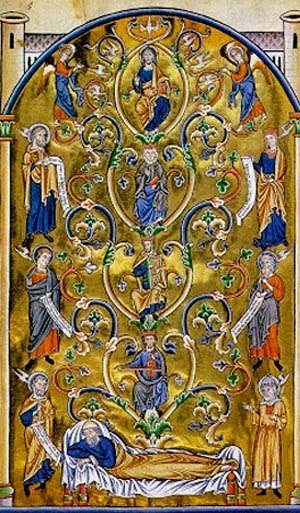
The sixth great “O” is: O Rex gentium, et desideratus earum, lapisque angularis, qui facis utraque unum: veni, et salva hominem, quem de limo formasti.
English: O King of the gentiles and their desired One, the cornerstone that makes both one: come, and deliver man, whom you formed out of the dust of the earth.
It reflects the following prophecies and Scripture:
O King of the gentiles and their desired One,
And they sing the song of Moses the servant of God, and the song of the Lamb, saying, Great and marvellous are thy works, Lord God Almighty; just and true are thy ways, thou King of saints. Revelation 15:3 Most probably the song of deliverance after the passage of the Red Sea (Exodus 15.), to which this bears a general resemblance. Moses is called the “servant of God” in Exodus 14:31 and elsewhere. The song of Moses is also the song of the Lamb; the Old Testament and the New Testament Churches are one. Saying, Great and marvellous are thy works, Lord God Almighty (cf. Exodus 15:7, “And in the greatness of thine excellency thou hast overthrown them;” also Psalm 111:2; Psalm 139:14). This song, like that in Revelation 4:8, is addressed to the “Lord God Almighty.” Christ is in this song addressed as a divine person, as Lord of all, God over all, blessed for ever, the Almighty God, as His works declare Him to be; His works of creation, providence, and redemption, which are all great and marvellous, particularly the accomplishment of the glorious things spoken of His church, and the destruction of His enemies, which are here designed (see O Adonai and O Clavis David).
the cornerstone…
Therefore thus saith the Lord GOD, Behold, I lay in Zion for a foundation a stone, a tried stone, a precious corner stone, a sure foundation: he that believeth shall not make haste. Isaiah 28:16 [comp. The stone which the builders refused is become the head stone of the corner. Psalm 118:22] In contrast with the insecure refuge and false ground of confidence whereon the nobles relied, the prophet puts forward the one sure “Rock” on which complete dependence may be placed – which he declares that Jehovah is laying, or “has laid,” in Zion as a tried stone, a precious corner stone, a sure foundation. The imagery is, no doubt, drawn from the practice of Oriental kings, and notably Solomon, to employ foundation-stones of enormous size and weight at the corners of buildings. Some of those uncovered at the corners of Solomon’s temple by the Palestine Exploration Fund are more than thirty-eight feet long, and weigh above a hundred tons (see ‘Our Work in Palestine,’ pp. 38, 115). But the reference cannot, of course, be to the material structure of the temple as Israel’s true refuge. Rather, Jehovah himself would seem to be the Rock (Isaiah 26:4; Isaiah 30:29, etc.) intended; and hence the application to Christ by the writers of the New Testament (Romans 9:33; Ephesians 2:20; 1 Peter 2:6-8) was natural and easy.
…that makes both one:
“Jesus saith unto them, Did ye never read in the scriptures, The stone which the builders rejected, the same is become the head of the corner: this is the Lord’s doing, and it is marvellous in our eyes?” Matthew 21:42 [Mark 12:10; Luke 20:17] By the Old Testament saints, and by saints in all ages, who have ventured their souls on Him, and laid the whole stress of their salvation upon Him, and have been saved by Him; and by Satan, and his principalities and powers, by his temptations of Him in the wilderness, and by his attacks upon Him in the garden, and on the cross, and found Him to be an immovable stone, and were broken by Him; and by His divine Father, who tried His faithfulness by trusting Him with all His elect, and the salvation of them; and His great strength, by laying upon Him all their sins, and the punishment due unto them. Some render it, “a stone of trial”, or “a trying stone” by which men are tried, and discovered to be what they are, whether believers or unbelievers, sincere Christians or hypocrites; which may be known by their conduct and behaviour to Christ; if they come to Him as a living stone, and He is precious to them, they are true believers; but if He is to them a stone of stumbling, and a rock of offence, they are unbelievers, and reprobate persons, 1 Peter 2:4,
This is the stone which was set at nought of you builders, which is become the head of the corner. Acts 4:11 So the Apostles preach themselves that Christ is the foundation of all their ministry, so that the churches “…are built upon the foundation of the apostles and prophets, Jesus Christ himself being the chief corner stone” Ephesians 2:20
come, and deliver man, whom you formed out of the dust of the earth.
So the Church expresses the prayer of the redeemed who recognise Christ as the “Word” i.e. the “logos”, the “Ruach Elohim” the Creator with God of the world, see O Sapientia.
The fifth great “O” is: O Oriens, splendor lucis aeternae, et sol iustitiae: veni, et illumina sedentes in tenebris et umbra mortis.
English: O dawn of the east, brightness of light eternal, and sun of justice: come, and enlighten those who sit in darkness and in the shadow of death.
It reflects the following prophecies and Scripture:
O dawn of the east, brightness of light eternal, and sun of justice:
But unto you that fear my name shall the Sun of righteousness arise with healing in his wings; and ye shall go forth, and grow up as calves of the stall. Malachi 4:2 The sun which is righteousness, who radiates the healing rays of salvation. This Divine righteousness shall shine forth upon them that live in holy fear of the the Name of God, filling and flooding them with joy and light, healing all wounds, removing all miseries, making them incalculably blessed. The Fathers generally apply the title of “Sun of Righteousness” to Christ, who is the Source of all justification and enlightenment and happiness, and who is called “The Lord our Righteousness.” (Jeremiah 23:6) The happiness of the righteous is illustrated by a homely image drawn from pastoral pursuits. They had been, as it were, hidden in the time of affliction and temptation; they shall go forth boldly now, free and exulting, like calves driven from the stall to pasture (comp. Psalm 114:4, 6; Song of Solomon 2:8, 17).
Through the tender mercy of our God; whereby the dayspring from on high hath visited us, Luke 1:78 So praises Zacharias in his noble hymn, all this tender care for Israel (though really for all humanity, if he hadn’t guessed it) is owing to the deep love of God. Whereby “the Dayspring from on high hath visited us.” In his temple service at Jerusalem the priest must have seen the ruddy dawn rise grandly over the dark chain of the distant mountains, and lighting up with a blaze of golden glory the everlasting hills as they stood around Jerusalem. This same thought has ever been held by the Church who in her worship bids us face East towards the Lord. The thought which pictured the advent of Messiah as a sunrise was a favourite with the prophets, “Arise, shine; for thy light is come, and the glory of the Lord is risen upon thee. For behold… Gentiles shall come to thy light, and kings to the brightness of the; rising” (Isaiah 60:1-3). “Unto you that fear my Name shall the Sun of Righteousness arise with healing in his wings” (Malachi 4:2).
come, and enlighten those who sit in darkness and in the shadow of death.
The people that walked in darkness have seen a great light: they that dwell in the land of the shadow of death, upon them hath the light shined. Isaiah 9:2 All the world was “in darkness” when Christ came; but here the Jews especially seem to be intended. “The Light of the world,” “the Sun of righteousness,” “the true Light, which lighteth every man that cometh into the world,” “first broke on man in that northern tract” by the way of the sea, “when Jesus came forward to teach and to preach in “Galilee of the Gentiles.” For thirty years He had dwelt at Nazareth, in Zebulon. There He had first come forward to teach in a synagogue (Luke 4:16-21); in Galilee He had performed His first miracles (John 2:11; John 4:54); at Capernaum. “Upon the sea coast, in the borders of Zabulon and Nephthalim,” He commenced His preaching of repentance (Matthew 4:13-17). The “light” first streamed forth in this quarter, glorifying the region on which contempt had long been poured, before bursting forth across the world, through the rays of the apostolic mission reaching through the ages to every quarter of the globe through their preaching of the Gospel.
The fourth great “O” is: O Clavis David, et sceptrum domus Israel; qui aperis, et nemo claudit; claudis, et nemo aperit: veni, et educ vinctum de domo carceris, sedentem in tenebris, et umbra mortis.
English: O Key of David and sceptre of the House of Israel; you open and no one can shut; you shut and no one can open: Come and lead the prisoners from the prison house, those who dwell in darkness and the shadow of death.
It reflects the following prophecies and Scripture:
O Key of David and sceptre of the House of Israel;
“For unto us a child is born, unto us a son is given: and the government shall be upon his shoulder: and his name shall be called Wonderful, Counsellor, The mighty God, The everlasting Father, The Prince of Peace.” Isaiah 9:6 (comp. Isaiah 7:14-16, where the promise of “a child,” “a son,” is first made – a child who was, like this Child, to be “God with us”). The word translated “government” (misrah) occurs only here and in verse 7, it is probably to be connected with sat, “prince,” and Israel. Government was regarded as a burden, to be born on the back or shoulders, and was sometimes symbolized by a key laid upon the shoulder. Vizier means “burdened.” The Latin writers often speak of the civil power as borne on the shoulders of magistrates (Cic., ‘Orat. pro Flacc,’ § 95; Plin., ‘Paneg.,’ § 10). “His name shall be called.” It is not important whether we view what follows as one name or several. Isaiah does not mean that the “Child” should bear as a name, or names, any of the expressions, but only that they should be truly applicable to him. “Wonderful” The Messiah would be “wonderful” in His nature as God-Man; in His teaching, which “astonished” those who heard it (Matthew 7:28); in His doings (Isaiah 25:1); in the circumstances of His birth and death; in His resurrection, and in His ascension. “Wonder” would be the first sentiment which His manifestation would provoke, and hence this descriptive epithet is placed first. “Counsellor” As the Word, as Wisdom itself, as He who says, “Counsel is mine, and sound wisdom: I am Understanding” (Proverbs 8:14), He is well named “Counsellor.” None will ever seek His counsel in vain, much less repent of following it. “The mighty God” The term “El”, God, had been previously applied to the Messiah only in Psalm 45:6. It denotes in Isaiah absolute divinity; it is never used hyperbolically or metaphorically. “The Everlasting Father” If the term “Father,” applied to our Lord, sits uncomfortably with us, we must remember that the distinction of three Persons in the Godhead had not yet been revealed (in Scripture). But the reference here is indeed to the Everlasting Father, the one Creator, Preserver, Protector of mankind who is absolutely eternal. “The Prince of Peace” A “Prince of Peace” had been long shadowed forth, as in Melchizedek, “King of Salem,” i.e. “of Peace;” and again in Solomon, “the peaceful one;” and Isaiah himself had already prophesied the peacefulness of the Messiah’s kingdom (Isaiah 2:4). Compare the song of the angels at our Lord’s birth (Luke 2:14). If the peacefulness has not vet very clearly shown itself, our Lord’s kingdom has yet to come into the hearts of most men. Christ is a Prince, often so called, Ezekiel 34:24 He is so by birth, being the King’s Son, the Son of God, and by office, power, and authority; He is so a Prince as that He is a King; He is exalted to be a Prince and a Saviour; and He is a Prince superior to kings, being the Prince of the kings of the earth, Acts 5:31 and He is called the “Prince of peace”, because he is the author of peace; just as He is said to be the “Prince of life”, Acts 3:15 for the same reason: He is the author of peace between Jew and Gentile, by abrogating the ceremonial law, the enmity between them, and by sending the Gospel to both, and making it the power of God to salvation to some of each of them, and by bringing them into the same Gospel church state, and making them partakers of the same privileges and blessings, internal and external, Ephesians 2:14 and He is the author of peace between God and sinners; He has made it by the blood of the cross, having the chastisement of their peace laid upon Him, in consequence of a covenant of peace He made with his Father, who was in Him reconciling the world to Himself.
“His authority shall grow continually, and there shall be endless peace for the throne of David and his kingdom. He will establish and uphold it with justice and with righteousness from this time onwards and for evermore.” Isaiah 9:7 The Messiah’s kingdom shall ever increase more and more; there shall be no limits to it; ultimately it shall fill the world (comp. Matthew 28:18, 19). The continual spread of Christianity tends to the accomplishment of this prophecy. That the Messiah is to sit on the throne of David, suggests, but does not absolutely imply, His Davidic descent. That descent is, however, announced with sufficient clearness in Isaiah 11:1, 10 (see O Radix Jesse). A gradual establishment of the kingdom would seem to be implied, such as is taught also in the parables of the mustard seed and the leaven. The kingdom is to be both universal in respect of extent and in respect of duration eternal. God’s jealousy of his own honour, which is bound up with the prosperity and final triumph of his people over all their enemies, will assure the performance of all that is here prophesied.
“I will place on his shoulder the key of the house of David; he shall open, and no one shall shut; he shall shut, and no one shall open.” Isaiah 22:22 The first mention of the key of the house of David is found in the book of Isaiah, in a description of the duties of Eliakim, the royal chamberlain of King Hezekiah of Judah: And it shall come to pass in that day, that I will call my servant Eliakim the son of Hilkiah: And I will clothe him with thy robe, and strengthen him with thy girdle, and I will commit thy government into his hand: and he shall be a father to the inhabitants of Jerusalem, and to the house of Judah. And the key of the house of David will I lay upon his shoulder; so he shall open, and none shall shut; and he shall shut, and none shall open. (Isaiah 22:20-22) The key of the house of David is symbolic for the government of Eliakim in Isaiah 22 (v.21), which is a type or symbol of the government of Jesus Christ as described in Isaiah 9. Note also that according to Isaiah, the government or kingdom of Jesus Christ is established, or founded, on a work of judgement(Isa 9:7). This is an important aspect of the key of the house of David.The key of the house of David, possessed by Christ, opens two important doors. In the travelling Tabernacle of Moses, there were two “doors”. Through the first door was the Holy Place, the first apartment. This is the door opened first chronologically in Revelation 4:1, in the heavenlyTabernacle, with the key of David. “After this I looked, and, behold, a door was opened in heaven: and the first voice which I heard was as it were of a trumpet talking with me; which said, Come up hither, and I will show thee things which must be hereafter. And immediately I was in the spirit; and, behold, a throne was set in heaven, and one sat on the throne.” Rev 4:1-2 The scene that John sees in heaven after the first door is opened, is a throne room (Rev 5:6-11). In this scene, the one on the throne is God the Father, and the Lamb as it had been slain is Jesus, returning to His Father from His crucifixion. There is a book or scroll with seven seals which only Jesus as the slain Lamb can open, and the seals are opened in sequence from Rev. 6:1 to 8:1. Christ as the sacrificed Lamb is the only one qualified to receive the title deed to the Kingdom, containing the names of all the saved, the Lamb’s book of life. The type of this in the Old Testament is the kinsman redeemer Boaz, who by purchasing the land of Naomi, also took Ruth as his wife. Jesus is our kinsman redeemer, who by His sacrifice bought back ownership of the earth, which Adam had forfeited to Satan at the fall. By this, Jesus also takes those faithful believer’s He has redeemed as His bride, restoring to them their inheritance. “For such as be blessed of him shall inherit the earth; and they that be cursed of him shall be cut off.”Psalm 37:22 The second door opened the veil or door from the Holy Place into the Most Holy. On the Day of Atonement the high priest entered the Most Holy apartment of the Sanctuary or Temple, which was symbolic of the judgement of God’s people. In the Most Holy was the Ark of the Covenant, containing the standard of judgement the Ten Commandments of God (Exodus 20:2-17). The last of the seven churches is called Laodicea “a people judged” because they are living in the time of the judgement. This event is also described in Daniel: “I beheld till the thrones were cast down [set in place], and the Ancient of days [God the Father] did sit, whose garment was white as snow, and the hair of his head like the pure wool: his throne was like the fiery flame, and his wheels as burning fire. A fiery stream issued and came forth from before him: thousand thousands ministered unto him, and ten thousand times ten thousand stood before him: the judgement was set, and the books were opened.” Dan 7:9-10 The books being opened in the judgement are the evidence, to include the Lamb’s book of life (Rev. 3:5), which is Christ’s last will and testament: “And for this cause he [Christ] is the mediator of the new testament, that by means of death, for the redemption of the transgressions that were under the first testament, they which are called might receive the promise of eternal inheritance. For where a testament is, there must also of necessity be the death of the testator. For a testament is of force after men are dead: otherwise it is of no strength at all while the testator liveth.” Hebrews 9:15-17Those being judged are the professed people of God, those who claim to be the heirs of Christ, the rightful inheritors of eternal life: “For the time is come that judgement must begin at the house of God: and if it first begin at us, what shall the end be of them that obey not the gospel of God?”1 Peter 4:17“And every one that hath forsaken houses, or brethren, or sisters, or father, or mother, or wife, or children, or lands, for my name’s sake, shall receive an hundredfold, and shall inherit everlasting life.” Matthew 19:29
you open and no one can shut; you shut and no one can open:
“Then Jesus came to them and said, “All authority in heaven and on earth has been given to me.”
Matthew 28:18 Jesus here asserts that He, as Son of man, has received from the Father supreme authority in heaven and earth, over the whole kingdom of God in its fullest extent. This is not given to Him as Son of God; for, as God, naught can be added to Him or taken from Him; it is a power which He has merited by His incarnation, death, and Passion (Philippians 2:8-10), which was foretold in the Old Testament (Psalm 2:8; Psalm 8:5-8 & Daniel 7:13, 14), and with which he was imbued on the day that He rose victorious from the grave. The power is exercised in His mediatorial kingdom, and will continue to be exercised till He has put all enemies under His feet, and destroyed death itself (1 Corinthians 15:24-27); but His absolute kingdom is everlasting; as God and Man He reigns forever and ever. This mediatorial authority extends not only over men, so that He governs and protects the Church, disposes bureau events, controls hearts and opinions; but the forces of heaven also are at his command, the Holy Spirit is bestowed by Him, the angels are in His employ as ministering to the members of His body. It is with this authority that He imbues His apostles and their successors in the Church
“And I will give to thee the keys of the kingdom of heaven. And whatsoever thou shalt bind upon earth, it shall be bound also in heaven: and whatsoever thou shalt loose on earth, it shall be loosed also in heaven.”Matthew 6:19,
And to the angel of the church of Philadelphia write: These things saith the Holy One and the true one, he that hath the key of David, he that openeth and no man shutteth, shutteth and no man openeth: I know thy works. Behold, I have given before thee a door opened, which no man can shut: because thou hast a little strength and hast kept my word and hast not denied my name. Revelation 3:7-8 Like the Philadelphians in Revelation 3 (see above ref the key of David), we must never deny the Lord, nor be overly proud of our attempts at holiness, remembering always from Whom our strength is supplied. “The keys of the kingdom of heaven” (Matthew 16:19) are not to be confounded with “the key of knowledge” in Christ’s rebuke to the hypocritical Pharisees “Woe unto you, lawyers! for ye have taken away the key of knowledge: ye entered not in yourselves, and them that were entering in ye hindered.” Luke 11:52. The keys belong to Christ, but have been committed to His Church, but not unreservedly. If the Church errs in binding or loosing, He cancels the judgement. Binding and loosing, in the common language of the Jews, signified to forbid and to allow, or to teach what is lawful or unlawful. The Church may open where Christ will shut, and shut where Christ will open. He alone openeth so that none shall shut, and shutteth so that none can open.
Come and lead the prisoners from the prison house, those who dwell in darkness and the shadow of death.
“…To open the blind eyes, to bring out the prisoners from the prison, and them that sit in darkness out of the prison house.” Isaiah 42:7. Though in Christ, the Messiah has the power to heal both physical as well as spiritual blindness, it is the latter we should interpret here. “Come and lead the prisoners” we might understand as those Jews shut up under the law, i.e. entrapped by ignorance and hypocrisy, tied to the “letter and not the spirit” of the law (cf 2 Corinthians 3:6); “from the prison house” we may understand as those entrapped and enslaved by sin and Satan; “those who dwell in darkness” i.e. the Gentiles, destitute of all divine knowledge, having not known the prophets and the law as had the Jews.
Modernist structures, liturgical compromise, and coalition politics cannot restore what they presuppose as negotiable. Only Tradition—received, binding, and lived—can confront the age.
There is no serious challenge to the contemporary culture that does not first confront the modernist culture entrenched within the Church herself. The Church is not merely a passive victim of the radical secularisation that accelerated in the 1960s; she absorbed its assumptions, vocabulary, and methods, and in doing so forfeited much of her capacity to act as a genuine counter-culture. A Church shaped by the categories of late modernity cannot credibly oppose the consequences of late modernity.¹ ² ³
The secular revolution of the post-war decades was philosophical before it was political. It enthroned autonomy over truth, experience over doctrine, process over form, and subjectivity over metaphysics. When these principles entered ecclesial life—through theological experimentation, pastoral pragmatism, and a systematic aversion to dogmatic clarity—the Church’s prophetic voice was dulled. A Church uncertain about God, man, sin, grace, judgment, and authority cannot meaningfully confront a culture that denies them outright.² ³ ⁴
This internal contradiction explains the failure of so many ecclesial strategies aimed at “engagement,” “dialogue,” and “accompaniment.” Detached from doctrinal precision and moral authority, such approaches merely accept the grammar of the age and attempt to baptise it. What results is not evangelisation but accommodation: the Church becomes a chaplain to the zeitgeist rather than its judge. Having internalised the logic of secularism—relativism, historicism, and therapeutic moralism—she finds herself incapable of resisting it externally.² ³ ⁴
It is precisely here that the incoherence of certain contemporary “traditionalist” projects becomes evident. Many claim to advocate for Tradition from within the structures of the post-conciliar Church while simultaneously defending the Novus Ordo Missae and Pope Benedict XVI’s twin strategies of a liturgical “reform of the reform” and a doctrinal “hermeneutic of continuity.” This position attempts to resolve a real rupture through interpretive and aesthetic means, without addressing its underlying causes.⁵ ⁶
The Novus Ordo Missae is not a neutral vessel awaiting more reverent implementation. It is the liturgical expression of a reconfigured ecclesiology and anthropology: dialogical rather than sacrificial, horizontal rather than vertical, didactic rather than propitiatory. Its architecture of options, its pastoral logic, and its underlying principles presuppose precisely those modern assumptions—adaptability, accessibility, and relevance—that mirror the broader secular project. To defend this rite while claiming to mount a serious resistance to modernity is to underestimate the formative power of liturgy itself. The law of prayer does not merely reflect belief; it generates it.⁶ ⁷ ⁸ ⁹
A recent intervention by Fr Matthew Solomon brings this fault line into sharper focus. Responding to appeals that reduce the question of liturgy to reverence or subjective impact, Solomon insists that such arguments collapse Tradition into preference unless they are grounded in the prior and more fundamental question of obligation: what must be handed on. Reverence, he argues, is neither an impression nor a sensibility, but the fruit of obedience to what the Church has received and is duty-bound to transmit. Where the Novus Ordo Missae is treated as a neutral form capable of redemption through improved execution, Solomon’s analysis implicitly rejects the premise altogether. If the Church’s mission is fidelity to what has been handed down, then the liturgy itself becomes a matter of judgment rather than accommodation.¹
The same unresolved contradiction reappears in broader attempts to build a “traditional coalition” without first resolving the theological questions that divide it. Calls to “unite the clans,” most notably associated with Michael Matt, proceed from a strategic rather than doctrinal diagnosis of the crisis. They assume that the problem is fragmentation among conservatives, rather than disagreement about authority, continuity, and the legitimacy of the post-conciliar settlement. Unity is thus pursued as an end in itself, rather than as the fruit of shared first principles.¹⁰
The same pattern is visible in projects such as the Catholic Identity Conference and LifeSite’s Roman Forum. These platforms often gather speakers who are rightly critical of secular modernity, moral collapse, and episcopal failure, yet who remain fundamentally divided on the causes of the crisis and the status of the reforms that followed the Council. The price of maintaining the coalition is silence—or studied ambiguity—on the very questions that determine whether Tradition is merely preserved as a theme or restored as a governing principle.¹¹ ¹²
This logic also explains the limited and ultimately compromising role played by institutes such as the Institute of Christ the King Sovereign Priest and the Priestly Fraternity of Saint Peter. There is no denying that these communities have helped many souls. They have preserved elements of traditional liturgy, fostered vocations, and offered refuge from the most egregious abuses of the reformed rites. In that narrow sense, they have helped. But they have not furthered the cause of Tradition as such, because their continued existence depends upon accepting the post-conciliar framework as normative and beyond adjudication.¹³ ¹⁴ ¹⁵ ¹⁶ ¹⁷
By design, these institutes bracket the central question—what must be handed on—and replace it with a pastoral workaround. Tradition may be preserved here, by permission, as an exception within a reformed system. The cost of that permission is silence: silence about the principles of the liturgical reform, silence about rupture, silence about the authority that displaced the Roman Rite and reserves the right to suppress it again. In exchange for recognition and stability, Tradition is rendered conditional, provisional, and structurally fragile.¹³ ¹⁴
This is precisely why the efforts of bodies such as the Priestly Society of Saint Pius X, the Old Roman Apostolate, the Sons of the Most Holy Redeemer, and the Servants of the Holy Family, together with similar societies, are not merely helpful but vital to the continuance of Tradition in any meaningful sense.¹⁸ ¹⁹ ²⁰ ²¹ ²² ²³ ²⁴
What unites these bodies is not a shared temperament or tactical posture, but a shared refusal to accept the post-conciliar settlement as the unquestionable norm within which Tradition must survive by tolerance. They begin instead from the conviction that Tradition is the Church’s rule of faith and worship, not an optional charism, and that extraordinary measures are justified when that inheritance is displaced, marginalised, or rendered conditional.¹⁸ ¹⁹ ²²
The SSPX, whatever disputes surround its canonical situation, has consistently refused to collapse Tradition into preference or aesthetics. Its founding rationale was not to create a “traditional option” within a pluralist Church, but to preserve intact the Church’s doctrinal, liturgical, and sacerdotal formation at a moment of acute rupture. It named the crisis as doctrinal before it was pastoral, and liturgical as the privileged site where that doctrinal rupture was embodied. In doing so, it preserved not merely external forms, but the internal logic of Tradition as something binding, objective, and transmissible.¹⁸ ¹⁹ ²⁰ ²²
The Old Roman Apostolate proceeds from a similar principle, though by a distinct historical and canonical path. By maintaining sacramental life, priestly formation, and episcopal governance rooted in pre-conciliar theology and liturgy—while explicitly orienting itself toward reconciliation on the basis of doctrinal continuity rather than accommodation—it demonstrates a truth sanctioned institutes cannot: that Tradition does not survive by permission. It survives by fidelity exercised under necessity.²¹ ²²
The same logic is evident in the witness of the Sons of the Most Holy Redeemer and the Servants of the Holy Family. These communities have resisted the reduction of religious life to pastoral utility or ideological alignment, and instead preserved a monastic and familial vision grounded in authority, asceticism, sacrificial priesthood, and the integral transmission of the Faith. Their importance lies not in numbers, but in coherence. Where Tradition is treated as obligatory, it becomes resilient; where it is treated as negotiable, it becomes fragile.²³ ²⁴
Taken together, these bodies function as living repositories of memory, practice, and formation. They ensure that the Roman Rite is not merely archived, aestheticised, or nostalgically admired, but lived. They preserve a priestly identity that is sacrificial rather than managerial, doctrinal rather than therapeutic. They keep alive an ecclesial worldview in which authority is real, doctrine determinate, and worship received rather than constructed.⁸ ⁹ ²⁵
By contrast, projects that seek unity without adjudication, or preservation without judgment, may delay decline but cannot reverse it. They depend upon goodwill, episcopal tolerance, and institutional stability—each of which can be withdrawn. The efforts of the SSPX, the Old Roman Apostolate, the Sons of the Most Holy Redeemer, the Servants of the Holy Family, and similar societies rest instead on clarity of principle: on knowing what must be handed on, and accepting the cost of handing it on.¹⁸ ¹⁹ ²²
In this sense, they are not obstacles to unity but witnesses to its proper foundation. Unity in the Church has never arisen from negotiated compromise or managed diversity, but from shared submission to what has been received. Until the wider Church is prepared to face honestly the question these bodies force into the open—what, precisely, must be handed on—their existence will remain not only justified, but indispensable.¹⁸ ²²
Only Tradition—understood not as nostalgia, aesthetic preference, or selective retrieval, but as the living transmission of revealed truth—breaks this paralysis. Tradition is fixed in doctrine, objective in sacramental form, authoritative in moral teaching, and supernatural in horizon. It alone provides a metaphysical account of reality that contradicts modern secular assumptions at their root. It restores the Church’s capacity to say no—to error, to sin, and to false notions of freedom—because it is grounded in something prior to and higher than the modern world.²⁵ ²⁶ ²⁷
The Church will not renew society by mirroring it, moderating it, or managing its decline. She can only renew society by standing outside the ideological framework of the age and calling it to conversion. That stance is impossible so long as modernist assumptions remain unchallenged within ecclesial structures themselves. A Church formed by the categories of the 1960s cannot meaningfully oppose the consequences of the 1960s.²³ ⁴
The recovery of Tradition, therefore, is not an internal preference dispute, a stylistic quarrel, or a matter of coalition politics; it is a civilisational necessity. To advocate for Tradition while defending the structures that displaced it is to fight the disease with its own symptoms. Until the Church reclaims her own inheritance—her theology, her liturgy, her moral clarity, and her supernatural orientation—she will remain unable to challenge the culture she helped to form. Only a full retrieval of Tradition, received rather than reconstructed, allows the Church once again to become a sign of contradiction to the age rather than a reflection of it.²⁵ ²⁶ ²⁷
Fr Matthew Solomon, A Disagreement with Phil Lawler, 19 December 2025. frsolomon.substack.com
Romano Guardini, The End of the Modern World (Wilmington, DE: ISI Books, 1998).
Joseph Ratzinger, Introduction to Christianity (San Francisco: Ignatius Press, 2004 [1968]).
Henri de Lubac, The Drama of Atheist Humanism (San Francisco: Ignatius Press, 1995).
Joseph Ratzinger, Address to the Roman Curia, 22 December 2005. vatican.va
Annibale Bugnini, The Reform of the Liturgy 1948–1975 (Collegeville: Liturgical Press, 1990).
Klaus Gamber, The Reform of the Roman Liturgy (San Juan Capistrano: Una Voce Press, 1993).
Joseph Ratzinger, The Spirit of the Liturgy (San Francisco: Ignatius Press, 2000).
Alcuin Reid, The Organic Development of the Liturgy (San Francisco: Ignatius Press, 2005).
Michael Matt, “Unite the Clans,” The Remnant. remnantnewspaper.com
Catholic Identity Conference, official materials. catholicidentityconference.org
LifeSiteNews, Roman Forum event series. lifesitenews.com
The third great “O” is:O Radix Jesse, qui stas in signum populorum, super quem continebunt reges os suum, quem Gentes deprecabuntur: veni ad liberandum nos, jam noli tardare.
English: O Root of Jesse, standing as a sign among the peoples; before you kings will shut their mouths, to you the nations will make their prayer: Come and deliver us, and delay no longer.
It reflects the following prophecies and Scripture:
O Root of Jesse…
“A shoot shall come out from the stock of Jesse, and a branch shall grow out of his roots.” Isaiah 11:1 Jesse was the father of King David (1 Sam. 16:10–13). David inaugurated a great kingdom, but the greater “David” (Ezek. 34:23–25; Zech. 12:7–10), now only a tender plant (53:2), will rule an incomparably greater kingdom. All that is left of the Davidic dynasty is a stump. The privileged sons of David no less than Assyria are like trees that have been chopped down (Is 10:33, 34). But in spite of this judgement on Judah, the Lord will raise up new leadership from the dynasty of David (Matt. 1:1). Micah had prophesied that the Messiah would be of the house and lineage of David and be born in David’s city, Bethlehem (Micah 5:2). see O Adonai
“A record of the origin of Jesus Christ, the son of David, the son of Abraham: Abraham begot Isaac…”Matthew 1:1–17and continues on until …and Jacob begot Joseph, the husband of Mary, of whom was born Jesus, who is called Christ. Thus there were fourteen generations in all from Abraham to David, fourteen from David to the exile to Babylon, and fourteen from the exile to the Christ. Matthew emphasizes, right from the beginning, Jesus’ title Christ—the Greek rendering of the Hebrew title Messiah—meaning anointed, in the sense of an anointed king. Jesus is presented first and foremost as the long-awaited Messiah, who was expected to be a descendant and heir of King David, so the genealogy serves the essential purpose of demonstrating this line of descent. Thus, Matthew begins by calling Jesus son of David, indicating his royal origin, and also son of Abraham, indicating that he was a Jew; both are stock phrases, in which son means descendant, calling to mind the promises God made to David and to Abraham.
“And Jesus himself began to be about thirty years of age, being (as was supposed) the son of Joseph, which was the son of Heli…” Luke 3:23-38 Luke places his genealogy at the beginning of the public life of Jesus (Luke 3:23-38) and his account ascends from Joseph to Adam or and to God. This genealogy descends from the Davidic line through Nathan, who is an otherwise little-known son of David, mentioned briefly in the Old Testament (1 Chronicles 3:5; but also see Zechariah 12:12). The prophecy of Nathan (2 Samuel 7:12–16) understood as foretelling a son of God who would inherit the throne of his ancestor David and reign forever is quoted in Hebrews (Hebrews 1:5) and strongly alluded to in Luke’s account of the Annunciation (Luke 1:32–35). Likewise, the Psalms (Psalms 89:3-4; Psalms 132:11) record God’s promise to establish the seed of David on his throne forever, while Isaiah (Isaiah 16:5) and Jeremiah (Jeremiah 23:5-6) speak of the coming reign of a righteous king of the house of David. David’s ancestors are also understood as progenitors of the Messiah in several prophecies. Isaiah’s description of the branch or root of Jesse (Isaiah 11:1–10) is cited twice by Paul as a promise of the Christ (Acts 13:23; Romans 15:12).
Concerning the genealogies…God promised to establish the throne of King Solomon over Israel forever, (1 Chronicles 22:9–10) but the promise was contingent upon obeying God’s commandments (1 Chronicles 28:6–7; 2 Chronicles 7:17–18; 1 Kings 9:4–5). Solomon’s failure to do so is explicitly cited as a reason for the subsequent division of his kingdom (1 Kings 11:4–11). Against King Jehoiakim, Jeremiah prophesied, “He shall have no one to sit on the throne of David,” (Jeremiah 36:30–31) and against his son King Jeconiah, “Write this man childless, a man who will not prosper in his days; for no man of his seed will prosper, sitting on the throne of David or ruling again in Judah.” (Jeremiah 22:24–30) Some see this prophecy as permanently disqualifying Jeconiah from the ancestry of the Messiah (though not necessarily of Joseph) [e.g, Irenaeus, Adversus haereses (“Against Heresies”), p. 3.21.9j].
To Zerubbabel, God declares through Haggai, “I will make you like my signet ring,” in clear reversal of the prophecy against his grandfather Jeconiah, “though you were a signet ring on my right hand, yet I would pull you off.” (Haggai 2:23 (cf. Jeremiah 22:24) Zerubbabel ruled as governor though not as king, and has been regarded by many as a suitable and likely progenitor of the Messiah. Clearly Matthew said that the blood father (begot) of Joseph was Jacob. Matthew had satisfied the Mosaic Law by showing the male ancestry of Jesus by going through Joseph instead of Mary. Keep in mind that this genealogy shows the legal, or royal, or public record, of descent and not the human descent, hence the inclusion of Jeconiah of Solomon. Luke shows the human descent of Christ through David to be Nathan, and not Solomon; thus avoiding the curse of Jeconiah. This alludes to the possibility that Luke’s genealogy is for a different person other than Joseph i.e. but of Mary. For Mary as the birth-giver of Jesus and a Jewess – it would be through her that the genetic Davidic bloodline would be inherited by Christ. Luke as a physician and writing for Gentiles might wish to emphasise this point, as Matthew would want to emphasise the legal point for the Jews following the Mosaic Law; both concur that Christ was born of Mary, a virgin, betrothed to Joseph.
standing as a sign among the peoples;
“On that day the root of Jesse shall stand as a signal to the peoples; the nations shall inquire of him, and his dwelling shall be glorious.” Isaiah 11:10 The prophet makes a further reference to the days of the Messiah and the accession of the Gentiles to His kingdom, which the apostle Paul follows, Rom. 15:12; There shall be a root of Jesse; and he that shall rise to reign over the Gentiles, in him shall the Gentiles trust. Here is the crux of this prophecy, speaking of Christ as the root of Jesse, or a branch out of his roots (Isa. 11:1), and also, a root out of a dry ground, Isa. 53:2. He is the root of David (Rev. 5:5), the root and offspring of David Rev. 22:16. He shall stand, or be set up, for an ensign of the people. When Christ was crucified he was lifted up from the earth, that, as an ensign or a beacon, He might draw the eyes and the hearts of all men upon him, John 12:32. His preaching of the everlasting gospel and the salvation He brings, in which the apostles and their successors as standard-bearers likewise by their ministry display the banner of His love, to allure us to Him (Song 1:4), the banner of His truth, under which we engage in the war against sin and Satan. Christ is the ensign to which the faithful children of God scattered abroad are gathered together (John 11:51), and in Him they meet as the centre of their unity. To him shall the Gentiles seek. We read of Greeks that did so (John 12:21; “We would see Jesus”), when Christ spoke of his being lifted up, to draw all men to Himself. His rest shall be glorious. The triumph of the Cross make even His death glorious and His resurrection and His ascension too after which He sits at the right hand of God and in the Church, that Mount Zion of which Christ has said, “This is my rest”, and in which he resides. This, though despised by the world, having upon it the beauty of holiness, is truly glorious, a glorious high throne, Jeremiah 17:12. Both Jews and Gentiles shall be gathered to Him, Isaiah 11:11. As God delivered His people, and gathered them out of all the countries where they were scattered (Ps. 106:47; Jer. 16:15, 16), so He will a second time by the powerful working of the Spirit of grace with the Word. The outcasts of Israel and the dispersed of Judah (Isa. 11:12), the diaspora to whom the apostles’ preached, the twelve tribes that were scattered abroad (Jas. 1:1; 1 Pet. 1:1), shall flock to Christ; and probably more of those scattered Jews were brought into the church, in proportion, than had remained in Israel. Many of the nations, the Gentiles, shall be brought in by the lifting up of the ensign, the Jews were jealous of Christ’s going to the dispersed among the Gentiles and of His teaching the Gentiles, John 7:35.
“And again, Esaias saith, There shall be a root of Jesse, and he that shall rise to reign over the Gentiles; in him shall the Gentiles trust.” Romans 15:12. That they should believe in Christ (Rom. 15:12), quoted from Isa. 11:10; where observe, First, The revelation of Christ as the Gentiles’ king. He is here called the root of Jesse, that is, such a branch from the family of David as is the very life and strength of the family: compare Isa. 11:1. Christ was David’s Lord (as God), and yet withal He was the Son of David (Matthew 1:1–17; Luke 3:23-38; Matt. 22:45), for he was the root and offspring of David, Rev. 22:16. Christ, as God, was David’s root; Christ, as man, was David’s offspring.—And he that shall rise to reign over the Gentiles. When Christ rose from the dead, when He ascended on high, it was to reign over the Gentiles. Secondly, The recourse of the Gentiles to Him: In Him shall the Gentiles trust. Faith is the soul’s confidence in Christ and dependence on Him. The method of faith is first to seek Christ for a Saviour; and, finding Him able and willing to save, then to trust in Him.
before you kings will shut their mouths, to you the nations will make their prayer:
“Thus saith the Lord, The labour of Egypt, and merchandise of Ethiopia and of the Sabeans, men of stature, shall come over unto thee, and they shall be thine: they shall come after thee; in chains they shall come over, and they shall fall down unto thee, they shall make supplication unto thee, saying, Surely God is in thee; and there is none else, there is no God.” Isaiah 45:14 Sabeans i.e. descendants of Seba (Gen. 10:7); Africans (Isa. 43:3). They were “men of stature,” and engaged in merchandise (Isa. 45:14). Their conversion to the Lord was predicted (Ps. 72:10). The nations will come to worship the one God (Zech. 8:23; Eph. 3:6). Encouragement given to the believing Jews, who trusted in God and continued instant in prayer, assuring them that God would in due time accomplish this work by the hand of Cyrus, Isa. 45:11-15. A challenge given to the worshippers of idols and their doom read, and satisfaction given to the worshippers of the true God and their comfort secured, with an eye to the Mediator, who is made of God to us both righteousness and sanctification, Isa. 45:16-25. And here, as in many other parts of this prophecy, there is much of Christ and of gospel grace.
“So shall he sprinkle many nations; the kings shall shut their mouths at him: for that which had not been told them shall they see; and that which they had not heard shall they consider.” Isaiah 52:15 Many nations shall be the better for Him, for he shall sprinkle them, and not the Jews only; the blood of sprinkling shall be applied to their consciences, to purify them. He suffered, and died, and so sprinkled many nations; for in His death there was a fountain opened, Zech. 13:1. He shall sprinkle many nations by his heavenly doctrine, which shall drop as the rain and distil as the dew Isaiah 45:8 “Drop down dew, you heavens, from above, and let the clouds rain the just: let the earth be opened and bud forth a Saviour.” Moses’s did so only on one nation (Deut. 32:2), but Christ’s on many nations. He shall do it by baptism, which is the washing of the body with pure water, Heb. 10:22. So that this promise had its accomplishment when Christ sent His apostles to disciple all nations, by baptizing or sprinkling them. As conceived by Christ, the Great Commission linked the missionary activity of the Church with that of Christ Himself (John 14:12). As the first and greatest missionary (Heb 3:1), He came to seek and to save the lost (Luke 19:10). The church’s mission was to be patterned after His (John 20:21). As His ministry included teaching, preaching and healing (Matt 4:23), so would theirs (Acts 4:2; 5:12-16). The great ones of the nation shall show Him respect: they shall with great humility and reverence receive His oracles and laws, as those who, when they heard Job’s wisdom, after his speech spoke not again, Job 29:9, 22. Kings shall see and arise, Isa. 49:7. The mystery which was kept secret from the beginning of the world shall by Him be made known to all nations as the apostle writes, “Now to Him who is able to establish you according to my gospel and the preaching of Jesus Christ, according to the revelation of the mystery which has been kept secret for long ages past, but now is manifested, and by the Scriptures of the prophets, according to the commandment of the eternal God, has been made known to all the nations, leading to obedience of faith” Romans 16:25, 26. The Gospel brings to light things new and unheard of, which will awaken the attention and engage the reverence of kings and kingdoms. This is applied to the preaching of the Gospel in the Gentile world, Romans 15:21. Much had been said in the Old Testament concerning the Messiah; much had been told them, and they had heard it and rejected it (Nehemiah 9:20, 30; Micah 3:8; Zechariah 7:12; Matthew 23:34); Christ disappointed the expectations of those who looked for a Messiah according to their fancies, but outdid theirs who looked for such a Messiah as was promised (Isaiah 44:24-28; Isaiah 46:8-11).
Come and deliver us, and delay no longer.
The prayer of the Church, of those who through obedience have received faith from God, echoing the cry of God’s faithful people throughout the centuries, imploring the Messiah “to come” as the prophets foretold and as He revealed Himself to be. That, beholding the Cross, His ensign, as many as may be saved in this world, may be through baptism and share eternity with Him when He comes again at the end of all ages.
The second great “O” is:O Adonai, et Dux domus Israel, qui Moysi in igne flammae rubi apparuisti, et ei in Sina legem dedisti: veni ad redimendum nos in brachio extento.
English: O Adonai, and leader of the House of Israel, who appeared to Moses in the fire of the burning bush and gave him the law on Sinai: Come and redeem us with an outstretched arm.
It reflects the following prophecies and Scripture:
O Adonai…
“For the Lord is our judge, the Lord is our ruler, the Lord is our king; he will save us.” Isaiah 33:22 “Adonai” means “Lord” and was the Hebrew word used to replace God’s name YHWH held to be too sacred to pronounce aloud; the repetition of “Adonai” three times is common in the Scriptures, here preceding judge, ruler and king. These attributes summarise the ideal theocracy, to be realised by the Messiah alone; the judicial, legislative, and administrative functions as king to be exercised by Him in person (Isa 11:4; 32:1; Jas 4:12). Jesus came to inaugurate the reign of God on earth “The kingdom of God has come near; repent and believe in the good news” (Mark 1:15), primarily by His rule in the hearts of men (Luke 17:20-21) through His saving redemptive sacrifice on the Cross (Hebrews 9:28). Ultimately we will live with Him in the fullness of the kingdom of God (John 6:40; 1 Corinthians 15) when it comes to earth “Your kingdom come. Your will be done, on earth as it is in heaven” (Matt 6:10). For as was revealed to St John the Beloved concerning the kingdom of God at the end of the ages, when Christ shall reign “Look what I have done,” Christ says from His throne “I have made all things new.” (Revelation 21:5)
“[…] but with righteousness he shall judge the poor, and decide with equity for the meek of the earth; he shall strike the earth with the rod of his mouth, and with the breath of his lips he shall kill the wicked. Righteousness shall be the belt around his waist, and faithfulness the belt around his loins.” Isaiah 11:4-5 This refers to the kingship of Christ as “Adonai”. Only Our Lord Jesus Christ could possess all these properties, for only He as the Son of God could possess the divine judgement: for He it is who touches the hearts of the faithful and mortifies their concupiscence: and to those who will not repent, He alone can pass sentence, so that all the world will be smitten with His rod, which is His Word, He who is life itself [cf O Sapientia].
and leader of the House of Israel…
But thou, Bethlehem Ephratah, though thou be little among the thousands of Judah, yet out of thee shall he come forth unto me that is to be ruler in Israel; whose goings forth have been from of old, from everlasting. Micah 5:2 echoed in St Matthew’s Gospel “And thou Bethlehem, in the land of Juda, art not the least among the princes of Juda: for out of thee shall come a Governor, that shall rule my people Israel.” Matthew 2:6 Both Christian and Jewish scholars have long held this prophecy referred to the birth-place of the Messiah. Bethlehem is called by Micah, Bethlehem Ephratah, and by Matthew, Bethlehem in the land of Judah, both are one and the same place. Bethlehem Ephratah was in the land of Juda, as appears from the prophecy of Micah itself, from Ruth 1:2 and the Septuagint version of Joshua 15:60 and is described in this manner by Matthew, partly to distinguish it from another Bethlehem in the land of Zebulun, Joshua 19:15 and partly because its other name Ephratah was now disused. This prophecy is relevant regarding “leader of the House of Israel” in the antiphon (above) for the Messiah would be “born of David’s line” and Bethlehem Ephrathah is the town and clan from which king David was born (1 Samuel 16:18-23). Luke 2:11 For unto you is born this day in the city of David a Saviour, which is Christ the Lord.
who appeared to Moses in the fire of the burning bush…
And the angel of the Lord appeared unto him in a flame of fire out of the midst of a bush: and he looked, and, behold, the bush burned with fire, and the bush was not consumed. Exodus 3:2 This was no ordinary angel, no created being but in fact “the Angel of the Covenant”, the Second Person of the Trinity Himself, the eternal Word and Son of God i.e. Christ! If we read on we find the “angel” describes Himself as YHWH, and calls himself the God of Abraham, Isaac, and Jacob, a created angel would never do that! Some scholars believe this was a prefigurement of the Incarnation, for certain the Divine Presence is indicated by Moses taking off his sandals. This would seem to tie-in with the proto-martyr Stephen’s own preaching to the Sanhedrin concerning Christ (cf Acts 7:30-53) and the Old Covenant. Consider too these words of the prophet, Isaiah 63:9 “In all their distress he too was distressed, and the angel of his presence saved them. In his love and mercy he redeemed them; he lifted them up and carried them all the days of old.” Consider also the “angel of the Covenant” referred to in the Canon of the Mass, “…We most humbly beseech Thee, Almighty God to command these things be carried by the hands of Thy holy angel to Thy altar on high, in the sight of Thy divine majesty; that as many as partake of the most sacred Body and Blood of Thy Son at this altar, may be filled with every heavenly grace and blessing. Through…”
and gave him the law on Sinai:
And the Lord said unto Moses, Come up to me into the mount, and be there: and I will give thee tables of stone, and a law, and commandments which I have written; that thou mayest teach them. Exodus 24:12 Jesus said, “Everything must be fulfilled that is written about me in the Law of Moses, the Prophets and the Psalms” (Luke 25:44). In the Exodus God gives Israel new life; they are redeemed not only from the physical oppression of Egyptian slavery but the spiritual bondage and deceit involved in worship of the Egyptian gods. God commands them to worship Himself alone as their true life (Exod. 20:2-3). Accordingly, the law in its total scope sets forth the way of life. True life comes from God and involves fellowship with Him. If the Israelites obey the commandments, they will live (Lev. 18:5; Deut. 28:1-14), and if they disobey they will die (Exod. 19:21-22; 32:9-10; Deut. 6:15; 28:15-68). The ten commandments embody the core of this life. They express what true life is like in our relations directly to God (primarily commandments 1-4) and in our relations to fellow human beings (primarily commands 5-10). Christ then who “is Wisdom” i.e. “life” (see O Sapientia) is “the way of life” encapsulated in the ten commandments.
Come and redeem us with an outstretched arm.
“He himself bore our sins in his body on the tree, so that we might die to sins and live for righteousness; by his wounds you have been healed. For you were like sheep going astray, but now you have returned to the Shepherd and Overseer of your souls” (1 Pet. 2:24-25) “ ‘Now is the judgement of this world. Now shall the prince of this world be cast out. And if I be lifted up from the earth, I will draw all to Myself.’ But He said this to signify by what death He was about to die” (John 12:31-33). “Dogs have surrounded Me; a band of evildoers have encircled me; they have pierced My hands and My feet…” (Psalm. 22:16). “And they crucified Him” (Mark 15:25).
Today marks the beginning of the great “O Antiphons” marking the passing of the “Golden Nights” as the Church prepares herself for the final octave (eight days) towards the Feast of the Nativity. They are recited at Vespers as the Magnificat antiphons and each emphasises a title of the Messiah. They express the hope of the prophets of Israel and the expectation of the Church.
The first great “O” is of Wisdom. O Sapientia, quae ex ore Altissimi prodiisti, attingens a fine usque ad finem, fortiter suaviter disponens que omnia: veni ad docendum nos viam prudentiae.
English: O Wisdom, coming forth from the mouth of the Most High, reaching from one end to the other, mightily and sweetly ordering all things: Come and teach us the way of prudence.
It reflects the following prophecies and Scripture:
O Wisdom, coming forth from the mouth of the Most High,
“I came out of the mouth of the most High, and covered the earth as a cloud.”Sirach 24:3 explicates the meaning of St John’s opening verses of his Gospel John 1:1, “In the beginning was the Word, and the Word was with God, and the Word was God.” It also reflects the nature of “Wisdom” that IS Christ, who as the “logos” (Greek: Word) is the “ruach Elohim” (Hebrew: spirit of God) referring to the creative activity of God (Genesis 1:2), and active power (Isaiah 40:13), in providence (Job 33:4, Psalm 104:30), in redemption (Ezekiel 11:19 & 36:26-27 ), in upholding and guiding the chosen ones (Nehemiah 9:20, Psalm 143:10, Haggai 2:5), and the empowerment of the Messiah (Isaiah 11:2; 42:1 & 61:1);
reaching from one end to the other, mightily and sweetly ordering all things:
“Wisdom reacheth from one end to another mightily: and sweetly doth she order all things.”Wisdom of Solomon 8:1 The most basic knowledge of Biblical symbolism reveals that any reference to the female gender in scripture points us to the head of that gender. The head of the woman is the man (Gen 2:23 And Adam said, This is now bone of my bones, and flesh of my flesh: she shall be called Woman, because she was taken out of Man), the head of the man is Christ (1 Corinthians 11:3 But I would have you know, that the head of every man is Christ; and the head of the woman is the man; and the head of Christ is God.) , and “the head of Christ is God”. Now which of these is ‘wisdom’? ‘Wisdom’ certainly is not the woman, because her head is the man. Wisdom is certainly not the man because his head is Christ. But since God “by wisdom founded the earth” (Prov. 3:19), and since wisdom “is a tree of life unto them that lay hold upon her” (Prov. 3:18), and since “the head of Christ is God” (1 Cor 11:3), then it only follows that it was by Christ that the earth was founded, and it is Christ who is a tree of life (cf Isaiah 11:2) to those who lay hold on Him, and it is Christ, who was with God “from the beginning” (John 1:1-2; Prov. 3:19). It is only Christ that can be this ‘wisdom’, because it is Christ who we are told, was used of God to create all things, “For by him [Christ, wisdom] were all things created, that are in heaven, and that are in earth, visible and invisible, whether they be thrones, or dominions, or principalities, or powers: all things were created by him, and for him: And he is before all things, and by him all things consist.” Colossians 1:16-17
Come and teach us the way of prudence.
“The spirit of the Lord shall rest on him, the spirit of wisdom and understanding, the spirit of counsel and might, the spirit of knowledge and the fear of the Lord. His delight shall be in the fear of the Lord.” Isaiah 11:2-3 At His baptism by St John the Baptist, the heavens opened and the Spirit of God descended like a dove upon Jesus (Matthew 3:13–17; Mark 1:9–11; Luke 3:21–23); here the human nature of our Lord required, and received abundantly, the sanctifying and enlightening influences of the Holy Ghost; “Wisdom and understanding,” or intellectual and moral apprehension (εὐσυνεσία) the ability to perceive moral and abstract truth; “counsel and might,” or the power at once to scheme and originate, and also to carry out thought into act; “The knowledge and the fear of the Lord,” or acquaintance with the true will of God, combined with the determination to carry out that will to the full (John 4:34; Luke 22:42; Hebrews 10:7).
“[…] he is wonderful in counsel, and excellent in wisdom.”Isaiah 28:29 Christ is the “husbandman” described in this chapter of Isaiah, the wonderful Counsellor, qualified to give suitable and proper advice to the sons of men; and of “might” or “power”, to preach the Gospel with authority; in giving counsel to man, both with respect to things temporal and spiritual; and whose counsel is always wise and good, and for the best; he is “wonderful” in forming wise plans and schemes of operation; the wise plan of his works of creation and providence was formed in his vast and infinite mind from eternity; the wise scheme of our redemption and salvation by Christ was concerted by him, wherein he has abounded towards us in all wisdom and prudence; and the manner, means, time, and place, of his gathering and the effectual calling of his people, are all wisely fixed by him; and he does all things after “the counsel of his will”, Ephesians 1:11; Proverbs 3:19 “The Lord by wisdom hath founded the earth; by understanding hath he established the heavens.”
Nota Bene.Sometimes the character of “Wisdom” is mis-attributed to the Blessed Virgin Mary, largely because of an assumption concerning the use of the feminine gender and perhaps because the Church often uses readings from the books of Proverbs and Sirach (Ecclesiasticus) on Marian festivals in the liturgy. It’s important to appreciate that it is about the Messiah, her son, that the allusion to “Wisdom” is ever made in connection with Our Lady; Our Lady certainly employed “wisdom” and chose “wisely” in accepting and applying herself to the Will of God for her, but it is her son, Christ, who is “Wisdom”.
For more than a decade, I have preached the words “Put Christ back into Christmas” from the pulpit. I have printed it on Advent notices, spoken it to families preparing for the Nativity, and used it to remind the faithful that Christmas is not sentiment but the Incarnation—God made man for our salvation. The phrase has appeared on parish notice boards, Catholic mission posters, evangelical banners, diocesan Advent reflections, and catechetical materials across Britain. It has never before been called extremist. It has been catechesis, not controversy.
That is why, when Tommy Robinson announced a public carol service in London using the same phrase, I did not expect the nation’s press to declare it a threat. The phrase did not change. Only the presumption of motive changed. When a minister says it, it is evangelical zeal. When Robinson says it, it is “Christian nationalism.” Here lies the strange crisis of our time: naming the Saviour at His own feast is safe or dangerous depending on who speaks His name.
The accusation is not theological; it is sociological. It does not claim the doctrine is wrong; it claims the speaker is unacceptable. The question has become not “Is Jesus Christ Lord?” but “Who has permission to say so in public?”
The accusation precedes the evidence The accusation did not arise from what Robinson said. It arose from what might be imagined if the same words were spoken by the wrong person. Newspapers warned of an “extremist event dressed up as a carol service,” of “Christian imagery at protests raising fears of racial nationalism,” and advised readers “not to be fooled by hymns,” as if the Gloria could conceal a programme for civil unrest.¹–⁴ Imagination became evidence. A possibility was declared a certainty. This could be so became this is so.
One national broadsheet framed Robinson’s call to “put the Christ back into Christmas” as “exploiting the Christian message for populist politics,” linking the phrase directly to “anti-migrant rhetoric” and calling his carol service a “political use of Christmas.”⁵
The logic was not: “he said something racist.” The logic was: “someone like him could say something racist.” This is not evidence. It is fiction used as accusation, a verdict delivered in advance of any offence.
The manufacture of racism The racism charge rests on a simple falsehood: that criticism of an ideological current within Islam is a form of racial hatred. But Islam is not a race. To treat theological disagreement as racism is to evacuate the word of moral meaning in order to silence the speaker. It is not a perspective on racial justice; it is a tactic of erasure, turning a debate about belief into a crime against identity.
The accusation also collapses when confronted with Robinson’s actual record. There is no public evidence of him preaching racial superiority or describing any ethnic group as inferior. His record shows the opposite. In the early years of the English Defence League he expelled neo-Nazis and racial supremacists, issued statements denouncing them, and clashed with those who attempted to turn the movement into a racial platform.⁶ He ultimately stepped down because he feared infiltration by racist elements.⁷ He has repeatedly stated that his opposition is to an ideology, not ethnicity, and his collaborators have included ex-Muslims, British Sikhs, and others who reject Islamist extremism.⁸
This is incompatible with the label “racist.” But the accusation is not made because of a record; it is made because the label is useful. When a curate says “Christ is King”, it is evangelical. When Robinson says it, it is “white nationalism.” The content does not change—only the assumption of motive changes.
Importing America into Britain The second falsehood is the claim of “Christian nationalism.” The phrase is borrowed from American politics, where it refers to a distinct sociological phenomenon: the fusion of Evangelical identity with Republican ideology, a restorative narrative of lost Christian nationhood, and a history marked by civil conflict. There are distinctive features—“Seven Mountains” rhetoric, Confederate symbolism, megachurch populism, and a political bloc shaped by Evangelical voting patterns.⁹ It is a real, debated current in American political religion.
Britain has none of these conditions. There is no Evangelical political constituency, no myth of a lost Christian republic, no Confederate memory, no party shaped by theology, no restorationist nationalism with ecclesial energy behind it. The Church of England is established as heritage, not conviction. Denominations are post-Christian, shaped more by contemporary ethics than apostolic doctrine. The English crisis is not Christian nationalism; it is Christian amnesia. The danger is not that Christianity will govern the nation, but that it no longer governs the conscience of it.
Why then is the American phrase used here? Because it functions as ready-made condemnation. It does not describe what exists; it prevents what might exist. It says, in effect: “You may not speak Christ in public unless authorised.” It is a means of policing proclamation, not analysing reality.
The paradox: the denominations politicised Christmas, not the layman Here the heart of the matter is revealed.
The denominations did not reject the phrase “Put Christ back into Christmas.” They affirmed its meaning and reproduced its theology. But they condemned the layman who spoke it publicly—not for doctrinal fault, but for identity. It was not Robinson who politicised Christmas, but the denominations who imagined politics into his proclamation. They heard nationalism where there was creed, and then used their rebuttal to preach asylum policy in the name of the Christ they were reluctant to name. Christmas itself was not defended by proclaiming the Incarnation; it was reframed as a message about immigration. The Child was not announced; the visa was. Thus the paradox: a layman proclaimed Christ, and was accused of ideology; the denominations preached ideology, and called it Christ.
This is the inversion: the accusation does not describe Robinson—it describes the response to Robinson.
Denominational adoption of the secular accusation The Church of England adopted the same framing. According to national coverage, bishops urged Christians to “resist the capture of Christian language and symbols by populist forces” and launched a campaign of bus-stop posters reading “Christ has always been in Christmas” and “Outsiders welcome.”¹⁰ The Independent reported this as a confrontation with the “exploitation of the Christian message for populist politics,” and described Robinson’s call to “put the Christ back into Christmas” as an attempt to “drive an anti-migrant agenda.”¹¹
The Bishop of Kirkstall declared that Robinson’s conversion “did not give him the right to subvert the faith so that it serves his purposes,” and urged believers to resist “populist forces seeking to exploit the faith for their own political ends.”¹¹ No doctrinal error was identified. The issue, again, was not the truth of the Incarnation but the identity of the man proclaiming it.
Coverage in The Telegraph likewise presented the initiative as a “pushback against the rise of Christian nationalism” and the “appropriation of Christian symbols by far-Right protesters,” quoting an open letter from seven Church of England bishops condemning “the co-opting of the cross” at Robinson’s rally.¹² The symbolism of Christianity—the cross, biblical citation, public carol singing—was treated as ideological when carried by laity, though identical when used by denominations.
This is the central paradox made visible: the denominations politicised Christmas in order to accuse someone else of politicising Christmas.
A feast without faith This controversy is possible only in a culture that remembers Christmas but no longer believes it. Britain still keeps the feast: markets fill the squares; schools sing about angels they do not believe in; “goodwill to all” is quoted without the One who gives peace. The nation loves the warmth of Christmas while fearing the fire that gives it meaning. The census records a fall from 59.3% identifying as Christian in 2011 to 46.2% in 2021.¹³ Among the young, Christianity is not rejected—it is forgotten.
The BBC documented the other side of this crisis: individuals “who do not necessarily believe in God, but have started going to church” after attending Robinson’s rallies, motivated by a sense that Christianity itself “could be replaced” in Britain.¹⁴ They carry wooden crosses and biblical texts not as political symbols, but because they recognise that what once was Christian has become secularised, and seek a return to what gave Britain its moral architecture. The institution’s response has been uncertainty: not doctrine, but discomfort. According to the same report, the Church of England is “grappling with fundamental questions” because this return comes from outside its authorised structures, without catechesis, yet with conviction.¹⁴
The BBC described clergy speaking of a “difficult road” as they attempt to welcome those whose return is motivated by cultural memory rather than doctrinal formation.¹⁴ They do not reject Christ—they do not yet know Him. Yet the institutional response has been to lead with condemnation, describing the presence of crosses as “co-opting” and “excluding others.”¹² The crisis revealed is not a movement of extremism against the Church, but a Church unable to welcome those who come seeking the Christ it no longer proclaims with conviction.
The constitutional duty of the Church of England, and the moral duty of all denominations It must be stated plainly: the silence—or rather, the mis-speech—of the Church of England is not merely a pastoral failure; it is a constitutional breach. The Church of England is established not as a chaplaincy to private sentiment, but as the public guardian of the nation’s Christian identity. Its bishops sit in Parliament to proclaim the Gospel, not to echo secular narratives. The Coronation oath binds the monarch to defend the faith; those who anoint him are charged to uphold that oath in public life.¹⁵ Establishment is not ornament; it is obligation. When public proclamation of Christ is denounced as extremism, the established church must be the first to correct the error—not the first to affirm it.
Yet the same pattern of abdication was seen among other denominations. A duty rooted in history obliges the Church of England; a duty rooted in baptism obliges every community that bears the name of Christ. The Methodist Church, the Baptist Union, the United Reformed tradition, and other signatories of the Joint Public Issues Team were not compelled by any Crown, oath, or statute to speak—but their speech still bore the weight of Christian witness. They might have defended the Incarnation by proclaiming the Saviour’s birth. They might have used their public voice to call a restless people to faith. Instead, they accepted the same framing handed to them by secular media: that proclaiming Christ at His own feast could be extremist, and that the proper Christian answer to the Nativity was the language of immigration policy.
When they affirmed “Christ has always been in Christmas,” they affirmed the doctrine. When they followed it with campaign posters about “outsiders welcome,” they displaced the doctrine into political messaging. None of these denominations corrected the impossible idea that a carol service could cloak a programme of hate. None challenged the bizarre suggestion that a wooden cross held by a layman is a symbol of exclusion while a wooden cross held by clergy is a symbol of inclusion. None confronted the underlying falsehood: that the birth of Christ is dangerous when proclaimed by the wrong person.
Their failure is not constitutional, but evangelical. By adopting the same secular accusation—and echoing it with ecclesial authority—they participated in the same politicisation of Christmas they claimed to resist. It was not Robinson who turned Christmas into a referendum on migration: it was the denominations who imagined that message into his proclamation and then preached the world’s politics under the banner of Bethlehem.
Establishment gives the Church of England a unique responsibility. But every denomination has a spiritual one: to proclaim the Gospel without fear or favour. If the Church of England must speak to the nation as its established church, the other denominations must speak to the nation as its un-established conscience. In this hour, neither fulfilled the true vocation of Christmas. The Child born of Mary was not announced in the name of salvation, but invoked in the name of policy. The Nativity became a billboard. The shepherds were replaced by slogans.
Establishment demands clear speech: Jesus Christ is Lord. Evangelical fidelity demands the same.
Until both are recovered, we will continue to witness this strange moment: the proclamation of the Saviour at His own feast treated as extremism—not because it is dangerous, but because Britain has forgotten what Christmas means.
The only restoration worthy of the feast begins where Christmas always begins—not in politics, but in worship. The shepherds did not negotiate asylum clauses; they knelt. The Magi did not issue rapid-response resources; they adored. The world was changed not by a campaign but by a revelation: the Word became flesh and dwelt among us. Renewal will not come from rallies or counter-posters, but from conversion, catechesis, sacrament, and the fearless proclamation of Christ as truth—not metaphor.
Christmas is not a symbol for a social programme. It is the birth of the Saviour. If Britain would have Christ in Christmas, it must hear His name again.
For unto you is born this day in the city of David a Saviour.
Daily Record, commentary warning of “an extremist event dressed up as a carol service”, December 2025.
The Mirror, advising readers “not to be fooled by hymns”, December 2025.
iNews, analysis referring to “Christian imagery at protests raising fears of racial nationalism”, December 2025.
The Independent, opinion framing carol events as a “front” for far-Right mobilisation, December 2025.
Eleanor Burleigh, “Church of England hits out at Tommy Robinson for ‘exploiting’ Christmas message”, Daily Express, 7 December 2025.
Interviews and official statements on expelling neo-Nazis from the EDL, 2009–2011.
Robinson resignation citing infiltration concerns, Channel 4 News, October 2013.
Record of public collaborations with ex-Muslim and Sikh activists in multiple interviews (TalkTV, LBC), 2017–2024.
Samuel Perry and Andrew Whitehead, Taking America Back for God, Oxford University Press, 2020.
Press reporting on Church of England poster campaign, December 2025.
Holly Bancroft, “Don’t exploit the Christian message for your populist politics”, The Independent, 7 December 2025.
Poppy Wood, “Churches using pro-migrant posters to challenge Tommy Robinson”, The Telegraph, 8 December 2025.
Office for National Statistics, Religion in England and Wales: Census 2021.
Aleem Maqbool and Catherine Wyatt, “Tommy Robinson supporters are turning to Christianity, leaving the Church in a dilemma”, BBC News, 23 November 2025.
A warning misunderstood As Britain prepares to mark Remembrance Sunday, the former Archbishop of Canterbury, Rowan Williams, has once again stepped into the public square with an appeal that is at once sincere and symptomatic. Together with several Anglican bishops, he issued a statement condemning what he called the rise of “Christian nationalism” in the United Kingdom.¹
The clergy’s declaration, published in The Catholic Herald, denounced the alleged “misuse of Christian symbols to exclude or stigmatise others.” Bishop Anderson Jeremiah of Edmonton insisted that such actions “betray the heart of the Gospel,” while Bishop Rosemary Mallett of Southwark added that “we must reject any narrative that says the Cross is a symbol of exclusion.”²
Williams himself declared: “It is more than time to challenge the story that every migrant approaching our shores is an unfriendly alien with unintelligible and hostile values. Christian culture, rightly understood, is based simply on the recognition that we share common human needs and that we are given strength and generosity in Christ’s Spirit.”³
The language is eloquent, the tone charitable, yet beneath it lies the enduring confusion that has haunted Anglicanism since its birth — a confusion between revelation and sentiment, between the Church as divinely constituted society and as social conscience for the modern state.
The liberal inversion of the Cross Williams’ appeal is not without truth: the Cross must never become an emblem of hatred or a tribal totem. But he proceeds as though these are the only two possibilities — either the Cross is sentimental philanthropy, or it is political idolatry. He cannot imagine the third and only true alternative: the Cross as the throne of the world’s Redeemer, before whom all nations must bow.
The danger of false universalism lies in severing compassion from conversion. For the Incarnation does not merely affirm humanity’s shared needs; it redeems humanity from sin. The Christian does not embrace the stranger because all religions teach kindness, but because Christ commands us to love as He has loved — a love that presupposes truth. Without truth, compassion becomes indulgence, and mercy without justice is mere sentimentality.
Thus the Cross ceases to be the key to salvation and becomes an empty metaphor of moral approval. A Christ who demands nothing, who never judges nor calls to repentance, cannot save. He becomes the patron of progressive causes, not the Redeemer of souls.
Christendom and the nation under God This misreading of the Gospel’s universality manifests most clearly in how modern churchmen misunderstand the concept of Christian nationhood. The Catholic tradition does not equate the faith with nationalism — indeed, it is the only religion that transcends ethnicity and language by divine constitution — yet it insists that the political order itself must acknowledge the moral authority of Christ.
This principle, solemnly reaffirmed by Pope Pius XI in Quas Primas, established the Feast of Christ the King as a counter-revolutionary act against the secularisation of nations.⁴ The Pontiff warned that when states deny Christ’s sovereignty, “discord and enmities arise, because they have cast away the yoke of our Lord.”⁵
To be patriotic, therefore, is not to idolise one’s nation, but to seek its sanctification. The Catholic loves his homeland as part of the created order, subject to divine law, not as an end in itself. This is why St. Thomas Aquinas classed patriotism under the virtue of piety — it is honour paid to those through whom we receive temporal goods, second only to those through whom we receive eternal ones.⁶
By contrast, the Anglican position, oscillating between civic religion and moral philosophy, lacks any coherent theology of nationhood. Its ecclesial imagination is tied to the English state, yet its moral sympathies belong to cosmopolitan liberalism. Hence it condemns “Christian nationalism” without offering a vision of Christian order.
A Remembrance emptied of remembrance It is particularly revealing that this denunciation was timed for Remembrance Sunday — the day Britain recalls her war dead, whose graves bear not political slogans but the Cross. Those young men did not die for an ideology of universal tolerance; they died for a civilisation shaped by the Cross and for the moral inheritance that Williams now calls oppressive.
Their sacrifice, sanctified by chaplains and priests in muddy fields, was not rooted in a hatred of the foreigner, but in a love of home, faith, and justice. The very “common humanity” Williams invokes was defended by those who knew that civilisation without Christ collapses into barbarism. To forget that is to forget why the Cross stands upon our cenotaphs.
The modern misuse of ‘Christian nationalism’ The term itself has become a rhetorical weapon. Like “far-right” or “extremist,” it is deployed less to clarify than to condemn. Any attempt to restore Christian moral order, to defend natural law, or to preserve the family and national identity shaped by the Gospel is caricatured as “Christian nationalism.”
In truth, what many decry under that label is not nationalism but Christendom — the social embodiment of faith in public life. The Church’s mission is not confined to the sacristy; it extends to every aspect of human order. “All power in heaven and on earth has been given to Me,” says the Lord (Matthew 28:18). To exclude Him from governance, education, or culture is to enthrone chaos.
Two errors to reject The Catholic must therefore avoid two opposing heresies. The first is the neo-pagan nationalism that substitutes blood and soil for baptism and creed. The second is the liberal humanitarianism that reduces faith to empathy and the Church to an NGO.
Against both, the Cross proclaims that every nation finds its dignity in submission to Christ. “He must reign,” wrote St. Paul, “until He has put all His enemies under His feet” (1 Corinthians 15:25). This reign is not merely spiritual but moral, social, and visible in the institutions and laws that reflect divine order.
The call to restoration In our day, to proclaim the Kingship of Christ is to invite misunderstanding. It is to affirm that governments, schools, parliaments, and even churches must conform to the law of God. Yet this is precisely the task of Christians who love their nation rightly. Only a people that honours Christ as Lord can preserve liberty without licence and unity without tyranny.
Let us, therefore, resist both the politicisation of faith and its privatisation. The flag must never replace the Cross — but neither must the Cross be hidden out of fear of offending the world. The true synthesis is found not in nationalism but in sanctification: a people, culture, and law transformed by grace.
That is the meaning of Remembrance Sunday for Christians: not nostalgia for empire, nor guilt over history, but thanksgiving for those who died that Christian civilisation might live — and a renewal of the vow that Christ, not Caesar, shall reign.
¹ The Catholic Herald, “Rowan Williams and Anglican clergy speak out against Christian nationalism ahead of Remembrance Sunday,” 7 Nov 2025. ² Ibid., statements by Bp Anderson Jeremiah and Bp Rosemary Mallett. ³ Ibid., Rowan Williams quoted in full. ⁴ Pope Pius XI, Quas Primas (1925), nn. 11–12. ⁵ Ibid., n. 24. ⁶ St. Thomas Aquinas, Summa Theologiae, II–II, q.101, a.1.
To the clergy, religious, and faithful of the Old Roman Apostolate, and to all those who seek to preserve the Catholic faith in its integrity and fullness: grace to you and peace from God our Father, and from the Lord Jesus Christ.
Carissimi
Concerning the obedience of truth — that golden chain which binds intellect and will to God — the faithful are once more unsettled by a voice from Rome claiming to defend devotion while, in fact, diminishing it. The newly issued Mater Populi Fidelis of the Dicastery for the Doctrine of the Faith, approved by Pope Leo XIV on 3 November 2025, declares that the ancient and venerable Marian titles Co-Redemptrix and Mediatrix omnium gratiarum are “theologically and pastorally inappropriate.”¹ It exhorts pastors to avoid them, proposing instead that Our Lady be invoked in more general terms as Mother of the Faithful or Mother of the People of God.
At first glance, such language might appear modest and uncontroversial. Yet beneath its mild tone there breathes the spirit of the age — that cautious, calculating moderation which hides its unbelief behind diplomacy. To the modern ear, “pastoral sensitivity” has become the velvet phrase by which the bold truths of revelation are softened, reshaped, or quietly withdrawn. But divine truth cannot be domesticated. The mysteries of the faith are not ours to edit or abbreviate for fear of offending men. To forbid the ancient titles of the Mother of God in the name of prudence is to repeat the perennial temptation: that the Church should make herself more acceptable to those who do not believe.
This new prohibition therefore touches not only Marian devotion but the heart of the Church’s obedience to divine revelation. When the voice of authority ceases to echo the voice of Tradition, the faithful rightly ask: to whom, and to what, must our obedience be given? For obedience in the Church is not servile submission to the variable opinions of men, but the joyful adherence of the mind to what God has revealed once for all. It is the obedience of faith — oboedientia fidei — by which the soul bows before truth, not before expediency. When obedience is detached from truth, it becomes mere conformity; when truth is detached from obedience, it becomes pride. Only when both are united in charity does the Church remain whole.
Mater Populi Fidelis is presented as a refinement of devotion, an act of “pastoral clarity.” Yet what appears merciful to men may in fact wound heaven’s truth. The Church has never feared to proclaim the glories of the Mother of God; she has only feared to neglect them. From the Apostolic age to our own, it has been a mark of orthodoxy to magnify her privileges, for in magnifying her, the Church magnifies the Lord who chose her. Every age that has diminished Mary has soon diminished Christ. Her titles — Theotokos, Mediatrix, Co-Redemptrix — are not the adornments of sentiment but the necessary expressions of doctrine. Each title protects a mystery of faith; remove one, and the whole balance of truth begins to collapse.
To silence the Mother’s titles is, therefore, to muffle the voice of the Incarnation itself. For no Mary, no Jesus. The flesh by which the Word redeems us is the flesh she gave Him; her consent is the hinge upon which the world’s salvation turned. Grace does not abolish nature — it perfects it — and in Mary that perfection is complete. Her fiat was not merely a passive permission but an active cooperation with the divine will. In her, grace and freedom met in perfect harmony: the human will so united to the divine that her very “Be it done unto me” became the first note in the hymn of redemption. The Word became flesh not by divine decree alone, but through her living obedience.
Her compassion beneath the Cross was the consummation of that obedience. She stood, as St John records, when the apostles had fled — standing not merely in body but in faith. She stood beneath the storm of blasphemy, beneath the sword of Simeon’s prophecy, beneath the weight of every human sin. There, as Christ offered Himself for the life of the world, she offered the Son of her womb and the love of her heart. Her maternal anguish became an oblation united to His, so that in the single sacrifice of Calvary both Priest and Mother gave what was dearest to them: He, His life; she, her Son. And from that hour she received all men as her children.
To diminish this truth under pretext of “ecumenism” is to misunderstand both charity and unity. True charity does not flatter error; it redeems it. True unity is not achieved by negotiation but by conversion. The world was not saved by compromise between light and darkness, but by the blood of the Cross. Every time the Church hesitates to proclaim what is true for fear of division, she repeats the cowardice of Pilate: “What is truth?” Every time she trims the Gospel to suit the tastes of the age, she forgets that she was born from a Crucified God.
When, therefore, ecclesiastical authority speaks as though Mary’s co-operation were an embarrassment to the modern world, the faithful must remember that the obedience owed to men is measured by the obedience owed to God. The Church does not exist to please her critics; she exists to sanctify them. The shepherd’s staff is crooked indeed when it bends toward convenience rather than Calvary. To stand beneath the Cross with Mary is to stand in the truth — and in every age, it is truth, not diplomacy, that saves souls.
Ecumenism and the Temptation to Compromise
The Dicastery itself admitted that this prohibition was motivated partly by the wish to foster “greater ecumenical understanding” among Christians separated from the Catholic Church, for whom such titles were deemed “obstacles to unity.”² Yet here lies the gravest irony: to veil revealed truth in the name of unity is not to heal division but to multiply it. Unity without truth is not communion but confusion. True peace is not purchased by the silence of faith but by the harmony of souls in the same confession of Christ.
The only authentic ecumenism is conversion — the return of all who are separated to the one Fold under the one Shepherd (John 10:16)³. It cannot consist in trimming doctrine to avoid offence, nor in re-phrasing dogma to placate unbelief. To change the Church’s speech so that error may feel comfortable is not charity but deceit. The desire for unity is noble, but it must be unity in the truth that makes us free. When that truth is obscured, all we achieve is the illusion of agreement and the death of conviction.
Modern man prizes dialogue, but he fears definition. Dialogue, in its proper sense, is the exchange that leads souls to the truth; yet when dialogue becomes an end in itself, it degenerates into the polite coexistence of contradictions. The Church cannot be content to sit at round tables while souls drift toward perdition. The charity that once sent missionaries across oceans now seems afraid to cross the street. What began as the call of Christ — “Go, and teach all nations” — has been diluted into the empty courtesy of “listen and learn.”
True charity speaks the truth in love (Ephesians 4:15)⁴; false charity whispers half-truths and hides the Cross. The martyrs were not slain for ambiguity. They died not for “dialogue,” but for doctrine. St. Stephen did not win the crown of glory by avoiding offence, but by speaking the truth to those who gnashed their teeth against it. St. Polycarp, St. Thomas More, the English martyrs — none of them sought compromise with error; they bore witness to the reality that love without truth is not love at all.
The Church of our time risks forgetting that unity must be built upon conversion, not concession. “If I yet pleased men,” warns the Apostle, “I should not be the servant of Christ” (Galatians 1:10)⁵. Yet many shepherds, anxious to be praised by the world, have begun to measure success by applause rather than by sanctity. They confuse the noise of consensus with the voice of the Spirit. But the Holy Ghost is not the author of confusion; He is the Spirit of truth, whose unity is wrought through baptismal faith and sacramental grace, not through the erasure of doctrine.
Consider the bitter fruit of false ecumenism: when the Church dilutes her witness, the world is not converted — it simply ceases to take her seriously. When she hides the Cross behind vague affirmations of goodwill, she ceases to be the light of the world and becomes merely one lamp among many, flickering in the fog. The scandal of the Cross cannot be removed without removing the Cross itself. The only way to make Christianity inoffensive is to make it meaningless.
The faithful must understand this clearly: to love our separated brethren is a command of Christ; to withhold the truth from them is a betrayal of Christ. We cannot invite men to the fullness of faith by pretending that fullness does not matter. We cannot heal division by amputating dogma. To suppress the Marian titles affirmed by the Magisterium, lest they offend those who reject the Mother, is to betray the Son. The Church was not founded to negotiate truth but to proclaim it; not to conform to the world, but to convert it.
The ecumenism of the saints was not a diplomacy of accommodation but a passion for conversion. It was the zeal of St. Peter preaching to the Jews and Gentiles alike, of St. Paul confronting idolatry at Athens, of St. Francis Xavier baptizing pagans on distant shores. Their unity was not a truce with error but the triumph of grace over division. To imitate them, the Church must rediscover her missionary heart. She must cease apologising for her dogmas and begin again to proclaim them. Her unity will not be restored by hiding the Mother of God, but by exalting her — for wherever Mary is honoured, Christ is known, and wherever she is silenced, the Gospel fades.
The Church’s task is not to make peace with the world but to win the world to peace in Christ. It is not the business of the Bride of Christ to apologise for her purity in the company of adulterous creeds. When she blushes for her motherhood, she ceases to be a mother and becomes a widow. When she forgets her Marian heart, she forgets how to bring souls to birth in grace. The more she hides the Virgin’s glory, the more she hides the glory of her own identity.
Therefore, let us reject this false ecumenism which disguises compromise as compassion. Let us cling to that true ecumenism which the saints practiced: the unity of all men in the one faith, the one baptism, the one Church, the one truth. For unity divorced from truth is treason to both.
The Faith Once Delivered and the Continuity of Catholic Tradition
Holy Scripture and the constant witness of the Church bear unanimous testimony to the Virgin’s singular participation in the Redemption wrought by Christ. She conceived the Redeemer by the power of the Holy Ghost (Luke 1:35)⁶, stood steadfast beneath the Cross (John 19:25–27)⁷, and was foretold from the beginning as the Woman whose seed would crush the serpent’s head (Genesis 3:15)⁸. As Eve once cooperated in man’s ruin, so Mary freely cooperated in his restoration. The whole rhythm of salvation turns upon that contrast: through the disobedience of one woman came death; through the obedience of another came life. St. Irenaeus, at the close of the second century, called her causa salutis nostrae — the cause of our salvation — for “as Eve by her disobedience became the cause of death, so Mary by her obedience became the cause of salvation.”⁹ St. Augustine echoed the same truth: “The woman who merited to bring forth Life merited thereby that life should return through her.” In her womb, obedience undid the knot of pride, and from her fiat flowed the stream of grace that has never ceased to water the Church.
This faith, born in Scripture and confirmed by the Fathers, matured through the centuries into the Church’s constant tradition. In the early centuries, the faithful instinctively perceived that Mary’s role was not marginal but central in God’s plan. She was the Ark of the New Covenant, the living tabernacle in which the Word took flesh; the new Eve, standing beside the new Adam in the drama of redemption. Her image adorned the catacombs; her name was invoked in the earliest prayers. When heresy threatened to divide the Church, it was her title Theotokos — “God-bearer” — that preserved the truth of the Incarnation against Nestorius and his followers. To defend her was to defend her Son’s divinity; to deny her was to dissolve the mystery of the Word made flesh.
By the tenth century, liturgical hymns and sermons were already venerating her as Redemptrix, and by the fifteenth century the faithful invoked her as Co-Redemptrix in public devotion.¹⁰ The Church did not invent these expressions; she recognised in them the faithful echo of her own heart. What was first the intuition of the saints became the prayer of the people, and in time, the teaching of the Popes. For as theology matures, it does not abandon what is old but makes explicit what has always been believed. The oak of doctrine grows from the acorn of revelation; and just as Christ’s sacrifice on Calvary was the flowering of the divine will revealed at Bethlehem, so the titles of Mary are the unfolding of the truths implicit in her motherhood.
Thus, Leo XIII (1885) approved prayers calling her corredentrice del mondo, “the Co-Redemptrix of the world.”¹¹ Pius X, that pope of orthodoxy and reform, confirmed the title in three separate decrees of the Holy Office between 1908 and 1914, recognising in it nothing contrary to the faith but rather a profound affirmation of the mystery of the Incarnation.¹² Benedict XV, in Inter Sodalicia (1918), gave the matter its most explicit formulation: “We may rightly say that she redeemed the human race together with Christ.”¹³ These are not the words of poetic enthusiasm but of papal theology. Pius XI, addressing pilgrims in 1933, declared: “By necessity, the Redeemer could not but associate His Mother in His work; for this reason we invoke her as Co-Redemptrix.”¹⁴ And Pius XII, who crowned the Marian century with a clarity worthy of the Fathers, affirmed in Mystici Corporis Christi that she “offered her Son to the Eternal Father on Calvary, together with the holocaust of her maternal rights and love,” adding in Mediator Dei that she is “Mediatrix of all graces.”¹⁵
The Second Vatican Council, far from abandoning this tradition, restated it with serenity and precision. “In suffering with Him as He died on the Cross,” the Council Fathers taught, “she cooperated in the work of the Saviour in an altogether singular way.” (Lumen Gentium §§56–61)¹⁶ Here we find the same faith clothed in conciliar formality: the doctrine remains, though phrased for a restless age. The Council did not invent Marian cooperation, nor did it demote her; it simply assumed what every previous century had confessed — that the Mother of God’s participation in the Redemption is unique, subordinate, and yet indispensable to the divine plan.
St. John Paul II, reading the Council in continuity, used the title Co-Redemptrix repeatedly between 1985 and 2000. In his address at the Shrine of Our Lady of Bonaria, he proclaimed: “Mary was spiritually crucified with her crucified Son; her role as Co-Redemptrix did not cease with the glorification of her Son.”¹⁷ His theology of the body extended also to the Body of the Church, showing how Mary’s maternal participation exemplifies the cooperation of every Christian soul with grace. In her, the Church contemplates her own vocation — to suffer with Christ, to bring forth souls into new life, to become, in a mystical sense, co-redeemers under the one Redeemer.
Thus the Church, from the catacombs to the Council, from the Fathers to the modern Popes, has spoken with one mind and one heart. The title Co-Redemptrix does not place Mary on equality with her divine Son; it proclaims that she cooperated with and under Him — that the Almighty, in His mercy, willed to redeem mankind not by bypassing human freedom but by ennobling it in one sinless Woman. In her, grace reached its human summit; in her, creation consented to its Creator. She is not the fountain of grace but the channel; not the source of redemption but its maternal instrument. Through her, the divine condescension touched the human race not abstractly but personally, not as a decree from heaven but as the embrace of a Mother.
To deny or suppress this truth, therefore, is not pastoral sensitivity but pastoral blindness. It ruptures the continuity of faith and introduces ambiguity where the saints and Popes have spoken with luminous simplicity. It deprives the faithful of the language by which the mysteries of salvation are most beautifully expressed. To take from the Church the title Co-Redemptrix is to take from her lips the word by which she has long confessed the depth of her gratitude to God. The Church may change her vesture, but she cannot change her voice.
As Professor Miravalle observes, “a public denial of the title Co-Redemptrix would gravely and negatively impact authentic Christian unity, since it would oppose the revealed truth of Scripture, the consistent voice of Tradition, and the sensus fidelium.”¹⁸ The faithful instinctively recognise that to honour the Mother is to honour the Son; to obscure her prerogatives is to diminish His glory. To obscure Mary’s office is to obscure the Incarnation itself. If the Church forgets the Mother, she will soon forget the Son who took flesh from her. Therefore, let us speak boldly what the ages have confessed humbly: that the Mother of God cooperated uniquely in the work of salvation, and that in honouring her, we safeguard the truth of Christ’s humanity and the splendour of divine mercy.
For as St. Louis de Montfort wrote, “Never was there, and never will there be, a creature who gives more glory to God than the Blessed Virgin Mary.” Her very being proclaims the logic of the Incarnation: that God’s grace does not destroy the natural order but elevates it; that He redeems not by rejecting the world He made, but by entering it through a woman. In her, heaven and earth meet; and through her, man learns how to say fiat again.
The Nature of True Obedience
Authentic obedience is never servility; it is the intelligent and loving submission of the will to divine truth. The Church does not command blind surrender, but enlightened assent to what God has revealed and entrusted to her keeping. Pastor Aeternus of the First Vatican Council teaches that the Holy Spirit was given to Peter’s successors “not to make known new doctrine, but to guard and faithfully expound the revelation handed down through the Apostles.”¹⁹ The Pope is the guardian of Tradition, not its author; his authority is ministerial, not creative. When he speaks rightly, he echoes the Word; when he deviates, he must himself be recalled to that same Word which he is bound to serve.
True obedience is therefore a participation in truth, not a suspension of conscience. It is the free act of a soul enlightened by faith, not the servile reflex of fear. The saints obeyed not because they were credulous, but because they believed in a God who cannot deceive. Their obedience was luminous, not blind — an obedience illuminated by understanding and inflamed by love. They obeyed authority precisely because they discerned in it the echo of Christ’s voice. When that echo fell silent, they clung to Christ Himself. For obedience is not primarily to men, but to the divine truth entrusted to men.
The Church has always taught that conscience is not an autonomous tribunal, but the application of divine law within the human heart. To obey God rather than men is not rebellion but fidelity when human commands contradict the divine order. Thus St. Peter, standing before the Sanhedrin, declared without hesitation: “We must obey God rather than men.” The same principle applies within the Church herself, for no human authority, not even the Supreme Pontiff, possesses power over the deposit of faith. He is its steward, not its master.
Therefore, when a papal or curial act appears to contradict or obscure what the Church has always taught, it loses its moral force. Authority is binding only when it is truthful; when it ceases to serve truth, it ceases to oblige conscience. The document Mater Populi Fidelis, being inconsistent with the prior Magisterium, cannot bind the faithful. It is disciplinary, not doctrinal — it attempts to regulate language, but it cannot erase the truths those titles enshrine. The divine constitution of the Church admits of no rupture between one era and another, for truth is one, and Christ is the same yesterday, today, and forever. To demand assent to a novelty that contradicts Tradition is to ask obedience to falsehood — an impossibility for any Catholic conscience.
The Council of Trent declared that all ecclesiastical discipline must be “wholesome and in conformity with sound doctrine.”²⁰ The Church’s laws exist to protect her dogmas, not to replace them. Likewise, Donum Veritatis permits theologians, when confronted by non-definitive statements that appear contrary to earlier teaching, to withhold assent — provided this is done with reverence, fidelity, and charity.²¹ Even the Code of Canon Law recognises the same principle: subordinates may suspend compliance with an order that is manifestly unlawful or contrary to the Church’s mind.²² Thus the Church, in her own legislation, admits that obedience without discernment is not virtue but weakness. True obedience never abandons reason; it perfects it in faith.
St. Thomas Aquinas teaches that obedience is a moral virtue, and like every virtue, it is bounded by right reason. It lies between the extremes of pride and servility. He writes, “It is better to obey God than men; and when the superior commands what is contrary to God, then the subject is bound to disobey.”²³ This is not an encouragement to defiance but a reminder of hierarchy: divine law stands above human law, eternal truth above temporal command. Even a pope is not infallible in every utterance; his authority is bounded by the perennial Magisterium. To resist error is therefore not disobedience but fidelity to the higher obedience owed to God.
Throughout history, the Church’s greatest defenders have exemplified this discernment. St. Athanasius resisted the majority of bishops when they faltered into Arianism, yet he was vindicated by time and by God. St. Catherine of Siena admonished popes to return from exile and restore reform, yet she never wavered in filial reverence. St. Paul resisted St. Peter to his face when the first Pope, out of human weakness, obscured the universality of the Gospel. Each of these saints teaches that authentic obedience may sometimes require holy resistance. Such resistance, when born of faith and charity, is not rebellion but purification.
The saints were not obedient to error but to grace. They bowed to authority because it reflected Christ; they resisted when it betrayed Him. So too must we. To refuse novelties that wound the deposit of faith is not schism but fidelity. When a father commands what dishonours the household, the son who disobeys preserves the family’s honour. Likewise, when churchmen attempt to dilute the faith, the faithful who hold fast preserve the Church herself.
This is not a call to insubordination but to integrity. True obedience is measured not by silence but by sanctity. The one who obeys truth obeys Christ Himself, even if this places him at odds with those who misrepresent Christ. The one who confesses what the saints confessed is not outside the Church but at her very heart. For the Church’s unity is the unity of truth, not the uniformity of error. To stand with Tradition is to stand with the living Magisterium in its continuity; to stand with novelty against Tradition is to oppose the very nature of the Church.
In our time, when many appeal to “synodality” or “discernment” as though these were virtues independent of truth, we must remember that discernment without doctrine is delusion, and synodality without faith is merely politics. The path of obedience is narrow, but it leads to freedom; the path of compromise is broad, but it leads to the loss of the soul. Therefore, let the faithful hold fast to the obedience of truth — humble before legitimate authority, but unyielding before error. For fidelity to Christ is the highest form of obedience, and He never contradicts Himself.
The Law of Prayer and the Law of Faith
Our forebears expressed the indissoluble bond between worship and belief in that sacred maxim: ut legem credendi lex statuat supplicandi — that the law of prayer establishes the law of faith.²⁴ This phrase, attributed to Prosper of Aquitaine, was not a mere aphorism but a theological axiom, summarising the Church’s living method of guarding the deposit of faith. The lex orandi and the lex credendi are not two separate realities but two aspects of the same mystery: the faith of the Church finds its purest expression in her prayer, and her prayer, in turn, safeguards the integrity of her faith.
The Church’s liturgy is not an ornament to theology but its living voice. In her prayers, her gestures, her silence, she confesses what she believes and believes what she confesses. The altar, the chant, the incense, the posture of the priest — all are doctrinal statements rendered in sacred sign. To touch the liturgy, therefore, is to touch doctrine; to change the language of prayer is to reshape the content of belief. Every heresy in history has sought, sooner or later, to alter the worship of the Church, because the devil knows that the surest way to change what men believe is to change what they pray.
In the early centuries, before creeds were formalised, the Church’s liturgy was her catechism. The faithful learned the mysteries of the Trinity, the Incarnation, and the Eucharist by the prayers they heard and the rites they saw. The baptismal formula, the Eucharistic canon, the sign of the Cross — these were the Church’s first theology textbooks. Thus, when Prosper wrote that the law of prayer establishes the law of belief, he was describing a reality already ancient: that orthodoxy breathes through worship. If worship falters, faith soon suffocates.
To alter the lex orandi is therefore never a neutral act. When official prayer no longer names the Virgin as Co-Redemptrix and Mediatrix, the faithful will slowly cease to believe what those titles signify. The Church’s piety is her memory; to silence her traditional language is to induce amnesia in her children. Suppress the words, and the truths they convey wither from memory. Language, once sanctified, forms the channels of belief; to dam them is to starve the soul. This is why the saints, even amid persecution, preserved the integrity of the sacred liturgy — because they knew that right worship is the guardian of right faith.
Pius XII warned: “The liturgy is a profession of immutable faith.”²⁵ To change that profession without necessity is to endanger the mysteries it proclaims. When the Church ceases to sing what she believes, she begins to forget it. And when she forgets, the world forgets with her. For the Church is the memory of mankind; her liturgy is the heartbeat of salvation history. Every time a sacred word or gesture disappears from her worship, some aspect of the divine truth grows dim in the world’s consciousness.
This is why the suppression of traditional devotions or venerable titles, such as Co-Redemptrix or Mediatrix, carries consequences far beyond vocabulary. To forbid their use in prayer is to diminish their place in theology; to expel them from theology is to impoverish the faith. Once the Church stops praying as she has always prayed, she will soon stop believing as she has always believed. This is not speculation but history. Every age that tampered with the liturgy — from the iconoclasts of the eighth century to the rationalists of the eighteenth — saw a parallel decay in doctrine. Worship and belief rise and fall together, for they share one soul.
The Old Roman liturgy, venerable in its unbroken continuity, has always borne witness to this truth. Its collects, prefaces, and hymns express not only devotion but doctrine: the kingship of Christ, the intercession of the saints, the sacrificial nature of the Mass, the mediation of Mary. When that language is silenced, the faith it embodies begins to erode. The Novus Ordo reforms, though claiming to simplify, in practice impoverished the Church’s spiritual vocabulary. The altar was turned to face man instead of God, the silence of adoration replaced with dialogue, and many prayers of atonement and sacrifice were reduced or omitted. The faithful were told that nothing essential had changed — yet the law of prayer had been rewritten, and with it the perception of belief.
Today, we witness a similar danger in Mater Populi Fidelis. By discouraging the invocation of Mary as Co-Redemptrix and Mediatrix, it touches the same nerve as those earlier liturgical innovations: it proposes to refine devotion by diminishing doctrine. But truth cannot be refined by subtraction. To silence the language of the saints is not progress but regression; it is to sever the present from the living stream of faith that flows from the Upper Room to the altars of today.
The faithful must therefore hold fast to the Church’s ancient prayers and titles, not as relics of nostalgia but as vessels of truth. The liturgy, like the Virgin Mary herself, is a mother: she nourishes faith by repetition, by beauty, by the familiar rhythms of sanctity. When we pray the same words that our fathers prayed, we breathe the same faith they breathed. In that continuity lies the Church’s identity. To rupture it is to fracture her memory, and a Church that forgets her past cannot recognise her future.
Let us, then, guard with jealous reverence the law of prayer that our forefathers handed down. Let us invoke Our Lady with the titles she has borne for centuries, confident that to do so is to join the unbroken chorus of believers who have honoured her from the dawn of Christendom. For the lex orandi is the Church’s heartbeat: when it falters, the body weakens; when it is strong, the whole Church lives. To wound the lex orandi is to imperil the lex credendi. But to preserve both, through fidelity to Tradition, is to remain in the full light of truth.
The Peril of Pastoral Innovation
Modern ecclesiastics often appeal to “pastoral necessity” as a cloak for doctrinal revision. The word pastoral — once rich with apostolic meaning — has been stretched until it hides a multitude of evasions. It once described the shepherd who laid down his life for his sheep; now it too often means the bureaucrat who refuses to offend the wolves. But pastoral care, if it is to remain truly Catholic, must always serve truth, never disguise it. Charity divorced from clarity is counterfeit; mercy without truth is sentimentality.
Christ Himself was the Good Shepherd — Pastor bonus — but He was also the Truth. He led His flock not by compromise but by conversion. His mercy was never at the expense of His mission. When He forgave the adulterous woman, He said, “Go, and sin no more.” When He healed the paralytic, He first said, “Thy sins are forgiven thee.” Divine mercy never bypasses moral reality. Yet modern pastoralism pretends to do just that: it seeks to heal wounds by denying that they exist. It replaces the Cross with comfort and the call to repentance with reassurance. It baptises compromise as compassion.
The Church’s mission is to convert the world, not to conform to it. Yet under the banner of “renewal,” whole generations have witnessed the retreat of faith beneath the banner of progress. This inversion is the essence of modernism — that ancient heresy reborn as sentimentality — which insists that the Church must adapt her truths to the needs of each age. Pius X warned that modernism “perverts the eternal concept of truth by making it subject to change,” and he foresaw that its most dangerous form would not be open rebellion but “pastoral adaptation.” When pastors prefer the approval of men to the fidelity of God, they cease to shepherd souls and begin to manage decline.
The tragedy of our age is that pastoral has been pitted against doctrinal — as though the care of souls could ever be severed from the truth that saves them. But genuine pastoral wisdom flows from doctrine; it is the application of divine law to human lives. The confessor who absolves without contrition is no healer but an accomplice. The bishop who refuses to preach repentance for fear of losing popularity abandons the souls entrusted to him. The priest who replaces penance with affirmation ceases to be a physician of souls and becomes their undertaker. Every age of decadence in Church history has begun when doctrine was set aside “for pastoral reasons.”
Under the pretext of outreach, the faithful were deprived of their inheritance. The Novus Ordo Missae was presented as a friendly gesture to “modern man,” a bridge toward unity with Protestants — yet it dismantled the very altar on which unity with heaven had been maintained. The sacred language of sacrifice was softened; the altar turned toward the congregation; the priest was reimagined as presider rather than sacrificer. The gestures of adoration faded, and faith in the Real Presence withered with them. The people were told that nothing essential had changed, but they awoke to find that the vocabulary of faith had been rewritten and the supernatural eclipsed by the horizontal.
The architects of this pastoral revolution promised renewal, but the fruits have been decline. Vocations dwindled, faith collapsed, and the faithful were scattered. When worship was made to please man, man ceased to worship. The lex orandi had been altered, and with it the lex credendi. This was not accidental; it was the inevitable consequence of substituting human psychology for divine theology. The liturgy was redefined as assembly rather than sacrifice, participation replaced contemplation, and the transcendent was eclipsed by the therapeutic. In this new climate, the language of salvation was replaced by the language of wellbeing — the shepherd became a facilitator, and the sheep were left without a guide.
The same logic animates Traditionis Custodes (2021), which, under the guise of “pastoral necessity,” sought to restrict the Mass that had nourished the saints for centuries. The faithful who clung to the ancient rite were accused of division — yet it was the decree that divided them from their patrimony. The document claimed to preserve unity by suppressing diversity, but true unity rests on truth, not uniformity in error. It declared the lex orandi of all time to be “abrogated” for the sake of unity — a phrase unknown to the Fathers and unimaginable to the saints. The irony was complete: the Mass that had built the Church was now treated as a threat to her stability.
Now, in Mater Populi Fidelis, the same pastoral sophistry has migrated from the sanctuary to the realm of doctrine. What was once called Co-Redemptrix is branded “theologically inappropriate”; what was once sung in prayer is now forbidden for “ecumenical sensitivity.” As the altar was stripped of its silence and sacrifice, so the Mother of God is stripped of her titles and honour — all in the name of “prudence.” But prudence without fidelity becomes deceit. Authentic prudence is the practical application of wisdom; false prudence is the camouflage of fear. To “protect unity” by suppressing truth is to imitate the chief priests who said, “It is expedient that one man should die for the people.” Such logic crucifies truth anew.
Both Traditionis Custodes and Mater Populi Fidelis spring from the same delusion: that the faith can be made more acceptable by concealing its splendour. Yet the Church’s task is not to please men but to glorify God. To make peace with error by muting truth is not evangelisation but apostasy. St. Paul’s warning rings with renewed power: “If I yet pleased men, I should not be the servant of Christ.”²⁷ The Church must choose between popularity and prophecy; she cannot have both. The prophets were never “pastoral” by worldly standards, yet through their fidelity the people of God were saved.
This is the perennial law of renewal: every true reform has been a return to clarity, not a descent into compromise. St. Gregory the Great, reforming the clergy, did not dilute doctrine to win sympathy; he called his priests to penance and sanctity. St. Charles Borromeo, faced with scandal and laxity, restored discipline by fidelity to Trent, not by softening its demands. The saints reformed the Church not by appealing to fashion but by conforming to the Cross. Their “pastoral method” was sanctity; their “strategy” was conversion. And their reward was the salvation of souls.
Therefore, dear brethren, let us recognise the danger of this false pastoralism that dresses accommodation as compassion. Let us expose its poison with the antidote of truth. The true shepherd does not alter doctrine to fit his flock’s desires; he calls his flock to the pasture of holiness. The voice of Christ still speaks: “My sheep hear My voice.” The sheep do not change the Shepherd’s song; they follow it. And that song, echoing through the ages, is the unchanging melody of Tradition. To silence it in the name of pastoral sensitivity is to betray both the Shepherd and His sheep.
Let the Church therefore return to the courage of her saints and the simplicity of her faith. Let her remember that no age was ever converted by compromise, but only by conviction. The blood of martyrs, not the ink of committees, has redeemed the world. The Cross remains the only true pastoral programme, and the Mother who stood beneath it remains the model of all pastoral fidelity. To follow her is to stand unflinchingly at the foot of truth, no matter the cost.
Exhortation to the Faithful
Dear brethren, do not be dismayed by shifting policies or ambiguous decrees. These pass like clouds; the sun of truth remains. Hold fast to what the Church has always believed and prayed. Continue to honour the Blessed Virgin under her rightful titles of Co-Redemptrix and Mediatrix of all graces. These names are not innovations, but the echoes of centuries of faith. To speak them is to join the chorus of saints and martyrs who confessed that “God became man through her, and through her we are brought to God.” Teach your children these truths; enshrine them in your homes and chapels; let them resound again from your altars and in your Rosaries. For if the faithful fall silent, even the stones will cry out.
You live in an age of noise and confusion, when many voices claim to speak for the Church while contradicting the faith that built her. Do not be troubled. The voice of Christ still speaks clearly to those who love Him. You have received the rule of faith, and you know the sound of the Shepherd’s voice. You need not follow every wind of novelty that blows through the hierarchy. The barque of Peter has weathered greater storms than these, and she will weather this one too — but only if her children cling to the mast of Tradition. Remember that truth does not evolve with fashion, nor holiness with convenience. What sanctified your forefathers will sanctify you; what saved the martyrs will save you still.
True obedience is obedience to truth. To obey those who oppose the faith is not obedience but confusion. To persevere in the ancient faith is not rebellion but fidelity to the Bride of Christ, who cannot deny her own voice. The Church lives by continuity, not novelty. When novelty intrudes, continuity must resist. This resistance is not disloyalty; it is the defence of loyalty itself. As St. Paul withstood St. Peter to his face, not in pride but in faith, so too the faithful may withstand error when it masquerades as authority. To stand with the saints of every age is to stand with the living Church, not against her.
Take courage, therefore, and remember the vocation of the Old Roman Apostolate — to preserve the faith whole and entire, without alteration or diminution; to guard the ancient liturgy; to keep alive the doctrine and devotion that sanctified our forebears. You have not been called to comfort but to witness; not to convenience but to sacrifice. The world demands compromise; God demands fidelity. In every age He raises up those who will not bow to idols, even when those idols wear episcopal robes or synodal slogans. To be faithful in such an age is to share in the Cross; but to bear that Cross is to reign with Christ.
Let your homes be schools of prayer, your chapels be beacons of truth, and your hearts be altars of charity. Teach the young that to honour Mary is to love Jesus more deeply; to defend her titles is to defend His Incarnation. Let your children grow hearing her name pronounced with reverence, and the saints’ names invoked with gratitude. Sing again the old hymns and litanies, for they carry within them the soul of the Church. Keep the feasts, observe the fasts, and frequent the sacraments. The enemy may change his tactics, but the weapons of victory remain the same: faith, prayer, and perseverance.
Above all, hold the Rosary in your hands and the Creed in your hearts. Pray for the Holy Father — not that he may please the world, but that he may once again confirm his brethren in the faith. Pray for priests, that they may preach boldly, offer reverently, and live purely. Pray for the bishops, that they may remember that their mitres are crowns of thorns, not emblems of power. Pray for yourselves, that you may not lose the joy of faith amid the trials of fidelity. The battle for truth is not fought only in Rome; it is fought in every parish, every home, and every heart. Your steadfastness, your prayers, and your sacrifices sustain the Church more than any decree or synod could ever do.
Do not be afraid to stand apart if standing apart means standing with Christ. The saints were always a minority before they became the cloud of witnesses. They were mocked as rigid, condemned as schismatic, and persecuted as obstinate — yet in their fidelity the Church was preserved. What you defend now, future generations will thank you for defending. You are custodians of a holy inheritance; guard it with reverence, transmit it with love, and suffer for it with joy. For fidelity to truth is the truest obedience, and the obedience of truth is the highest act of love.
Therefore, beloved in Christ, lift up your hearts. The darkness of confusion is deep, but dawn always follows Calvary. Let us stand with the Mother of Sorrows beneath the Cross of this age, confident that the Resurrection will vindicate her and all who have remained faithful. The world may sneer, prelates may scold, but the Immaculate Heart will triumph. When it does, may she find in us sons and daughters who never ceased to call her Co-Redemptrix and Mediatrix of all graces — not because Rome commanded it, but because heaven revealed it.
Haec est via.
I.X.
Brichtelmestunensis Die VI Octavae Omnium Sanctorum, A.D. MMXXV
Oremus
Deus, fons omnis veritatis et gratiae, qui in Unigenito Filio tuo plenitudinem lucis revelasti, praesta nobis, quaesumus, ut, Spiritu Sancto roborati, in oboedientia veritatis perseveremus, nec umquam seducamur blanditiis erroris. Da Ecclesiae tuae constantiam in fide, et corda pastorum tuorum accende zelo pro veritate. Fac ut, exemplo Beatae Mariae Virginis, quae in humilitate cooperata est Redemptori, nos quoque in caritate et fide quotidie respondeamus gratiae tuae. Per Christum Dominum nostrum. Amen.
V. Maria, Mater Veritatis, R.Ora pro nobis, ut veritatem semper confiteamur in caritate.
O God, source of all truth and grace, who hast revealed the fullness of light in Thine Only-Begotten Son, grant us, we beseech Thee, strengthened by the Holy Ghost, to persevere in the obedience of truth, and never be led astray by the allurements of error. Give Thy Church constancy in faith, and enkindle the hearts of her shepherds with zeal for truth. Following the example of the Blessed Virgin Mary, who in humility cooperated with the Redeemer, may we too respond each day to Thy grace in charity and in faith. Through Christ our Lord. Amen.
V. Mary, Mother of Truth, R. Pray for us, that we may ever confess the truth in charity.
¹ DDF, Doctrinal Note: The Blessed Virgin Mary, Mother of the Faithful (Mater Populi Fidelis), 3 Nov 2025; cf. Vatican News, “Doctrinal Note: Mother of the Faithful, Not Co-Redemptrix,” 3 Nov 2025. ² Ibid., Prefatory Explanation, §2. ³ John 10:16. ⁴ Ephesians 4:15. ⁵ Galatians 1:10. ⁶ Luke 1:35. ⁷ John 19:25–27. ⁸ Genesis 3:15. ⁹ St Irenaeus, Adversus Haereses III, 22, 4; cf. St Augustine, De Sancta Virginitate §6. ¹⁰ Miravalle, Mary Co-Redemptrix Is Catholic Tradition (2024). ¹¹ ASS 18 (1885), p. 93. ¹² AAS 41 (1908), p. 409; AAS 5 (1913), p. 364; AAS 6 (1914), pp. 108–109. ¹³ AAS 10 (1918), p. 182. ¹⁴ L’Osservatore Romano, 29 Apr 1933, p. 1. ¹⁵ AAS 35 (1943), pp. 247–248; Mediator Dei §90. ¹⁶ Lumen Gentium §§56–61 (1964). ¹⁷ Insegnamenti di Giovanni Paolo II XXIII/1 (2000), p. 630. ¹⁸ Miravalle, Mary Co-Redemptrix Is Catholic Tradition (2024). ¹⁹ Pastor Aeternus, ch. 4 (1870). ²⁰ Council of Trent, Sess. XXII, ch. 4. ²¹ CDF, Donum Veritatis §§30–31 (1990). ²² Code of Canon Law, Canons 33 §1; 41 (1983). ²³ Summa Theologiae II-II, q.104, a.5. ²⁴ Prosper of Aquitaine, Indiculus, ch. 8. ²⁵ Mediator Dei, §46 (1947). ²⁶ Hebrews 13:8. ²⁷ Galatians 1:10.
Please note that all material on this website is the Intellectual Property (IP) of His Grace, the Titular Archbishop of Selsey and protected by Copyright and Intellectual Property laws of the United Kingdom, United States and International law. Reproduction and distribution without written authorisation of the owner is prohibited.


 And they sing the song of Moses the servant of God, and the song of the Lamb, saying, Great and marvellous are thy works, Lord God Almighty; just and true are thy ways, thou King of saints. Revelation 15:3 Most probably the song of deliverance after the passage of the Red Sea (Exodus 15.), to which this bears a general resemblance. Moses is called the “servant of God” in Exodus 14:31 and elsewhere. The song of Moses is also the song of the Lamb; the Old Testament and the New Testament Churches are one. Saying, Great and marvellous are thy works, Lord God Almighty (cf. Exodus 15:7, “And in the greatness of thine excellency thou hast overthrown them;” also Psalm 111:2; Psalm 139:14). This song, like that in Revelation 4:8, is addressed to the “Lord God Almighty.” Christ is in this song addressed as a divine person, as Lord of all, God over all, blessed for ever, the Almighty God, as His works declare Him to be; His works of creation, providence, and redemption, which are all great and marvellous, particularly the accomplishment of the glorious things spoken of His church, and the destruction of His enemies, which are here designed (see O Adonai and O Clavis David).
 Therefore thus saith the Lord GOD, Behold, I lay in Zion for a foundation a stone, a tried stone, a precious corner stone, a sure foundation: he that believeth shall not make haste. Isaiah 28:16 [comp. The stone which the builders refused is become the head stone of the corner. Psalm 118:22] In contrast with the insecure refuge and false ground of confidence whereon the nobles relied, the prophet puts forward the one sure “Rock” on which complete dependence may be placed – which he declares that Jehovah is laying, or “has laid,” in Zion as a tried stone, a precious corner stone, a sure foundation. The imagery is, no doubt, drawn from the practice of Oriental kings, and notably Solomon, to employ foundation-stones of enormous size and weight at the corners of buildings. Some of those uncovered at the corners of Solomon’s temple by the Palestine Exploration Fund are more than thirty-eight feet long, and weigh above a hundred tons (see ‘Our Work in Palestine,’ pp. 38, 115). But the reference cannot, of course, be to the material structure of the temple as Israel’s true refuge. Rather, Jehovah himself would seem to be the Rock (Isaiah 26:4; Isaiah 30:29, etc.) intended; and hence the application to Christ by the writers of the New Testament (Romans 9:33; Ephesians 2:20; 1 Peter 2:6-8) was natural and easy.
 “Jesus saith unto them, Did ye never read in the scriptures, The stone which the builders rejected, the same is become the head of the corner: this is the Lord’s doing, and it is marvellous in our eyes?” Matthew 21:42 [Mark 12:10; Luke 20:17] By the Old Testament saints, and by saints in all ages, who have ventured their souls on Him, and laid the whole stress of their salvation upon Him, and have been saved by Him; and by Satan, and his principalities and powers, by his temptations of Him in the wilderness, and by his attacks upon Him in the garden, and on the cross, and found Him to be an immovable stone, and were broken by Him; and by His divine Father, who tried His faithfulness by trusting Him with all His elect, and the salvation of them; and His great strength, by laying upon Him all their sins, and the punishment due unto them. Some render it, “a stone of trial”, or “a trying stone” by which men are tried, and discovered to be what they are, whether believers or unbelievers, sincere Christians or hypocrites; which may be known by their conduct and behaviour to Christ; if they come to Him as a living stone, and He is precious to them, they are true believers; but if He is to them a stone of stumbling, and a rock of offence, they are unbelievers, and reprobate persons, 1 Peter 2:4,